

If you have recently found yourself turning a plate over to check the backstamp, you are not alone.
The question of whether dishes made in China are safe has become one of the most searched kitchen safety questions of 2025, partly because of a recent FDA warning that caused widespread confusion about exactly which products were flagged and which were not.
This guide gives you the evidence-based answer, distinguishes the real risks from the misunderstood ones, and provides a specific framework for evaluating any dishes you own or are considering buying, regardless of where they were made.
Written by Sarah Emirone | Reviewed by James Daniels, B.Sc, Inorganic Chemist & Materials Researcher | Updated September 2026 | See How We Test | Filed under: Origin & Manufacturing
Are Dishes Made in China Safe?
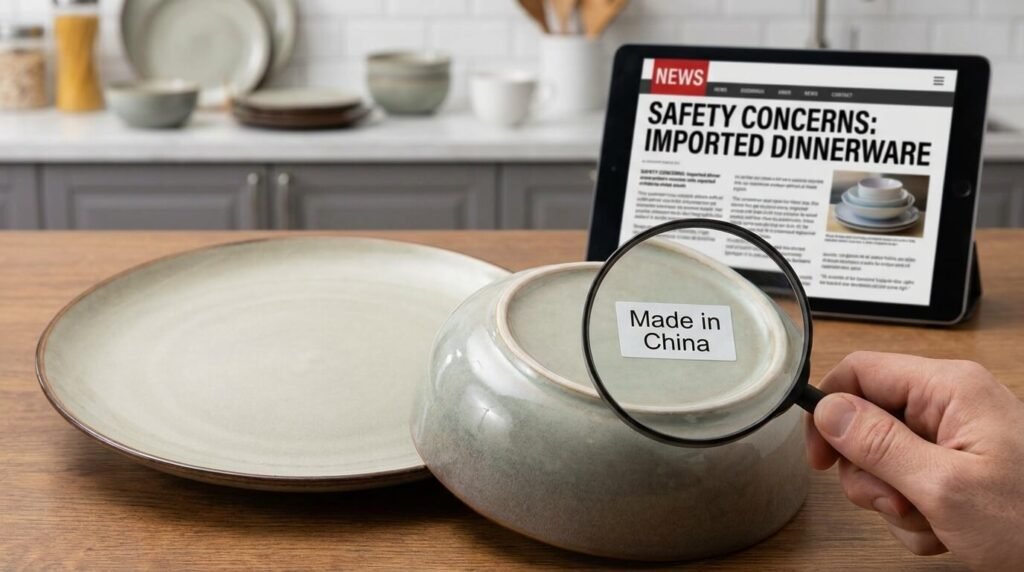
The short answer is this: It depends on the Manufacturer, not the Country.
China produces rigorously tested, export-certified ceramics for global brands sold in Walmart, IKEA, and John Lewis, and it also produces unverified domestic-market products that have been tested at up to forty times the acceptable FDA lead limit.
Both are true, and both carry a “Made in China” label. The country of origin tells you nothing meaningful about safety. The manufacturer’s documented standards, the material’s firing temperature, and the presence of independent third-party certification tell you everything.
The Actual Risks in Chinese-Made Dishes — and What Causes Them
The risk in Chinese ceramic dishes is not abstract. It is specific to chemistry and manufacturing, and understanding it takes the guesswork out of every purchasing decision.
Lead in ceramic glazes — how it gets in and how it gets out
Lead has been used in ceramic glazes for centuries because it lowers the glaze’s melting temperature, produces a brilliant glass-like finish, and intensifies colour saturation.
These are genuinely useful manufacturing properties, and they are why lead persisted in ceramic glazes long after its toxicity was established.


Lead leaches from glazed ceramic surfaces into food primarily through two mechanisms: acid contact and heat.
Acidic foods, such as tomato sauce, citrus, vinegar-based dressings, coffee, and tea, draw lead out of glaze more aggressively than neutral foods. Heat amplifies the process.
A bowl of hot tomato soup sitting on a lead-containing glaze is a meaningfully higher exposure event than a bowl of cold salad. The concern is cumulative: daily use, across years, adds up in a way that a single meal does not.
Cadmium in colour pigments — the bright dish problem
Cadmium compounds — primarily cadmium sulphide and cadmium selenide — produce the vivid reds, oranges, and yellows that are difficult to achieve through other means in ceramic glazes.
They are classified as human carcinogens, accumulate in the kidneys over time, and are leached by the same mechanisms as lead.
The practical visual signal is reliable: the more intensely coloured a dish in the warm spectrum — deep orange, brick red, bright yellow — the higher the probability that cadmium compounds were used.


Lead and cadmium are frequently found together in the same high-risk pieces. For unverified imported ceramics with these colour profiles, the safest approach is display use rather than food service.
What leaches from unverified Chinese ceramics — the documented numbers
Some independently tested, unverified ceramics imported from China have been found to leach lead at levels up to 40 times higher than FDA compliance guidelines permit for food-contact ceramics. FDA limits for leachable lead range from 0.5–3.0 μg/mL depending on the type of dishware (e.g., 0.5 μg/mL for cups, 3.0 μg/mL for plates).
It describes the worst end of the unverified, unregulated product spectrum: cheap imported pieces sold through uncontrolled channels with no export certification, no independent testing, and no manufacturing accountability.
It does not describe export-certified Chinese ceramics produced under FDA or LFGB compliance requirements.
The gap between the safest and most dangerous Chinese ceramic products is enormous, and the country of origin label does not tell you where on that spectrum a specific product sits.
Firing Temperature — the Primary Safety Indicator Most Buyers Never Consider
The single most important manufacturing variable in determining how safe a Chinese ceramic dish is has nothing to do with the brand name, the price, or the country label.
It is the temperature at which the ceramic was fired. Higher firing temperature means more complete vitrification, the process by which ceramic particles fuse into a dense, non-porous mass that dramatically reduces heavy metal migration.
See our dinnerware materials guide for the full material breakdown.
| Ceramic type | Firing temperature | Porosity after firing | Lead leach risk | Typical use |
|---|---|---|---|---|
| Porcelain | 2,300–2,600°F (1,260–1,430°C) | Non-porous — fully vitrified | Very low when certified | Fine dining, everyday quality sets |
| Bone china | 2,300–2,550°F (1,260–1,400°C) | Non-porous — fully vitrified | Very low when certified | Premium dinnerware |
| Stoneware | 2,100–2,300°F (1,150–1,260°C) | Low porosity — mostly vitrified | Low–moderate | Everyday casual dining |
| Earthenware | 1,700–2,100°F (925–1,150°C) | Moderate–high porosity | Moderate–high | Artisan, decorative, budget imports |
Why porcelain and bone china from China are the safest ceramic options
Porcelain and bone china fired at 2,300–2,600°F undergo full vitrification.
At these temperatures, the glaze and the ceramic body fuse into a single continuous structure, not a glaze coating sitting on top of a ceramic base, but an integrated material where the boundary between them effectively disappears.
This fusion dramatically reduces the surface area through which heavy metal migration can occur. A well-manufactured, certified Chinese porcelain plate presents essentially the same safety profile as its European or Japanese equivalent fired at the same temperature.
The manufacturing principle is the same; the quality of execution and the oversight of that execution are what vary by manufacturer, not by country.
Why earthenware and low-fired ceramics carry a higher risk
Earthenware fired at 1,700–2,100°F does not fully vitrify. The ceramic particles do not completely fuse, leaving a partially porous body.
The glaze sits more loosely on this porous surface rather than fusing into it, and that looser bond means higher leaching potential if the glaze contains lead or cadmium.
Low-fired earthenware is more common in artisan and handmade ceramics, budget imports, and the domestic-market products that enter Western markets through unverified channels.
It is not inherently unsafe, but it requires certification more urgently than high-fired porcelain, because the material’s structure is less forgiving of glaze chemistry errors.
The Two-Channel Problem — Why the Same “Made in China” Label Covers Very Different Products
The most important structural reality in this topic is that Chinese ceramics exist in two fundamentally different manufacturing streams, and both can end up on the same shelf or marketplace listing with the same country-of-origin label.
See our cookware made in China safety guide for the parallel reality in cookware.
| Standard | Governing body | Nickel limit | Lead limit (flatware) | Who it applies to |
|---|---|---|---|---|
| FDA 21 CFR | US Food and Drug Administration | No numeric limit — CGMP only | 3.0 μg/mL | Required for the US market sale |
| LFGB | EU / German food contact law | Stricter than the FDA | Stricter than the FDA | Required for EU market sale |
| California Prop 65 | CA Office of Environmental Health | — | 3.0 μg/mL | Required for CA-compliant labelling |
| Chinese GB/T domestic | Standardization Admin. of China | 0.14 mg/kg | Varies | Applies to the domestic Chinese market |
Export-quality vs domestic-market Chinese ceramics — the actual numeric gap
Chinese domestic standards (GB 4806.9-2023) limit nickel migration from food-contact metal materials to 0.14 mg/kg. This matches the EU’s nickel migration limit of 0.14 mg/kg.
The FDA does not set a numeric nickel limit for flatware; instead, nickel is affirmed as GRAS (Generally Recognized As Safe) with no limitation other than current good manufacturing practice (CGMP) [21 CFR § 184.1537].
For lead in ceramic flatware, the FDA enforces a leaching limit of 3.0 μg/mL (not mg/kg), which is the same threshold California Prop 65 adopts.
A Chinese manufacturer producing for US or EU export markets must meet the applicable international standard (EU’s 0.14 mg/kg nickel limit or FDA’s 3.0 μg/mL lead limit for ceramics). A manufacturer producing for the domestic Chinese market operates under GB 4806.9-2023’s requirements.
How unverified Chinese dishes enter Western markets
- Unverified Amazon third-party sellers — marketplace sellers without direct brand accountability and no verified export compliance.
- Ethnic grocery markets — often stocking products imported for the domestic Chinese diaspora market rather than for regulated export.
- Discount importers and dollar stores — buying at price points that cannot support independent third-party testing costs.
- Flea markets and estate sales — vintage or secondhand pieces with unknown origin and manufacturing standards.
- Direct-from-factory online platforms (Temu, AliExpress, DHgate) — products sold directly from Chinese manufacturers to consumers, bypassing standard export compliance channels.
The August 2025 FDA Warning — What It Actually Covered and What It Did Not
In August 2025 (specifically August 13), the FDA issued a warning about certain imported cookware products leaching dangerous levels of lead. The warning was updated on September 12, 2025, adding three more products to the list.
However, the affected cookware is NOT from China; it is mostly manufactured in India and made from aluminum, brass, and aluminum alloys known as Hindalium/Hindolium or Indalium/Indolium.
The warning specifically targeted cookware (pots, pans, kadai/karahi, milk pans), not dishes, plates, or ceramic tableware. The FDA identified 19 cookware products as of November 2025 that may leach lead when used for cooking.
Here is what the warning actually said:
“The FDA is warning retailers and consumers not to sell or use certain imported cookware that may leach significant levels of lead (Pb) into food. Some types of imported cookware products made from aluminum, brass, and aluminum alloys known as Hindalium/Hindolium or Indalium/Indolium have been tested by the FDA and state partners and found to leach lead into food when used for cooking, thereby making food unsafe.”
The broader implication of the warning is this: imported kitchen products sold through unverified channels require scrutiny regardless of material.
The specific risk flagged was in metallic alloy cookware. If you own ceramic dinner plates, even Chinese-made ones from a verified brand, your plates are not the subject of the August 2025 FDA warning.
Visual Risk Signals — How to Identify Higher-Risk Dishes Before Testing
These signals apply to Chinese-made dishes and to dishes from any country. Each one independently warrants either testing or avoiding food use:
- Intense reds, oranges, or yellows in the glaze or decoration — the colour range most historically associated with cadmium pigment use; high-risk until independently certified
- Decorative overglaze patterns with painted detail — designs applied after the primary firing at lower temperatures carry a higher lead risk than underglaze designs fused during the main firing
- Very low purchase price for the stated material — certified porcelain has a production cost floor; dishes priced well below market rate for the claimed material may be lower-fired or lower-quality than stated
- No visible certification mark or food-safety labelling on the piece or packaging — certified export products carry identifiable compliance marking; absence is a meaningful signal
- Sold through unverified marketplace channels with no named manufacturer — accountability requires a traceable brand; anonymous sellers offer none
- Chips, cracks, or crazing on any piece you already own — physical damage to glaze dramatically increases heavy metal leaching; retire any chipped ceramic from heated food use immediately
What Certifications to Look for on Dishes Made in China
| Standard | What it tests | Lead limit | How to identify on packaging |
|---|---|---|---|
| FDA 21 CFR compliance | Lead and cadmium leaching from food-contact surfaces | 3.0 μg/mL | “FDA compliant” or FDA compliance statement |
| California Prop 65 | Lead, cadmium, 900+ chemicals | 3.0 μg/mL | “Prop 65 compliant” or warning absence with stated compliance |
| LFGB (EU/German standard) | Lead, cadmium, heavy metal migration | Stricter than the FDA | “LFGB certified” with lab name |
| SGS / Intertek / TÜV Rheinland | Third-party heavy metal testing | Per applicable standard | Lab name and certificate number on packaging or brand website |
The most meaningful signal is not a compliance statement on the box; it is a brand that publishes the actual third-party test results from a named accredited laboratory on its website.
Any brand can print “FDA compliant” on packaging; a brand that links to the SGS report with the specific test results is making a verifiable commitment.
See our non-toxic plates and bowls guide for a full breakdown of what each standard actually tests and which is strictest.
How to Test Dishes You Already Own for Lead
- At-home lead swab test — EPA-recognized swabs, such as 3M LeadCheck, apply a chemical reagent that turns pink or red in the presence of surface lead. Cost: $5–$15. Limitation: false negatives occur when lead is sealed beneath an intact overglaze layer. A negative result from a vintage or heavily decorated piece is not a reliable safety confirmation; it only means surface lead was not detected at that contact point.
- XRF elemental analysis via mail-in service — X-ray fluorescence identifies total elemental lead content in the material. More reliable than swab testing for detecting lead presence. Cost: $30–$80 per piece via mail-in service. Limitation: XRF measures total lead present, not the amount that actually leaches into food — so a positive XRF result requires context, and a negative result is more conclusive than a positive one. See our complete guide to testing dinnerware for lead for how to interpret XRF results correctly.
- Laboratory leach test (ASTM C738-94) — The gold standard. A 4% acetic acid solution (comparable to vinegar) is applied to the food-contact surface for 24 hours, then tested for lead and cadmium content. This measures actual leachable metals — the same method manufacturers use for FDA and Prop 65 compliance. Cost: $50–$150 per piece at an EPA-accredited laboratory. This test is definitive; a pass at this standard is the most meaningful safety confirmation available.
Safe Chinese Dinnerware Brands — Who Publishes Their Testing
| Brand | Material | Certification | Testing published | Notes |
|---|---|---|---|---|
| IKEA (most lines) | Porcelain /stoneware | EU LFGB compliant | Available on IKEA product pages | Strict EU testing requirement applied consistently |
| Corelle | Stoneware | XRF non-detectable | Corelle website | No glaze — inherently lower risk category |
| Fable Home | Glazed ceramic | ASTM C738-94 per colour | Full results on the Fable website | Publishes test results by specific glaze colour |
| East Fork | Glazed stoneware | Prop 65 compliant | Published summaries on the site | US-manufactured; testing standards disclosed |
| Year & Day | Vitrified ceramic | Prop 65 compliant | Year & Day website | Portuguese clay; independently verified |
The 4-Question Safety Checklist — How to Evaluate Any Dishes Regardless of Origin
- Does the brand specify the material and firing temperature or material grade? For ceramic dishes, porcelain and bone china (fully vitrified) are lower risk than earthenware. For decorated pieces, under-glaze decoration is safer than overglaze. If the brand cannot or does not specify, that is a meaningful gap.
- Has the product been tested by a named independent third-party laboratory? SGS, Intertek, TÜV Rheinland, or an EPA-accredited lab for the leach test. Not an internal test. Not a vague safety claim. A named, accredited, independent lab with a verifiable certificate.
- Are the test results published and accessible? A link to actual results — not just a compliance statement — on the brand’s website. A brand committed to safety makes this easy to find.
- Does the product comply with a named regulatory standard that has a numeric threshold? FDA 21 CFR, Prop 65, or LFGB — each has specific numeric limits and enforcement mechanisms. “Safe” and “non-toxic” are marketing terms, not regulatory designations. See our safe kitchen guide for how dinnerware safety fits into the broader picture of a non-toxic kitchen.
Frequently Asked Questions About Dishes Made in China
Are dishes made in China automatically unsafe?
No. China manufactures ceramics for IKEA, Wedgwood, and dozens of other global brands under rigorous export compliance testing. The variable that determines safety is the manufacturer’s documented standards, not the country.
Unverified budget products from uncontrolled import channels present real risk; certified export-compliant products from accountable manufacturers do not.
Is Chinese porcelain safe for daily use?
Yes, when it is genuinely high-fired porcelain from a manufacturer that tests to FDA or LFGB standards. Porcelain fired at 2,300–2,600°F undergoes full vitrification, creating a non-porous surface that dramatically reduces heavy metal migration.
The safety question for Chinese porcelain is not about the material; it is about whether the specific manufacturer has independently verified their glaze chemistry and firing process.
Are brightly coloured dishes from China more dangerous?
Higher risk than plain white, yes. Vivid reds, oranges, and yellows in ceramic glazes have historically been produced using cadmium compounds. Bright decorative patterns applied as overglaze after the primary firing carry a higher lead risk than underglaze designs.
Neither is automatically unsafe — but both require independent certification to confirm safety, and that certification requirement is more urgent for vivid warm-coloured pieces than for plain white porcelain.
Is it safe to use Chinese dishes for hot or acidic food?
For certified export-quality porcelain and bone china: yes. For unverified or potentially unsafe pieces: no. Heat and acid are the two primary drivers of heavy metal leaching from ceramic glazes.
Hot tomato sauce, coffee, tea, citrus-based dressings, and vinegar all accelerate lead and cadmium migration from any compromised glaze surface. If you cannot verify that a piece has been independently tested, avoid using it for hot or acidic food.
Are IKEA dishes made in China safe?
Most IKEA ceramic products are manufactured in China and tested to EU LFGB standards — one of the strictest food contact material standards globally.
IKEA’s supply chain requires LFGB compliance across its ceramic range, and the company publishes material safety information on product pages. For standard IKEA white or minimally decorated ceramics, the EU compliance requirement makes them a reliable choice among Chinese-manufactured options.
How do I know if the dishes I already own contain lead?
Start with an at-home lead swab test for a quick surface check, understanding that false negatives are possible on older or heavily glazed pieces. For a more reliable result, an XRF mail-in analysis identifies total lead content in the material.
For a definitive answer, an ASTM C738-94 laboratory leach test measures actual leachable lead using the same method used for FDA compliance testing. If you own vintage or heavily decorated ceramic pieces of uncertain origin, the laboratory test is worth the cost.
Are bone china dishes from China safe?
Yes, when manufactured to export certification standards. Bone china requires a minimum of 25% bone ash in the clay body, fired at 2,300–2,550°F to achieve full vitrification.
Chinese bone china manufacturers producing for global export, including brands supplying major Western retailers, operate under the same material and firing standards as European producers.
Plain bone china from a certified source, regardless of Chinese origin, is among the safer ceramic options available.
About the Author & Reviewer
Sarah Emirone, Author
Sarah researches and writes SafeKitchn’s dinnerware and kitchenware guides, with a focus on material safety, lead content, and manufacturer specifications. She cross-references product data sheets, safety certifications, and regulatory filings (including FDA and Prop 65 records) before publishing, and updates articles when new information becomes available.
James Daniels, Reviewer
James reviews SafeKitchn’s material safety content for scientific accuracy. He holds a B.Sc in inorganic chemistry and works as a materials researcher, with particular focus on the composition and safety behavior of glass, ceramic, and metal used in kitchenware.