

Dishes are called china because fine porcelain originated in China, and for several centuries, Europe had no word for it other than the country it came from.
When Portuguese traders first brought glazed ceramic ware home from Chinese ports in the 1500s, they didn’t know what it was made of or how it was fired.
They just knew nothing in Europe came close. So they called it what it was: China. The name stuck so hard that even after European factories learned to make the same material, everyone kept using it.
For a broader look at how China compares to other dinnerware materials, see our complete dinnerware materials guide: china, stoneware, earthenware.
Written by Sarah Emirone | Reviewed by James Daniels, B.Sc, Inorganic Chemist & Materials Researcher | Updated September 2026 | See How We Test | Filed under: Buying, Care & Product Guides
The Short Answer: Why Dishes Are Called China
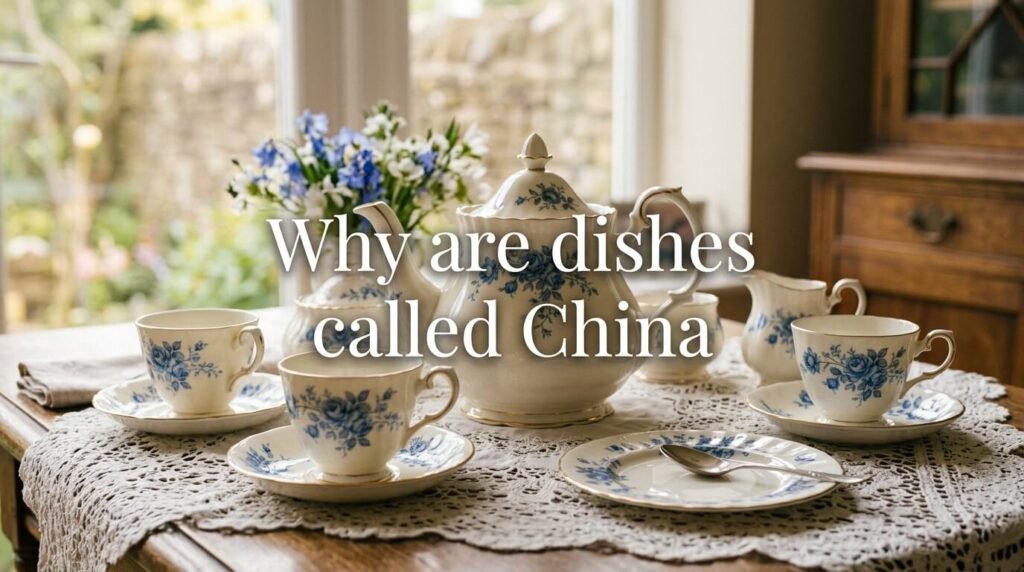
Dishes got the name “china” the same way many things get named by where they came from, before anyone had a better word.
Chinese craftsmen had been producing a hard, white, translucent ceramic since at least the Eastern Han Dynasty (1st–2nd century AD). When it reached European markets via the Silk Road and later by sea, it had no European equivalent.
No European potter could make anything like it. So traders, collectors, and aristocrats simply called it “china ware” — ware from China — which eventually shortened to just “china.”
It stopped being a geographic descriptor sometime in the 18th century and became a material category instead. That’s why a plate made in England or Germany today can still be called china.
Where the Word “Porcelain” Comes From (It’s Weirder Than You’d Think)
“Porcelain” and “china” mean the same material, but they have completely different naming origins — and the porcelain one is stranger.
The word comes from the Italian porcellana, which was the Italian name for the cowrie shell. Venetian traders, including, reportedly, Marco Polo, used porcellana to describe Chinese ceramic ware because the glazed surface looked like the smooth, glossy interior of a cowrie shell.
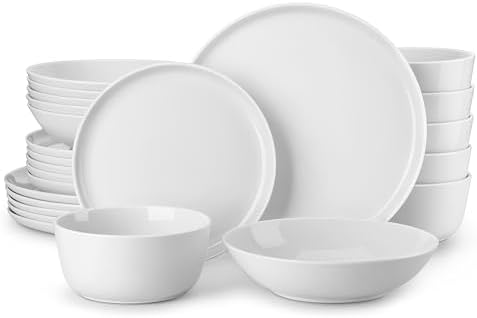
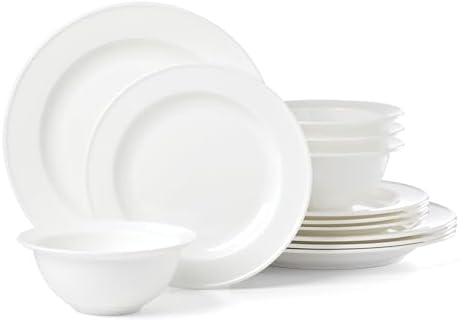

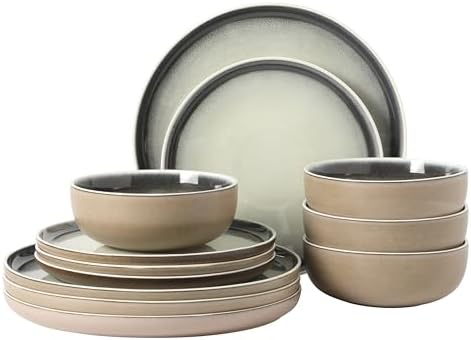

Nothing to do with chemistry or geography. It was a visual comparison. The name traveled from Italian into French (porcelaine) and then into English, where it landed alongside “china” as a parallel term for the same object.
So we ended up with two words for the same material. “China” is named it by origin. “Porcelain” was named after how it looked. Both survived.
Why “China” and “Porcelain” Mean the Same Thing — and Why That Matters
China and porcelain are used interchangeably in everyday English, and for most practical purposes, that’s fine.
Technically, “china” is the broader cultural/commercial term, while “porcelain” is more often used in ceramic science and manufacturing to describe a specific clay body. In a kitchen context, “china” usually signals quality or formality — you “use the good china” for guests.
In a materials context, “porcelain” describes a composition of high-fired, vitrified, non-porous ceramic.
The distinction matters more when comparing specific product types: bone china, fine china, and hard-paste porcelain are not the same thing, even though all three get called “china” loosely.
Where Did Porcelain Originally Come From?
Porcelain is Chinese in origin, and China’s lead over the rest of the world lasted roughly a thousand years.
That’s not a rounding error — European potters were still trying to figure out the formula while Chinese kilns had been producing export-quality ware since the Tang Dynasty (618–907 AD).
From the Han Dynasty to Jingdezhen: How China Built a 1,000-Year Monopoly
The earliest proto-porcelains date to the Eastern Han Dynasty, roughly 100–200 AD. True high-fired porcelain white, translucent, vitrified — developed through the Tang and Song dynasties.
By the Yuan Dynasty (1271–1368), Jingdezhen in Jiangxi Province had become the center of Chinese porcelain production. It still is. The city sits on deposits of kaolin (white china clay) and petuntse (china stone), the two raw materials that make hard-paste porcelain possible.
The combination fires at over 1,300°C and produces a ceramic so dense it doesn’t absorb water. European stoneware of the same era, fired at lower temperatures, remained slightly porous and chipped more readily.
The gap wasn’t small. To fully understand the ceramic timeline, seek out the history of Chinese porcelain from the Han Dynasty to today.
What Made Chinese Porcelain So Different From Every Other Ceramic in the World
- Translucency — hold a thin piece of Chinese porcelain to light, and it glows; European earthenware and stoneware of the same era was opaque at any thickness.
- Hardness — fired kaolin and petuntse at 1,300°C+ produces a body harder than most metals; a knife blade won’t scratch it.
- Non-porosity — the vitrification process seals the clay body completely, so no liquid absorbs into the material; European low-fire ceramics needed a separate glaze layer to achieve this, and even then, chips exposed to absorbent clay.
- Resonance — tap a piece of true porcelain, and it rings clearly, almost like a bell; earthenware thuds; this became one of the practical tests collectors used to identify genuine Chinese ware.
- Whiteness — the kaolin deposits at Jingdezhen produced an exceptionally white body; combined with cobalt blue decoration, the result was unlike anything European craftsmen could produce.
Why Was Chinese Porcelain So Valuable in Europe?
For European buyers, Chinese porcelain wasn’t just nice-looking tableware. It was a material that didn’t exist at home, couldn’t be replicated, and arrived in limited quantities after a journey of thousands of miles.
That combination made it genuinely scarce — not artificially scarce. Owning it meant something.
The Silk Road and the Maritime Routes: How Porcelain Reached Europe
Porcelain first reached Europe overland via the Silk Road, most visibly documented through Marco Polo’s accounts from the 13th century. But overland trade was slow, expensive, and subject to the politics of every kingdom between China and Western Europe. The volume was small.
The sea routes changed that. Portuguese navigators established direct maritime trade with China in the early 16th century, the first European country to do so.
The Dutch East India Company (VOC), founded in 1602, took over as the dominant carrier and began shipping porcelain to Europe in quantities that made it a mass luxury rather than a royal curiosity.
In the 17th century alone, the VOC shipped an estimated 3 million pieces of Chinese porcelain to Europe. The British East India Company arrived at the end of the 17th century and built its own trade relationship.
Tea, silk, and porcelain moved west. Wool, tin, lead, and silver moved east.
“White Gold”: How European Royalty Treated Chinese Porcelain as a Status Symbol
Augustus the Strong, Elector of Saxony and King of Poland, collected Chinese porcelain with a focus that bordered on obsession.
By his death in 1733, he had accumulated more than 20,000 pieces filling an entire palace, the Japanisches Palais in Dresden, which he had rebuilt specifically to house the collection.
He reportedly traded 600 Saxon dragoon soldiers to the King of Prussia for 151 large Chinese vases. The exchange rate says everything about how porcelain was valued at the time.
Louis XIV had the Trianon de Porcelaine built at Versailles in 1670, a pavilion decorated inside and out with blue-and-white ceramic tiles in imitation of Chinese style.
The broader European design movement that this sparked was called Chinoiserie, from the French chinois (Chinese) — a European interpretation of Chinese aesthetics that spread through furniture, wallpaper, and tableware across the 17th and 18th centuries.
It was admiration mixed with invention, since most European artists had never been to China and worked from second-hand descriptions and the objects themselves.
Europe’s 200-Year Race to Crack the Porcelain Formula
European potters knew what Chinese porcelain looked like. They didn’t know what it was made of. The kaolin and petuntse formula was a trade secret kept inside the Jingdezhen kilns for centuries.
European attempts to replicate it produced soft-paste porcelains closer in appearance but softer, less durable, and still not the real thing.
The race to crack the formula ran from roughly the early 1500s to 1708. That’s about 200 years of failed experiments.
The Alchemist Who Finally Cracked It: Johann Friedrich Böttger and Meissen, 1709
Johann Friedrich Böttger was an alchemist, not a ceramicist. He had fled to Saxony, claiming he could turn base metals into gold — a claim that got him imprisoned by Augustus the Strong rather than ignored, because Augustus wanted the gold. Böttger never produced gold.
But under the direction of physicist Ehrenfried Walther von Tschirnhaus, he pivoted to ceramic research and began testing clay bodies from across Saxony.
On January 15, 1708, Böttger and Tschirnhaus fired the first true European hard-paste porcelain at Albrechtsburg Castle in Meissen.
The Meissen Royal Porcelain Manufactory opened officially on January 23, 1710. Augustus understood immediately what he had — a product that could rival China’s exports and generate the revenue his gold-making alchemist never could.
The formula was classified as a state secret. Workers at Meissen were forbidden from leaving Saxony. The castle itself was guarded.
It didn’t hold. By the 1720s, workers had carried the knowledge to Vienna. By mid-century, Sèvres in France and factories across Germany had their own hard-paste production. The monopoly collapsed fast once the first breach happened.
Why “China” Stuck Even After Europe Made Its Own Porcelain
This is the part that’s easy to miss. Once Meissen, Sèvres, Wedgwood, and dozens of other European manufacturers were producing porcelain at scale, the word “china” should logically have faded. It didn’t.
By the mid-18th century, “china” had stopped being a geographic label and had become a quality marker. Calling your tableware “china” told the buyer it was fine, fired hard, and worth paying more for, regardless of where it was made.
The word had accumulated enough prestige over two centuries of scarcity that European makers didn’t want to give it up. They kept it because it sold.
That’s still true today. A plate made in Stoke-on-Trent, Limoges, or Arita is called china. The word no longer tells you anything about origin. It tells you about the category.
What Is the Difference Between Bone China, Fine China, and Porcelain?
These three terms are not synonyms, though all three get called “china” in everyday use. The differences are in composition, firing temperature, and the physical properties that result.
Bone China, Fine China, and Porcelain: A Definitive Side-by-Side Comparison
| Property | Bone China | Fine China | Hard-Paste Porcelain |
|---|---|---|---|
| Key ingredients | Bone ash + china stone + china clay | Kaolin + feldspar + quartz | Kaolin + petuntse (china stone) |
| Bone ash content | ~50% (Spode formula: 6:4:3.5 ratio) | None | None |
| Firing temperature | ~1,000°C (calcination) then ~1,260°C | ~1,200°C | ~1,300–1,400°C |
| Translucency | High — warm glow when held to light | Moderate | Moderate to high |
| Color tone | Creamy-warm white | Bright white | Bright white |
| Durability | High — more chip-resistant than porcelain | Moderate | High — hardest of the three |
| Weight | Lighter than porcelain | Medium | Heavier |
| Historic origin | England (1790s) | Various | China (Han Dynasty) |
| Best for | Everyday fine dining, gifts | Formal occasions | Decorative, display, high-end dining |
| Price tier | Mid to high | Mid | Mid to very high (vintage/heritage) |
For everyday use, bone china wins on the combination of durability and lightness. For decorative and heritage pieces, hard-paste porcelain has a deeper tradition and a harder body.
Fine china sits between the two, presentable but not as resistant to chipping as bone china.
For a deeper breakdown of each material’s properties and pricing, see our complete bone china vs porcelain comparison guide.
How Bone China Was Invented in England — and Why It Changed Everything
Thomas Frye at the Bow factory in London filed the first patent for a bone ash ceramic body in 1748.
But the formula most manufacturers still use today was developed by Josiah Spode at his factory in Stoke-on-Trent in the 1790s: 6 parts calcined bone ash, 4 parts china stone, 3.5 parts china clay.
Spode’s version fired at a lower temperature than hard-paste porcelain, which made it cheaper to produce. But it came out lighter, more translucent, and — critically — more resistant to chipping than the Continental hard-paste factories could match.
English bone china took a significant share of the tableware market within decades of Spode’s refinement.
How to Tell Bone China From Porcelain Without a Lab
- Hold it up to a light source — bone china lets warm light through and glows slightly; porcelain transmits less light and appears cooler and more opaque at equivalent thickness.
- Tap the rim gently — bone china produces a clear, sustained ring; porcelain rings too, but with a shorter decay; earthenware thuds.
- Look at the color of the body — bone china is creamy or slightly warm in tone; hard-paste porcelain is a cooler, brighter white.
- Check the weight — a bone china dinner plate is noticeably lighter than a porcelain plate of the same size; if you pick up two comparable plates and one is significantly heavier, it’s likely porcelain or stoneware.
If you’re working with older pieces, see our guide on how to identify and value vintage china dishes.
Does China Have to Be Made in China to Be Called China?
No. The word “china” is a material category, not a country-of-origin label, and hasn’t functioned as one since the 18th century. Wedgwood is English. Limoges is French. Meissen is German.
Noritake is Japanese. All are called China. The geographic meaning dropped out of the word once European manufacturers adopted it for their own products and buyers accepted it.
The World’s Most Famous China Brands — and Where They’re Actually Made
| Brand | Country | Founded | Notes |
|---|---|---|---|
| Meissen | Germany | 1710 | First European hard-paste porcelain factory |
| Sèvres | France | 1738 | French royal manufactory; known for elaborate painted decoration |
| Wedgwood | England | 1759 | Josiah Wedgwood; bone china and jasperware |
| Royal Doulton | England | 1815 | Now part of the WWRD group; bone china |
| Limoges (various makers) | France | 1771 (region) | Kaolin deposits near Limoges made it France’s porcelain center |
| Noritake | Japan | 1904 | Major export brand: fine china |
| Lenox | USA | 1889 | American fine china; used at the White House since Woodrow Wilson |
| Jingdezhen kilns | China | ~600 AD | Still the world’s largest porcelain production center |
For full brand profiles and what to look for when buying, see our guide to the world’s most respected fine china brands.
What “Made in China” on a China Dish Actually Means Today
A dish labeled “Made in China” is manufactured in the country of China. A dish called “china” is made of a specific ceramic material. These are two separate statements that happen to share a word.
Most mass-market tableware sold globally including items sold under European-sounding brand names is now manufactured in China (the country) because of lower production costs and the concentration of ceramic manufacturing infrastructure there.
Heritage brands like Meissen and Wedgwood still produce in their home countries, but they’re the exception. The word on the bottom of the plate tells you where it was made.
The word used to describe what it is tells you the material. They don’t have to match.
Now That You Know the History — Find the Right China for Your Table
Bone china, fine china, and hard-paste porcelain each have a different use case. Our guides break down what to buy for everyday dining, gifting, and collecting.
best bone china dinnerware sets for everyday use ·
Frequently Asked Questions
Why exactly are dishes called “china”?
Dishes are called china because fine porcelain originated in China, and European traders who first imported it in the 16th century had no other word for the material.
The name shortened from “chinaware” to “china” and eventually became a material category rather than a place name.
Is China the same as porcelain?
In everyday use, yes — both words describe the same high-fired ceramic material. Technically, “porcelain” is the material science term and “china” is the cultural/commercial one, but the distinction rarely matters outside manufacturing contexts.
What’s the actual difference between bone china and fine china?
Bone china contains roughly 50% calcined animal bone ash in its clay body, which makes it lighter, more translucent, and more chip-resistant than fine china. Fine china contains no bone ash and fires at a slightly higher temperature, producing a brighter white but a less forgiving body.
Does China have to be made in China?
No. China is a material category, not a country-of-origin label. Wedgwood (England), Meissen (Germany), Limoges (France), and Lenox (USA) all produce what is correctly called china. The word stopped indicating geographic origin in the 18th century.
When did Europeans first successfully make their own porcelain?
Johann Friedrich Böttger fired the first true European hard-paste porcelain on January 15, 1708, at Albrechtsburg Castle in Meissen, Saxony. The Meissen Royal Porcelain Manufactory opened on January 23, 1710 — roughly 200 years after European potters first began trying to replicate the Chinese formula.
How can I tell if a dish is bone china or regular porcelain?
Hold it to light — bone china glows with a warm translucency; porcelain appears cooler and less transparent. Tap the rim — bone china rings clearly and sustains the note slightly longer. Check the weight — bone china is noticeably lighter than a porcelain plate of the same size.
Why is bone china more expensive than regular porcelain?
The calcination and processing of bone ash adds a production step that standard porcelain manufacturing doesn’t require.
The lighter, more translucent result also commands a premium in the market. Heritage brands like Wedgwood and Royal Doulton that have produced bone china for over 200 years carry additional pricing from their reputation.
Is bone china or porcelain better for daily use?
Bone china is better for daily use in most households, it’s lighter to handle, more resistant to chipping at the rim, and the creamy tone hides minor marks better than bright-white porcelain.
Hard-paste porcelain is harder overall, but that hardness also makes chips more likely on impact rather than less. To learn more about this hardness, read our guide on the difference between hardened dinnerware and durable dinnerware.
About the Author & Reviewer
Sarah Emirone, Author
Sarah researches and writes SafeKitchn’s dinnerware and kitchenware guides, with a focus on material safety, lead content, and manufacturer specifications. She cross-references product data sheets, safety certifications, and regulatory filings (including FDA and Prop 65 records) before publishing, and updates articles when new information becomes available.
James Daniels, Reviewer
James reviews SafeKitchn’s material safety content for scientific accuracy. He holds a B.Sc in inorganic chemistry and works as a materials researcher, with particular focus on the composition and safety behavior of glass, ceramic, and metal used in kitchenware.