

Walk into any homeware shop or scroll through any dinnerware listing and you’ll see both terms everywhere: “hardened porcelain,” “ultra-durable stoneware,” “tempered for life.”
The problem is that hardened plates vs durable plates are not the same thing, and most buyers spend money based on whichever label sounds more confident.
This article breaks down what each term actually means, how the manufacturing process behind “hardened” differs from the performance outcome behind “durable,” and which materials hold up in real kitchens.
Written by Sarah Emirone | Reviewed by James Daniels, B.Sc, Inorganic Chemist & Materials Researcher | Updated September 2026 | See How We Test | Filed under: Brand & Product Comparisons
What Does “Hardened” Actually Mean in Dinnerware?
“Hardened” on a dinnerware label refers to a specific manufacturing process, either thermal tempering or high-temperature vitrification, that changes the physical structure of the material to resist surface damage.

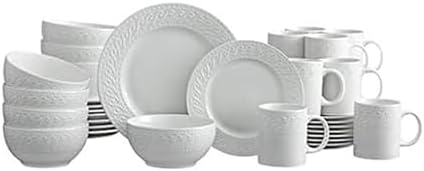
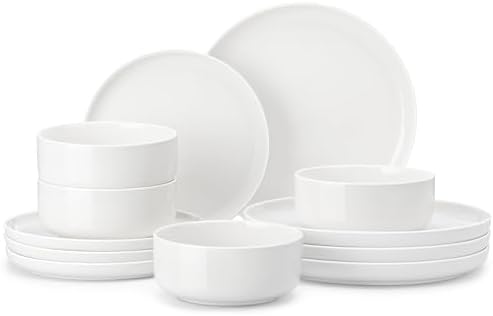
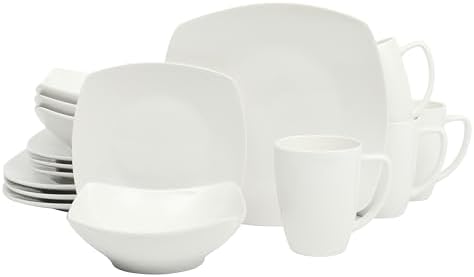
It is not a quality grade. It is not regulated. It describes how the plate was made, not how long it will last in your kitchen.
The Hardening Process — Tempering and Vitrification Explained
Two separate processes sit behind the word “hardened,” and they apply to different materials entirely.
Thermal tempering is used for glass dinnerware. The process works like this:
- The glass is formed into shape and heated to around 620–650°C.
- It is then blasted with cold air on both surfaces simultaneously.
- The rapid cooling forces the outer layers to compress while the inner core remains under tension.
- That compressed surface layer is what gives tempered glass its impact and scratch resistance — roughly four to five times stronger than untreated glass.
Vitrification is used for ceramic dinnerware — porcelain, china, stoneware. It works differently:
- The clay body is fired at high temperatures, typically above 1,200°C and up to 1,450°C for fine porcelain.
- At those temperatures, the clay particles fuse into a dense, glass-like mass.
- The result is a non-porous body that resists water absorption, staining, and surface chipping.
- “Super-vitrified” porcelain goes further — manufacturers add aluminium oxide to the clay body and fire at the top of the temperature range, producing a plate dense enough for commercial restaurant use.
These are two entirely different processes producing two different types of “hardened” plates. Calling both simply “hardened” is where most product descriptions go wrong.
What “Hardened” Gives You — and What It Doesn’t Guarantee
- Chip resistance at the surface — hardened plates resist edge chips better than untreated versions of the same material.
- Scratch resistance — the compressed or fused surface holds up against cutlery marks better than soft-fired ceramics.
- Impact resistance on contact — a hardened plate absorbs more energy from a knock before cracking than a standard plate.
- Not immunity from breakage — tempered glass, when it does break, shatters into hundreds of small pebble-like pieces all at once. It doesn’t chip gradually; it fails completely. That’s safer than jagged shards, but it’s still a total failure.
- Not protection from thermal shock — some hardened ceramics are still vulnerable to rapid temperature swings (oven to cold water, for example) unless specifically rated for it.
- Not an indefinite lifespan — hardening improves the starting condition of a plate. It doesn’t replace proper care or prevent glaze wear over the years of dishwasher cycles.
What Does “Durable” Mean in Dinnerware? (It’s More Than Just Not Breaking)
Durability in dinnerware is a performance outcome across multiple dimensions, not a single property, and not something a manufacturer can claim without your knowing which dimension they mean.

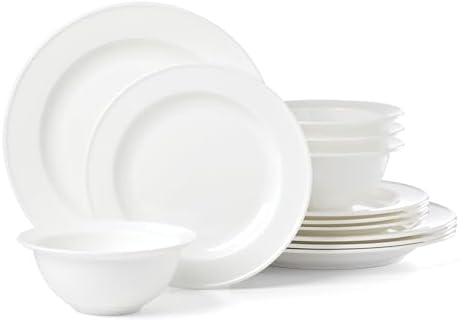
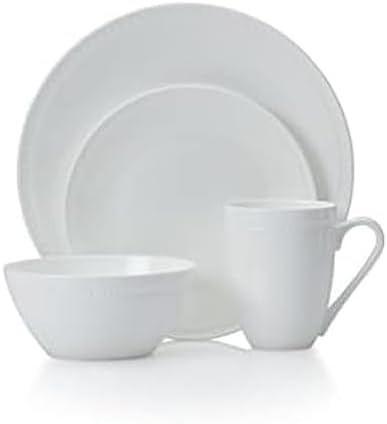


A plate can be marketed as “durable” because it survived a drop test, even if it scratches badly, fades in the dishwasher after a year, and cracks under thermal stress.
The Six Dimensions of Dinnerware Durability
Real durability means performing well across all six of these:
- Chip resistance — the plate’s edges and surface hold up against daily knocks, stacking, and contact with other plates in the dishwasher.
- Scratch resistance — cutlery, stacking, and abrasive cleaning don’t visibly mark the surface over time.
- Drop survival — the plate survives falling from counter height onto a hard floor without shattering; some materials do this consistently, others don’t.
- Dishwasher cycle integrity — the glaze, colour, and structural body remain intact after hundreds (or thousands) of machine wash cycles, including exposure to commercial detergents and high-pressure water.
- Thermal shock resistance — the plate handles moving between temperature extremes (freezer to microwave, or oven to cold countertop) without cracking.
- Long-term glaze and colour stability — the surface doesn’t cloud, fade, or develop a milky film after extended use, which is a common failure mode for lower-quality glazes run through the dishwasher repeatedly.
Why “Durable” on a Label Means Almost Nothing Without Specifics
Brands use “durable” with no standard definition behind it. There is no regulated durability rating for consumer dinnerware in the way there are ratings for, say, commercial electrical equipment. So when you see “ultra-durable” on a box, look for these specifics instead:
- Firing temperature — above 1,280°C is the threshold at which genuine vitrification occurs in ceramics.
- Vitrification level — fully vitrified means zero water absorption; partially vitrified means the body is still slightly porous and will eventually absorb stains and odours.
- Edge construction — a rolled or beaded rim adds 30–40% more impact resistance at the edge, which is where chipping almost always starts.
- Aluminium oxide content — added to commercial-grade ceramic bodies to increase both surface hardness and thermal shock tolerance.
- Dishwasher cycle rating — some commercial manufacturers publish a cycle count (500+ per year) that home buyers can use as a benchmark.
If none of those specs appears on the product page, “durable” is marketing, not engineering.
Hardened Plates vs Durable Plates — The Core Distinction Most Buyers Miss
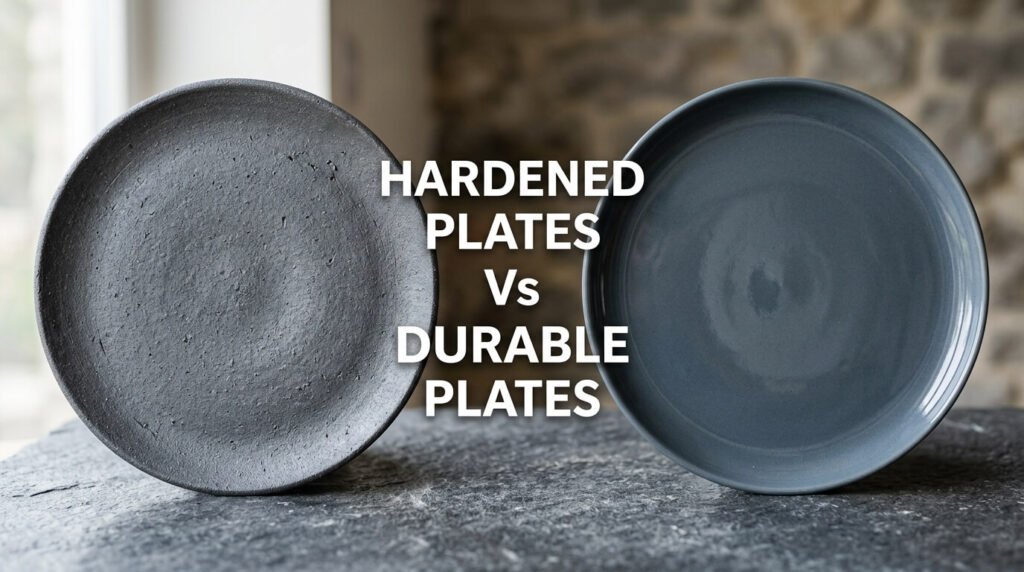
The terms describe different things entirely: hardened is about the manufacturing process, durable is about long-term performance. A plate can be one without being the other.
A Plate Can Be Hardened Without Being Durable — Here’s Why
| Material | Hardening process | Chip resistance | Scratch resistance | Drop survival | Dishwasher longevity | Verdict |
|---|---|---|---|---|---|---|
| Tempered glass (Corelle/Vitrelle) | Thermal tempering + lamination | Excellent | Very good | Excellent | Excellent | Hardened AND durable |
| Standard tempered glass | Thermal tempering | Good | Good | Good — but catastrophic failure mode | Good | Hardened, partially durable |
| Super-vitrified porcelain | Vitrification at 1,300°C+ | Excellent | Excellent | Good | Excellent | Hardened AND durable |
| Standard porcelain | Vitrification at 1,200°C+ | Good | Good | Moderate | Good | Hardened, moderately durable |
| Melamine | None — resin moulding | Poor (scratches) | Poor | Excellent | Moderate (no microwave) | Not hardened, selectively durable |
| Stoneware | Partial vitrification | Good | Moderate | Good | Good | Lightly hardened, generally durable |
| Bone china | Vitrification with bone ash | Very good | Good | Moderate | Very good | Hardened, durable |
| Earthenware | Low-temp firing | Poor | Poor | Poor | Poor | Neither |
Tempered glass is technically “hardened” but when a Corelle plate eventually fails, it doesn’t chip: it breaks into a pile of small fragments all at once. That’s a durability limit that the hardening process doesn’t solve.
And Some Durable Materials Are Not Hardened at All
- Melamine is one of the most drop-resistant materials you can buy — it absorbs impact without shattering — but it goes through no hardening process. It scratches from metal cutlery within months, cannot go in the microwave, and degrades with prolonged UV exposure outdoors.
- Thick stoneware survives drops well because of its mass and density, not because of a hardening treatment. The trade-off is weight and moderate scratch resistance.
- SAN resin (styrene-acrylonitrile) behaves similarly to melamine — shatter-proof but not hardened, with the same limitations around heat and scratching.
If drop survival is all you need, “not hardened” doesn’t disqualify a material.
But if you want a plate that also resists scratches, handles the dishwasher daily for a decade, and stays looking new, you need a material that scores across all six durability dimensions, and hardening is usually part of how it gets there.
Material-by-Material Breakdown — Hardness and Durability Rated
Porcelain and Vitrified Porcelain — The Hardening Sweet Spot
Vitrified porcelain is the material most consistently identified as the best balance of hardness and real-world durability. For a deeper look at what the vitrification process involves and why restaurants use it, see what super-vitrified porcelain is and why restaurants use it.
- Standard porcelain fires at 1,200–1,300°C, producing a dense, non-porous body that resists chips and scratches well.
- Super-vitrified porcelain fires at the top of that range with aluminium oxide added — the result is what commercial restaurants specify, and it’s available to home buyers through several brands (HF Coors is one US-made example with published commercial-grade specs).
- The main downside: porcelain chips at the edges if dropped on hard tile from a height. The chip is visible and permanent; it doesn’t shatter, but it does mark.
- Dishwasher safe, oven safe, microwave safe, and rated for thermal shock in most commercial-grade versions.
Tempered Glass (Corelle/Vitrelle) — Hardened, But With a Catch
Corelle uses a proprietary Vitrelle construction, three layers of tempered glass laminated together, which makes it lighter and more chip-resistant than either standard glass or standard tempered glass alone. For a full side-by-side breakdown, Corelle vs porcelain — full durability comparison covers the differences in detail.
- Chip resistance is excellent. It’s the hardened property that performs most consistently in real use.
- Drop survival is very good — until it isn’t. The failure mode is sudden and complete rather than gradual chipping. When a Vitrelle plate breaks, it does so all at once.
- Dishwasher longevity is strong. The non-porous glass surface doesn’t absorb detergent residue or food particles.
- Scratch resistance is good but not exceptional — metal cutlery will leave marks on the surface over the years of daily use.
Stoneware — Durable by Composition, Not by Hardening Process
Stoneware gets its durability from the density and thickness of the clay body, which is mixed with vitreous glass material and fired at 1,200–1,350°C. It’s tougher and heavier than earthenware.
But it fires at a lower temperature than fine porcelain, which means it’s less fully vitrified and therefore slightly more porous and more prone to surface scratching.
- Good drop survival — the weight and thickness absorb impact.
- Moderate scratch resistance — not as hard-surfaced as vitrified porcelain.
- Dishwasher safe in most cases, but glaze quality varies significantly between brands.
- Heavy. That’s a real consideration for large sets or for older users.
Melamine and Resin Plates — Most Durable for Drops, Least Hardened
- Near-shatter-proof — the right choice for homes with young children, outdoor eating, or anywhere drops are frequent.
- Scratches permanently from metal cutlery, and those scratches harbour bacteria.
- Cannot go in the microwave — the resin heats faster than the food, and at high temperatures, it can release low levels of melamine compounds into food.
- UV exposure degrades the surface over time; outdoor-only use accelerates this.
- In the right context — kids’ plates, camping, poolside — it outlasts everything. In a normal adult kitchen with metal cutlery, it looks worn within two years.
Bone China — Surprisingly Hard Despite Its Appearance
Bone china contains 25–50% bone ash, which produces a denser, more vitrified structure than standard porcelain at the same firing temperature.
The “delicate” reputation is about aesthetics, not performance. Bone china is historically the strongest ceramic category per unit of weight.
- Chip and scratch resistance are both strong; the dense surface holds up to daily cutlery contact.
- Drop survival is the weak point — it’s thin and light, so it absorbs less impact energy than thick stoneware when it hits a hard floor.
Head-to-Head — Full Comparison Across Every Durability Dimension
The Full Comparison Table
| Material | Hardening process | Chip resistance | Scratch resistance | Drop survival | Dishwasher safe | Thermal shock | Best use case |
|---|---|---|---|---|---|---|---|
| Super-vitrified porcelain | Vitrification 1,300°C+ | ★★★★★ | ★★★★★ | ★★★★ | ★★★★★ | ★★★★★ | Daily use, restaurants, families |
| Bone china | Vitrification + bone ash | ★★★★ | ★★★★ | ★★★ | ★★★★ | ★★★ | Every day + occasional formal |
| Corelle / Vitrelle | Thermal tempering + lamination | ★★★★★ | ★★★ | ★★★★ | ★★★★★ | ★★★★ | Daily use, compact storage |
| Standard porcelain | Vitrification 1,200°C | ★★★★ | ★★★★ | ★★★ | ★★★★ | ★★★ | Everyday home use |
| Stoneware | Partial vitrification | ★★★ | ★★★ | ★★★★ | ★★★ | ★★★ | Casual everyday use |
| Standard tempered glass | Thermal tempering | ★★★ | ★★★ | ★★★ | ★★★ | ★★★ | Budget option |
| Melamine | None | ★★ | ★★ | ★★★★★ | ★★★ | ✗ | Kids, outdoor, camping only |
| Earthenware | Low-temp firing | ★ | ★ | ★ | ★★ | ★ | Display only |
Commercial Grade vs Home Grade — What Restaurants Know That You Don’t
Restaurants don’t replace dinnerware every year because they choose better-looking plates.
They replace them less often because they specify plates built to a different standard. Restaurant-grade dinnerware you can buy for home covers. Which brands make commercial-spec plates available to home buyers?
Here’s what those specs actually mean:
- Firing above 1,280°C — the threshold at which the clay body becomes genuinely non-porous. Below this, partial porosity means the plate slowly absorbs water, food particles, and detergent over time.
- Rolled or beaded rim — the edge is folded and reinforced during manufacture, adding roughly 30–40% more resistance to edge chipping, which is where almost all ceramic dinnerware eventually fails first.
- Aluminium oxide in the clay body — increases hardness and thermal shock resistance simultaneously.
- Industrial dishwasher rating — some manufacturers publish a cycles-per-year figure. 500 cycles/year for five years means 2,500 total cycles. That’s the number worth comparing against “dishwasher safe” on a retail box.
- Edge chip warranty — some commercial-grade brands (HF Coors, for example) offer a chip warranty on home purchases, which tells you something about how confident they are in the edge construction.
Which Plate Type Should You Buy? Decision Framework by Use Case
- Young children at home → Melamine or Corelle. Melamine for toddlers (drop-proof, lightweight); Corelle once they’re past the throwing stage.
- Daily adult use, dishwasher every day → Super-vitrified porcelain or bone china. Both handle daily machine washing for 10–15 years without significant degradation.
- Cooking and serving from oven to table → Super-vitrified porcelain with a thermal shock rating. Check the spec sheet — not all porcelain qualifies.
- Outdoor use, camping, or travel → Melamine only. Nothing else survives drops on hard ground consistently.
- Budget-first, moderate use → Standard stoneware from a reputable brand. Expect 5–8 years of good performance before visible wear.
- Restaurant or hospitality setting → Commercial-grade vitrified porcelain with a rolled rim and published cycle rating. No exceptions.
Ready to find a set that matches your kitchen? Browse the best chip-resistant plates tested. Each pick is assessed against the six durability dimensions above. Or use the comparison table to match your use case before you buy.
FAQ — Hardened Dinnerware vs Durable Dinnerware
What does “hardened” mean when it’s printed on a dinnerware box?
It refers to one of two manufacturing processes: thermal tempering (for glass) or high-temperature vitrification (for ceramics).
Neither term is regulated, so two brands can both say “hardened” and mean very different things. Look for the specific process name and firing temperature on the product page.
Is hardened dinnerware the same as chip-resistant dinnerware?
Not exactly. Hardening improves chip resistance, but the two aren’t identical. A hardened plate resists chips better than an unhardened one — but chip resistance also depends on edge construction (rolled vs straight rim), wall thickness, and the specific glaze used.
Can hardened dinnerware still break?
Yes. Tempered glass breaks suddenly and completely when it fails — into small pebble-like pieces rather than jagged shards. Vitrified ceramic chips at the edges from drops or knocks.
Hardening raises the threshold for damage; it doesn’t remove the possibility of it.
What is the difference between vitrified and tempered dinnerware?
Vitrified refers to ceramic fired at high enough temperatures that the clay body becomes dense and glass-like.
Tempered refers specifically to glass that’s been heat-treated and rapidly cooled to compress the surface layer.
They’re different processes applied to different materials, both result in a “hardened” product, but via different mechanisms.
Is bone china actually durable, or does it break easily?
Bone china is stronger per unit of weight than most stoneware. The bone ash content creates a dense, vitrified structure that resists chips and scratches well.
Its weak point is drop survival; it’s thin and light, so it absorbs less impact energy than thick stoneware when it hits a hard floor.
Which dinnerware survives the dishwasher best after years of use?
Super-vitrified porcelain and Corelle (Vitrelle) consistently outperform other materials over hundreds of dishwasher cycles.
Both have fully non-porous surfaces that don’t absorb detergent residue, and neither fades nor develops the cloudy film that affects lower-quality glazes over time.
What type of plates do restaurants use that don’t chip or break?
Commercial restaurants typically specify super-vitrified porcelain with a rolled or beaded rim and aluminium oxide in the clay body.
The rolled rim is the single most important spec; it’s where chipping always starts, and reinforcing it is what separates commercial dinnerware from retail dinnerware made from the same material.
Is melamine dinnerware durable enough for everyday home use?
For drop resistance: yes, it’s among the best. For everything else, it scratches from metal cutlery, cannot go in the microwave, and the surface degrades visibly within a couple of years in a normal adult kitchen.
It’s the right choice for specific contexts — kids, outdoor use — and the wrong choice for a daily set used with knives and forks.
How many years should a good set of dinnerware last?
Super-vitrified porcelain and bone china: 15–20 years with normal care. Corelle: 10–15 years. Standard stoneware: 5–10 years. Melamine: 2–5 years depending on use. Earthenware: 1–3 years in daily use before visible degradation.
Is super-vitrified porcelain worth the extra cost?
For daily use, yes — by a significant margin when you run the numbers. A super-vitrified set at £120–£180 lasting 15 years costs roughly £0.02–0.03 per day.
A budget stoneware set at £40 lasting 4 years costs about the same or more per day, and you replace it four times over that period. The higher upfront cost is usually the cheaper long-term decision.
For a complete guide to the most durable dinnerware materials with more cost breakdowns, see that guide before you buy.
About the Author & Reviewer
Sarah Emirone, Author
Sarah researches and writes SafeKitchn’s dinnerware and kitchenware guides, with a focus on material safety, lead content, and manufacturer specifications. She cross-references product data sheets, safety certifications, and regulatory filings (including FDA and Prop 65 records) before publishing, and updates articles when new information becomes available.
James Daniels, Reviewer
James reviews SafeKitchn’s material safety content for scientific accuracy. He holds a B.Sc in inorganic chemistry and works as a materials researcher, with particular focus on the composition and safety behavior of glass, ceramic, and metal used in kitchenware.