

Most people who start researching kitchen safety do so after a specific trigger, such as an article about Teflon, a documentary about plastic, or a news story about forever chemicals.
They arrive feeling that something is wrong but unclear about how bad it really is, where the actual risks lie, and what to do about it without spending a thousand dollars overhauling their entire kitchen.
This guide answers all of that. It covers the chemicals that genuinely warrant concern, the safest cookware and storage materials, what recent research has changed about cutting boards, the kitchen habits that matter as much as the equipment, and the section no other guide includes: a prioritised swap list so you know exactly where to start if you can only make one or two changes right now.
The tone throughout is deliberate: calm, evidence-based, and practical. A lot of content in this space leans on fear to drive clicks. This guide leans on facts.
Written by Sarah Emirone | Reviewed by James Daniels, B.Sc, Inorganic Chemist & Materials Researcher | Updated September 2026 | See How We Test | Filed under: Material Safety & Lead Testing
What a Safe Kitchen Actually Means

A safe kitchen is not one where every item has been replaced with the most expensive non-toxic alternative available.
It is a kitchen where the materials that regularly touch your food at high temperatures are made from substances that do not leach harmful chemicals into what you eat, where food is stored in ways that minimise contamination, and where basic hygiene practices prevent the bacterial risks that are, statistically, far more likely to make you ill than any chemical in your cookware.
The four pillars are: cookware materials, food storage, cutting surfaces, and kitchen practices. Weakness in any one of them undermines the others.
A kitchen with premium stainless steel pans and plastic storage containers heated in the microwave every day is not a safe kitchen.
Neither is one with perfect equipment, and no separation between raw meat and ready-to-eat food on the same cutting board.
The Chemicals Worth Knowing About — and Which Ones to Actually Worry About

The kitchen safety conversation is dominated by chemical names that most people have encountered, but few understand clearly.
Before making any purchasing decisions, it is worth understanding what these terms actually refer to, which concerns are well-supported by evidence, and which ones have been exaggerated by marketing.
PFAS, PTFE, and PFOA — what they are and why they matter
PFAS is the umbrella term — per- and polyfluoroalkyl substances — a family of thousands of man-made chemicals used across manufacturing since the 1940s.
They are called “forever chemicals” because they do not break down naturally in the environment or in the human body. PTFE, better known as Teflon, is one specific PFAS compound and the most common nonstick coating used in cookware.
PFOA is a chemical that was historically used to manufacture PTFE. PFOA has been associated with cancer, thyroid effects, and reproductive/developmental harm, which contributed to regulatory action in the U.S. and EU.
The problem is that PFOA was replaced by structurally similar PFAS compounds — GenX, PFBS, and others — that have not been as thoroughly studied but share many of the same chemical characteristics.
This is why “PFOA-free” on a pan label does not mean what most buyers assume it means.
BPA and microplastics — the food storage and cutting board concern
BPA (bisphenol A) is a chemical used in the production of certain hard plastics and epoxy resins that has been linked to hormonal disruption.
Its removal from consumer products has been widespread since the mid-2000s, which is why “BPA-free” labelling became a selling point.
The limitation of that label is that BPA was most commonly replaced by BPS (bisphenol S) and BPF (bisphenol F) — compounds with similar structures and, emerging research suggests, similar hormonal effects.
The broader microplastics concern is separate and more recent. All plastics shed microscopic particles, and the rate of shedding increases with heat, age, and physical damage like scratching.
“A 2023 study in Environmental Science & Technology estimated that people could be exposed to 14.5 to 71.9 million polyethene microplastics annually from plastic cutting boards, and 79.4 million from polypropylene boards, during normal chopping use.”
“A 2024 study published in The New England Journal of Medicine found micro- and nanoplastics in carotid arterial plaque and reported a higher risk of heart attack, stroke, or death over about 34 months of follow-up in patients with detectable particles.”
Lead and heavy metals — where they still appear in kitchen products
Lead contamination in kitchen products is not a historical relic.
It remains a genuine concern in three specific contexts: older ceramic and pottery cookware where the glaze may contain lead, particularly pieces made before modern safety standards or imported from regions with less stringent regulation; vintage Corelle and other decorated dinnerware from before approximately 2005, where painted designs sometimes used lead-containing ink; and some imported enamelled or ceramic-coated products where heavy metal testing has not been independently verified.
The lead concern applies to the glaze and decoration, not to the underlying ceramic or glass — an undecorated ceramic plate is a different safety profile from one with a painted pattern on a soft glaze.
If you are using vintage or imported decorated cookware, testing with an inexpensive lead test swab is a simple precaution worth taking. See our non-toxic dinnerware guide for a full material-by-material breakdown.
The Greenwashing Problem — What “Non-Toxic,” “PFOA-Free,” and “Ceramic” Actually Mean
The kitchen products industry has a significant marketing language problem. Terms that sound like safety certifications have no legal definition, and claims that appear to address health concerns often address only part of them.
Understanding what these terms actually mean and what they do not guarantee is a prerequisite for making genuinely informed purchasing decisions.
| Marketing term | What it means | What it does NOT guarantee |
|---|---|---|
| Non-toxic | Nothing with a legal basis — any company can use this term | Freedom from PFAS, BPA, lead, or any specific chemical |
| PFOA-free | The product does not contain PFOA specifically | Absence of other PFAS compounds — many “PFOA-free” pans still contain PFAS |
| PFAS-free | No intentional addition of the broader PFAS family | Independent third-party verification (check for Bluesign or similar certification) |
| Ceramic (coating) | A silica-based coating — not an actual ceramic | Regulatory standard, consistent composition, or durability of the coating over time |
| Eco-friendly / Green / Natural | A marketing choice with no regulatory definition | Any specific environmental or health standard has been met |
The practical implication: choose cookware based on the base material, not the marketing claims on the box.
A stainless steel pan with no coating needs no safety claims because the material itself is well-studied and consistently safe. A pan with a coating, however, that coating is labelled, requires more scrutiny.
The Safest Cookware Materials — and What Each Is Best for
All of the materials below are considered safe for everyday household cooking when purchased from reputable manufacturers and used as intended. The table gives a quick overview; the sections below explain each one in practical terms.
| Material | Safety profile | Best for | Key limitation |
|---|---|---|---|
| Stainless steel (18/10) | Excellent — non-reactive, no coating | Sautéing, searing, boiling, all-purpose | Requires fat to prevent sticking; food can stick on lower grades |
| Cast iron (bare) | Excellent — no coating, adds beneficial iron | High-heat searing, oven use, and long braises | Heavy; reactive with acidic foods over extended cooking |
| Enamelled cast iron | Excellent — glass coating is inert | Braises, soups, oven-to-table serving | Heavy, enamel can chip if dropped; expensive |
| Carbon steel | Excellent — same safety profile as cast iron | High-heat cooking, woks, crepes | Requires seasoning; reactive with acidic foods |
| Ceramic-coated | Good when intact — PFAS-free when properly made | Low-heat cooking, eggs, delicate proteins | Coating degrades; replace when scratched; “ceramic” is unregulated |
| Glass/borosilicate | Excellent — fully inert | Baking, casseroles, food storage | Not suitable for stovetop; thermal shock risk |
Stainless steel — the all-round safe choice
Stainless steel is the most consistently recommended safe cookware material for one straightforward reason: it has no coating that can degrade, leach, or be damaged by normal cooking.
High-quality stainless steel is non-reactive under normal cooking conditions, meaning it does not interact with acidic or alkaline foods in any meaningful way.
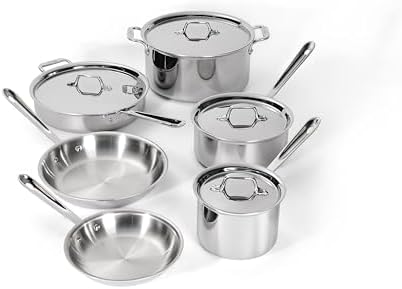
- Our kitchen favorite, 10-piece cookware set includes a 8 and 10-inch fry pan, 2 and 3-quart saucepan with lids, 3-quart …
- Built for professional kitchens & cherished by home cooks this heirloom cookware is Made in the USA with global componen…
- D3 Stainless is the original fully bonded tri-ply cookware trusted by chefs. The aluminum core delivers fast, even heat,…
There is some evidence that trace amounts of chromium and nickel can migrate into food during prolonged cooking of acidic dishes in lower-grade steel, but the amounts are well below any established health threshold, including for people with nickel sensitivities.
Look for 18/10 grade stainless (18% chromium, 10% nickel) for the most stable and corrosion-resistant alloy. Avoid cheap, unbranded stainless steel at very low price points, where the alloy composition is less reliably controlled.
Cast iron — safe, durable, and adds dietary iron
Bare cast iron has no coating, no synthetic chemistry, and has been used as cookware for centuries. Its safety profile is exceptionally well-documented.
The one thing to look out for is that cast iron does leach iron into food, particularly with acidic ingredients like tomato sauce. For most people, this is not a concern and is, in fact, a minor dietary benefit.
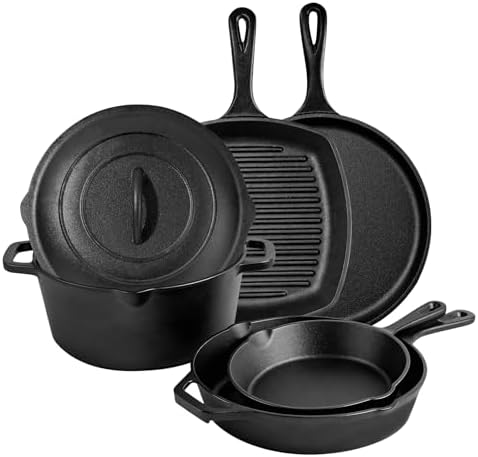
- 【6-Piece Cast Iron Cookware Set】Includes 5 qt dutch oven, 8” & 10.25” cast iron skillets, 10.5” cast iron round gridd…
- 【Healthy Nonstick Cooking】Pre-seasoned with 100% natural vegetable oil, this cast iron set cookware offers a durable non…
- 【Premium Quality】Thick, sturdy cast iron oven-safe up to 500°F. Every piece in this cast iron kitchen set is meticulousl…
For people with hemochromatosis or other iron-related conditions, it is worth factoring in.
Enamelled cast iron, such as Le Creuset or Staub, uses a vitreous (glass-based) enamel coating that is completely inert; it does not leach, does not react with food, and requires no seasoning maintenance.
It is one of the safest options for slow cooking and oven use. See our full cast iron vs stainless steel comparison for a detailed breakdown of daily cooking differences.
Carbon steel — the lighter cast iron alternative
Carbon steel shares essentially the same safety profile as cast iron — no coating, the same iron-leaching characteristics, the same reactivity with extended acidic cooking — but weighs significantly less.
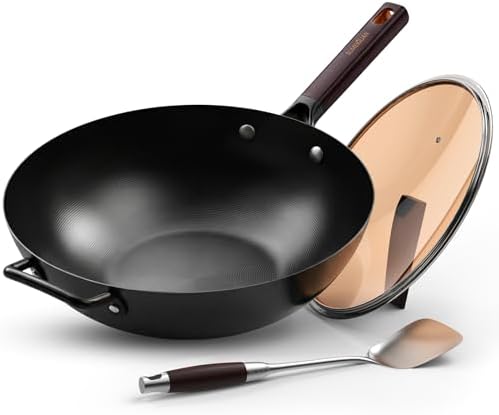
- PRE SEASONED & NONSTICK: Tired of rusty woks? SUMEIGUAN carbon steel wok is pre-cured and engineered with advanced Nitri…
- SPACIOUS BOTTOM DESIGN: Upgraded with a wide 17cm (6.7″) flat base that delivers superior heat stability and ample tossi…
- EXTRA LONG & STURDIER HANDLE: Crafted from premium solid wood, it maintains a comfortable coolness even at high temperat…
A 12-inch carbon steel skillet runs approximately 3 to 4 lbs compared to 6 to 8 lbs for an equivalent cast iron pan. Like cast iron, it requires seasoning to maintain its non-stick surface and should not be soaked or left wet.
Carbon steel is the material of choice in professional kitchens for high-heat searing and is an increasingly popular choice for home cooks who want cast iron’s safety profile without the weight.
Ceramic-coated — safe when intact, with caveats
Ceramic-coated cookware has grown significantly in the market as a PFAS-free alternative to traditional Teflon nonstick.
When properly manufactured by a reputable brand, ceramic-coated pans do not contain PFAS and are safe for everyday cooking at moderate temperatures.
The important caveats are: the “ceramic” label is completely unregulated — it refers to a silica-based coating that can vary widely in composition between manufacturers; the coating does degrade with use, particularly if exposed to high heat or metal utensils; and once the coating is visibly scratched or beginning to flake, the pan should be replaced.
Use only low to medium heat, avoid metal utensils, and hand-wash to maximise the coating’s lifespan.
Glass and enamelled cast iron — the safest options for baking and oven use
Borosilicate glass and enamelled cast iron are the two fully inert, non-reactive options for oven and baking use. Neither leaches anything into food under any cooking condition.
Glass is also ideal for food storage because it does not absorb odours, does not scratch or degrade over time the way plastic does, and is dishwasher safe indefinitely.
The one practical caveat for glass cookware is thermal shock — sudden temperature changes, such as moving a glass dish directly from a freezer to a hot oven or placing a hot glass dish on a cold wet surface, can cause cracking.
Tempered borosilicate glass handles temperature transitions better than standard glass, but is not immune to rapid thermal shock. See our non-toxic cookware guide for current top-rated models across all safe materials.
Cookware to Avoid or Limit
- PTFE nonstick pans (Teflon and equivalents) — PTFE is stable under normal cooking conditions but begins to degrade above approximately 500°F (260°C), releasing fumes that are harmful to birds and potentially damaging to human lung tissue at sustained high temperatures.
- Scratched or damaged PTFE surfaces accelerate particle release. If you continue to use nonstick pans, do so only at low to medium heat, never preheat an empty pan, and replace them immediately when the coating is scratched or flaking.
- Unlined aluminium — Aluminium is highly reactive with acidic foods, and unlined aluminium cookware can leach detectable amounts of the metal into food during cooking.
- Hard-anodised aluminium has a sealed surface that significantly reduces this reactivity, but bare aluminium pots and pans — common in budget cookware sets — are worth replacing as a priority.
- Unlined copper — Copper is a toxic metal when consumed in more than trace amounts. Unlined copper cookware can leach copper into food, particularly with acidic ingredients.
- Traditional copper cookware is always lined with tin or stainless steel for this reason. If the lining in any copper piece you own is worn through or damaged, retire the piece from food use immediately.
- Cheap imported ceramic or nonstick with unknown coatings — Products sold at very low price points with vague “non-toxic” or “eco” marketing and no third-party safety certification represent genuine uncertainty.
- The coating composition may not be independently verified, and the durability of the surface under daily use is typically much lower than that of established brands. When buying coated cookware, spend enough to buy from a brand that publishes its material testing.
Safe Food Storage — Why Plastic Is the Biggest Everyday Exposure Point
Of all the areas in the kitchen, food storage is where most households have the highest daily exposure to potentially harmful materials — simply because plastic containers are used so frequently, for so long, and often with hot food.
The cookware sitting in your cabinet is only in contact with food during cooking. A plastic container can hold food for days and be reheated multiple times, each cycle increasing the leaching risk.
Why “BPA-free” plastic is not the full answer
When BPA was removed from most consumer plastics in the mid-2000s following evidence of hormonal disruption, it was replaced primarily by BPS (bisphenol S) and BPF (bisphenol F).
These compounds were selected as substitutes in part because they were less studied, but emerging research indicates they have similar endocrine-disrupting effects.
Buying “BPA-free” plastic containers reduces one specific exposure but does not eliminate the broader bisphenol concern.
Beyond bisphenols, all plastics shed microplastics — the rate increases with physical damage (scratching from utensils, dishwasher abrasion) and with heat (microwaving, hot food added directly to containers).
Older, scratched, or dishwasher-clouded plastic containers are the highest-risk items in most households and should be the first to go.
What to use instead: glass, stainless steel, and silicone
| Material | Safe for hot food | Microwave safe | Dishwasher safe | Best use |
|---|---|---|---|---|
| Borosilicate glass | Yes | Yes | Yes | All food storage — the gold standard |
| Standard tempered glass | Yes — handle carefully | Yes | Yes | Every day, containers and meal prep |
| Stainless steel | Yes | No | Yes | Packed lunches, dry storage, cold food |
| Food-grade silicone | Yes — check grade | Yes (pure silicone) | Yes | Bags, pouches, flexible lids, freezing |
| BPA-free plastic | Low to medium heat only | Low power only | With care | Dry or cold storage only — avoid heating |
The practical recommendation for most households: move to glass containers for anything that will be reheated.
Glass costs more upfront but does not degrade, does not absorb odours, and lasts indefinitely. Stainless steel is ideal for packed lunches and cold storage.
Silicone bags are a practical replacement for disposable plastic bags for snacks and freezing. See our guide to the safest food storage containers for the current top-rated options across all three materials.
Safe Cutting Boards — What the Latest Research Actually Shows
For decades, the conventional food safety guidance was clear: use plastic cutting boards, not wood, because non-porous plastic is easier to sanitise and less likely to harbour bacteria.
That guidance is now more complicated, and for a reason that most people have not yet heard.
The microplastics finding — what 2023 research changed
A 2023 study published in Environmental Science and Technology examined how much plastic is released from cutting boards during normal use — specifically from polyethene and polypropylene boards, the two most common materials in household plastic cutting boards.
The researchers found that chopping on these boards releases between 14 and 71 million microplastic particles per person per year, with total mass releases ranging from 7.4 to 50.7 grams annually.
A separate study found that microplastics released during meat cutting adhere directly to the surface of chicken, fish, and beef. This data does not prove that plastic cutting boards are dangerous — but it does mean that the traditional safety calculus, which focused only on bacteria, was incomplete.
The 2024 New England Journal of Medicine study, which found micro and nanoplastics in arterial plaque and linked higher concentrations to a significantly elevated risk of cardiovascular events over three years, added a dimension of cardiovascular concern to what had previously been treated as primarily a hormonal or inflammatory issue.
Wood and bamboo — safer for microplastics, with one important caveat
“A UC Davis study found that bacteria on wooden cutting boards were drawn into the wood and became unrecoverable within minutes as the surface dried, while bacteria on plastic boards remained recoverable for much longer.”
The anti-bacterial mechanism of wood is not fully understood, but appears to be related to the natural compounds in hardwood and the way wood fibres close around bacteria, cutting off their nutrient supply.
Hard maple, teak, and cherry are the most widely recommended hardwoods for cutting boards.
Bamboo is harder and even less porous than most hardwoods, but comes with a specific caveat: most bamboo cutting boards are made from laminated bamboo strips held together with adhesive resins that may contain formaldehyde.
Solid bamboo boards without adhesive binders avoid this issue, but they are harder to find and more expensive. If you choose bamboo, check that it is made from a single piece or that the manufacturer confirms formaldehyde-free adhesives.
The safest all-round choice for most households is a solid hardwood board — ideally end grain maple — which requires no adhesives and provides the full antimicrobial benefit of the wood itself.
Cross-contamination rules apply regardless of board material
The bacterial risk from cutting boards is real, regardless of what they are made from, and it comes primarily from cross-contamination — not from the board material itself. These rules apply whether your board is plastic, wood, or bamboo:
- Use a dedicated board for raw meat, poultry, and seafood — separate from the board used for produce, bread, and ready-to-eat foods
- Wash the meat board with hot, soapy water immediately after use, before using it for anything else
- Sanitise with a dilute bleach solution (one tablespoon of unscented bleach per gallon of water) after contact with raw meat — particularly raw poultry
- Replace any board — regardless of material — that has deep grooves or cuts in the surface that cannot be cleaned effectively; these grooves protect bacteria from sanitisation
- After four hours of continuous use in a food preparation context, clean and sanitise the board regardless of what was cut on it
See our best cutting boards guide for a full comparison of top-rated boards across hardwood, bamboo, and HDPE options.
Safe Kitchen Practices — the Habits That Matter as Much as the Equipment
No amount of premium cookware compensates for practices that create bacterial contamination.
Foodborne illness — from Salmonella, E. coli, Listeria, and Campylobacter — is a far more statistically significant kitchen health risk for most households than chemical leaching from cookware.
The six habits below address the highest-risk points in a typical home kitchen.
- Wash your hands before and after handling raw meat, poultry, and seafood. Use soap and warm water for a minimum of 20 seconds. This single habit prevents the majority of cross-contamination incidents in home kitchens.
- Cook meat and poultry to safe internal temperatures. Chicken and turkey: 165°F (74°C). Ground beef: 160°F (71°C). Whole beef, pork, lamb: 145°F (63°C) with a three-minute rest. A probe thermometer is the only reliable way to verify doneness — colour and texture are not sufficient indicators.
- Refrigerate leftovers within two hours of cooking — within one hour if the ambient temperature is above 90°F (32°C). Bacteria multiply rapidly between 40°F and 140°F (4°C and 60°C), a range food safety authorities call the danger zone. Divide large quantities into smaller containers, so they cool quickly.
- Never thaw meat at room temperature. Thaw in the refrigerator, in cold running water with the packaging sealed, or in the microwave immediately before cooking. Room temperature thawing allows the outer surface of the meat to enter the danger zone while the interior is still frozen.
- Clean and sanitise countertops and surfaces after contact with raw meat. Soap removes organic material; a dilute bleach or food-safe disinfectant spray kills bacteria. Both steps are needed — soap alone does not sanitise, and sanitiser is less effective on surfaces with food residue.
- Do not reheat food more than once. Each reheat and cool cycle creates another window for bacterial growth. Portion leftovers into single-serve containers before refrigerating so only what will be eaten needs to be reheated.
Where to Start — A Prioritised Swap Guide for Real Households
Most households cannot overhaul their entire kitchen at once, and they should not feel they need to.
The question is not “what is the ideal kitchen?” It is “what change will reduce my exposure the most for the lowest cost and effort right now?”
The table below ranks the five highest-impact swaps in priority order.
| Priority | Swap | Why this first | Low-cost option | Premium option |
|---|---|---|---|---|
| 1 | Replace scratched or old PTFE nonstick pans | Highest daily heat exposure; damaged coating sheds particles directly into food | Lodge carbon steel skillet (~$30–$40) | Made In stainless steel or Caraway ceramic (~$80–$145)* |
| 2 | Replace plastic containers used to reheat food | Heat activates leaching; microplastics shed at the highest rate; daily exposure | IKEA glass containers (~$10–$15) | Pyrex or OXO glass storage sets (~$30–$60)* |
| 3 | Replace plastic cutting boards (if deeply grooved) | Microplastic shedding directly to the food surface during cutting | Teakhaus end-grain wood board (~$35–$50) | Boos maple end-grain board (~$100–$200)* |
| 4 | Replace plastic cooking utensils used at high heat | Spatulas, ladles, and spoons in contact with hot oil or boiling water shed microplastics | Wooden spoons and a stainless steel spatula (~$10–$15 total) | GIR silicone utensil set (~$30–$50)* |
| 5 | Replace plastic water bottles and drink containers | Daily use, sometimes with warm liquids; cumulative exposure adds up over time | IKEA stainless steel water bottle (~$5–$8) | Hydro Flask or Klean Kanteen (~$30–$50)* |
A note on pace: There is no health justification for throwing out a full kitchen of cookware and replacing it immediately.
Replacing items as they wear out — prioritising the ones in the highest-exposure categories above — is both financially sensible and sufficient.
The cookware risk from a stainless steel pan you have used for five years and will use for another five is not an emergency. The plastic container you microwave food in every day is a more immediate priority.
Frequently Asked Questions About Building a Safe Kitchen
Is non-stick cookware safe to use?
Traditional PTFE nonstick (Teflon) cookware is safe under normal cooking conditions — low to medium heat, not preheated empty, and used with plastic or silicone utensils.
The risk increases with damaged coatings, high heat above 500°F, and overheated empty pans. If your nonstick pans are scratched, flaking, or old, replacing them is worthwhile.
For a genuinely safe nonstick alternative, ceramic-coated pans from reputable brands offer similar cooking convenience without PFAS, though they require more careful handling to preserve the coating.
What is the difference between PFOA-free and PFAS-free?
PFOA is one specific compound within the broader PFAS family. It was banned in the US and EU in 2013, which is why “PFOA-free” became a standard claim on cookware packaging shortly afterwards.
However, PFOA-free does not mean PFAS-free — the same manufacturers that removed PFOA typically replaced it with other PFAS compounds such as GenX or PFBS that are structurally similar and share many of the same environmental persistence characteristics.
PFAS-free is the more meaningful claim, but even that has no regulatory standard and is not independently verified on most products.
The safest approach is to choose cookware with no coating at all — stainless steel, cast iron, carbon steel, or glass — rather than relying on marketing language.
Is cast iron or stainless steel safer?
Both are considered safe and are among the best choices for everyday cooking. The difference comes down to use case rather than safety.
Cast iron is ideal for high-heat searing, oven use, and long braising; it adds a small amount of iron to food, which is a benefit for most people and a consideration for those with iron overload conditions.
Stainless steel is more versatile across cooking styles, easier to maintain, and non-reactive with acidic foods. Neither material requires a coating, which is why both consistently top safety recommendations.
Choose based on how you cook rather than which is “safer” — they are both excellent choices.
Are plastic food containers safe if they’re BPA-free?
Safer than older BPA-containing plastics, but not entirely without concern. BPA was replaced primarily by BPS and BPF, which have similar chemical structures and are suspected to have comparable hormonal effects.
All plastics also shed microplastics, and the rate increases with heat, scratching, and age.
The safest use of BPA-free plastic containers is for cold or room-temperature dry storage only, not for reheating in the microwave, not for hot food added directly to the container, and not for long-term storage of liquids.
For anything that will be heated, glass containers are the safest choice.
Should I throw out my old plastic cutting board?
If it is deeply grooved or scratched, yes. The grooves in a damaged plastic cutting board both harbour bacteria that survives sanitisation and increase the rate of microplastic shedding during cutting.
A new plastic board — particularly one made from HDPE (high-density polyethylene) — is safer than a heavily worn one, though a hardwood board eliminates the microplastics concern.
If you replace your plastic board, replace it with end-grain hardwood maple or a solid hardwood equivalent. Avoid laminated bamboo unless you can confirm the adhesive is formaldehyde-free.
Is ceramic cookware actually safe?
Ceramic-coated cookware from reputable brands — those that publish third-party testing for PFAS — is safe when the coating is intact.
The caveats are meaningful: the word “ceramic” on cookware packaging has no regulatory definition and covers a wide range of silica-based coatings with varying compositions and durabilities; the coating degrades with use, particularly under high heat or with metal utensils; and a scratched or flaking ceramic-coated pan should be replaced.
For a no-caveat safe option, solid ceramic bakeware (not coated steel) is fully inert.
For stovetop cooking, stainless steel or cast iron requires no such monitoring.
What kitchen items are most likely to contain lead?
The highest-risk items for lead in a typical household kitchen are: vintage Corelle or decorated dinnerware made before approximately 2005; imported ceramic cookware or pottery without verified lead-free certification; antique or vintage enamelware where the glaze composition is unknown; and some brightly coloured ceramic mugs or bowls made in regions without stringent heavy metal regulations.
Plain white or undecorated ceramics from reputable modern manufacturers carry minimal risk. If you are uncertain about any piece, a lead test swab costs a few dollars and provides a quick answer.
Do I need to replace everything at once?
No, and doing so is unnecessary and wasteful. The most sustainable approach is to use the prioritised swap guide in this article to identify your highest-exposure items and replace them as they wear out or when budget allows.
The stainless steel pan you have owned for ten years is not an emergency. The deeply scratched plastic container you microwave food in every day is a more immediate priority.
Gradual, informed replacement over time achieves the same result as an immediate overhaul, at a fraction of the cost, and without discarding items that still have useful life in them.
About the Author & Reviewer
Sarah Emirone, Author
Sarah researches and writes SafeKitchn’s dinnerware and kitchenware guides, with a focus on material safety, lead content, and manufacturer specifications. She cross-references product data sheets, safety certifications, and regulatory filings (including FDA and Prop 65 records) before publishing, and updates articles when new information becomes available.
James Daniels, Reviewer
James reviews SafeKitchn’s material safety content for scientific accuracy. He holds a B.Sc in inorganic chemistry and works as a materials researcher, with particular focus on the composition and safety behavior of glass, ceramic, and metal used in kitchenware.