

Is Cookware Made in China Safe? The question is understandable, but it is also the wrong question.
China manufactures cookware for Caraway, T-fal, and dozens of premium Western brands under rigorous, independently verified standards. It also produces dangerous, unverified budget products that have failed safety testing.
The country of origin is not what determines whether a pan is safe to cook in. The manufacturer’s documented quality standards are.
This article explains the specific, documented risks in Chinese-manufactured cookware and, more importantly, how to assess any cookware purchase regardless of where it was made.
Written by Sarah Emirone | Reviewed by James Daniels, B.Sc, Inorganic Chemist & Materials Researcher | Updated September 2026 | See How We Test | Filed under: Origin & Manufacturing
Is Cookware Made in China Safe?
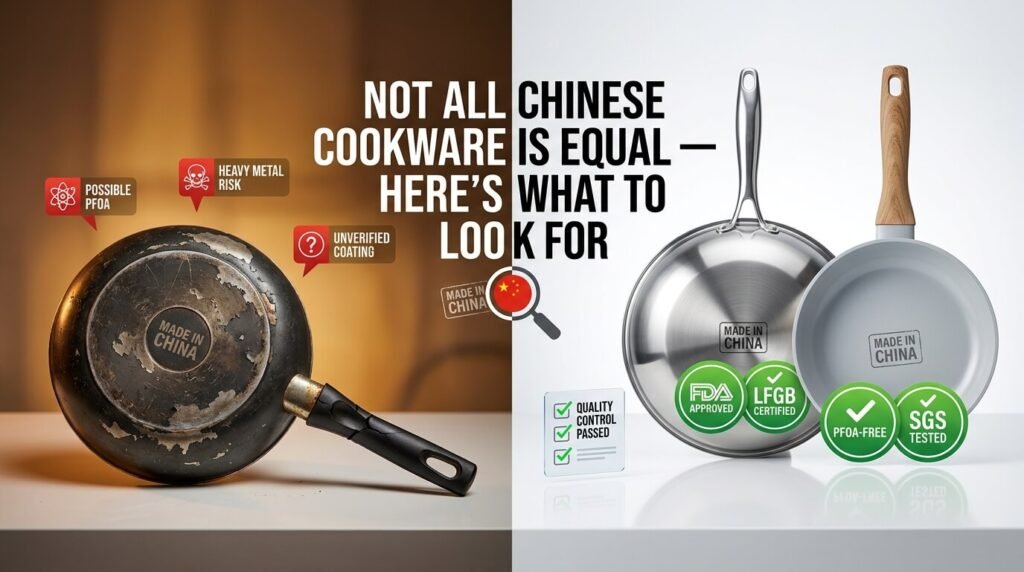
Yes and No, cookware manufactured in China is deemed safe based on the manufacturer’s production standards, not the country of origin.
For example, a Caraway pan manufactured in China to Caraway’s published PFAS-free, independently tested specification is safer than a pan manufactured in Germany with no published testing data.
Origin tells you nothing about the grade of stainless steel used, whether the nonstick coating contains PFAS, or whether the ceramic glaze was tested for lead.
Those variables are determined by the manufacturer’s choices and standards, not by geography. The useful question is not “where was this made?” It is “does this manufacturer document its materials, test to a named standard, and publish the results?”
What Manufacturing Standards Actually Govern Chinese Cookware
Two tiers of Chinese cookware exist and behave very differently from a safety standpoint: products manufactured for export to the EU and US, and products manufactured for the domestic Chinese market or sold through unverified online channels.

- 16-PIECE DELUXE COOKWARE SET: Included in this 16-piece cookware set is a 10.5″ frying pan, 3 qt. sauce pan with lid, 6….
- NATURALLY NON-STICK: The kitchen cookware is designed with a slick ceramic surface that smoothly releases food with mini…
- STOVETOP & OVEN SAFE: Built for versatility, this non-toxic cookware set is compatible with induction, gas, and electric…
The export compliance standards
| Standard | Governing body | What it tests | Who requires it |
|---|---|---|---|
| LFGB | German/EU food safety law | Heavy metal migration, PFAS, and material safety | Required for EU market sale |
| FDA 21 CFR 175.300 | US Food and Drug Administration | Food contact material safety | Required for the US market sale |
| ISO 9001 | International Standards Organization | Quality management systems | Voluntary; signals process rigour |
| GB/T (Chinese national standard) | SAC — China’s standards body | Material composition, food safety | Applies to the domestic Chinese market |
Why are domestic-market and export products different
Manufacturers producing for export to the EU or US must meet LFGB or FDA requirements and submit to independent testing from accredited labs such as SGS, TÜV Rheinland, or Intertek.
Manufacturers producing solely for the Chinese domestic market or selling through unverified online channels, including many marketplace listings on Amazon, Temu, and AliExpress, face different and often less rigorous oversight.
The cheap cookware that tests poorly is rarely the export-compliant product. It is the unverified channel product that bypasses export compliance entirely.
The 201 vs 304 Stainless Steel Problem
This is the most specific and well-documented safety risk in Chinese stainless steel cookware. Grade 201 stainless steel is a lower-cost alloy that looks visually identical to the food-safe 304 grade.
It is cheaper to produce, has poor corrosion resistance, and leaches manganese and chromium into food, particularly acidic food.
It is routinely misrepresented as 304 by unscrupulous manufacturers because buyers have no way to distinguish the two by looking at them.
304 vs 201 — what the difference actually means
| Material | 304 (18/10 — food safe) | 201 (budget grade — avoid) |
|---|---|---|
| Nickel content | 8–10% | 1–2% |
| Chromium content | 18% | 13–15% |
| Manganese content | Low | High (substituted for nickel) |
| Corrosion resistance | Excellent | Poor — pits and corrodes with acids |
| Leaching risk | Minimal under normal use | Manganese and chromium leach readily |
| Food safe rating | FDA and EU approved | Not recommended for food contact |
The 2024 CCTV investigation
In 2024, China Central Television — China’s state broadcaster — aired an investigation exposing 19 thermos cup manufacturers selling 201 stainless steel products marketed and labelled as 304 grade.
Testing found manganese levels at six times the established safety standard. This case is significant for two reasons: it is the most documented recent evidence of the 201/304 substitution fraud, and it was a domestic Chinese investigation, meaning the problem is actively acknowledged and regulated within China’s own system.
The risk is real, well-documented, and specifically concentrated in unverified budget products, not in export-compliant manufacturing.
The Magnet Test — Why the Advice Everyone Gives Does Not Work
304 stainless steel is non-magnetic or only weakly magnetic in its annealed state. 201 stainless steel is also non-magnetic or only weakly magnetic in its annealed state.
Both grades can develop slight magnetism after cold-working during manufacturing. The magnetic test reliably identifies 430 ferritic stainless steel, which is strongly and clearly magnetic, but it cannot distinguish 304 from 201.
That is exactly the comparison buyers need to make, and the magnet cannot make it.
How to actually verify stainless steel grade
- XRF elemental analysis via mail-in service. X-ray fluorescence measures the actual elemental composition of the metal — nickel percentage, chromium percentage, and manganese percentage — and identifies the grade precisely. Several mail-in services offer consumer XRF testing for $30–$60. The most reliable method available outside a laboratory.
- Chemical nickel spot test. A dimethylglyoxime test kit costs under $15 and turns pink in the presence of nickel above a threshold concentration. 304 contains 8–10% nickel and produces a clear positive. 201 contains 1–2% nickel and produces a weak or negative result. More accessible than XRF for immediate testing.
- Lemon juice acid test. Apply lemon juice or diluted vinegar to the cooking surface and leave for 24 hours. Inferior steel — particularly 201 — will show visible rust, pitting, or surface discolouration. 304 will show no reaction. This is the least precise method, but it requires no equipment.
PFAS in Chinese Nonstick Cookware
The PFAS risk in nonstick cookware is not unique to Chinese manufacturing; it applies globally wherever nonstick coatings are produced without adequate testing.
PFOA, the original PTFE manufacturing compound, was phased out worldwide, including in China, by 2016. The “PFOA-free” claim that appears on virtually all nonstick cookware today has been accurate but incomplete since then: PFOA’s replacement compounds — GenX, PFBS, and other PFAS — may be present in products that truthfully claim to be PFOA-free.
What “PFOA-free” on a Chinese nonstick label actually means
Since 2016, “PFOA-free” means only that PFOA specifically is absent. It says nothing about other PFAS compounds. The meaningful claim is “PFAS-free” — and only when that claim is backed by third-party testing from an accredited laboratory.
Brands that publish PFAS testing results from named labs (Intertek, SGS, TÜV Rheinland, or Light Labs) are making a verifiable commitment. Brands that use “PFOA-free” as a standalone marketing claim without published PFAS testing data are not.
Lead and Cadmium in Chinese Ceramic and Enamel Cookware
The heavy metal risk in ceramic and enamel-coated cookware applies to all manufacturing origins, not specifically to China.
The risk is in the glaze chemistry — bright reds, oranges, and yellows have historically used cadmium compounds; certain decorative overglaze patterns have used lead.
The same Prop 65 or LFGB testing standards that apply to European or American ceramic cookware apply equally to Chinese-manufactured equivalents. Look for published leach test results from the specific brand, not from a generic “Chinese manufacturer” category.
See our non-toxic cookware and non-toxic dinnerware guide for a full material breakdown by risk level.
Is Cast Iron Cookware from China Safe?
For uncoated cast iron, yes — with chemistry as the basis for that answer, not assumption. Cast iron is an alloy of iron, carbon, and trace amounts of silicon and manganese. Its melting point is approximately 2,200°F (1,204°C).
Lead melts at 621°F (327°C). At the temperatures required to produce cast iron, any lead present in the raw materials would volatilize and escape during the casting process, as it cannot survive the manufacturing temperature.
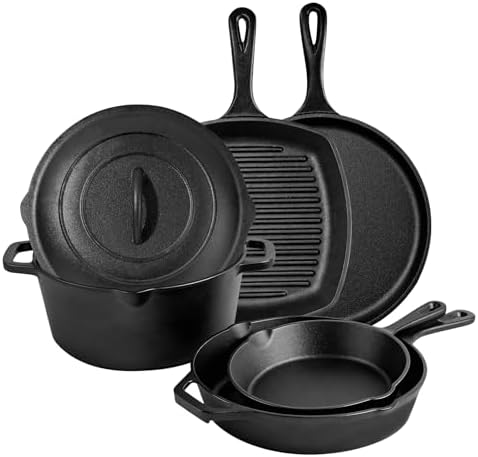
- 【6-Piece Cast Iron Cookware Set】Includes 5 qt dutch oven, 8” & 10.25” cast iron skillets, 10.5” cast iron round gridd…
- 【Healthy Nonstick Cooking】Pre-seasoned with 100% natural vegetable oil, this cast iron set cookware offers a durable non…
- 【Premium Quality】Thick, sturdy cast iron oven-safe up to 500°F. Every piece in this cast iron kitchen set is meticulousl…
Independent testing of Chinese cast iron from reputable manufacturers consistently returns non-detectable lead levels.
The risk with Chinese cast iron is not the iron itself; it is the unknown coatings applied to it. Enamel-coated Chinese cast iron requires the same heavy metal testing as any enamel product.
Pre-seasoned coatings with unknown composition from unverified manufacturers introduce a separate concern. Uncoated, unseasoned cast iron from any origin has no meaningful lead risk.
Premium Western Brands That Manufacture in China

- ULTIMATE COOKING VERSATILITY: This set includes the Always Pan 2.0 and Perfect Pot along with their mini counterparts, a…
- ADVANCED NON-STICK TECHNOLOGY: Featuring Thermakind ceramic nonstick coating, our most advanced and durable formula that…
- 5-PIECE BAKEWARE SET: A multifunctional five-piece set with everything you need to grill, cook, and bake all at once: ou…
The presence of “Made in China” on the packaging of a well-known brand is not a safety red flag. The following brands are manufactured in China under published safety standards.
| Brand | Made in China | Third-party testing | Certification | Results published |
|---|---|---|---|---|
| Caraway | Yes | Yes — PFAS, BPA, PTFE, lead | PFAS-free verified | Caraway website |
| T-fal (Tefal) | Partially | Yes — varies by product line | PFOA-free; some PFAS-free | Contact the brand for specifics |
| GreenPan | Yes | Yes — Thermolon coating tested | PFAS-free; LFGB compliant | GreenPan website |
| Our Place | Yes | Yes — independent lab testing | Lead, cadmium, and PFAS tested | Our Place website |
| Lodge (some lines) | US and China | Yes | Uncoated cast iron — inherently safe | Lodge website |
Red Flags — How to Identify Unsafe Cookware Regardless of Origin
These signals apply to cookware from any country. Each one independently warrants walking away.
- No material grade specified on stainless steel products. Any stainless steel cookware that does not state 304, 18/8, or 18/10 on the packaging or product page should be treated as potentially 201 or lower grade.
- “PFOA-free” is the only safety claim on nonstick. This claim has been meaningless since 2016. Look for “PFAS-free” with a named testing laboratory.
- No published third-party testing results. Brands that test their products make those results available. Brands that do not publish results either have not tested or did not like what they found.
- Extremely low price for the stated material. A 12-inch tri-ply 304 stainless steel pan that retails for $8 is not made from what it claims. True material costs have a floor.
- Sold exclusively through unverified marketplace third-party sellers. Direct brand sales or authorized retailers carry accountability that anonymous marketplace listings do not.
- Bright orange, red, or yellow enamel or ceramic coatings with no heavy metal testing disclosed. These colour ranges have the highest historical use of cadmium compounds in glazes.
The 4-Question Safety Checklist
Before buying any cookware — Chinese-made or otherwise — ask these four questions. If any answer is “no” or “unknown,” keep looking.
- Does the brand specify the exact material grade? For stainless steel: 304, 18/8, or 18/10 must be stated. For nonstick: the coating chemistry must be named. For ceramic: the glaze composition or certification must be disclosed.
- Has the product been tested by a named independent third-party laboratory? Not an internal test. Not a vague “tested for safety” claim. A named accredited lab: SGS, Intertek, TÜV Rheinland, Light Labs, or equivalent.
- Are the test results published and accessible? A link to actual results — not a certificate image with no underlying data — on the brand’s website.
- Does the brand claim comply with a named regulatory standard? LFGB, Prop 65, FDA 21 CFR, or NSF. Each of these has a numeric threshold and an enforcement mechanism. “Safe” and “non-toxic” are not regulatory standards.
If a brand answers yes to all four, the country of origin is irrelevant to the safety assessment. See our safe kitchen guide for how cookware safety fits into the broader picture of a non-toxic kitchen.
Frequently Asked Questions
Is cookware made in China automatically unsafe?
No. China manufactures cookware for dozens of premium Western brands, including Caraway, GreenPan, and Our Place, under rigorous, independently tested standards.
The variable that determines safety is the manufacturer’s documented quality process, not the country. Unverified budget cookware from any country — including products manufactured domestically — can be equally unsafe.
How do I know if my stainless steel cookware is 304 or 201 grade?
The most reliable method is XRF elemental analysis via a mail-in testing service, which identifies the exact nickel and chromium percentages that define the grade. A chemical nickel spot test (dimethylglyoxime kit, under $15) is a practical second option.
The lemon juice acid test, leaving diluted lemon juice on the surface for 24 hours, will reveal inferior steel through visible rust or pitting.
Do not rely on the magnet test: both 304 and 201 can be non-magnetic or weakly magnetic, making the test unreliable for distinguishing between them.
Is Caraway cookware made in China?
Yes, and it is safe. Caraway publishes third-party testing results from accredited laboratories confirming their cookware is free of PFAS, BPA, BPS, BPF, PTFE, and lead.
The “Made in China” label is irrelevant to the safety assessment when the manufacturer’s testing programme is this transparent.
What does LFGB certification mean on cookware?
LFGB is Germany’s Food and Feed Code, which sets one of the strictest food contact material standards in the world.
LFGB certification for cookware means the product has been tested by an accredited laboratory for heavy metal migration (lead, cadmium, nickel), PFAS compounds, and other regulated substances, and has passed at numeric thresholds that are typically stricter than FDA requirements.
A genuine LFGB certificate names the testing laboratory and lists the specific tests passed.
Is Chinese cast iron safe compared to American or European cast iron?
Uncoated cast iron from China is as safe as uncoated cast iron from anywhere else.
The chemistry of cast iron manufacturing — temperatures above 2,200°F — makes lead contamination physically implausible; lead volatilizes far below cast iron’s production temperature. Independent testing consistently confirms non-detectable lead in uncoated Chinese cast iron.
The safety question for Chinese cast iron applies to any coatings applied after casting, not to the iron itself.
Why does some cookware from China contain PFAS?
PFAS compounds are used in nonstick coatings because they provide the low-friction surface properties that make nonstick cookware functional.
Some manufacturers in China and elsewhere continue to use PFAS compounds other than PFOA (which was phased out in 2016) because they are cheaper than verified PFAS-free alternatives and because “PFOA-free” can be truthfully claimed without disclosing their presence.
The solution is to buy only from brands that publish PFAS-free verification from a named independent testing laboratory.
Is it safe to buy cookware from Amazon marketplace sellers if it is made in China?
It carries a higher risk than buying directly from a verified brand. Anonymous third-party marketplace sellers are not subject to the same accountability as direct brand sales, cannot be held to consistent product specifications, and frequently sell products that bypass export compliance testing.
If you buy through a marketplace, purchase only from listings that are sold and fulfilled by the brand itself or a verified authorized retailer — not from third-party sellers whose identity you cannot verify.
What is the safest cookware to buy if I want to avoid Chinese-made products?
Made In Cookware (USA/Italy), Demeyere (Belgium), Solidteknics (Australia/USA), and Le Creuset enamelled cast iron (France) are among the brands that manufacture wholly or primarily outside China and publish safety testing.
Uncoated cast iron from Lodge (USA) is made domestically and carries no coating-related risk. That said, origin alone is not a reliable safety indicator; a Chinese-manufactured pan from a transparent, tested brand is safer than a domestically made pan with no published safety data.
For further reading, see our safest cookware materials guide, best non-toxic cookware options, and our full stainless steel cookware safety guide.
About the Author & Reviewer
Sarah Emirone, Author
Sarah researches and writes SafeKitchn’s dinnerware and kitchenware guides, with a focus on material safety, lead content, and manufacturer specifications. She cross-references product data sheets, safety certifications, and regulatory filings (including FDA and Prop 65 records) before publishing, and updates articles when new information becomes available.
James Daniels, Reviewer
James reviews SafeKitchn’s material safety content for scientific accuracy. He holds a B.Sc in inorganic chemistry and works as a materials researcher, with particular focus on the composition and safety behavior of glass, ceramic, and metal used in kitchenware.