

Claytan and Corelle are both durable, lead-safe, microwave-safe dinnerware brands with strong reputations in their respective markets, but they are built from entirely different materials, serve different performance profiles, and suit different buyers.
Choosing between them without understanding the material difference leads to frustration: buyers who want to roast food in their dishes will find Corelle’s 350°F limit too restrictive; buyers who want the lightest possible plates will find ceramic heavier than Vitrelle glass at every equivalent size.
This guide covers every meaningful difference between Claytan dinnerware vs Corelle: who each brand is, what the materials actually deliver, how their performance compares across oven use, weight, durability, lead safety, and design, and which type of buyer each brand genuinely suits.
Written by Sarah Emirone | Reviewed by James Daniels, B.Sc, Inorganic Chemist & Materials Researcher | Updated September 2026 | See How We Test | Filed under: Brand & Product Comparisons
Who Makes Each Brand — Background and Manufacturing Origin
Understanding the company behind each brand shapes how you interpret product claims and quality assurances.
Claytan: Malaysia’s Century-Old Ceramic Pioneer
Claytan traces its origins to 1920, making it one of Southeast Asia’s oldest ceramic manufacturers.
The Oriental Ceramics branch of the Claytan Group was founded in 1973 by Tan Chong Cheng in Ayer Hitam, Kluang, Johor, Malaysia, the brand name itself combining “clay” with the founder’s family surname.
Claytan Fine China (Tableware) Sdn Bhd, the current tableware entity, was incorporated in 1995 and specializes in stoneware, fine china, earthenware, and vitreous china tableware under the Claytan brand.
Today, Claytan describes itself as the most diversified ceramic manufacturer in Malaysia, producing four types of ceramic bodies for tableware: earthenware, stoneware, fine china, and vitreous china.
It is also Malaysia’s only major ceramic dinnerware manufacturer and the only lead-safe ceramic tableware producer and exporter in its Asian region — a specific claim it supports with US FDA and California Proposition 65 compliance certification for lead and cadmium content.
Claytan exports to over 35 countries across Africa, Asia Pacific, Europe, the Middle East, North America, and South America, with approximately 80% of its production exported.
It also operates as an OEM producer for international brands, supplying products to the Japanese and UK markets under licensing arrangements.
Claytan’s manufacturing is domestic; all production occurs at its Malaysian facilities, primarily in Johor. This makes it one of the few remaining large-scale ceramic manufacturers in Southeast Asia with genuine domestic production rather than imported components or contract manufacturing in China.
Corelle: The American Vitrelle Glass Standard
Corelle was introduced in 1970 by Corning Glass Works, the same company that developed Pyrex, and is now operated by Instant Brands.
Its core product, Vitrelle glass dinnerware, is manufactured at the Corning facility in Oneida, New York, making it one of the few mainstream dinnerware brands with genuine USA-based glass production.


Corelle’s reach is global: it holds strong market positions in the United States, India, Southeast Asia, and across markets where its combination of lightweight construction and durability is valued.
In Southeast Asian markets — including Malaysia, where Claytan is the dominant domestic ceramic brand — Corelle is the most widely recognized imported dinnerware, available through major retailers and e-commerce platforms.
Both brands therefore compete directly in the same regional market, which is why this comparison matters most to Malaysian, Singaporean, and broader Southeast Asian buyers evaluating their options.
The Core Material Difference: Ceramic vs. Corelle Vitrelle Glass
Every meaningful performance difference between Claytan and Corelle follows from one fundamental fact: they are made from categorically different materials.
What Claytan Is Made From
Claytan produces dinnerware across four ceramic body types. Its consumer dinnerware lines are primarily earthenware and stoneware, with fine china used for premium and hotel lines. The key properties of each:
Earthenware is clay fired at lower temperatures (approximately 999°C–1,140°C), producing a material that is relatively porous and requires glazing to be food-safe.
It is typically heavier than stoneware at an equivalent size and more susceptible to chipping at the edges. Claytan’s English fine earthenware uses a blend of Japanese and British manufacturing technology and is positioned as its accessible everyday consumer range.
Stoneware is fired at higher temperatures (approximately 1,200°C–1,300°C), producing a denser, semi-vitrified to fully vitrified material with significantly lower porosity than earthenware.
Stoneware is inherently stronger, more chip-resistant, and more hygienic than earthenware. Claytan’s stoneware line is marketed with over 100 years of development behind it and is the body type used for its hotel and commercial collections.
Stoneware retains heat at the table better than glass, which is a practical advantage when serving hot food that needs to stay warm through a meal.
Both earthenware and stoneware are opaque, relatively thick-walled materials with an earthy, substantial feel in the hand. They look and feel categorically different from glass dinnerware, warmer, heavier, and more artisanal in character.
What Corelle Is Made From
Corelle’s plates and bowls are made from Vitrelle, a proprietary three-layer laminated glass developed by Corning.
Two outer layers of glass in compression are thermally bonded to a central core layer under tension, producing a material that is significantly lighter than ceramic at equivalent plate size, non-porous throughout its entire structure (not just at the glazed surface), and chip-resistant at the rim through its engineered stress distribution.
Vitrelle glass is not ceramic at all; it is a glass-ceramic hybrid that looks superficially similar to white ceramic or fine china but performs differently in nearly every measurable way.
Claytan Dinnerware vs Corelle Head-to-Head Comparison: Every Factor That Matters
Oven Temperature — The Most Significant Performance Difference
This is the comparison that separates the two brands most decisively, and the one that most buyers overlook because it is not prominent.
Claytan ceramic dinnerware is rated for oven use up to 300°C (572°F). Product listings from Claytan’s official store confirm this rating explicitly: “Our products are microwave and oven safe, so you can use them up to 300 degrees Celsius.”
This temperature rating covers the full range of home cooking: roasting meat and vegetables (typically 200°C–220°C), high-temperature baking, pizza reheating, and serious casserole cooking.
Claytan also specifies that its thermal shock resistance allows for a temperature difference of 180°C — meaning the transition between temperatures should not exceed this differential, but normal cooking and cooling cycles fall comfortably within it.
Corelle Vitrelle glass is rated for oven use up to 350°F (177°C) in a preheated conventional or convection oven. This is a genuinely limited rating: it covers gentle reheating, warming plates, baking egg dishes and casseroles, and heating frozen meals, but it excludes the majority of high-temperature cooking tasks.
Roasting, broiling, high-temperature baking, and pizza are all outside Corelle’s oven capability. Corelle is also explicitly not broiler safe under any conditions.
For buyers who use their everyday dinnerware for both serving and cooking, a common habit in Southeast Asian households where dishes move fluidly between kitchen and table, Claytan’s 300°C oven rating is a substantially more practical capability than Corelle’s 177°C limit.
For buyers who primarily use the microwave for reheating and the oven only occasionally for gentle warming, Corelle’s limit is rarely a practical constraint.
Weight and Handling
This is where Corelle wins decisively. Vitrelle glass is notably lighter than ceramic at every equivalent plate size.
A standard Corelle dinner plate typically weighs around 300 grams; an equivalent earthenware plate can weigh 400–550 grams, and stoneware even more.
Over a full meal of setting and clearing the table, handling many plates, and washing up, this weight difference is noticeable, particularly for elderly users, those with limited grip strength, or households where children help with table duties.
Claytan earthenware and stoneware have the heavier, more substantial feel that many buyers associate with quality dinnerware.
For buyers who prefer weight in the hand as a signal of robustness, Claytan will feel more premium. For buyers who value the ease of handling lightweight dishes daily, Corelle’s advantage is real and practical.
Chip Resistance and Breakage
Both brands are marketed as chip-resistant, but through different mechanisms and with different failure modes.
Corelle’s three-layer Vitrelle laminate distributes stress through the engineered compression of the outer layers, making it highly resistant to the rim-edge chipping that is the most common form of everyday dinnerware damage.
When Vitrelle fails under impact, typically a hard drop on a tile or stone floor, it can fragment into fine, sharp glass shards rather than breaking into larger pieces.
This shard fragmentation is the specific breakage characteristic of tempered and laminated glass and is worth understanding before choosing Corelle for households with very young children or elderly adults.
Claytan ceramic, when dropped or impacted, tends to chip or break in the manner typical of ceramic: a localized chip at the impact point, or a clean break into a small number of larger pieces.
The failure is more predictable and easier to contain. Stoneware is more chip-resistant than earthenware, and Claytan’s glazed foot is a specific manufacturing choice where the base of the plate is also glazed rather than left as raw clay, which protects the underside from abrasion when stacking and reduces scratch transfer to table surfaces.
Lead Safety — Where Both Brands Excel, and Why Claytan’s Claim Is Significant
Both Claytan and Corelle are certified compliant with US FDA food contact standards and California Proposition 65 for lead and cadmium. Neither brand presents a documented lead safety concern in its current production.
Claytan’s lead-safe positioning deserves specific attention, however, because it addresses a real and documented concern in the regional ceramic market.
The vast majority of ceramic dinnerware available in Southeast Asian markets is manufactured in China, and market sampling data from the ceramic industry indicates a meaningful rate of non-compliance with lead and cadmium migration standards among Chinese-manufactured ceramics sold in the region.
Against this backdrop, Claytan’s claim to be the only lead-safe ceramic tableware producer and exporter in its Asian region, backed by FDA and Prop 65 certification, is a substantive differentiator from the competitive set it actually competes against, not just a marketing statement.
Corelle’s Vitrelle glass is non-porous and chemically inert. The lead safety concern with Corelle applies specifically to pre-2005 decorated patterns, where pigments used in the decoration, not in the glass body, may contain detectable lead.
Post-2005 Corelle is produced under certified lead-free standards. For a full discussion of this issue, see our non-toxic dinnerware guide and how to test ceramic dinnerware for lead.
Microwave Safety
Both Claytan and Corelle are microwave safe. Claytan’s ceramic is microwave safe without metallic decoration; pieces with gold or silver rim accents should not be microwaved.
The same applies to Corelle plain and underglaze-decorated pieces, which are fully microwave safe; metallic trim requires caution.
Dishwasher and Freezer Safety
Both brands are dishwasher safe and freezer safe. Claytan product documentation confirms dishwasher compatibility “under normal dishwashing conditions” and freezer-safe status.
Corelle’s freezer safety applies to Vitrelle glass plates and bowls with the standard precaution of leaving headspace for liquids and allowing gradual temperature transitions.
Design Range and Aesthetic
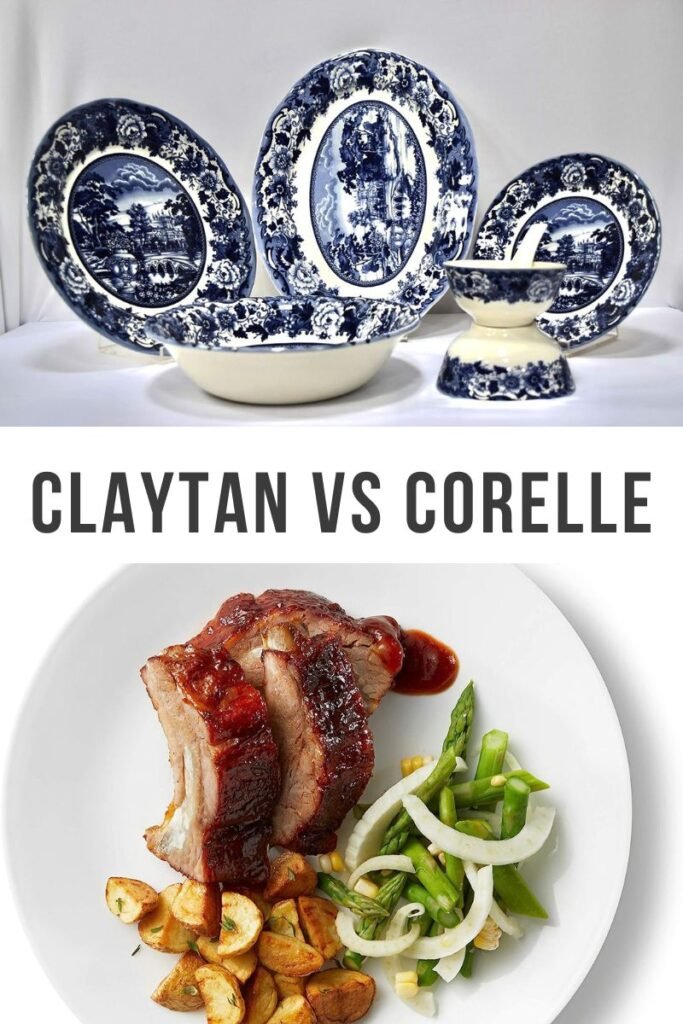
Claytan produces ornate, decorative ceramic patterns suited to the Southeast Asian preference for richly detailed tableware collections like Serenity Blue, Vintage Garden Rose, Lagny, and the Dr. Arabica coffee series.
Its designs draw on both traditional ceramic heritage and contemporary artisan aesthetics. The thick-walled ceramic body and glazed surface produce a warm, tactile quality that glass cannot replicate.
Corelle’s pattern range has expanded significantly in the 2020s from traditional border designs toward contemporary full-surface speckle and illustrated botanical patterns.
Its range is broader in total catalog size and includes both plain white (Winter Frost White) and decorated options from traditional to modern. For a full guide to current Corelle patterns, see our article on the newest Corelle patterns.
Global Availability
Corelle is available through mainstream retailers worldwide, Amazon, Walmart, major Southeast Asian e-commerce platforms, and direct from corelle.com. Finding replacement pieces for any current pattern is straightforward through retail channels.
Claytan exports to over 35 countries but remains primarily a Southeast Asian brand at the retail level. Within Malaysia, it is widely available directly from its factory stores, online through claytantableware.com, and through Malaysian retailers.
Outside of Southeast Asia, it is less commonly stocked at mainstream retailers, though its OEM relationships with international brands mean Claytan-manufactured products sometimes appear under different brand names in Western markets.
Price Comparison
Both brands occupy accessible mid-market price positions for everyday dinnerware.
In Malaysian and Southeast Asian markets, Claytan and Corelle are directly competitive on price — a 12-piece Claytan set, and an equivalent Corelle set typically fall in a similar price band, with Corelle often carrying a slight premium as an imported product.
In Western markets, Corelle is priced as an accessible everyday brand; Claytan, when available, is positioned as a premium import ceramic.
Feature Comparison Table
| Factor | Claytan | Corelle |
|---|---|---|
| Material | Ceramic (earthenware, stoneware, fine china) | Vitrelle laminated glass (three-layer) |
| Maximum oven temperature | 300°C (572°F) | 177°C (350°F) |
| Broiler safe | No | No |
| Stovetop safe | No | No |
| Microwave safe | Yes (no metallic trim) | Yes (no metallic trim) |
| Dishwasher safe | Yes | Yes |
| Freezer safe | Yes | Yes |
| Weight | Heavier (ceramic) | Lighter (glass) |
| Chip resistance | Good (stoneware) / Moderate (earthenware) | Very good (laminated glass construction) |
| Breakage pattern | Chip or clean break | Can fragment into sharp shards |
| Lead safety | FDA and Prop 65 certified; only lead-safe ceramic producer in its Asian region | FDA and Prop 65 certified (post-2005 collections) |
| Non-porous | Stoneware: yes; Earthenware: requires glaze | Yes (glass throughout) |
| Manufacturing origin | Malaysia | USA (Vitrelle glass); China (mugs/accessories) |
| Warranty | Not formally specified | 3-year limited warranty |
| Global availability | Strong in Southeast Asia; growing internationally | Wide global retail distribution |
| Best aesthetic | Ornate, decorative, artisanal ceramic | Contemporary, minimalist, glass-based |
Which Brand Is Right for You
Choose Claytan if:
- You use your everyday dinnerware in the oven for high-temperature cooking — roasting, baking above 177°C, or casseroles at full cooking temperature; Claytan’s 300°C rating covers these tasks, and Corelle’s does not
- You prefer the substantial, tactile feel of ceramic in the hand and associate it with quality
- You want a Malaysian-made product with documented domestic manufacturing and regional lead-safe certification
- You are buying for a Southeast Asian household where ceramic design aesthetics and heavier weight are the expected norm
- You are equipping a hotel, café, or commercial kitchen — Claytan specifically produces vitrified hotelware for commercial use
Choose Corelle if:
- You want the lightest possible everyday plates — Vitrelle glass is meaningfully lighter than ceramic at every equivalent size
- You primarily reheat in the microwave and use the oven only for gentle warming at or below 177°C
- You want the strongest documented chip resistance — Corelle’s three-layer laminate outperforms ceramic on this specific property
- You want a formal three-year breakage warranty from the manufacturer
- You need globally available replacement pieces for your specific set
- You want a non-porous material throughout the plate body, not just at the glazed surface
Neither is the right choice if:
- You need truly shatterproof dinnerware for toddlers or elderly adults with frequent drops for these situations, wheat straw or melamine eliminates the shard and chip risk. See our guide on unbreakable dishes like Corelle for the full comparison.
For buyers in Malaysia and Singapore, comparing these two brands in a retail context, the oven temperature difference is the single most useful filter.
If you cook in your dishes regularly at temperatures above 177°C — and most Southeast Asian cooking involves wok-adjacent high heat or oven roasting at full temperature Claytan’s ceramic rating is the practical choice. I
f you cook in pots and serve on plates, both brands perform comparably for their primary purpose.
Frequently Asked Questions
Is Claytan better than Corelle?
Neither brand is objectively better; they are better at different things. Claytan’s ceramic outperforms Corelle on oven temperature capability (300°C vs 177°C), heat retention at the table, and suitability for high-temperature cooking tasks.
Corelle outperforms Claytan on weight, chip resistance, glass-body non-porosity, and global availability for replacement pieces. The correct choice depends on how you actually use your dishes.
Does Claytan have the same chip resistance as Corelle?
Corelle’s three-layer Vitrelle laminate gives it a structural edge in chip resistance. The engineered compression of the outer layers specifically resists rim-edge chipping, which is the most common everyday damage mode.
Claytan stoneware has good chip resistance for a ceramic material, significantly better than earthenware.
The practical trade-off is breakage pattern: chipped Claytan ceramic stays in place at the chip location; Corelle Vitrelle glass, when it breaks under impact, can fragment into sharp, scattered shards rather than a contained chip.
Can I mix Claytan and Corelle dishes at the table?
Technically, yes, but visual consistency is difficult to achieve.
Both brands produce predominantly white or white-based dinnerware, but the warmth, thickness, and surface texture of Claytan ceramic read differently from the thinner, brighter, glassier surface of Corelle Vitrelle; they do not look like the same material at the table.
For a cohesive table setting, using one brand throughout is the more consistent approach.
About the Author & Reviewer
Sarah Emirone, Author
Sarah researches and writes SafeKitchn’s dinnerware and kitchenware guides, with a focus on material safety, lead content, and manufacturer specifications. She cross-references product data sheets, safety certifications, and regulatory filings (including FDA and Prop 65 records) before publishing, and updates articles when new information becomes available.
James Daniels, Reviewer
James reviews SafeKitchn’s material safety content for scientific accuracy. He holds a B.Sc in inorganic chemistry and works as a materials researcher, with particular focus on the composition and safety behavior of glass, ceramic, and metal used in kitchenware.