

You’ve heard that Corelle is nearly indestructible; maybe that’s even why you bought it. But then it shattered on your kitchen floor, and suddenly you’re questioning everything. If it’s so tough, why are there pieces everywhere?
Calling Corelle “shatterproof” is the kind of claim that sounds reassuring until it isn’t, and understanding the difference between shatter-resistant and shatterproof changes everything.
This post digs into this question: Is Corelle Shatterproof? We will also provide answers to what exactly Corelle’s three-layer Vitrelle glass construction can and can’t withstand, which conditions trigger breakage, and what “break-resistant” actually means in real-world kitchen use, not just lab testing.
The real problem isn’t that Corelle is fragile; it’s that most people are unknowingly creating the exact conditions that guarantee it will break.
Written by Sarah Emirone | Reviewed by James Daniels, B.Sc, Inorganic Chemist & Materials Researcher | Updated September 2026 | See How We Test | Filed under: Buying, Care & Product Guides
What Corelle Actually Claims — and What It Does Not
The distinction between what Corelle claims and what buyers assume it claims is the root of most disappointment and some genuine safety incidents.
What Corelle Claims
Corelle’s official marketing and product documentation consistently use these terms:
- Break-resistant — the most frequently used durability claim
- Chip-resistant — a specific structural claim about edge integrity
- Scratch-resistant — a surface claim about the Vitrelle glass coating
- Dramatically stronger than standard glass — a comparative claim against single-layer glass
- Triple-layer Vitrelle glass technology — a construction description
None of these terms means shatterproof. Break-resistant means the material resists breaking under typical everyday stresses, such as normal handling, moderate impacts, and standard stacking. It does not mean the material cannot break.
Chip-resistant means the edge geometry and laminated structure make edge chips less likely than in standard ceramic. It does not mean chips are impossible.
Is Corelle Shatterproof? What Corelle Does Not Claim
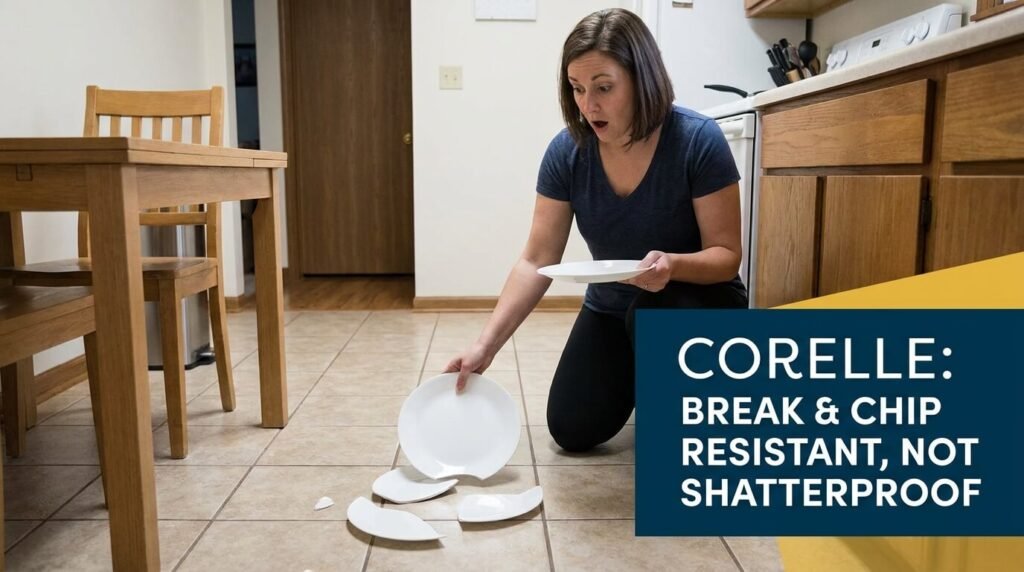
Corelle isn’t shatterproof, although vitrelle glass material is known for its strength and durability; all glass is breakable, according to Corelle.
Its three-year warranty against breakage explicitly excludes accidental breakage — a warranty structure that makes no sense for a product claiming shatterproof status. If Corelle were genuinely shatterproof, accidental breakage would not exist as a category needing exclusion from the warranty.
Secondly, Corelle has never used the word “shatterproof” in its official product documentation. The word appears in buyer descriptions, review titles, and secondhand marketing copy but not in Corelle’s own product claims.
This is a meaningful legal and accuracy distinction that every buyer should understand before purchase.
How Vitrelle Glass Is Engineered — and Why It Breaks the Way It Does
Understanding Corelle’s breakage pattern requires understanding what the Vitrelle engineering achieves and what stresses it is not designed to resist.
The Three-Layer Laminate Structure
Vitrelle is a proprietary three-layer laminated glass. Two outer skin layers of glass are held in compression, a state of inward stress.
A central core layer is held in tension, a state of outward stress. These three layers are thermally bonded at temperatures above 1,000°F into a single fused structure. The engineered stress distribution between the layers is what gives Vitrelle its performance characteristics.

- 8 PLATES: This set includes (8) 10-1/2-inch plates. These versatile plates are a household essential and work perfectly …
- VITRELLE EXCLUSIVE: Using up to 80% recycled, pure glass, Corelle’s triple layer glass technology provides extra strengt…
- LOW MAINTENANCE: This dinnerware set is designed to provide the best dining experience while requiring low maintenance. …


- Complete 6-Piece Set – Includes 6 lunch plates for everyday meals, replacements, and casual hosting. Crisp, bright, and …
- 5X More Durable Than Stoneware – Triple-layer Vitrelle glass resists chips and cracks so you don’t replace dishes every …
- Easy to Carry and Stack – Lightweight design is comfortable to handle and stores in half the cabinet space of stoneware
The compressed outer layers resist fracture initiation from everyday impacts, such as a scratch on the surface, a rim knock against a faucet, or the mild impact of stacking plates.
This is why Corelle outperforms standard ceramic on chip resistance: the compressive stress in the outer layer actively resists the opening of surface cracks that would lead to chipping.
The same principle is used in safety glass in automobile windshields and tempered glass used in phone screens.
Why the Engineering Creates a Specific Failure Mode
The laminate structure that makes Corelle chip-resistant also creates its characteristic failure mode when it does break.
When an impact or thermal stress exceeds the material’s tolerance, the stored energy in the compressed and tensioned layers is released rapidly.
Because all three layers are bonded into a single structure, the failure propagates through the entire piece almost instantaneously, not as a localized crack spreading slowly from an impact point, as in ceramic, but as a rapid total disintegration of the plate or bowl into many small fragments.
This is the same mechanism that causes tempered glass phone screens to “spider web” completely across the entire surface when they fail at a crack initiation point; the energy stored in the tempered structure is released through the whole piece.
In Corelle’s case, the pieces produced are small, sharp glass fragments rather than the two or three large pieces that ceramic typically produces on breaking.
Consumer injury reports document this pattern consistently: a Corelle bowl dropped on tile produces an “explosion” of tiny shards that scatter across the kitchen, embed in nearby surfaces, and require careful, systematic cleanup to ensure all fragments are recovered.
A ceramic bowl dropped in the same way typically breaks into three to five large pieces that are immediately visible and easily collected.
When and Why Corelle Breaks: The Real Causes
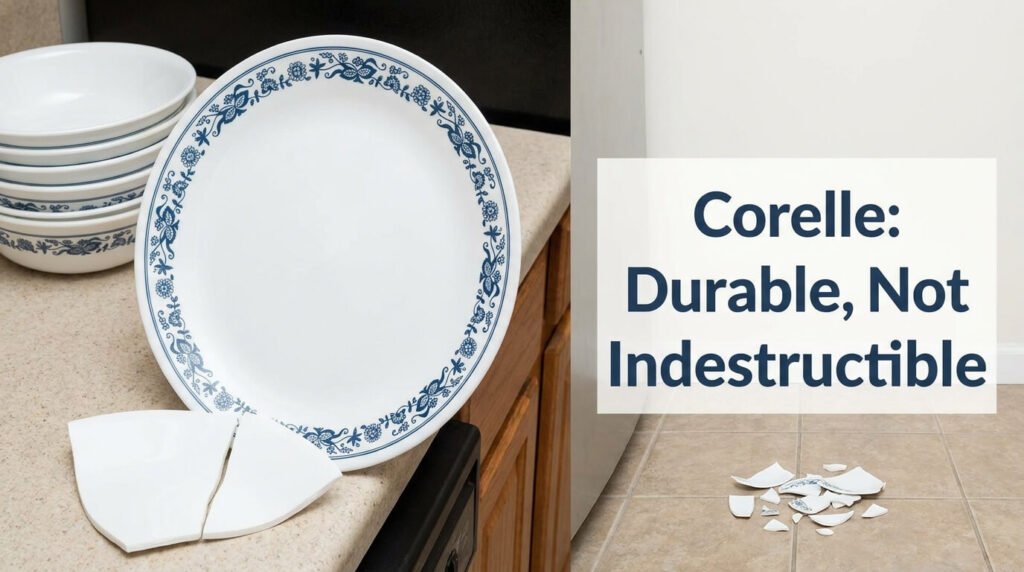
Corelle breaks for specific, identifiable reasons. Most unexpected breakage falls into one of four categories, and understanding them will help you avoid the situations most likely to cause failure.
Impact on Hard Surfaces
The most common cause of Corelle breakage is impact with hard flooring, particularly tile, stone, or concrete.
Corelle’s laminate structure is engineered to resist the moderate impacts of daily use: setting a plate on a counter, stacking dishes, and a gentle bump against the sink.
It is not designed to survive a direct drop onto tile from counter height with an edge-first impact. This is not a product defect; it is the physical limit of what the engineering addresses.
Any glass object will break under sufficient impact force. What matters for buyers is whether Corelle’s break-resistance threshold covers the impacts most likely to occur in their specific household.
Thermal Shock
Thermal shock, a rapid and steep temperature change, creates stress in the Vitrelle laminate that can exceed its tolerance and trigger failure.
The specific scenarios Corelle’s documentation identifies as thermal shock risks include: moving a dish directly from the freezer to a preheated oven, placing a hot dish on a cold, wet countertop, and adding cold liquid to a hot dish.
A Corelle dish does not need to be dropped to break; thermal shock alone can cause failure, and the breakage pattern is the same catastrophic fragmentation as impact failure.
For the complete guide to oven and thermal transition rules, see our article on whether Corelle dinnerware is oven safe.
Age and Dishwasher Detergent Damage
This is the cause of unexpected Corelle breakage that most users fail to see, and it is the one that explains reports of dishes breaking “spontaneously” without any obvious impact or thermal event.
Corelle states explicitly: “We have recently learned that abrasive automatic dishwasher detergents can cause damage to Corelle Dinnerware and cause the dinnerware to become weak. Over time, the dinnerware may become rough or chipped along the edges.”
World Kitchen, the previous Corelle owner, confirmed the same finding and recommended a less abrasive detergent. The Corning Museum of Glass has documented this mechanism: repeated exposure to abrasive dishwasher detergents gradually degrades the surface of the compressed outer glass layer, roughening and weakening the very surface that provides Vitrelle’s structural resistance.
Once the surface compression layer is degraded through micro-abrasion from detergent, from edge chips, or from accumulated microscopic damage, the engineered stress balance within the laminate is disrupted.
A dish that has been damaged in this way may have retained its visual appearance while losing the structural integrity that makes Corelle’s laminate engineering effective.
At this point, a stress level the dish would have survived when new — a moderate impact, a thermal transition — can trigger complete failure.
The practical implication
Corelle dishes that have been washed in automatic dishwashers with harsh detergents for 10–15 or more years carry a meaningfully higher breakage risk than new dishes, even if they appear undamaged.
Any Corelle dish with visible edge roughness, cloudiness, or surface dullness that does not respond to cleaning should be retired from use. The dish may look intact while being structurally compromised.
Pre-Existing Chips and Cracks
A chip in a Corelle plate is not a cosmetic issue; it is a structural failure point that changes the physics of the entire dish.
Even a small chip at the rim breaks the surface compression seal at that location, disrupting the engineered stress distribution that the laminate relies on.
From a chip, internal stress concentrates at the damage point and dramatically lowers the threshold for complete failure. The same applies to hairline cracks.
Corelle’s own guidelines state clearly: if items crack or break, stop use immediately and use care when picking up sharp pieces to avoid cuts.
This guidance applies to any level of damage; a hairline crack visible on close inspection should be treated as a discard-and-replace signal, not a continue-and-monitor situation.
The Shard Pattern: What Happens When Corelle Breaks
The specific breakage pattern of Vitrelle glass is the most practically important safety fact about Corelle and the one most frequently absent from buying guides that recommend it as “virtually unbreakable.”
When a Corelle plate or bowl breaks, it typically produces many small, sharp glass fragments rather than a few large pieces.
Consumer accounts describe shards embedded in nearby surfaces, countertops, cabinet faces, walls, and in clothing and skin. The fragments are fine enough to be difficult to see on light-colored flooring. They scatter over a wide radius from the impact point.
This breakage pattern has two practical consequences:
First, cleanup after Corelle breakage is more demanding and more dangerous than cleanup after ceramic breakage. Large ceramic pieces are visible and easy to collect.
Fine glass shards require systematic cleanup sweeping followed by damp paper towel pressing, bright side-lighting to catch glass reflections, and inspection of nearby food and surfaces before eating anything that may have been in the scatter zone.
Second, the shard pattern creates a specific risk for young children and elderly adults.
Toddlers and young children on the floor are at eye level with fine glass shards. Elderly adults with limited vision may not see fine fragments during cleanup.
For these specific household situations, the breakage pattern of Corelle is a more serious concern than for households of healthy adults.
Corelle does not attempt to hide this property. Its warranty excludes accidental breakage because it knows breakage occurs.
What Corelle Is Genuinely Good At
The preceding sections are not an argument against Corelle; they are context that makes an honest evaluation possible. Corelle Vitrelle glass is genuinely excellent at a specific performance profile that no competing material matches at its price point.
- Chip resistance is real and impressive. The compressed outer layers make Corelle meaningfully more resistant to rim chipping than ceramic, stoneware, or standard glass. Households that have used Corelle for 15–20 years without a single chip are reporting a real experience, not an anomaly.
- Weight advantage is significant. Vitrelle is approximately half the weight of an equivalent-size ceramic. For daily handling, washing up, and storage, this matters practically — particularly for elderly users and households where children help with table duties.
- Non-porous throughout. Unlike glazed ceramic, where a chip exposes absorbent clay, a Vitrelle chip exposes more non-porous glass. The hygiene properties of the material are not contingent on glaze integrity.
- Microwave, oven (to 350°F), dishwasher, and freezer safe. The versatility of Vitrelle glass across cooking scenarios is unmatched at its price tier. No single alternative material covers all four. For more on Corelle’s freezer safety, see our guide on whether Corelle dinnerware is freezer safe.
- Long service life under normal use. Consumer reports of 15–20 years of chip-free daily use are not outliers — they are the typical experience for households that do not drop dishes on hard floors or run them through aggressive dishwasher cycles.
Genuinely Shatterproof Alternatives — and When You Need Them
If the shard fragmentation pattern of Vitrelle glass is specifically the concern because you have toddlers on the floor, elderly adults with limited grip, or an outdoor dining environment where breakage cleanup is impractical, there are genuinely shatterproof options that address this.
Wheat Straw Fiber
Wheat straw fiber dinnerware (combined with food-grade polypropylene) is fully shatterproof: it will not break, chip, or fragment on impact, regardless of drop height.
It is BPA-free, microwave safe (to approximately 248°F), dishwasher safe, and available in full sets at prices comparable to Corelle.
Its limitations are a shorter service life (surface degradation typically begins within 2–4 years of intensive daily use) and lower oven temperature tolerance than Corelle.
For households with toddlers, it is the strongest alternative to Corelle’s glass.
Melamine
Melamine is shatterproof and will not fragment on impact. It is available in a wide range of designs at very low prices. Its critical limitation is microwave safety: melamine should never be used in the microwave, as it leaches chemicals above 160°F regardless of manufacturer labeling.
This makes it unsuitable for households where the microwave is the primary reheating method. For outdoor dining and picnic use where microwaving is not a factor, melamine is the most affordable shatterproof option.
Stainless Steel
Stainless steel is the most durable option in any drop scenario. It will dent but will not crack, chip, or fragment. It is fully non-porous, non-reactive, and safe for any food temperature.
Its limitations are weight (heavier than Corelle), heat conductivity (plates become hot when used with hot food), and microwave incompatibility.
For camping, outdoor use, and institutional settings, stainless steel is the correct choice when shatterproof performance is the primary requirement.
Material Comparison for Households That Need Shatterproof
| Factor | Corelle Vitrelle | Wheat Straw | Melamine | Stainless Steel |
|---|---|---|---|---|
| Shatterproof | No (fragments on failure) | Yes | Yes | Yes (dents) |
| Microwave safe | Yes | Yes (to 248°F) | No | No |
| Oven safe | Yes (to 350°F) | No | No | No |
| Dishwasher safe | Yes | Yes | Yes (top rack) | Yes |
| Weight | Light | Very light | Medium | Heavy |
| Lifespan | 15–20+ years | 2–4 years | 3–7 years | 20+ years |
| Fragmentation on break | Yes — fine, sharp shards | No | No | No |
| Best for | Adults, indoor daily use | Toddlers, kids | Outdoor, picnic | Camping, outdoor |
For a full guide to choosing between these materials based on your household situation, see our guide on unbreakable dishes like Corelle.
The Warranty Structure Tells You Everything
The structure of Corelle’s three-year warranty is the clearest signal of what the brand understands about its own product’s durability. The warranty covers breakage, chipping, and staining under normal household use — but explicitly excludes accidental breakage.
A genuinely shatterproof product would not need to exclude accidental breakage from its warranty. The exclusion exists because Corelle knows accidental breakage occurs and is not a manufacturing defect; it is the expected outcome of dropping a glass object on a hard surface.
The warranty instead covers the scenario where a dish breaks without user error: under normal handling, without being dropped or thermally shocked, within the first three years.
This is a meaningful warranty that protects against manufacturing defects and premature glass failure. It is not a guarantee that the dish will survive being dropped.
Understanding this distinction prevents the frustration of buyers who expected a shatterproof product and received a break-resistant one — and it gives credit to Corelle for what its warranty actually delivers, which is genuine protection against premature failure in normal use.
If you are deciding between Corelle and a genuinely shatterproof alternative for your specific household, the most useful question is: what is the most likely breakage scenario in your home?
For households where drops on hard floors are the primary risk, toddlers and elderly adults with limited grip, a shatterproof material eliminates the risk that Corelle cannot.
For households where the main risk is everyday chipping from normal use, Corelle’s chip-resistance advantage is the property that matters most.
About the Author & Reviewer
Sarah Emirone, Author
Sarah researches and writes SafeKitchn’s dinnerware and kitchenware guides, with a focus on material safety, lead content, and manufacturer specifications. She cross-references product data sheets, safety certifications, and regulatory filings (including FDA and Prop 65 records) before publishing, and updates articles when new information becomes available.
James Daniels, Reviewer
James reviews SafeKitchn’s material safety content for scientific accuracy. He holds a B.Sc in inorganic chemistry and works as a materials researcher, with particular focus on the composition and safety behavior of glass, ceramic, and metal used in kitchenware.