

You love your Corelle dishes, lightweight, nearly unbreakable, and perfect for everyday meals. But the moment you want to prep ahead and slide that dish straight into the freezer, doubt creeps in. What if it cracks? What if I ruin it?
Googling “is Corelle dinnerware freezer safe” only gives you contradicting answers. Here’s what the actual specs and real-world use say.
This post breaks down exactly which Corelle collections handle freezer temperatures, what precautions matter, the transition rules for every reheating scenario, which Corelle pieces have different freezer considerations, and where the real risk lies, so you stop guessing and start using your dishes confidently.
The truth is, most Corelle damage isn’t from the cold; it’s from the transition.
Written by Sarah Emirone | Reviewed by James Daniels, B.Sc, Inorganic Chemist & Materials Researcher | Updated September 2026 | See How We Test | Filed under: Buying, Care & Product Guides
Is Corelle Dinnerware Freezer Safe?
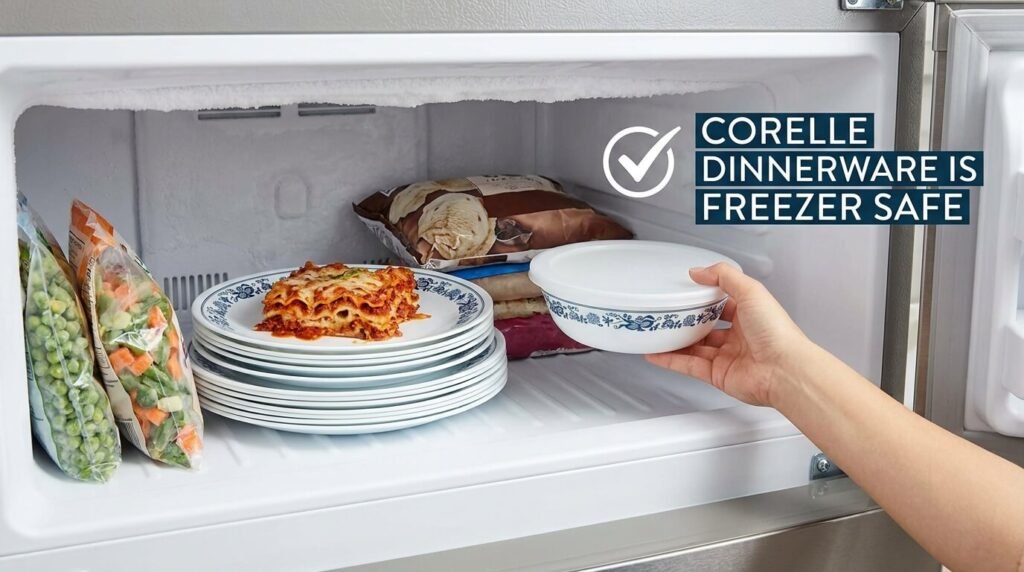
Yes, Corelle dinnerware is freezer safe. Corelle Vitrelle glass plates and bowls can go in the freezer, and so can Corelle MilkGlass and Corelle Stoneware pieces.
This is confirmed in Corelle’s official use-and-care documentation and directly by Instant Brands, Corelle’s parent company, in product Q&A responses.
What Corelle’s Official Documentation Actually Says About Freezer Use: Corelle’s use-and-care documentation, published across its regional websites, including Corelle Asia Pacific, states the following about freezer use: “CORELLE can be used in refrigerator or freezer as well as in microwave oven. For use in a freezer, please use with caution as liquid expansion may cause possible pressure for the glass to break.”
That second sentence is the one most corelle users don’t pay attention to.
The freezer safe rating is real, but it comes with a documented, manufacturer-stated caution about liquid expansion. Water and liquid-based foods expand as they freeze, increasing the internal pressure on any container they are stored in.
For most freezer-safe containers, this is managed by leaving adequate headspace. For Corelle glass, the same principle applies: storing liquid-heavy foods in a Corelle dish in the freezer without sufficient headspace creates internal pressure that can stress the Vitrelle glass structure.
This does not mean Corelle is unsafe for freezer use. It means Corelle is safe for freezer use when used correctly, and “correctly” includes leaving headspace when storing liquids, soups, stews, or any food with significant liquid content.
The full practical guidance drawn from Corelle’s official sources breaks down as follows:
- Corelle Vitrelle glass plates and bowls: Freezer safe ✅
- Corelle MilkGlass dinnerware: Freezer safe ✅ (confirmed by Instant Brands directly)
- Corelle Stoneware dinnerware: Freezer safe ✅
- Corelle BPA-free plastic lids: Freezer safe ✅ (top-rack dishwasher, freezer, and microwave safe)
- Corelle porcelain and stoneware mugs: Check individual piece; stoneware mugs are generally freezer safe — verify on the base of the specific piece
The Liquid Expansion Risk: The Warning Competitors Skip
The liquid expansion issue deserves its own explanation because it is the most practically relevant freezer risk for Corelle dishes that guide and because understanding it changes how you use your dishes.
When water-based liquids freeze, they expand in volume by approximately 9%. In a container filled to the brim, this expansion has nowhere to go the pressure is absorbed by the container walls.


For flexible containers (plastic bags, certain plastic tubs), the walls flex to accommodate the expansion. For rigid glass, the walls cannot flex, so the pressure either fractures the glass or, if the glass holds, stresses the material in ways that may compromise its integrity for subsequent use.
Vitrelle glass is a three-layer laminated structure engineered for impact resistance and thermal stability. It handles cold temperatures well.
What it is not engineered to resist is significant internal pressure from liquid expansion. The risk is specific to liquids and high-liquid-content foods: soups, stews, curries, sauces, marinades, and fruit compotes. Solid foods, leftovers like rice, pasta, cooked vegetables, and meat do not expand on freezing and do not create this pressure risk.
The practical rule
When storing any liquid or high-liquid-content food in a Corelle dish in the freezer, leave at least one inch of headspace, ideally more for soups and broths.
Cover the dish with a compatible lid, plastic wrap, or a freezer bag laid flat across the top. Do not fill a Corelle bowl to the rim with soup and then freeze it, expecting the dish to handle the full expansion pressure.
This is not unique to Corelle; it is good practice for any rigid container used in the freezer. But because Corelle is marketed as durable and chip-resistant, buyers sometimes assume those properties extend to all forms of stress.
Liquid expansion pressure is a different stress type from the impact and thermal stress that Vitrelle’s engineering specifically addresses.
Freezer Transition Rules: What You Can and Cannot Do After Freezing
The freezer itself is safe for Corelle. The transition out of the freezer is where most problems occur, specifically, what you do with a frozen Corelle dish in the minutes after you remove it from the freezer.
From Freezer to Microwave: Safe With One Caveat
Moving a Corelle dish from the freezer to the microwave is safe, provided you do not apply maximum microwave power immediately to a fully frozen dish.
The concern is the same thermal shock principle that governs oven use: when a frozen glass object is suddenly exposed to intense, uneven heat, different areas of the glass heat at different rates, and the differential expansion creates internal stress.
In practice, this means:
- Defrost mode first: Use the microwave’s defrost setting to bring the food from frozen to thawed before applying full reheating power. Defrost mode cycles the microwave at reduced power, allowing the dish and food to warm gradually and evenly.
- Do not microwave at full power from frozen: Starting a microwave at full power on a frozen Corelle dish creates the most rapid possible temperature differential — exactly the thermal shock condition to avoid.
- Allow 2–3 minutes at room temperature first if possible: Even a brief room temperature rest before microwaving gives the dish a head start toward a more even temperature, reducing the intensity of the thermal transition.
Corelle’s official documentation confirms that Corelle can be used in the microwave after freezer storage. The caveat is gradual reheating rather than full-power immediate heating from a fully frozen state.
From Freezer to Oven: Never Directly
This is the most critical freezer transition rule and the one most likely to result in a broken dish if ignored. Never transfer a Corelle dish directly from the freezer to a preheated oven.
This is explicitly stated in multiple sources of Corelle guidance and represents one of the highest-risk thermal shock scenarios for Vitrelle glass.
The temperature differential between a household freezer (typically 0°F / -18°C) and a preheated oven at even the minimum useful cooking temperature (300°F / 149°C) is approximately 300°F (167°C) — more than enough to induce thermal shock in Vitrelle glass.
When different parts of the dish heat at vastly different rates, the engineered stress distribution within the three-layer laminate is overwhelmed by the thermally induced stress, and the dish fails.
The correct procedure when you want to reheat frozen food from a Corelle dish in the oven:
- Remove the Corelle dish from the freezer.
- Allow it to come to room temperature — approximately 30 to 45 minutes for a typical plate or bowl of leftovers.
- Place the room-temperature dish into a fully preheated oven (not a still-heating oven).
- Keep the oven temperature at or below 350°F (177°C), which is Corelle Vitrelle’s maximum rated oven temperature.
Skipping step 2 is the mistake that causes freezer-to-oven breakage. The room temperature rest is not optional; it is the buffer that removes the dangerous temperature differential before the dish enters the oven.
From Freezer to Room Temperature Countertop: Safe
Placing a frozen Corelle dish on a room temperature countertop for thawing is safe, with one rule: avoid placing a frozen dish on a very cold stone or granite countertop, as the cold surface can slow the bottom of the dish from warming while the ambient air warms the sides and top a mild but real thermal gradient.
A dry kitchen towel or trivet under the dish eliminates this concern.
Do not place a frozen Corelle dish on a wet countertop surface. A wet surface can create localized cold spots under the dish and, in some cases, cause the dish to bond slightly to the surface through freezing water, creating a handling hazard when you try to lift it.
After Removing a Hot Dish from the Oven — Before the Freezer
The reverse transition — from oven to freezer — is equally important to handle correctly. Never place a hot Corelle dish directly into the freezer.
The sudden cold exposure from above-oven temperatures creates the same thermal shock risk in reverse. Allow a hot Corelle dish to cool to room temperature on a trivet or dry kitchen towel before placing it in the refrigerator, and to room temperature before the freezer.
Which Corelle Pieces Have Different Freezer Considerations
Not every piece sold under the Corelle brand has the same freezer profile. Understanding the differences prevents incorrect assumptions.
Corelle Vitrelle Glass Plates and Bowls
The core Corelle product, the lightweight plates and bowls made from three-layer Vitrelle glass, is fully freezer safe.
This is the piece most people mean when they say “Corelle dishes,” and the freezer safety rating applies to it without reservation, subject to the liquid expansion headspace rule and transition rules above.
Corelle MilkGlass Dinnerware
MilkGlass is Corelle’s opal-glass product line, positioned as a different visual aesthetic from standard Vitrelle. Instant Brands has directly confirmed that MilkGlass is safe for refrigerators, freezers, microwaves, and dishwashers.
However, MilkGlass is not oven-safe. This is explicitly stated in Corelle’s FAQ: “Although Corelle MilkGlass is safe for use in refrigerators, freezers, microwaves, and dishwashers, it is not for use in any type of oven.”
This is a meaningful distinction for buyers who freeze leftovers intending to reheat them in the oven.
A MilkGlass dish can go into the freezer, but must be transferred to a different oven-safe vessel before oven reheating. The microwave is the correct reheating appliance for frozen MilkGlass dishes.
Corelle Stoneware Dinnerware
Corelle Stoneware is confirmed freezer safe in Corelle’s FAQ: “Our Corelle Stoneware dinnerware can be used in the refrigerator, freezer, microwave, and dishwasher as long as all of the use and care instructions are followed.”
Corelle Stoneware is also oven safe up to 400°F — higher than Vitrelle’s 350°F limit — making it the most versatile Corelle product for freeze-to-oven workflows, again subject to the room temperature rest before oven placement.
Corelle Stoneware and Porcelain Mugs
Corelle mugs are made from stoneware or porcelain, not Vitrelle glass. Stoneware mugs are generally freezer safe, as confirmed in Corelle’s documentation, and are also microwave safe.
The more commonly relevant consideration for mugs is: do not freeze a liquid-filled mug without leaving significant headspace. A mug filled to the brim with soup or broth and then frozen is a liquid expansion pressure risk regardless of the material.
BPA-Free Plastic Lids and Accessories
Corelle’s BPA-free plastic lids, sold as part of sets and as accessories, are explicitly confirmed as freezer safe in product documentation, alongside dishwasher-safe (top rack) and microwave-safe ratings.
These lids can go directly from the freezer to the microwave with the food they cover.
Practical Guide: Using Corelle to Freeze Leftovers
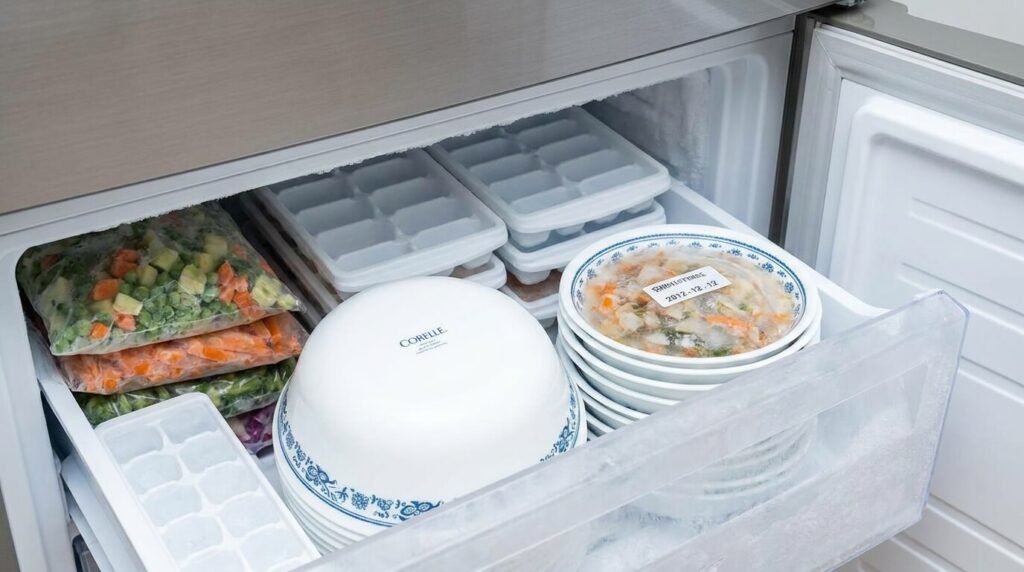
The most common real-world freezer use case for Corelle is storing leftover meals. Here is the complete step-by-step workflow that avoids the failure points covered above.
Step-by-Step: Freezing Leftovers in Corelle
- Cool the food first. Do not place hot food into a Corelle dish and immediately transfer it to the freezer. Allow cooked food to cool to room temperature — approximately 30 to 60 minutes for most dishes — before freezing. This protects both the dish (no thermal shock from hot-to-cold transition) and food safety (rapid temperature drops through the bacterial growth danger zone are better achieved with shallower containers or an ice bath if needed).
- Leave headspace for liquids. For soups, stews, sauces, and any liquid-heavy food, leave at least one inch of space between the food surface and the top of the dish. For drier solid foods — pasta, rice, roasted vegetables, sliced meat — headspace is less critical but still a good practice.
- Cover securely. Use a compatible lid, plastic wrap pressed directly onto the food surface to minimize freezer burn, or a well-fitting freezer bag placed flat over the dish. Label the dish with contents and date.
- Place on a flat freezer surface. Avoid stacking heavy items on top of frozen Corelle until it has fully frozen, and the contents are solid. A partially frozen soup in a Corelle bowl under the weight of other frozen items can shift and create uneven pressure on the dish walls.
- For oven reheating: Remove from the freezer, allow 30 to 45 minutes at room temperature, then place in a fully preheated oven at or below 350°F (Vitrelle) or 400°F (Stoneware).
- For microwave reheating: Remove from the freezer, use the defrost cycle first, then reheat. Do not microwave at full power immediately from frozen.
How Corelle’s Freezer Safety Compares to Other Dinnerware Materials
Understanding where Corelle sits relative to alternatives helps buyers who are evaluating whether to use Corelle specifically for freeze-and-reheat meal prep.
| Material | Freezer Safe | Microwave After Freezer | Oven After Freezer | Notes |
|---|---|---|---|---|
| Corelle Vitrelle glass | ✅ Yes | ✅ Yes (defrost first) | ✅ Yes (thaw to room temp first; max 350°F) | Liquid expansion headspace required |
| Corelle MilkGlass | ✅ Yes | ✅ Yes | ❌ No | Not oven safe under any condition |
| Corelle Stoneware | ✅ Yes | ✅ Yes | ✅ Yes (thaw first; max 400°F) | Most versatile for freeze-reheat workflow |
| Standard ceramic/earthenware | ⚠️ Check label | ⚠️ Check label | ⚠️ Check label | Unglazed bases can absorb moisture and crack |
| Borosilicate glass (Pyrex) | ✅ Yes | ✅ Yes | ✅ Yes (thaw first) | Low thermal expansion coefficient; strong freeze-reheat option |
| Melamine | ✅ Yes | ❌ No | ❌ No | Never microwave or oven; freezer storage only |
| Stainless steel | ✅ Yes | ❌ No | ❌ Not practical | No microwave; good for freezer storage only |
For buyers who specifically want a dish that can go from freezer directly to oven without a thaw period, no glass or ceramic dinnerware, including Corelle, supports this workflow safely.
The room temperature rest before oven use is a requirement across all glass and ceramic materials. If direct freezer-to-oven capability is the priority, dedicated borosilicate glass bakeware from manufacturers who specifically engineer and test for this transition is the better-suited tool.
For a full comparison of Corelle’s capabilities across cooking scenarios, see our article on whether Corelle dinnerware is oven safe.
When in doubt about any specific Corelle piece, check the base of the dish — manufacturer use-and-care markings are the definitive reference for that individual item. The freezer-safe symbol (a snowflake icon) or the explicit text “freezer safe” on the base confirms the rating for that piece specifically, which is more reliable than assuming all Corelle products carry identical ratings.
Frequently Asked Questions
Is it safe to freeze Corelle dishes for long periods?
Yes, there is no documented limit on how long Corelle can remain in the freezer. The material does not degrade in cold temperatures.
The relevant risks, liquid expansion pressure, and thermal shock on removal are present each time the dish is used, not as a function of storage duration. Follow the same precautions for a dish frozen for one day as for one frozen for three months.
Will freezing Corelle cause the patterns to fade?
No. Corelle’s patterns are applied using a fired decoration process that bonds the design to the Vitrelle glass surface.
Freezer temperatures do not affect the pattern adhesion. The same patterns that resist fading through hundreds of dishwasher cycles are unaffected by freezer storage.
Is Corelle Stoneware freezer safe in the same way as Vitrelle glass?
Yes, Corelle Stoneware is confirmed freezer safe in Corelle’s official FAQ. Unlike MilkGlass, Stoneware is also oven safe up to 400°F, which means it supports the full freeze-refrigerate-microwave-oven workflow without the restriction that applies to MilkGlass.
The same headspace and thermal transition rules apply to Stoneware as to Vitrelle glass.
About the Author & Reviewer
Sarah Emirone, Author
Sarah researches and writes SafeKitchn’s dinnerware and kitchenware guides, with a focus on material safety, lead content, and manufacturer specifications. She cross-references product data sheets, safety certifications, and regulatory filings (including FDA and Prop 65 records) before publishing, and updates articles when new information becomes available.
James Daniels, Reviewer
James reviews SafeKitchn’s material safety content for scientific accuracy. He holds a B.Sc in inorganic chemistry and works as a materials researcher, with particular focus on the composition and safety behavior of glass, ceramic, and metal used in kitchenware.