

You’ve seen the term “milk glass” thrown around on Corelle packaging and product descriptions, but nobody seems to explain what it actually means.
You’re not sure if it’s a marketing buzzword, a material, or something that actually affects how your dishes perform. That confusion is frustrating, especially when you’re trying to make an informed buying decision.
Skimming product pages won’t give you a real answer; understanding the actual material science will.
This post breaks down exactly what Corelle milk glass is, how it’s made, what gives it that distinct opaque-white finish, and why those properties make it behave differently from regular glass or ceramic.
Here’s the thing: milk glass isn’t just what Corelle is made of; it’s why Corelle performs the way it does.
Written by Sarah Emirone | Reviewed by James Daniels, B.Sc, Inorganic Chemist & Materials Researcher | Updated September 2026 | See How We Test | Filed under: Buying, Care & Product Guides
The Three Things People Mean by “Corelle Milk Glass” — and Why the Distinction Matters
Before covering the Corelle MilkGlass product line specifically, the terminology needs to be untangled. The phrase “Corelle milk glass” appears in three genuinely different contexts, and conflating them produces wrong answers to purchase and safety questions.
Traditional Antique Milk Glass (Not a Corelle Product)
Milk glass is an old term in glassware history, referring to an opaque white or translucent colored glass produced since the 16th century.
Traditional milk glass was made by adding bone ash, tin oxide, arsenic, or fluorine compounds to glass during production to create its characteristic milky opacity.
The term is associated with decorative Victorian-era glassware vases, compotes, candy dishes, and oil lamp shades that were widely produced in the United States from the 1890s through the 1960s by companies like Westmoreland, Fenton, Anchor Hocking, and Milk Glass by Imperial.
Traditional milk glass is a vintage collectible category. It has no manufacturing relationship to Corelle or to Corelle’s MilkGlass product line.
When antique dealers, estate sale listings, or collector communities mention milk glass, they mean this historical glassware, not Corelle.
When Corelle buyers describe their standard white Vitrelle plates as “milk glass” because of the color similarity, they are using the term descriptively, not accurately.
Standard Corelle Vitrelle Described as “Milk Glass”
The second usage is purely colloquial. Standard Corelle Vitrelle glass — the three-layer laminated glass that has been Corelle’s core material since 1970 — is bright white and slightly translucent. When held up to strong light, you can see a faint shadow of your hand through a thin Vitrelle plate.
This translucent, milky-white quality visually resembles traditional milk glass, which is why many buyers, reviewers, and articles describe Corelle Vitrelle as looking like “milk glass.”
This is a descriptive comparison, not a material fact. Corelle Vitrelle is not milk glass; it is a three-layer laminated borosilicate glass with no bone ash or fluorine milk-glass compounds in its composition.
Calling it milk glass describes how it looks. It does not describe what it is. This colloquial usage is harmless but causes significant confusion when a buyer searches for “Corelle milk glass” expecting to find the decorative appearance of standard white Vitrelle and instead lands on the Corelle MilkGlass product line documentation.
Corelle MilkGlass — The Actual Product Line
Corelle MilkGlass, with a capital M and capital G — formatted as a registered product name in Corelle’s official documentation is a specific collection of dinnerware launched in 2021 as part of Corelle’s Everyday Expressions line.
It is made from a different type of glass than Vitrelle. It is manufactured in China, not the United States, where Vitrelle is produced.
It has higher rims and deeper bowls than standard Vitrelle. And it carries a critically different use restriction: Corelle MilkGlass is not oven safe under any conditions.
Everything that follows in this guide refers to this third context, the actual Corelle MilkGlass product line, unless otherwise specified.
What is Corelle MilkGlass?: The Official Definition
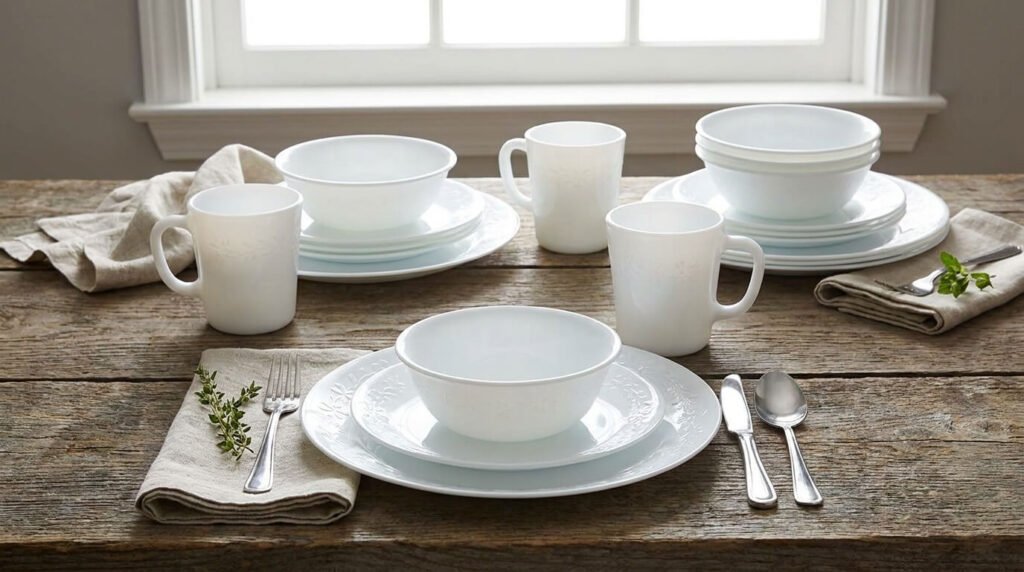
Corelle MilkGlass is made from pure natural glass, different than the traditional Corelle Vitrelle glass dinnerware.
Corelle MilkGlass follows fundamentally different glass compositions with different manufacturing processes.
The three-layer lamination process that makes Vitrelle structurally unique and gives it its chip and break resistance also constrains the shapes that can be formed.
Vitrelle’s lamination requires the glass layers to be pressed and bonded in specific geometric configurations. Higher rim walls and deeper bowl profiles are not achievable with the Vitrelle lamination process at a commercial scale.

- 12-PIECE SET: This service for 4 dinnerware set includes (4) 10.5″ inch dinner plates, (4) 7.5″ inch salad plates and (4…
- ECO-FRIENDLY GLASS: The Corelle MilkGlass dinnerware is made from 2 layers of tempered, opal glass. It is durable and ch…
- DURABLE & SAFE: This dinnerware set is designed to provide the best dining experience while requiring low maintenance. I…
MilkGlass uses a different glass formulation and forming process that allows these shapes to trade the specific structural advantages of Vitrelle’s three-layer engineering for greater design flexibility in form.
Furthermore, Corelle MilkGlass is manufactured in China.
Standard Corelle Vitrelle glass plates and bowls are manufactured at the Corning facility in Oneida, New York, a domestic manufacturing point that Corelle prominently highlights.
MilkGlass is manufactured in China, in a separate production facility from the US-based Vitrelle production. This is confirmed directly in Corelle’s FAQ and is a meaningful distinction for buyers who specifically want USA-made Corelle.
The Higher Rim Design — Why It Exists and What It Changes
The higher rim is the defining physical characteristic of Corelle MilkGlass and the specific feature that drove Corelle’s decision to develop a new glass type for this product line.
Standard Corelle Vitrelle plates use a coupe format with a smooth, relatively low-profile surface and a gentle curve from center to edge.
The Vitrelle lamination process, while producing exceptional structural properties, constrains the depth and height of rim profiles achievable in production. This is not a material weakness; it is a geometry limitation inherent in how laminated glass is formed.
![Winter Frost Serving Bowl [Set of 3] 3](https://m.media-amazon.com/images/I/21DAsEzmX2L._AC_.jpg)

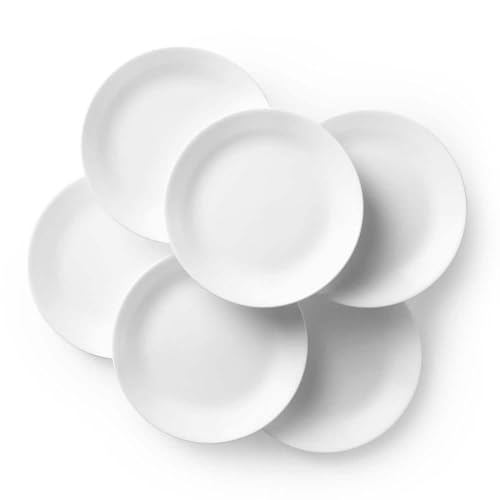
The higher rims in MilkGlass serve a specific contemporary eating behavior. Corelle’s Everyday Expressions marketing explicitly addresses this: “We designed Everyday Expressions for the way we eat today.
The higher rims make these dinner plates ideal for the types of foods we eat now, and for eating meals anywhere around the house.” The phrase “eating anywhere around the house” is the key.
Higher rims prevent food from sliding off the plate when it is held in the lap, balanced on a sofa arm, or eaten away from a flat table surface.
This suits casual eating habits that have become standard in households where meals are consumed in front of screens, during remote work, or in informal settings.

- 4 PIECES: This 4-piece pack includes (2) 12 oz bowls and (2) 46 oz bowls. Perfect for ramen, rice, cereal, pasta, soups,…
- MILKGLASS: Experience the beauty of natural Opal glass this sleek dinnerware set that’s ultra-hygienic, non-porous, and …
- HIGHER RIMS: These deep bowls with high rims are perfect for one-bowl meals, soups, cereal, ice cream, ramen, fruits, an…
Higher-rimmed plates also perform differently than flat-profile plates for specific foods, such as pasta, rice dishes, salads with dressing, and dishes with sauces, where a rim wall containing the food makes the eating experience easier.
Standard Vitrelle’s low coupe profile works well for most dishes but allows liquid-heavy foods to reach the plate edge easily.
What Corelle MilkGlass Can and Cannot Do: The Complete Capability Profile
This is the section that most guides handle inadequately, typically burying the oven safety limitation in a footnote or missing it entirely. Corelle’s own FAQ is explicit. Here is the complete picture:
What Corelle MilkGlass Is Safe For
- Microwave: Yes — MilkGlass is microwave safe, as confirmed in Corelle’s FAQ. This is the primary reheating method for most households, and MilkGlass supports it fully.
- Dishwasher: Yes — MilkGlass is dishwasher safe. Standard dishwasher cycles at household temperatures are within the material’s tolerance.
- Refrigerator: Yes — MilkGlass can be used for food storage in the refrigerator.
- Freezer: Yes — MilkGlass is freezer safe, confirmed in Corelle’s official FAQ. The same liquid expansion precautions apply as with Vitrelle: leave adequate headspace when storing liquid-heavy foods to account for expansion during freezing.
What Corelle MilkGlass Cannot Do
- Oven: MilkGlass is not oven safe under any conditions. Corelle’s FAQ states this without qualification: “Although Corelle® MilkGlass® is safe for use in refrigerators, freezers, microwaves, and dishwashers, it is not for use in any type of oven.” This applies to all oven types — conventional, convection, and toaster ovens. There is no temperature threshold below which MilkGlass becomes oven safe. The material is simply not rated for oven use.
This is the most significant capability difference between MilkGlass and standard Corelle Vitrelle. Vitrelle is oven safe up to 350°F (177°C) in a preheated conventional or convection oven, a rating that covers reheating, warming plates, baking casseroles and egg dishes, and heating frozen meals.
MilkGlass covers none of these oven use cases. For buyers who routinely use their dinnerware in the oven for reheating, serving warm dishes, or baking, this limitation disqualifies MilkGlass from replacing their Vitrelle set.
For a full guide to what standard Corelle Vitrelle can do in the oven, see our article on whether Corelle dinnerware is oven-safe.
How Corelle MilkGlass Compares to Standard Corelle Vitrelle
| Factor | Corelle MilkGlass | Corelle Vitrelle |
|---|---|---|
| Glass type | Different — opal/milk glass type | Vitrelle three-layer laminate |
| Manufacturing country | China | USA (Oneida, NY) |
| Oven safe | No | Yes (up to 350°F / 177°C) |
| Microwave safe | Yes | Yes |
| Dishwasher safe | Yes | Yes |
| Freezer safe | Yes | Yes |
| Rim profile | Higher rims, deeper bowls | Lower coupe profile |
| Shape variation per piece | Some natural variation | Highly consistent |
| Chip resistance | Good (tempered glass) | Very good (laminated three-layer) |
| Weight | Similar — lightweight | Lightest in class |
| Warranty | 1-year limited | 3-year limited |
| Introduced | 2021 (Everyday Expressions line) | 1970 |
| Recyclability | Not household-recyclable | Not household-recyclable |
The warranty difference is notable. Standard Corelle Vitrelle carries a three-year limited warranty against chips, cracks, and breaks under normal household use.
Corelle MilkGlass carries a one-year limited warranty. The shorter warranty period reflects the different glass type and manufacturing process, and it is a signal that buyers should register when comparing value across the two product lines.
The Shape Variation Issue — What Corelle Acknowledges and What It Means
One detail in Corelle’s official FAQ about MilkGlass is worth quoting directly because it appears in no buying guide and surprises buyers who receive their sets:
“Due to the unique manufacturing process used to form this dinnerware, each of your MilkGlass plates and bowls will have some variation regarding size and shape. This variation gives the dinnerware its characteristic fun and stylish design that is perfect for everyday meals and entertaining at home.”
This is Corelle acknowledging that MilkGlass pieces are not dimensionally consistent across a set. The glass forming process for MilkGlass, which allows the higher rims not achievable with Vitrelle’s precision lamination, does not produce the tight dimensional tolerances of the Vitrelle process.
In practical terms, the dinner plates in a MilkGlass set may not be the same size, and the bowls may have slight differences in shape from piece to piece.
Corelle frames this as a design characteristic rather than a quality issue. Consumer reviews on platforms like Walmart include feedback from buyers who found the variation noticeable enough to describe pieces as “warped,” though Corelle’s position is that variation within the manufacturing range is expected and normal for this product type.
If precise dimensional consistency across all pieces in a set is important to you for stacking, for presentation uniformity, or for perfectionist preference, this is a genuine MilkGlass characteristic to factor into the purchase decision.
Standard Vitrelle, by contrast, is produced through a highly controlled precision lamination process with tight dimensional tolerances.
Plates and bowls within a Vitrelle set stack with the snug, near-perfect fit that Corelle describes as a feature; the pieces nest so closely that they can appear warped when they are simply fitting together precisely.
Current MilkGlass Patterns and Collections
Corelle MilkGlass is sold under the Everyday Expressions product line and currently includes a range of named patterns, each with its own design identity. Available patterns include:
- Hearts — the most recognized MilkGlass pattern; embossed heart shapes around the plate rim on white glass, available in 12-piece sets and as a 4-piece bowl set
- Azure Medallion — painted medallions and flourishes in shades of blue; Mediterranean holiday aesthetic
- Rutherford — bold botanical patterns in burnt sienna and cobalt blue; described as bohemian in character
- Geometrica — a modern geometric pattern; contemporary and minimalist
- Medallion (plain) — simple medallion accents for a clean, classic look
All MilkGlass patterns are sold as 12-piece sets (service for 4: 4 dinner plates, 4 salad plates, 4 bowls) and some as individual bowl sets.
Unlike standard Vitrelle, MilkGlass sets do not typically include mugs in the coordinated line; the product focuses on the plate and bowl format, where the higher rim design is the distinguishing feature.
Who Should Choose Corelle MilkGlass — and Who Should Not
The oven limitation is the clearest filter for this decision.
Choose Corelle MilkGlass if:
- You reheat exclusively in the microwave and never use your everyday dinnerware in a conventional oven.
- You eat frequently in informal settings — sofa, lap, away from a flat table — where the higher rim wall containing food is a practical benefit.
- You prefer the higher-rim bowl profile for soups, pasta, rice, and sauced dishes.
- The Hearts embossed design or another MilkGlass pattern specifically appeals to your table aesthetic in a way that standard Vitrelle patterns do not.
- You do not have a specific requirement for USA-made dinnerware.
Choose standard Corelle Vitrelle instead if:
- You use your dinnerware in the oven for any purpose — reheating, warming plates, baking casseroles, heating frozen meals.
- You want the longest available Corelle warranty — three years versus MilkGlass’s one year.
- USA manufacturing origin is a purchasing priority.
- You want the tightest dimensional consistency across pieces in the set.
- You want the widest selection of patterns — Vitrelle’s pattern catalog is significantly larger than MilkGlass’s current range.
For a full comparison of all Corelle product lines and how they compare on durability, see our guide on whether Corelle is shatterproof.
The Manufacturing Origin Question Buyers Ask Most
Corelle Vitrelle glass plates and bowls are manufactured in Oneida, New York — the same Corning facility where the Vitrelle glass technology was developed.
This is genuine USA manufacturing of the core product. MilkGlass is manufactured in China. Corelle Stoneware is also manufactured in China.
The USA manufacturing claims that Corelle highlights in Vitrelle marketing apply specifically to Vitrelle glass, not to the full range of products sold under the Corelle brand name.
For buyers who specifically prioritize domestic US manufacturing for quality assurance, supply chain transparency, or personal preference, understanding this distinction matters.
Choosing “Corelle” without specifying “Corelle Vitrelle” may result in receiving a product made in China, depending on which product line is selected.
For an in-depth look at where different Corelle products are manufactured, see our guide on where Gibson dinnerware is made for a broader comparison of how major dinnerware brands handle manufacturing origin transparency.
If you are shopping for Corelle and see the term MilkGlass on the product page, check two things before purchasing: whether oven use is part of how you use everyday dinnerware, and whether the country of manufacture matters to your purchase decision. Both answers are in Corelle’s own FAQ — they are just not in the marketing copy.
About the Author & Reviewer
Sarah Emirone, Author
Sarah researches and writes SafeKitchn’s dinnerware and kitchenware guides, with a focus on material safety, lead content, and manufacturer specifications. She cross-references product data sheets, safety certifications, and regulatory filings (including FDA and Prop 65 records) before publishing, and updates articles when new information becomes available.
James Daniels, Reviewer
James reviews SafeKitchn’s material safety content for scientific accuracy. He holds a B.Sc in inorganic chemistry and works as a materials researcher, with particular focus on the composition and safety behavior of glass, ceramic, and metal used in kitchenware.