

Microwave weight matters more than most people realize until they are standing in a car park trying to lift one into a hatchback, or drilling into a wall cabinet that may or may not hold 60 pounds above a gas range.
Whether you are moving house, buying a new model, planning an installation, or calculating what it will cost to ship a secondhand unit, knowing what a microwave typically weighs and what affects that figure makes the difference between a plan that works and one that ends badly.
This guide covers how much do microwaves weigh, average weights for every microwave type and size, and a full breakdown by brand.
What makes one model heavier than another, how to work out whether you can carry it safely on your own, and the often-confusing difference between the weight listed on a spec sheet and the weight your courier will charge you for.
Written by Sarah Emirone | Reviewed by James Daniels, B.Sc, Inorganic Chemist & Materials Researcher | Updated September 2026 | See How We Test | Filed under: Buying, Care & Product Guides
Microwave Weights at a Glance
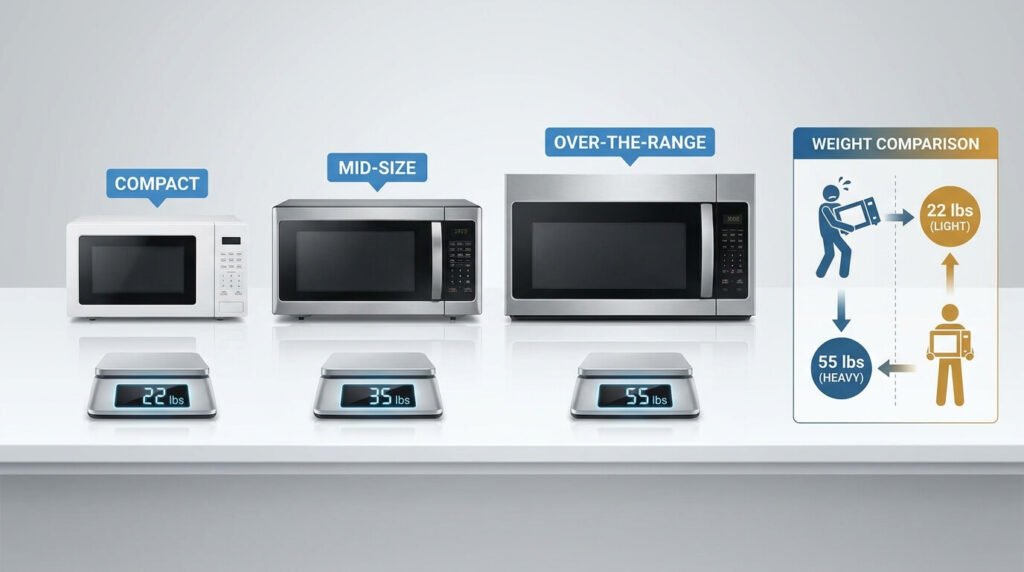
Before diving into detail, here are the average weights for each microwave type in both pounds and kilograms. These figures are based on data compiled across more than fifty models from major manufacturers.
| Microwave type | Average weight | Typical range | Average weight (kg) | Typical range (kg) |
|---|---|---|---|---|
| Compact countertop | 25 lbs | 20–30 lbs | 11 kg | 9–14 kg |
| Mid-size countertop | 35 lbs | 30–45 lbs | 16 kg | 14–20 kg |
| Large countertop | 50 lbs | 45–65 lbs | 23 kg | 20–29 kg |
| Over-the-range | 60 lbs | 50–80 lbs | 27 kg | 23–36 kg |
| Built-in / trim kit | 65 lbs | 40–90 lbs | 29 kg | 18–41 kg |
| Drawer microwave | 75 lbs | 60–90 lbs | 34 kg | 27–41 kg |
| Commercial | 100+ lbs | 80–140+ lbs | 45+ kg | 36–63+ kg |
If you need a quick number for planning purposes, a standard household countertop microwave averages around 32 lbs (14.5 kg). An over-the-range model averages around 60 lbs (27 kg).
See our full microwave buying guide if you are at the research stage and want guidance beyond weight.
How Much Does a Countertop Microwave Weigh?
Countertop microwaves are the lightest and most portable category, built for placement on a surface rather than wall or cabinet mounting.
Their weight varies significantly based on size; a compact dorm model and a large family countertop are both technically countertop microwaves, but can differ by 30 or more pounds.
Small and compact countertop microwaves — 20 to 30 lbs (9–14 kg)
Small countertop microwaves typically have an internal capacity of 0.5 to 0.9 cubic feet and weigh between 20 and 30 pounds.
These are the models most commonly found in dorm rooms, office kitchens, caravans, and small flats where counter space is limited and portability matters.

- Two-step Child Lock Feature: For extra protection and prevent misuse, all microwave oven manufacturers are asked to foll…
- Mute Function: Turn off all the microwave beeps by pressing the sound on/off button for 3 seconds, for a quiet cooking e…
- Easy one-touch express cooking function with 1-6 minutes and +30 seconds functions, and two defrost settings (by weight …
The COMFEE EM720CPL-PMB at 0.7 cubic feet comes in at 20.3 lbs (9.2 kg) — one of the lightest consumer microwaves available.
A standard GE 0.7 cubic foot model weighs approximately 21 lbs, and a comparable Magic Chef compact sits around 23 lbs.
In this weight range, one person can comfortably carry the unit without assistance, and these models are a practical choice for anyone who moves frequently or has limited lifting capacity.
Mid-size countertop microwaves — 30 to 45 lbs (14–20 kg)
Mid-size countertops fall within the 1.0 to 1.4 cubic foot range and are the most commonly purchased household size. Weight in this band runs from 30 to 45 lbs, with most models clustering around 34 to 38 lbs.
A GE 1.4 cubic foot model weighs 34 lbs; a Samsung 1.1 cubic foot unit comes in at around 35 lbs; a Toshiba 1.2 cubic foot model typically runs 34 to 36 lbs.

- Compact Design: With external dimensions of 20.6×14.8×11.8 inches (WxDxH) and internal dimensions of 13.9×14.1×10 inches…
- Versatile Cooking: Featuring 10 unique power levels and 13 preset menus for effortless sensor cook of various dishes, sn…
- User-Friendly Features: Enjoy convenient functions like defrosting frozen food by weight or time, mute mode to silence t…
Within the same nominal size, the finish makes a meaningful difference. A stainless steel exterior adds 5 to 8 lbs compared to a painted plastic equivalent at the same internal capacity.
If weight is a consideration, opting for a plastic-finished mid-size model rather than a full stainless can keep you in an easier-to-handle range.
See our best countertop microwaves roundup for current top-rated models in this category.
Large countertop microwaves — 45 to 65 lbs (20–29 kg)
Large countertop models at 1.6 to 2.2 cubic feet are primarily aimed at families who use the microwave for full-meal cooking rather than just reheating.
Their weight reflects the larger cavity, thicker insulation, and typically more robust feature sets — convection cooking, air fry capability, or inverter technology all add components that increase mass.
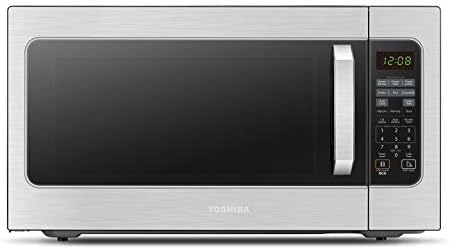
- 2.2 Cu. Ft. Large Capacity: The spacious countertop microwave easily fits a 16″ pizza or a whole chicken, with 1200W out…
- Smart Humidity Sensor: Built-in sensor automatically adjusts cooking power and time. Ensures even heating and seals mois…
- 23 Menus Meet All Your Needs: One-touch presets for your most common needs like pizza, patato, beverage, vegetable. Simp…
A 1.6 to 1.8 cubic foot stainless countertop model from most major brands runs between 40 and 50 lbs; the largest 2.0 to 2.2 cubic foot units reach 55 to 65 lbs.
At this weight, safe single-person lifting becomes a genuine question. See the carrying guidance section below before moving one alone.
How Much Does an Over-the-Range Microwave Weigh?
Over-the-range microwaves are installed above your cooktop in place of a range hood, combining microwave cooking with ventilation.
They are consistently the heaviest consumer microwave category, averaging around 60 lbs (27 kg) with a typical range of 50 to 80 lbs, depending on brand and size.
Even the more compact OTR models rarely drop below 50 lbs because of what is built into them beyond the basic cooking cavity.
Why do over-the-range microwaves weigh so much more
A countertop microwave at a similar internal size will be significantly lighter than its OTR equivalent. The weight difference comes from four main additions:
- Integrated ventilation system. The fan, motor, ductwork interface, and grease filters add 8 to 12 lbs that countertop models simply do not carry.
- Mounting hardware and bracket. The wall mount plate, bolts, and structural reinforcing components built into the chassis add another 5 to 8 lbs.
- Additional insulation. OTR models are positioned above a heat source, which requires heavier thermal insulation on the underside to protect the electronics during cooktop use.
- Larger internal cavity. Most OTR models run at 1.7 to 2.1 cubic feet, which is toward the large end of the consumer range, and larger cavities require more structural material.
Can kitchen cabinets support the weight of an over-the-range microwave?
Most standard kitchen cabinets are engineered to handle the weight of a typical OTR microwave — wall cabinets are generally rated to support between 50 and 75 lbs per linear foot of shelf, and OTR mounting systems distribute the load across the cabinet base and a wall-mounted bracket rather than relying on the cabinet alone.
The wall bracket anchors into wall studs and takes the majority of the load; the cabinet above provides secondary support at the top.
Where problems occur is in older kitchens with cabinets that have weakened over decades, homes where the previous range hood installation was not properly anchored, or cases where the replacement microwave is significantly heavier than what was previously installed.
Before installing any OTR model over 65 lbs, confirm that the mounting wall bracket anchors into at least two studs and inspect the cabinet base for any signs of sagging or water damage.
If in any doubt, have a professional assess the installation; the cost is marginal compared to what happens if the mounting fails. See our over-the-range microwave installation guide for full details.
How Much Does a Built-In Microwave Weigh?
Built-in microwaves are integrated into cabinetry using a trim kit that frames the unit flush with the surrounding panels. They range from 40 to 90 lbs, with most models falling in the 60 to 80 lbs band.
They are typically heavier than comparable countertop models at the same internal size for two reasons: the casing is reinforced to support integration without a countertop surface underneath, and the trim kit itself adds material that is counted in the overall product weight.
Manufacturer-reported weights for built-in models can be misleading because some include the trim kit in the stated weight, and others do not.
The Wolf 1.6 cubic foot built-in microwave is listed at 80 lbs, and the Café 1.7 cubic foot built-in runs 75 lbs, both shipping at closer to 95 to 100 lbs once packaging is included.
Always check whether the published weight is for the microwave unit alone or includes the trim kit, particularly when calculating whether two people are needed for installation.
How much does a drawer microwave weigh?
Drawer microwaves are the heaviest consumer type, typically ranging from 60 to 90 lbs (27 to 41 kg).
The mechanical drawer mechanism, the tracks, rollers, and motor that allow the unit to open downward rather than swinging outward, add significant mass beyond the cooking cavity itself.
A Sharp 1.2 cubic foot drawer microwave weighs 79 lbs; a Bosch equivalent at the same capacity comes in at a lighter 50 lbs due to design differences; a Viking under-counter drawer unit reaches approximately 86 lbs.
Drawer microwaves almost always require professional installation because of their weight and the precision required for proper levelling and alignment in a cabinet cutout.
Microwave Weight by Brand
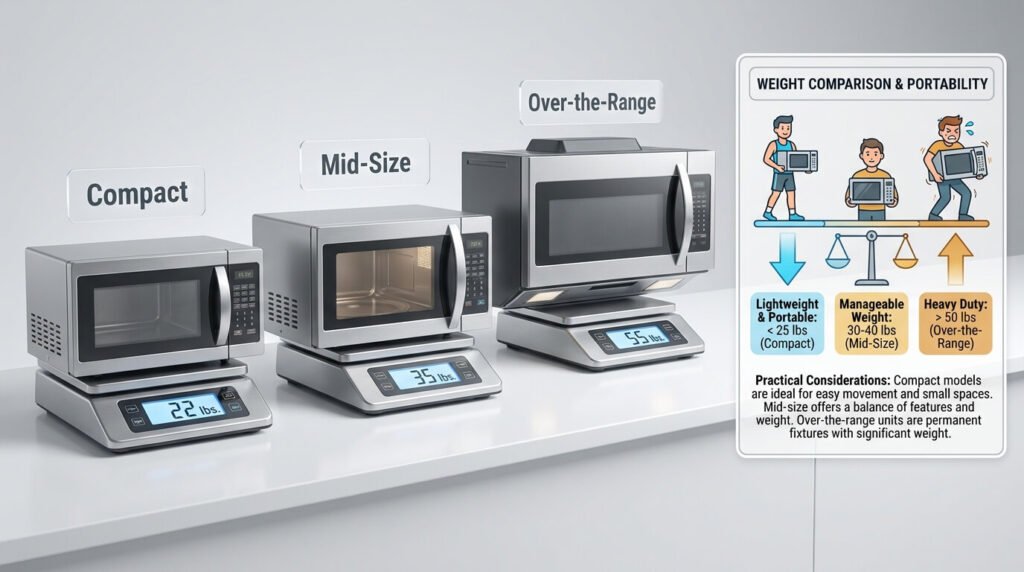
Brand matters because manufacturers make different design choices around materials, insulation thickness, and casing construction, even for products at similar capacities.
The table below covers the six most widely sold brands in the US and UK.
| Brand | Type | Weight range (lbs) | Weight range (kg) | Notes |
|---|---|---|---|---|
| GE | Countertop | 21–38 lbs | 9.5–17 kg | Wide range; compact to large |
| GE | Over-the-range | 51–63 lbs | 23–28.5 kg | Consistent mid-heavy range |
| Samsung | Countertop | 34–44 lbs | 15–20 kg | Larger average size; stainless common |
| Samsung | Over-the-range | 48–62 lbs | 22–28 kg | Slightly lighter than GE OTR |
| LG | Countertop | 25–36 lbs | 11–16 kg | Efficient builds; lighter for size |
| Panasonic | Countertop | 21–40 lbs | 9.5–18 kg | Inverter models trend lighter |
| Whirlpool | Countertop | 37–42 lbs | 17–19 kg | Heavier average; robust builds |
| Whirlpool | Over-the-range | 58–70 lbs | 26–32 kg | Among heavier OTR options |
| Toshiba | Countertop | 23–35 lbs | 10–16 kg | Competitive value; lighter builds |
| Sharp | Drawer | 79 lbs | 36 kg | Heaviest consumer drawer option |
The lightest brands in the countertop category tend to be Panasonic, LG, and Toshiba. Whirlpool and Samsung trend heavier at equivalent capacity due to build choices that favour rigidity and premium finish over portability.
What Makes a Microwave Heavier or Lighter?
Weight does not correlate directly with quality; a heavy microwave is not necessarily better built than a lighter one, and a compact model is not automatically inferior.
Understanding the actual drivers of microwave weight helps you evaluate whether a heavier unit is worth carrying.
Casing material — stainless steel vs plastic
The exterior finish is the most immediately visible weight driver. A full stainless steel exterior, where the steel casing wraps the entire body rather than just the front panel, adds approximately 5 to 10 lbs compared to a painted plastic shell at the same internal capacity.
Many budget and mid-range models use a stainless-look front panel with a plastic body, which delivers the aesthetic at a fraction of the weight premium.
If you want to keep weight down but still want a stainless appearance, look for models described as having a “stainless front” rather than “full stainless” in the specifications.
Capacity and size — a bigger cavity means a heavier unit
The internal cavity is surrounded by a magnetron, insulation, and a structural chassis, all of which scale proportionally with cavity size.
A 0.7 cubic foot microwave and a 1.6 cubic foot microwave are not just different in interior volume; the larger unit requires more of every structural and electronic component.
The weight-per-cubic-foot figure is a useful way to compare models on an even footing: a 35 lb microwave at 1.1 cubic feet works out to approximately 32 lbs per cubic foot; a 60 lb OTR at 1.9 cubic feet is around 32 lbs per cubic foot as well, which suggests comparable build density.
Where that ratio spikes is in drawer microwaves — at over 60 lbs per cubic foot, the mechanical components account for a disproportionate share of the total weight relative to cooking capacity.
Features — convection, inverter, and air fry add weight
Additional cooking technologies require additional physical components. A convection microwave adds a fan, heating element, and associated ducting.
An inverter microwave replaces the standard transformer with an inverter circuit board and capacitor assembly, which is actually slightly lighter than a traditional transformer but still represents added hardware.
An air fry function adds a fan motor and typically requires additional insulation on the interior walls. Realistically, each major feature addition contributes 2 to 5 lbs over an equivalent basic model.
A full-featured 1,200W convection microwave with air fry and sensor cooking will be noticeably heavier than a basic 1,000W unit at the same nominal size.
See our standard microwave wattage guide for more on how wattage and features are connected.
Can One Person Carry a Microwave Safely?
This is the most practically important question for anyone moving house or replacing a unit, and it is one that weight data alone does not fully answer.
The safe carrying threshold depends on both the weight of the microwave and the conditions of the move, such as stairs, distance, surface type, and the carrier’s physical capacity, all of which matter.
The table below provides practical guidance based on weight alone, assuming a fit adult of average strength on a flat surface with a clear path.
| Weight range | Carrying guidance | Equipment recommended |
|---|---|---|
| Under 30 lbs (14 kg) | One person — straightforward | None required |
| 30–45 lbs (14–20 kg) | One person — manageable with care; use proper lifting form | Gloves recommended |
| 45–65 lbs (20–29 kg) | Two people strongly recommended | Furniture straps or moving grips |
| Over 65 lbs (29 kg) | Two people required | Appliance trolley / dolly advised |
For OTR and built-in installations specifically, two people are required regardless of weight because one person needs to hold the unit in position while the other secures the mounting hardware. Weight aside, the geometry of the task makes solo installation unsafe.
Safe lifting tips for moving a heavy microwave
- Clear the path completely before lifting. Open all doors, remove any rugs or obstacles, and confirm the destination surface is clear and stable before you pick the unit up.
- Grip from the bottom, not the sides. Microwave side panels often have no structural purchase points. Position your hands under the base, gripping the edges, and keep the unit close to your body during the carry.
- Lift with your legs, not your back. Bend at the knees, keep your back straight, and stand by extending your legs — not by pulling with your spine. This is especially important above 35 lbs.
- Do not twist while carrying. Turn your whole body, feet first, rather than rotating your torso with the weight in your arms.
- Protect the door. Wrap the door with a folded towel or piece of cardboard secured with tape before moving — the hinge and latch are the most vulnerable points to impact damage during a move.
Microwave Actual Weight vs Shipping Weight — What Is the Difference?
This distinction matters significantly if you are shipping a microwave, selling one online, or using a removal company that charges by weight — yet it is one that almost no guide explains clearly.
Actual (product) weight is the figure listed on the manufacturer’s specification sheet. It is the weight of the microwave itself, with no packaging.
Shipping weight is the actual weight plus all packaging materials — the outer cardboard box, internal cardboard inserts, corner foam blocks, plastic wrapping, instruction manual, and accessories.
For a typical countertop microwave, packaging adds 5 to 15 lbs. A 34 lb countertop microwave will typically ship at 42 to 48 lbs. A 60 lb OTR model commonly ships at 70 to 75 lbs.
Carriers use shipping weight — not product weight — for billing. If you are planning to send a microwave via a courier service, measure the boxed dimensions as well, because carriers use whichever is larger between actual shipping weight and dimensional weight (a calculation based on the box’s volume divided by a standard divisor).
A large but light box can be billed at its dimensional weight rather than its scale weight. For an OTR microwave in a large box, dimensional weight will often exceed actual shipping weight, making the true cost higher than the spec sheet suggests.
When buying a microwave online, the “shipping weight” listed on retail pages like Amazon or Walmart is the boxed weight, useful for delivery logistics but not what the microwave actually weighs on your countertop or in your cabinet.
What Is the Lightest Microwave You Can Buy?
If weight is a priority, whether for a small kitchen, frequent moves, elderly users, or a shelf with limited load capacity, the lightest consumer microwave options currently available are all compact countertop models in the 700W to 900W range.
- COMFEE EM720CPL-PMB — 20.3 lbs (9.2 kg), 0.7 cu ft, 700W. The lightest widely available consumer microwave. Handles basic reheating and simple tasks reliably.
- GE JES1072SHSS — 21 lbs (9.5 kg), 0.7 cu ft, 700 W. A compact GE option with a reputation for consistent reliability at the budget end.
- Magic Chef MCD770W — 23 lbs (10.4 kg), 0.7 cu ft, 700W. A lightweight budget pick suited to low-frequency use in small spaces.
- Panasonic compact series — approximately 21 lbs (9.5 kg) for the 0.8 cubic foot models, benefiting from Panasonic’s inverter-efficient builds.
- Toshiba ML-EM34P — approximately 24 lbs (11 kg), 0.9 cu ft, 900W. A slightly larger option that offers more cooking flexibility while staying below 25 lbs.
All of these fall comfortably in the single-person carry range. None will handle large meals, extended defrosting, or complex cooking tasks, but for users whose priority is minimum weight and maximum portability, these are the fields to look in.
See our full guide to the lightest microwaves you can buy for an extended comparison.
Find the Right Microwave for Your Kitchen
Now that you know what to expect in terms of weight, the next step is matching that to the right type and size for your cooking habits.
Our microwave buying guide covers wattage, capacity, features, and installation in full — or jump straight to our best countertop microwaves roundup for current top-rated models ready to buy.
Frequently Asked Questions About Microwave Weight
u003cstrongu003eHow much does the average countertop microwave weigh?u003c/strongu003e
The average countertop microwave weighs approximately 32 lbs (14.5 kg), based on data across fifty-plus models from major brands. u003cbru003eu003cbru003eCompact models start around 20 lbs; large full-size countertop units reach 55 to 65 lbs. The most commonly purchased mid-size models — around 1.0 to 1.4 cubic feet — cluster in the 30 to 38 lb range.
u003cstrongu003eHow much does an over-the-range microwave weigh with the bracket?u003c/strongu003e
The microwave unit itself averages 60 lbs (27 kg); the wall mounting bracket adds approximately 3 to 6 lbs, depending on the manufacturer. u003cbru003eu003cbru003eTotal installed weight — the figure relevant for cabinet and wall load calculations — runs 63 to 85 lbs for most OTR models. u003cbru003eu003cbru003eAlways anchor the wall bracket into structural studs and confirm the overhead cabinet base can support the unit’s weight before installation.
u003cstrongu003eHow much does a microwave weigh in kg?u003c/strongu003e
Compact models weigh 9 to 14 kg; mid-size countertop models run 14 to 20 kg; large countertop models reach 20 to 29 kg. Over-the-range microwaves average 27 kg with a range of 23 to 36 kg. u003cbru003eu003cbru003eBuilt-in and drawer models range from 27 to 41 kg. Commercial units start around 36 kg and go significantly higher.
u003cstrongu003eWill movers charge extra for a heavy microwave?u003c/strongu003e
Most removal companies do not charge separately per item by weight for standard household moves — they price by volume, time, or distance. u003cbru003eu003cbru003eHowever, very heavy appliances that require extra labour or equipment can attract a surcharge, particularly for stairs or awkward access. u003cbru003eu003cbru003eFor courier and freight shipping, weight (or dimensional weight, whichever is larger) directly affects cost. u003cbru003eu003cbru003eA 60 lb OTR microwave sent via courier could cost $50 to $100 in shipping alone on top of packaging materials — sometimes more than the microwave’s resale value, which is worth factoring into the decision to ship vs replace.
u003cstrongu003eWhat is the lightest over-the-range microwave?u003c/strongu003e
Among widely available OTR models, Panasonic’s over-the-range units (which use a conversion kit to adapt countertop models for OTR installation) are among the lightest available, running approximately 45 to 50 lbs. u003cbru003eu003cbru003eMost other mainstream OTR models from GE, Samsung, Whirlpool, and LG start at 50 to 55 lbs at the lightest end. u003cbru003eu003cbru003eIf minimizing OTR weight is a priority, Panasonic’s convertible design is currently the most practical route to a lighter installation.
u003cstrongu003eHow do I find the exact weight of my microwave model?u003c/strongu003e
Open the microwave door and check the inside door frame or inner cavity wall for a specification plate. It typically lists the model number and may include wattage and weight. u003cbru003eu003cbru003eIf not, search the model number on the manufacturer’s website and look under the u0022specificationsu0022 tab for u0022product weightu0022 or u0022net weight.u0022 u003cbru003eu003cbru003eRetail listings on Amazon and manufacturer sites both publish this figure, though be aware that retail pages may show shipping weight (boxed) rather than product weight. u003cbru003eu003cbru003eCheck whether the listing specifies which figure it is showing.
u003cstrongu003eCan a weak countertop support a heavy microwave?u003c/strongu003e
Standard kitchen countertops made from granite, quartz, or solid laminate over a cabinet base are engineered to handle appliance loads well beyond even a large countertop microwave. u003cbru003eu003cbru003eWhere problems arise is with unsupported spans — a countertop extension or breakfast bar with no cabinet underneath — or with damaged or water-swollen particleboard that has lost structural integrity. u003cbru003eu003cbru003eIf your countertop flexes noticeably when you press down in the middle, have it assessed before placing a 40-plus-pound appliance on it. u003cbru003eu003cbru003eFor renters uncertain about their surfaces, positioning the microwave near the wall where the countertop is supported by a cabinet below reduces risk significantly.
About the Author & Reviewer
Sarah Emirone, Author
Sarah researches and writes SafeKitchn’s dinnerware and kitchenware guides, with a focus on material safety, lead content, and manufacturer specifications. She cross-references product data sheets, safety certifications, and regulatory filings (including FDA and Prop 65 records) before publishing, and updates articles when new information becomes available.
James Daniels, Reviewer
James reviews SafeKitchn’s material safety content for scientific accuracy. He holds a B.Sc in inorganic chemistry and works as a materials researcher, with particular focus on the composition and safety behavior of glass, ceramic, and metal used in kitchenware.