

Microwave wattage is one of those specifications that sits on the box, gets glanced at in the store, and is then largely forgotten until something goes wrong.
Either your food keeps coming out half-cold, or you are staring at a recipe that says “cook on high for 3 minutes at 1,000W” while your microwave is an 800W model, and you have no idea how to adjust it.
Both problems have the same root cause: not knowing what your microwave’s wattage actually means in practical terms.
This guide covers what counts as standard, how wattage varies by microwave type, which wattage you actually need for your household, and — critically — a full cooking time conversion table and step-by-step water boil test that no other guide includes.
Whether you are buying a new microwave or making better use of the one you already have, this is everything you need to know.
Written by Sarah Emirone | Reviewed by James Daniels, B.Sc, Inorganic Chemist & Materials Researcher | Updated September 2026 | See How We Test | Filed under: Microwave & Appliance Specs
What Is the Standard Wattage for a Microwave?
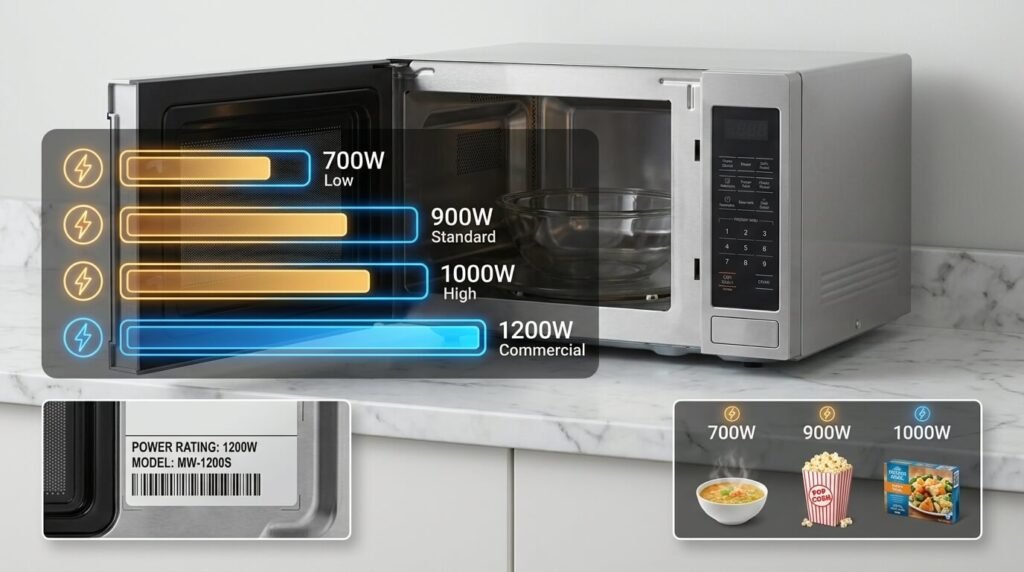
The standard wattage for a household microwave is 1,000 watts.
This is the figure that recipe writers use as their default, the wattage that frozen food manufacturers assume when printing cooking instructions on packaging, and the level at which most mid-range countertop models are manufactured.
In practice, the full range of consumer microwaves runs from around 600W at the compact end to 1,200W at the high end, with commercial units going significantly higher.
If someone asks what a “normal” microwave runs at, 1,000W is the correct answer. Anything between 800W and 1,100W is comfortably within the standard household range.
Why 1,000 watts became the industry benchmark
The 1,000W figure became standard for a straightforward reason: it represents a practical balance between cooking speed and energy consumption that suits the majority of household tasks.
When frozen food companies develop their microwave cooking instructions, they test at 1,000W because that is what most of their customers own.
Recipe websites and cookbooks follow the same convention. The result is a self-reinforcing standard — the more products assume 1,000W, the more manufacturers make 1,000W microwaves, and the more buyers seek them out.
For the purposes of adjusting cooking times, understanding packaging instructions, and comparing models, 1,000W is the baseline against which everything else is measured.
Wattage ranges at a glance — from compact to commercial
| Microwave type | Typical wattage range | Best for |
|---|---|---|
| Compact / small countertop | 600W – 800W | Reheating, drinks, simple tasks, small kitchens |
| Standard countertop | 800W – 1,100W | Everyday household cooking and reheating |
| Over-the-range | 1,000W – 1,200W | Families, larger meals, and combined ventilation use |
| Built-in / drawer microwave | 1,000W – 1,200W | Kitchen integration, mid-to-large households |
| Commercial microwave | 1,200W – 2,000W+ | Restaurants, cafes, high-volume foodservice |
Standard Wattage by Microwave Type
Not all microwaves are designed for the same environment, and their wattage reflects that. Understanding what is typical for each type helps you benchmark what you own or set realistic expectations before you buy.
Compact and small countertop microwaves — 600W to 800W
Compact microwaves in the 600W to 800W range are designed for light, infrequent use in small spaces. They handle reheating leftovers, warming drinks, defrosting small portions, and cooking simple single-serve items well.
What they struggle with is anything that requires sustained, even heat — defrosting a large piece of meat, cooking raw vegetables from scratch, or handling recipes that call for multiple minutes at full power.

- Two-step Child Lock Feature: For extra protection and prevent misuse, all microwave oven manufacturers are asked to foll…
- Mute Function: Turn off all the microwave beeps by pressing the sound on/off button for 3 seconds, for a quiet cooking e…
- Easy one-touch express cooking function with 1-6 minutes and +30 seconds functions, and two defrost settings (by weight …
If your household primarily uses a microwave to reheat coffee, warm a bowl of soup, or heat a ready meal, a 700W or 800W model is perfectly adequate and typically costs significantly less than higher-wattage alternatives.
Compact models are also the most common choice for dorm rooms, office kitchens, caravans, and small flats.
Standard countertop microwaves — 800W to 1,100W
This is the household sweet spot, and where the majority of consumer microwave purchases fall.
An 800W to 1,100W countertop microwave handles reheating, defrosting, steaming vegetables, cooking ready meals, making popcorn, and preparing basic microwave recipes without meaningful limitation.

- Two-Step Child Lock: This mandatory safety feature for microwaves helps prevent unintended use by younger family members…
- Microwave output power 900 watts, input power 1400 watts. External dimensions 18.7x 14.7x 10.7 inches (WxDxH); internal …
- 6 Preset Menus: This compact microwave features 6 preset menu options for popular foods like popcorn, pizza, potato and …
Most frozen food packaging is designed for this range, and recipes that call for 1,000W will produce accurate results with minimal time adjustment.
Within this band, a 900W model will be noticeably faster than an 800W model for larger tasks, and a 1,000W or 1,100W unit will cover virtually every common household use.
See our guide to the best countertop microwaves for current top-rated models across this range.
Over-the-range and built-in microwaves — 1,000W to 1,200W
Over-the-range microwaves are installed above a cooktop in place of a range hood, combining microwave cooking with ventilation in a single unit.
Because they serve larger households and are used more frequently than a secondary countertop unit, they tend to be manufactured at the higher end of the consumer wattage range — typically 1,000W to 1,200W. Built-in drawer and cabinet microwaves follow a similar pattern.
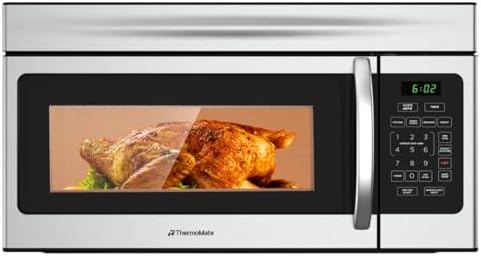
- 1.7 Cu. Ft. Large Capacity – The microwave over the range offers a large capacity of 1.7 cu. ft., with a size of 29.92×1…
- 1000 Watts&10 Power Levels – An over-the-range microwave comes with 1000 watts of cooking power and a 10 different power…
- One-Touch Cooking Options – The microwave oven features one-touch cooking buttons allow you to easily cook your favorite…
Both types require professional installation and represent a larger upfront investment than countertop models, which is reflected in their specification levels.
For a household where the microwave is used multiple times daily for full meals, the step up to 1,100W or 1,200W delivers noticeably faster and more consistent results.
See our full comparison of over-the-range vs countertop microwaves for more on installation considerations.
Commercial microwaves — 1,200W to 2,000W and above
Commercial microwaves are built for restaurant and foodservice environments where speed and continuous use are the priority.

- 【Sleek Design with Large Capacity】Stylish Stainless Steel (color of door frame is stainless steel, enclosure is black) w…
- 【Origin Inverter Technology】Inverter technology provides even heating and defrosting, enables faster cooking and more sa…
- 【6 Smart Sensor Auto Menus】Pre-programmed sensor menus for optimum heating of popular foods like pizza, potato, vegetabl…
A light-duty commercial unit starts at around 1,200W; heavy-duty models used in fast-food kitchens can reach 1,800W to 2,000W or beyond.
For home use, these are unnecessary and impractical — the wattage advantage provides diminishing returns for standard household portions, the units are physically much larger than consumer models, and they are priced accordingly.
The only domestic scenario where a commercial or semi-commercial microwave makes sense is a large catering household that prepares food in bulk regularly.
What Wattage Microwave Do You Actually Need?
Wattage is a means to an end — faster, more even cooking. The right level depends on how your household actually uses a microwave, not on which number sounds most impressive on a spec sheet.
| Household profile | Primary use | Recommended wattage |
|---|---|---|
| Single person or couple, light use | Reheating, drinks, and occasional ready meals | 700W – 900W |
| Family of 3–4, regular cooking | Full meals, defrosting, and daily reheating | 900W – 1,100W |
| Large household or frequent entertainer | Large portions, multiple daily uses, recipe cooking | 1,100W – 1,200W |
| Office kitchen or secondary microwave | Reheating only, infrequent use | 700W – 800W |
Is 700 watts good enough for everyday use?
For basic reheating — leftovers, soups, coffee, ready meals — a 700W microwave is sufficient. It will complete those tasks reliably, just somewhat more slowly than a higher-wattage model.
Where 700W falls short is with tasks that require sustained, high-power heating: defrosting large cuts of meat, cooking raw, dense foods like potatoes or chicken from scratch, or following recipes that assume 1,000W.
For those uses, you will find yourself significantly extending cooking times, and the results may be less even because the lower wattage struggles to penetrate food as effectively.
If reheating is your primary use and speed is not critical, 700W works. If you cook regularly using your microwave, 900W or 1,000W is a more practical floor.
Is higher wattage always better?
Not always. Higher wattage cooks food faster, but speed is not universally desirable. Reheating delicate items — fish, eggs, or sauces — at full power in a high-wattage microwave can lead to overcooking on the edges before the centre has warmed through.
This is why power levels exist and why the wattage vs power level distinction in the next section matters.
A 1,200W microwave used at 60% power is effectively delivering 720W — similar to a 700W model. Higher wattage gives you more headroom and flexibility; it does not mean you must always cook faster.
The cost premium for a 1,100W or 1,200W model is also worth factoring in — for light users, the difference in daily cooking speed rarely justifies the price gap over a solid 900W or 1,000W model.
Wattage vs Power Level — The Difference Most People Get Wrong
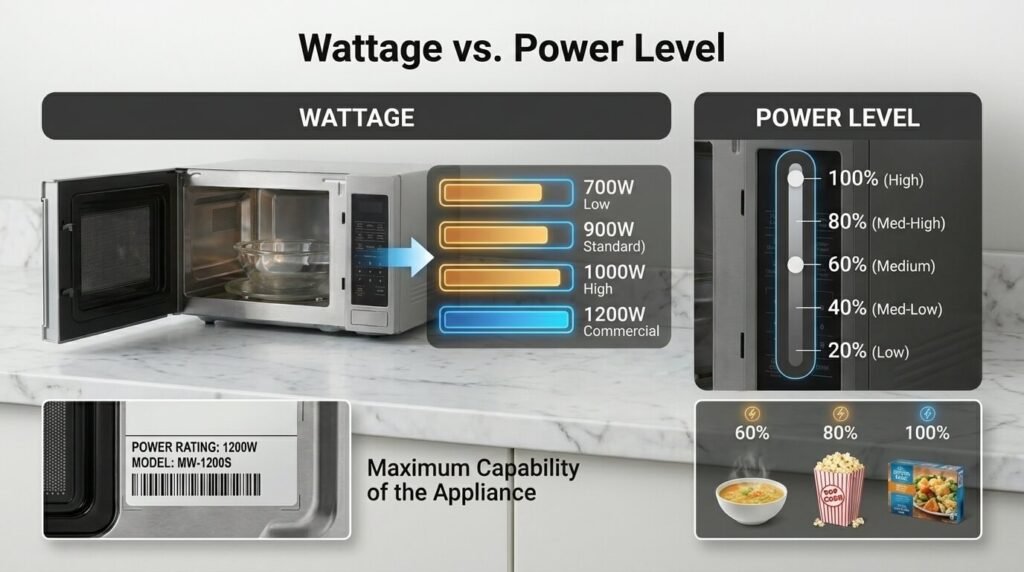
Wattage and power level are not the same thing, and confusing them is the single most common reason microwave cooking produces inconsistent results.
Wattage is a fixed hardware specification. It is the maximum amount of power your microwave’s magnetron can generate, and it does not change.
Power level is a setting you choose, expressed as a percentage of that maximum. When you set a 1,000W microwave to power level 5 (50%), you are telling it to deliver an effective average of 500W during that cooking cycle.
You are not reducing the microwave’s wattage; you are controlling how it distributes that wattage over time.
How standard (cycling) microwaves manage power levels
In a standard microwave, power level settings work by cycling the magnetron on and off in a timed pattern. At 100% power, the magnetron runs continuously.
At 50% power, it runs for roughly half of each cycle and sits idle for the other half. The microwave is still producing its full rated wattage when it is on — it is simply on for less of the time.
This is why some foods can develop hot spots even at lower power levels: the on-phase delivers full-intensity heat before the off-phase gives the food time to equalise.
For most reheating tasks, this is perfectly adequate, but for delicate foods that need gentle, even warming, cycling can cause uneven results.
How inverter microwaves deliver power differently
Inverter microwaves use a different internal technology that delivers a true continuous stream of power at the level you set, rather than cycling on and off.
A 1,000W inverter microwave set to 50% power delivers a genuine, uninterrupted 500W throughout the cooking cycle — not an alternating burst of 1,000W and nothing.
The practical result is more even cooking and better texture preservation, particularly for delicate proteins, dairy-based dishes, and anything that would toughen or curdle under the heat bursts of standard cycling.
Inverter models carry a price premium over standard cycling microwaves at the same wattage, but for regular cooks, the difference in results can be meaningful.
See our guide on whether an inverter microwave is worth it for a full comparison.
How to Find Your Microwave’s Wattage
If you need to look up your microwave’s wattage — to convert a recipe, check an energy calculation, or compare it against a new model — there are three ways to find it, in order of simplicity.
- Check the door frame label. Open the microwave door and look at the inside of the door frame or the inner wall of the cavity. Most manufacturers print a specification plate here listing the model number, serial number, and wattage. It is the quickest method and works for the vast majority of models.
- Check the user manual or the manufacturer’s website. If you have the model number (from the door frame label or the outside of the unit), you can look up the full specification sheet on the manufacturer’s website in under a minute. The wattage will be listed under power output or cooking power.
- Use the water boil test. If neither of the above is available — common with older models, secondhand units, or microwaves in rented properties — the water boil test gives you a reliable estimate.
The water boil test — how to estimate wattage if there is no label
The water boil test uses the known relationship between energy input and the time required to bring a specific volume of water to a full rolling boil.
It is not precise to the watt, but it accurately identifies your wattage bracket, which is sufficient for recipe conversion purposes.
- Fill a microwave-safe measuring cup with exactly 1 cup (237ml) of cold tap water. The water should be at normal tap temperature — around 60°F (15°C). Do not use ice water or warm water.
- Place the cup in the centre of the microwave. Do not cover it.
- Set the microwave to full power (100%) and start timing from the moment you press start.
- Watch closely. Stop the timer the moment the water reaches a full rolling boil — not just a few bubbles, but active boiling across the surface.
- Note the time and match it to the table below.
| Time to boil 1 cup of water | Estimated wattage |
|---|---|
| Under 1 min 30 sec | 1,200W or above |
| 1 min 30 sec – 2 min | 1,000W – 1,100W |
| 2 min – 2 min 45 sec | 900W |
| 2 min 45 sec – 3 min 30 sec | 800W |
| 3 min 30 sec – 4 min 30 sec | 700W |
| Over 4 min 30 sec | 600W or below |
Note: Results can vary slightly based on your local water temperature, altitude, and the exact starting temperature of the water. Run the test twice and average the results if you want a more reliable reading.
How to Convert Cooking Times for Your Microwave’s Wattage
When a recipe or food package specifies a cooking time at 1,000W and your microwave runs at a different wattage, the time needs adjusting.
Lower-wattage microwaves need more time to deliver the same amount of energy; higher-wattage microwaves need less.
The conversion formula explained
The maths behind wattage conversion follows one straightforward relationship: energy delivered = power × time. To get the same energy output from a different power level, you adjust the time proportionally.
New time = Original time × (Recipe wattage ÷ Your microwave’s wattage)
For example, if a recipe says cook for 3 minutes at 1,000W and your microwave is 800W:
New time = 3 min × (1,000 ÷ 800) = 3 min × 1.25 = 3 min 45 sec
Always treat the result as a starting point, not an exact answer. Food thickness, container shape, and starting temperature all affect the outcome.
Check the food near the end of the calculated time, then add short additional bursts if needed rather than committing to the full extended time at once.
Cooking time conversion table — 1,000W recipes adjusted for every wattage
Use this table when following a recipe or package instruction written for a 1,000W microwave. Find the original cooking time in the left column and read across to your microwave’s wattage.
| Recipe time at 1,000W | At 600W | At 700W | At 800W | At 900W | At 1,100W | At 1,200W |
|---|---|---|---|---|---|---|
| 1 minute | 1 min 40 sec | 1 min 26 sec | 1 min 15 sec | 1 min 7 sec | 55 sec | 50 sec |
| 2 minutes | 3 min 20 sec | 2 min 51 sec | 2 min 30 sec | 2 min 13 sec | 1 min 49 sec | 1 min 40 sec |
| 3 minutes | 5 min 0 sec | 4 min 17 sec | 3 min 45 sec | 3 min 20 sec | 2 min 44 sec | 2 min 30 sec |
| 4 minutes | 6 min 40 sec | 5 min 43 sec | 5 min 0 sec | 4 min 27 sec | 3 min 38 sec | 3 min 20 sec |
| 5 minutes | 8 min 20 sec | 7 min 9 sec | 6 min 15 sec | 5 min 33 sec | 4 min 33 sec | 4 min 10 sec |
| 7 minutes | 11 min 40 sec | 10 min 0 sec | 8 min 45 sec | 7 min 47 sec | 6 min 22 sec | 5 min 50 sec |
| 10 minutes | 16 min 40 sec | 14 min 17 sec | 12 min 30 sec | 11 min 7 sec | 9 min 5 sec | 8 min 20 sec |
Practical tips when using converted times:
- For dense foods (potatoes, thick cuts of meat), add 10–15% on top of the converted time and check for doneness rather than assuming the formula is exact
- Stir or rotate the food halfway through cooking to compensate for any uneven heat distribution
- Allow standing time of 1–2 minutes after the microwave stops — food continues to cook from residual heat, and this time is factored into most recipe development
Does Microwave Wattage Affect Your Electricity Bill?
In short: yes, but not by a meaningful amount in most households. The electricity cost of running a microwave is one of the lowest of any kitchen appliance because the usage time per day is brief.
Here is how the maths works. Electricity consumption is measured in kilowatt-hours (kWh) — the energy used by a 1,000W appliance running for one hour. To calculate your microwave’s consumption:
(Wattage ÷ 1,000) × hours used per day × 365 = annual kWh consumed
At an average US electricity rate of approximately $0.17 per kWh, a 1,000W microwave used for 15 minutes per day consumes about 91 kWh per year — costing roughly $15–$16 annually.
A 700W microwave on the same schedule costs around $11 per year. A 1,200W model runs to approximately $19 per year. The difference between the cheapest and most powerful consumer microwave in annual electricity cost is under $10.
One figure that surprises most households is standby power. A microwave sitting idle but plugged in draws between 2 and 5 watts continuously to power the clock and control panel.
Over a full year, that adds $3–$10 to your bill without cooking a single thing. If your microwave is rarely used, unplugging it when not in use is a more meaningful energy saving than choosing a lower wattage.
Which Wattage Should You Buy? A Quick Summary
For most households, buying a new microwave, a 900W to 1,000W countertop model covers every standard use case — reheating, defrosting, recipe cooking, and ready meals — without overpaying for power you will not meaningfully use.
If you have a large household and use the microwave as a primary cooking tool multiple times per day, stepping up to 1,100W makes sense. If you want the best possible results for delicate foods at any wattage, choose an inverter model over a standard cycling one.
A 700W microwave is a sound choice if your use is genuinely limited to reheating and space or budget is the priority. Anything below 700W is difficult to recommend for a primary household microwave in 2025.
Frequently Asked Questions About Microwave Wattage
What is the standard wattage for a household microwave?
The standard is 1,000 watts, which is the figure most recipes and frozen food packaging assume.
Consumer microwaves typically range from 600W at the compact end to 1,200W at the top of the household range, with 800W to 1,100W covering the majority of models sold for home use.
What wattage do most frozen food instructions assume?
The overwhelming majority of frozen food packaging in the US, UK, Canada, and Australia is written for a 1,000W microwave.
Some products list alternative times for 700W or 800W models as a secondary option, but 1,000W is the default.
If your microwave is lower or higher than 1,000W, use the conversion table in this guide to adjust the stated cooking time accordingly.
Is 1,200 watts too powerful for a home microwave?
No, but for most households, it is more power than is strictly necessary.
A 1,200W microwave cooks faster and handles large portions well, but the practical difference over a 1,000W model in daily use is relatively small, and the price premium is real.
Where 1,200W earns its place is in large households, frequent entertaining, or any scenario where the microwave is used as a primary cooking appliance multiple times per day.
Does higher wattage mean more electricity is used?
Yes, in direct proportion — a 1,200W microwave uses 20% more electricity per minute than a 1,000W model. However, because it also cooks faster, the total energy consumed per task is very similar.
Heating a bowl of soup takes a 1,000W microwave 2 minutes; the same task takes a 1,200W microwave around 1 minute 40 seconds. The energy used is comparable either way.
On an annual basis, the real-world cost difference between a 700W and a 1,200W microwave is typically under $10 for an average household.
What is the difference between a 900W and a 1,100W microwave in real cooking?
For basic reheating, the difference is minor — a few extra seconds per task.
For longer cooking tasks, it becomes more noticeable: a 5-minute cook at 1,000W becomes 5 minutes 33 seconds at 900W and 4 minutes 33 seconds at 1,100W — a difference of a full minute on a single item. F
or households that use the microwave primarily for quick reheating, 900W is entirely adequate. For anyone cooking regularly from scratch or defrosting frequently, 1,100W provides a meaningful speed and consistency advantage.
Can I use an 800W microwave for everything a 1,000W can do?
Yes, with adjusted cooking times. An 800W microwave can perform every task a 1,000W model can — reheating, defrosting, cooking, steaming — it simply takes 25% longer for equivalent results.
The one practical limitation is that at lower wattage, the magnetron works harder for longer to reach the same energy output, which can mean slightly less even heating on very dense foods.
For most household tasks, this is manageable by stirring halfway through and allowing proper standing time after cooking.
Why do some microwaves have the same wattage but cook at different speeds?
Three factors cause this. First, inverter vs cycling technology: two 1,000W microwaves will deliver power differently if one is an inverter and one is a standard cycling model, which affects cooking evenness even at the same wattage.
Second, turntable placement and cavity design affect how evenly the microwave energy distributes across the food.
Third, the actual measured output of a microwave can vary slightly from its rated wattage depending on the age of the unit and the condition of the magnetron.
A new 1,000W microwave and a five-year-old 1,000W microwave from the same brand may not perform identically on a time-matched cooking task.
See our full microwave buying guide, comparison of the various microwave weights by sizes and types, understanding the power of an 800-watt microwave oven and our guide on reducing kitchen energy use for related reading.
About the Author & Reviewer
Sarah Emirone, Author
Sarah researches and writes SafeKitchn’s dinnerware and kitchenware guides, with a focus on material safety, lead content, and manufacturer specifications. She cross-references product data sheets, safety certifications, and regulatory filings (including FDA and Prop 65 records) before publishing, and updates articles when new information becomes available.
James Daniels, Reviewer
James reviews SafeKitchn’s material safety content for scientific accuracy. He holds a B.Sc in inorganic chemistry and works as a materials researcher, with particular focus on the composition and safety behavior of glass, ceramic, and metal used in kitchenware.