

Few kitchen appliances have changed the way people eat quite like the microwave oven.
Since its accidental invention in the 1940s, it has moved from a novelty to an absolute staple in homes, offices, dorm rooms, and commercial kitchens worldwide.
Yet despite how common they are, plenty of people still have real questions: Is microwave radiation dangerous? What containers are actually safe? Which type is right for my kitchen?
This guide cuts through the noise and covers everything you need to know: how microwave ovens work, the different types available, safety facts versus myths, and practical tips for choosing and maintaining the right appliance for your cooking habits and kitchen setup.
Written by Sarah Emirone | Reviewed by James Daniels, B.Sc, Inorganic Chemist & Materials Researcher | Updated September 2026 | See How We Test | Filed under: Microwave & Appliance Specs
What Is a Microwave Oven?
Definition of a Microwave Oven
A microwave oven is an electric kitchen appliance that heats and cooks food by exposing it to electromagnetic waves in the microwave frequency range — typically 2.45 GHz.
Unlike a conventional oven that heats food from the outside in using radiant heat, a microwave oven penetrates food and excites the water molecules inside it, generating heat throughout the food simultaneously.
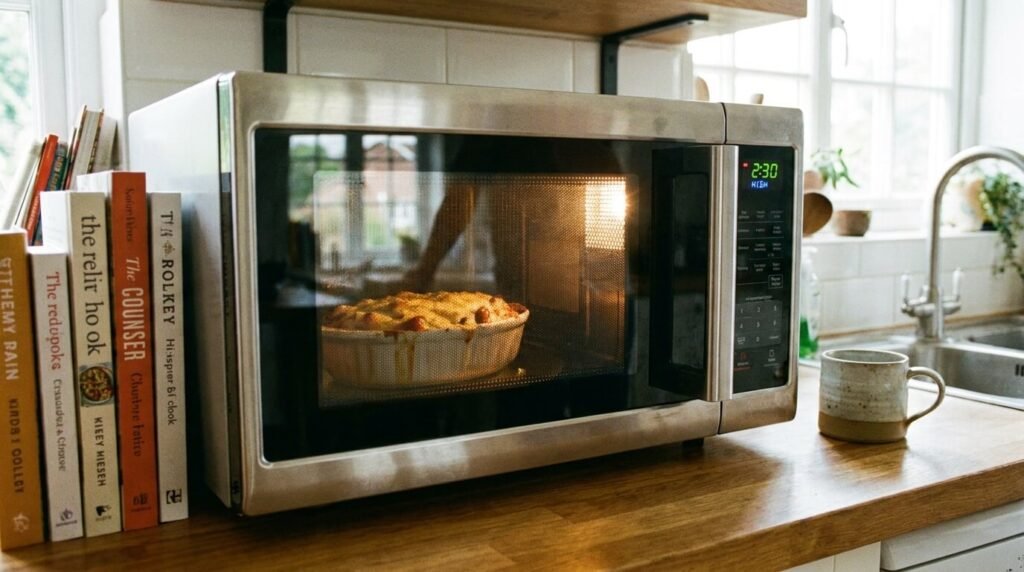
This makes microwave cooking significantly faster than traditional methods for most tasks.
The appliance is categorized as a countertop appliance in most homes, though built-in and over-the-range installations are increasingly common in modern kitchen design.
How Microwave Ovens Work
The science behind microwave cooking is straightforward once you break it down. Inside every microwave oven, a component called the magnetron converts electrical energy into microwave radiation, electromagnetic waves that penetrate food and cause polar molecules, primarily water molecules, to vibrate rapidly.
That rapid molecular vibration generates heat through a process called dielectric heating, and that heat cooks or warms the food. The microwaves don’t make food radioactive or chemically alter it; they simply transfer energy efficiently.
The entire process happens in seconds or minutes, which is why microwaves are so effective for food heating, reheating, and defrosting tasks.
Main Components of a Microwave Oven
Understanding the key parts helps explain both how a microwave performs and why certain safety features matter. The magnetron is the core component — it generates the microwave energy that does the actual heating.
The microwave turntable rotates food during cooking, which helps reduce uneven heating by exposing all sides of the food to microwave energy more consistently.
The digital control panel allows users to set time, power levels, and preset cooking programs.
The door safety mechanism, a combination of a door seal and a metal mesh screen acting as a Faraday cage, keeps microwave radiation contained inside the cavity during operation.


Types of Microwave Ovens
Solo Microwave Ovens
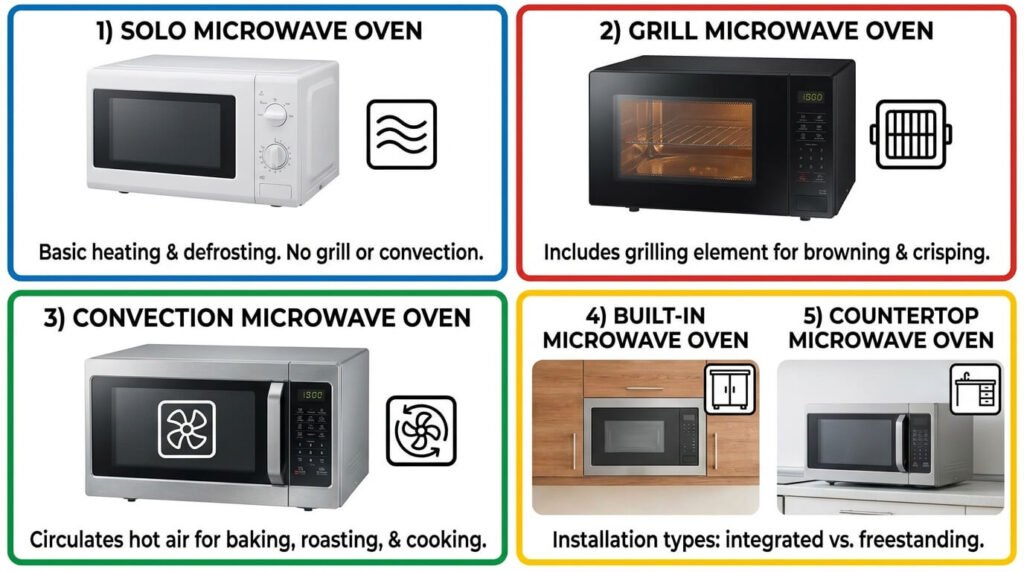
The solo microwave is the most basic and widely used type. It performs the core functions of reheating food, defrosting frozen meals, and simple microwave cooking without additional features such as grilling or convection.
Solo-style cute microwaves are typically the most affordable option and ideal for households that primarily use their microwave for reheating leftovers, warming beverages, or cooking convenience foods.
They come in a range of wattages, weights, and cavity sizes, making them suitable for everything from small dorm room appliances to larger family kitchen units.
For straightforward, everyday microwave use, a solo model covers most needs effectively.
Grill Microwave Ovens
A grill microwave combines standard microwave heating with a built-in grilling element, typically a quartz or metal heating rod positioned inside the cavity.
This allows users to brown and crisp food surfaces in ways a solo microwave simply cannot achieve.
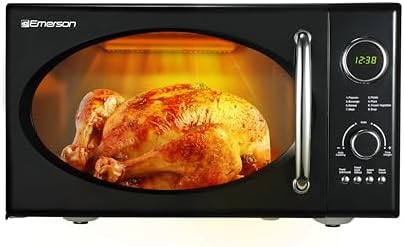
- Built-In 1,000W Grill Function: Go beyond reheating—achieve golden-brown finishes, crispy toppings, and grilled textures…
- Compact Yet Powerful: With 800 watts of microwave cooking power and 5 adjustable power levels, this 0.9 cu. ft. unit del…
- Stylish Retro Black Design: The glossy black exterior with chromed accents adds a nostalgic charm to your kitchen, while…
Samsung and similar brands produce popular grill microwave models that handle tasks like grilling chicken pieces, toasting sandwiches, and crisping vegetables with a browned finish.
The grill function operates independently or in combination with microwave energy, giving users more cooking flexibility than a solo unit.
It’s a smart middle-ground option for households that want browning capability without investing in a full convection microwave.
Convection Microwave Ovens
A convection microwave is the most versatile microwave type available. It combines microwave radiation with a convection fan that circulates hot air throughout the cavity, enabling genuine baking, roasting, and even air-frying functions alongside standard microwave heating.
This makes it capable of tasks like baking a cake or roasting chicken that a solo or grill microwave can’t handle.

- 4-in-1 Multifunctional Countertop Microwave One microwave with multi-functions of microwave, air fry, convection, combin…
- Healthy Air Fryer Combo Enjoy your wholesome fried food with original taste but less fat with healthy air fry
- One Kitchen Appliance, Better Texture Combines microwave and convection cooking in one appliance, with auto bake, defros…
Samsung and other major appliance brands produce well-regarded convection microwave models that effectively replace both a standard microwave and a small conventional oven in compact kitchens.
The trade-off is higher cost and slightly greater complexity in operation compared to simpler microwave types.
Built-In Microwave Ovens
A built-in microwave is designed to integrate seamlessly into kitchen cabinetry or walls, eliminating counter space use.
Brands like KitchenAid produce built-in models that are engineered to complement modern kitchen design, sitting flush with surrounding cabinets for a clean, professional look.

- built-in trim kit available in 27″ (GMTK2768AF) and 30″ (GMTK3068AF) Sold Seperatly
- Provides 2.2 cu. ft. of cooking space, accommodating large dishes and multiple items at once for convenient and efficien…
- Sensors in the microwave determine and set the appropriate power levels and cook time to ensure great tasting food
Built-in installation requires more planning than a countertop appliance — proper ventilation, cabinet dimensions, and electrical placement all need to be addressed.
They’re typically found in higher-end kitchen renovations and are popular with homeowners prioritizing both aesthetics and space efficiency. Functionality is generally comparable to countertop models of similar wattage and feature sets.
Countertop Microwave Ovens
The countertop microwave remains the most common microwave type in homes worldwide. It’s freestanding, requires only a power outlet, and can be placed virtually anywhere there’s counter space available.
Panasonic, Toshiba, LG Electronics, and most major appliance brands produce extensive countertop microwave lineups spanning compact models for small kitchens and dorm rooms to full-sized family units with advanced features like sensor cooking and inverter technology.
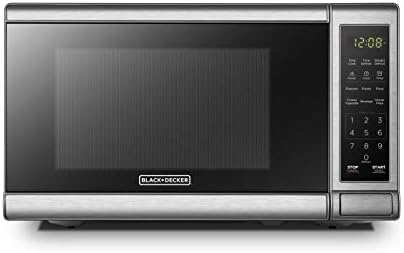
- Pre-programmed buttons for popcorn, potato, pizza, frozen vegetable, beverage and dinner plate.Voltage : 110 Volts.Rate…
- 700 Watts with 10 power settings, clock and kitchen timer, 30 Seconds Express Cooking
- Large LED digital display, easy-to-read control panel, child safety lock, interior light, removable 10” glass turntable
The main drawback is counter space — a full-sized countertop microwave occupies meaningful real estate in smaller kitchens.
But for flexibility, value, and ease of installation, countertop models remain the default choice for most households.
Common Uses of Microwave Ovens
Reheating Leftovers
Reheating food is the single most common reason people use a microwave oven, and it’s where the appliance genuinely excels.
Leftover soups, pasta, rice, casseroles, and most cooked meals reheat quickly and evenly, especially when using a microwave-safe cover to trap steam and prevent splattering.
The auto-reheat function on many modern microwaves adjusts time and power automatically based on the food type, making the process even more effortless.
For busy households, the ability to reheat a meal in two to three minutes rather than fifteen in a conventional oven makes the microwave an irreplaceable time-saving appliance in daily kitchen routines.
Defrosting Frozen Food
The defrost function is one of the most practical microwave features for home cooks. Rather than waiting hours for frozen meat, fish, or vegetables to thaw at room temperature, the microwave’s defrost setting uses low-power microwave energy to gently soften and thaw frozen items in minutes.
Many modern microwaves offer defrost by weight. You enter the food weight, and the appliance calculates the optimal defrost time and power cycle automatically.
This helps prevent the edges of food from beginning to cook while the center remains frozen, which is the main challenge with microwave defrosting when done on full power by mistake.
Quick Meal Preparation
Beyond reheating, microwave cooking handles a surprisingly wide range of quick meal preparation tasks.
Vegetables steam beautifully in a microwave steamer in three to five minutes, retaining both moisture and nutrients better than boiling in many cases.
Scrambled eggs, oatmeal, baked potatoes, and rice all cook reliably in a microwave with minimal prep. Frozen meals and convenience foods are specifically designed for microwave preparation, with packaging that includes precise timing instructions for consistent results.
For fast cooking on weekday mornings or low-effort lunches, a microwave delivers genuine meal preparation capability well beyond simple reheating.
Baking and Grilling Functions
Convection and grill microwave models extend the appliance’s capability into territory most people don’t associate with microwave cooking.
A convection microwave with a working convection fan can bake muffins, brownies, and small cakes with results comparable to a conventional oven.
Grill microwaves brown and crisp food surfaces. Grilled sandwiches, chicken pieces, and fish fillets come out with the kind of surface texture a solo microwave simply can’t produce.
For smaller households or compact kitchens where a full-size oven isn’t practical, a convection or grill microwave genuinely replaces multiple appliances and expands everyday cooking options considerably.
Beverage and Snack Heating
Heating a cup of coffee, warming milk for a child, making a mug of soup, or popping microwave popcorn, these small everyday tasks are where the microwave’s speed and convenience shine most clearly.
The popcorn function on most microwaves is a preset cooking program optimized specifically for standard microwave popcorn bags, automatically adjusting time and power for consistent results.
Beverage reheating is equally simple: most modern microwaves include beverage presets that heat drinks to an appropriate temperature without overheating.
For quick snacks and single-serve beverages, the microwave is unmatched in speed and ease of use compared to any other kitchen appliance.
Microwave Oven Safety
Are Microwave Ovens Safe?
Yes — microwave ovens are safe when used correctly, and the scientific consensus on this has been consistent for decades.
The FDA monitors and regulates microwave radiation exposure through its FDA microwave standards, which set strict limits on the amount of radiation that can leak from an appliance over its lifetime.
Modern microwave ovens are engineered with multiple layers of microwave shielding, including the door seal, metal mesh screen, and a Faraday cage design of the door that contains radiation inside the cavity during operation.
Microwave radiation is non-ionizing, meaning it does not have enough energy to damage DNA or cause the kinds of harm associated with X-rays or nuclear radiation.
Radiation and Microwave Myths
The word ‘radiation’ triggers unnecessary alarm in many people, but microwave radiation is fundamentally different from the ionizing radiation people rightfully worry about.
Microwave ovens emit RF energy in the same frequency family as Wi-Fi routers and mobile phones — non-ionizing electromagnetic waves that heat food without making it radioactive or chemically dangerous.
Microwave leakage is monitored by regulatory agencies and kept well below any threshold associated with harm.
The appliance’s Faraday cage door design blocks radiation from escaping during operation. Standing next to a functioning microwave oven poses no documented health risk at normal use distances and conditions.
Microwave-Safe Containers
Using the right container is one of the most important microwave safety practices. A microwave-safe container is specifically rated to withstand microwave heating without warping, melting, or leaching chemicals into food.
Look for the microwave-safe symbol on the bottom of containers. Most reputable brands mark this clearly. Microwave-safe glass, like Pyrex borosilicate glass, is among the safest and most reliable container options.
Microwave-safe plastic carries BPA-free certification on most modern products, though it’s worth checking each product individually.
Ceramic and porcelain dishes without metallic glazes or trim are generally safe as well. When in doubt, transfer food to a verified microwave-safe container.
Foods That Should Not Be Microwaved
Most foods can be microwaved safely, but a few require caution. Whole eggs in their shell should never be microwaved, as steam builds up inside and can cause them to explode.
Foods in sealed containers or airtight packaging face the same risk. Grapes can arc and spark inside a microwave under specific conditions. Very dense foods with thick skins — whole potatoes, squash — should be pierced before microwaving to allow steam to escape.
Hot spots can develop in foods with uneven density, so stirring soups and thick dishes halfway through cooking is recommended.
These are practical usage habits rather than fundamental safety flaws with the technology.
Child Safety and Proper Usage
For households with children, the child safety lock available on most modern microwave brands is an important feature as it prevents accidental operation by disabling the control panel until a specific button sequence is entered.
Teaching children appropriate microwave use, what containers are safe, not to run the appliance empty, and not to microwave sealed containers is equally important.
Supervising young children around hot food removed from the microwave is essential, since containers and food can become very hot even when the exterior of the dish feels cool to the touch.
Proper usage habits from the start significantly reduce the risk of burns and accidents.
Microwave-Safe Materials
Microwave-Safe Glass
Microwave-safe glass is the gold standard container material for microwave use.
Borosilicate glass — the kind used in Pyrex products — is specifically engineered to handle rapid temperature changes without cracking or shattering. It doesn’t leach any chemicals into food during heating and is completely inert even at high microwave temperatures.
Glass containers also distribute heat more evenly than plastic and are easier to clean thoroughly.
The one thing to verify is that the glass doesn’t have any metallic rim, paint, or trim — even decorative metallic accents on glassware can cause arcing inside a microwave cavity.
Microwave-Safe Plastic
Microwave-safe plastic is approved for microwave use, but not all plastic qualifies. The microwave-safe symbol on a container indicates it has been tested to withstand microwave heating without warping or releasing harmful compounds at normal cooking temperatures.
BPA-free plastics are the current standard for food storage and reheating containers. Brands like Tupperware produce specifically rated microwave-safe plastic containers designed for regular reheating use.
Avoid using random takeout containers, thin plastic wrap directly on food, or any plastic not specifically marked as microwave safe, as these may warp, melt, or leach chemicals under microwave heat conditions.
Ceramic and Porcelain Safety
Most ceramic and porcelain dishes are microwave safe, with one important exception: any piece with metallic glazes, gold or silver trim, or metallic paint should not be microwaved.
Plain ceramic mugs, bowls, and plates without metallic decoration generally handle microwave heating without issue. However, some handmade or older ceramic pieces contain metallic compounds in their glazes that aren’t always obvious visually.
When in doubt, do a quick microwave test by placing the empty dish in the microwave alongside a cup of water for one minute on high. If the dish becomes hot but the water doesn’t, the dish is absorbing microwave energy and shouldn’t be used.
Why Metal Should Not Go in a Microwave
Metal in a microwave causes arcing, visible electrical sparks generated when microwave radiation reflects off conductive surfaces rather than being absorbed.
This can damage the microwave cavity, potentially damage the magnetron, and in serious cases start a fire.
Even small amounts of metal, aluminum foil, metal-trimmed containers, and metallic twist ties on food packaging are enough to cause arcing.
The microwave door itself contains a metal mesh screen that blocks radiation from escaping while allowing visibility, but this is engineered as part of the microwave shielding system and behaves differently from loose metal objects inside the cavity.
The rule is simple: no metal inside the cooking chamber.
BPA and Chemical Concerns
BPA (bisphenol A) is a chemical used in some older plastic formulations that raised food safety concerns due to potential hormonal effects.
Most modern microwave-safe plastic containers are now explicitly labeled BPA-free, and major manufacturers have phased out BPA from food-contact plastics following regulatory guidance.
The key is using containers that are specifically certified as both BPA-free and microwave-safe, not assuming that any plastic container is appropriate for microwave heating simply because it’s food-grade for cold storage.
For anyone concerned about chemical migration, microwave-safe glass remains the most straightforward and chemically inert option for reheating and cooking food.
Advantages of Microwave Ovens
Fast Cooking and Reheating
Speed is the microwave oven’s defining advantage. Reheating a bowl of soup takes ninety seconds. Cooking a baked potato takes five minutes versus an hour in a conventional oven.
Defrosting a chicken breast takes eight minutes rather than several hours on the counter.
This fast cooking capability isn’t just convenient, it genuinely changes how people approach meal preparation, making it practical to cook and eat real food on busy weekday schedules rather than defaulting to takeout.
For time-saving appliances, the microwave compresses cooking timelines in ways no other single kitchen appliance can match for everyday reheating and preparation tasks.
Energy Efficiency
Microwave ovens are significantly more energy efficient than conventional ovens for most tasks. A standard microwave oven uses 600 to 1200 watts and heats only the food, not the surrounding air or the oven cavity itself.
A conventional oven uses 2000 to 5000 watts and requires preheating the entire chamber before cooking even begins. For reheating a single portion or cooking a small meal, the microwave consumes a fraction of the electricity.
This energy efficiency advantage adds up meaningfully over daily use, making the microwave a genuinely greener option for the kinds of quick food preparation tasks it handles best.
Convenience for Busy Households
The microwave’s convenience extends well beyond cooking speed.
It requires minimal cleanup compared to stovetop cooking, operates with simple touchpad controls that most people can use without instructions, and handles the most frequent kitchen tasks: reheating, defrosting, and quick cooking with a reliability that makes it indispensable.
For households where multiple people eat at different times, the microwave makes individual meal reheating entirely practical without heating a full oven for one portion.
For office kitchen appliances, it’s the universal choice for a reason: low maintenance, easy operation, and consistently useful for the broad range of food preparation tasks that come up in a shared workplace setting.
Compact Kitchen Solution
A compact microwave, particularly a well-chosen countertop model, delivers remarkable capability in a relatively small footprint.
For studio apartments, dorm room appliances, small office kitchens, and compact living situations where counter space is at a premium, a microwave often handles the bulk of everyday food heating needs without requiring a full stovetop or oven.
Convection microwave models push this further by combining microwave, grill, and baking functions in a single footprint, effectively replacing multiple appliances in a single countertop unit.
For anyone working with limited kitchen space, a thoughtfully chosen microwave is arguably the highest-value appliance per square inch available.
Easy Operation and Automation
Modern microwaves have evolved well beyond simple timers and power level dials.
Sensor cooking technology available from brands like LG Electronics uses internal sensors to detect steam and humidity from food and automatically adjusts cooking time and power levels for optimal results without guesswork.
Preset cooking programs cover common foods like popcorn, pizza, beverages, and vegetables with a single button press. Inverter technology, developed notably by Panasonic, delivers continuous power at precise levels rather than cycling on and off, which improves cooking consistency significantly.
Smart microwaves with Wi-Fi connectivity even support voice control through Amazon Alexa and similar systems.
Disadvantages of Microwave Ovens
Uneven Heating Issues
Uneven heating is the most commonly cited limitation of microwave cooking. Because microwave energy doesn’t distribute perfectly uniformly through every food type and shape, hot spots can develop in some areas while others remain cooler.
The microwave turntable helps reduce this by rotating food through different positions during cooking, and stirrer fans in some models distribute microwave energy more evenly through the cavity.
Pausing cooking to stir thick dishes, rotating food manually in flatbed microwaves, and using appropriate power levels for dense foods all help.
But for foods where perfectly uniform temperature is critical, thick roasts, casseroles with dense centers, a conventional oven remains more reliable.
Texture and Flavor Limitations
Microwave cooking changes food texture in ways that don’t always work in the cook’s favor. Bread and pastries reheated in a microwave often become soft and slightly rubbery rather than maintaining their original crispy or flaky texture.
The reason is moisture: microwave heating generates steam inside food, which softens starches and can make textures that depend on dry heat feel dense or chewy.
For foods where surface texture matters — crusty bread, crispy fried chicken, pizza — a conventional oven or toaster oven almost always produces better results.
The microwave excels at moisture-based reheating; it struggles when dry, crispy textures need to be preserved or recreated.
Limited Browning Capability
Standard solo microwave ovens can’t brown food surfaces — browning and crisping require the Maillard reaction, which needs dry surface heat above 280°F (138°C).
Microwave energy heats through moisture excitation, which keeps food surfaces relatively moist rather than hot and dry enough to brown.
This is why microwaved meat, bread, and baked goods lack the appealing color and crust that oven or stovetop cooking produces.
Grill, microwave, and convection microwave models address this with additional heating elements, but a basic solo microwave produces food that looks noticeably pale compared to conventionally cooked equivalents, which matters for presentation and, in many cases, flavor development.
Container Compatibility Restrictions
The requirement for microwave-safe containers is a genuine practical restriction. Metal is entirely off-limits. Not all plastic is suitable. Dishes with metallic trim or decoration can’t be used.
This means many everyday kitchen items, such as standard takeout containers, foil trays, certain mixing bowls, and decorative plates, need to be transferred to appropriate microwave-safe containers before reheating, which adds a step compared to simply putting a pan directly in a conventional oven.
For households with extensive ceramic or glass cookware, this is rarely an issue, but for those relying heavily on plastic storage containers, understanding what is and isn’t microwave safe requires some ongoing attention.
Microwave Oven vs Conventional Oven
Heating Method Comparison
The fundamental difference between a microwave oven and a conventional oven is how each transfers heat to food.
A conventional oven uses radiant heat from electric coils or gas burners to heat the air inside the cavity, which then heats food from the outside surface inward.
A microwave oven uses electromagnetic waves that penetrate food and excite water molecules throughout its interior simultaneously.
This means microwave cooking heats food faster overall, but conventional ovens create the surface conditions of dry heat, high temperatures needed for browning, crisping, and developing the complex flavors associated with roasting and baking.
Cooking Speed Differences
In cooking speed, the microwave wins decisively for most reheating and simple cooking tasks. Reheating a plate of food takes two to three minutes in a microwave versus fifteen to twenty minutes in a preheated conventional oven.
Cooking a baked potato takes five minutes versus sixty. For frozen meals, the microwave is four to six times faster in most cases.
However, for complex cooking tasks that require gradual, even heat development — slow-roasted meats, layered casseroles, delicate baked goods — the conventional oven’s slower, more controlled heat distribution produces superior results that simply can’t be replicated with microwave speed alone.
Energy Consumption Comparison
Microwave ovens consume significantly less electricity than conventional ovens for equivalent tasks. A typical microwave operates at 700 to 1200 watts and reaches full operating power instantly, with no preheating required.
A conventional oven draws 2000 to 5000 watts and may require ten to fifteen minutes of preheating before cooking begins. For single portions and short cooking tasks, the electricity consumption difference is substantial.
For large meals cooked over extended periods, the gap narrows, but the microwave still holds an energy efficiency advantage for most household cooking scenarios.
Choosing the right appliance for each specific task is the most energy-conscious approach.
Best Uses for Each Appliance
The microwave oven excels at reheating food, defrosting, steaming vegetables, cooking convenience foods, and any task requiring fast, moisture-based heat.
The conventional oven excels at roasting, baking, slow cooking, browning, and any recipe that benefits from dry, even heat over a longer period.
These appliances complement rather than compete with each other in a well-equipped kitchen.
Using the microwave for reheating and quick tasks while reserving the conventional oven for recipes that genuinely need it is the most practical and energy-efficient approach for most households.
There’s no reason to choose one exclusively over the other.
Which Option Is Better for Everyday Cooking?
For pure everyday practicality, reheating leftovers, defrosting ingredients, making quick meals on busy evenings — the microwave oven handles the majority of what most households actually need from a cooking appliance daily.
The conventional oven is indispensable for serious cooking and baking, but the average weekday meal preparation in most homes involves the microwave far more than most people might initially estimate.
A convection microwave narrows this gap further by adding baking and roasting functionality.
For most everyday cooking needs, especially in smaller households, the microwave delivers more utility per use than any other single kitchen appliance.
How to Choose the Best Microwave Oven
Choosing the Right Capacity
Microwave capacity is measured in cubic feet, typically ranging from 0.5 cubic feet for compact models up to 2.2 cubic feet for large family units.
A compact microwave in the 0.7 to 0.9 cubic foot range suits single users, dorm rooms, and small office kitchens well. A 1.0 to 1.5 cubic foot model handles most couples and small family needs comfortably.
Households regularly cooking for four or more people, or reheating large dishes and casseroles, benefit from the 1.6 to 2.2 cubic foot range.
Matching capacity to realistic usage rather than buying the largest model available helps avoid an appliance that occupies more counter space than it justifies.
Wattage and Cooking Performance
Wattage directly determines how quickly and powerfully a microwave oven heats food. Lower wattage models — 600 to 800 watts — take longer to cook and may heat less evenly.
Mid-range models at 900 to 1100 watts handle most everyday reheating and cooking tasks efficiently.
High-power microwaves at 1200 watts and above heat food the fastest and most evenly, which is why commercial microwave units typically operate at 1000 watts or more.
For home use, a 900 to 1100-watt countertop microwave represents the practical sweet spot between cooking performance, energy consumption, and appliance cost for the majority of households.
Essential Features to Look For
Beyond capacity and wattage, several features meaningfully improve the microwave ownership experience.
Sensor cooking — which LG Electronics pioneered widely automatically detects steam from food and adjusts cooking time, eliminating the guesswork of manual timing. Auto menus with preset cooking programs simplify common tasks with one-touch operation.
Inverter technology, developed by Panasonic, delivers smooth, consistent power levels rather than cycling on and off, which improves cooking quality for delicate items.
A child safety lock is important for family households. An easy-clean interior coating — stainless steel or ceramic enamel — makes maintenance significantly less tedious over the appliance’s lifetime.
Best Microwave Type for Small Kitchens
For small kitchens where counter space is genuinely limited, the choice of microwave type matters more than the specific brand.
An over-the-range microwave — like those produced by GE Appliances — mounts above the stovetop and also serves as a ventilation system, eliminating both the countertop footprint and the need for a separate range hood.
A built-in microwave integrated into cabinetry achieves the same counter-space result in kitchens with cabinet space to spare.
Among countertop options, compact microwave models from Toshiba and similar brands offer solid reheating performance in a footprint small enough not to dominate tight kitchen layouts.
Budget vs Premium Microwave Ovens
Budget countertop microwaves in the $50 to $100 range, from brands like Toshiba and Amazon Basics, handle basic reheating and defrost functions reliably.
Mid-range models from Panasonic and LG in the $150 to $300 range add inverter technology, sensor cooking, and better build quality that typically translates to a longer appliance lifespan.
Premium convection microwaves and built-in models from KitchenAid and Samsung can exceed $500 to $1000 but deliver genuine multi-function cooking capability.
The right budget point depends on how heavily you use your microwave. Light daily users get strong value from mid-range models, while frequent cooks benefit from investing in premium features.
How to Clean and Maintain a Microwave Oven
Interior Cleaning Tips
The most effective microwave cleaning method requires almost no scrubbing.
Place a microwave-safe bowl with one cup of water and a few tablespoons of white vinegar or lemon juice inside the cavity, heat on high for three to five minutes, then let it sit with the door closed for another five minutes.
The steam loosens baked-on food residue throughout the interior, which then wipes away easily with a damp cloth. For stainless steel interiors, use a soft cloth rather than abrasive scrubbers that scratch the surface.
Regular cleaning after spills rather than waiting for buildup makes microwave maintenance a two-minute task rather than a substantial one.
Removing Food Odors
Lingering food odors inside a microwave are a common complaint, especially after heating strongly scented foods like fish or certain spices. The vinegar steam method mentioned above helps with odors as well as residue.
Alternatively, placing a small bowl of baking soda inside the microwave overnight absorbs smells effectively. Heating a cup of water with several slices of fresh lemon for three minutes, then letting it steam inside the closed cavity, is another well-regarded odor removal approach.
Consistent cleaning after strongly scented foods is the most effective long-term strategy for keeping the microwave interior smelling neutral.
Preventing Grease Build-Up
Grease build-up in a microwave is almost entirely preventable with one habit: using a microwave cover when heating anything with fat or oil content.
A microwave cover, a simple domed lid placed over food during heating, dramatically reduces splatter prevention needs by containing grease and food particles.
This is especially important when reheating meats, sauces, and soups. The splatter that does occur on the cover is far easier to clean than baked-on grease inside the microwave cavity.
Combined with wiping down the interior after each use, using a microwave cover reduces deep cleaning frequency considerably and improves overall kitchen hygiene around the appliance.
Maintaining the Door Seal and Turntable
The microwave door seal is a critical safety component; it ensures the door closes properly and maintains microwave radiation containment during operation.
Inspect the door seal periodically for cracks, tears, or deformation, and have it serviced if any damage is visible.
The microwave turntable and its support ring should be removed and washed regularly — both are typically dishwasher safe.
Ensuring the turntable rotates freely and sits properly in its track maintains even heating performance. If the turntable motor stops working correctly, the food heating consistency degrades noticeably.
Replacement turntable components are available for most major microwave brands and are inexpensive to replace.
Common Myths About Microwave Ovens
“Microwave Radiation Is Dangerous”
Microwave radiation is non-ionizing electromagnetic energy — the same category as radio waves and Wi-Fi signals — not the ionizing radiation from X-rays or nuclear sources that damages biological tissue.
The FDA microwave standards set strict emission limits that modern microwaves are engineered to stay well below. Microwave shielding, including the Faraday cage door design, contains radiation inside the cavity during operation.
Decades of scientific research and regulatory review have consistently found that properly functioning microwave ovens operating within established safety standards pose no documented radiation risk to users standing at normal distances from the appliance.
“Microwaves Destroy Nutrients”
Microwave cooking actually preserves nutrients better than many conventional cooking methods.
Nutrient retention in food is primarily affected by cooking temperature and time, and microwaves cook food faster and at lower sustained temperatures than boiling or oven roasting.
Vitamins, particularly water-soluble ones like vitamin C and B vitamins, degrade with prolonged heat exposure. Since microwave cooking times are shorter, nutrient loss is typically lower than with longer conventional cooking methods.
Steam cooking vegetables in a microwave steamer produces particularly good nutrient retention results compared to boiling, where nutrients leach into the water.
“Plastic Containers Are Always Unsafe”
This myth overgeneralizes a legitimate concern into an absolute that isn’t accurate. Not all plastics are unsafe for microwave use.
Microwave-safe plastic containers from reputable manufacturers like Tupperware are specifically engineered and tested for safe microwave heating.
The concern applies to plastics not rated for microwave use: thin takeout containers, plastic bags, styrofoam, and any container without the microwave-safe symbol.
Using containers clearly labeled as microwave-safe and BPA-free addresses the legitimate underlying concern.
The safest approach is verifying the microwave-safe symbol on any container before use, rather than either avoiding all plastic or assuming all plastic is fine.
“Microwave Ovens Cook From the Inside Out”
This is one of the most persistent microwave myths, and it’s not quite accurate. Microwave radiation penetrates food to a depth of roughly one to two inches, heating from that penetration point outward, not from the very center of the food outward.
For thin foods and small portions, this creates relatively even heating throughout. For larger, denser items, the outer layers absorb more microwave energy than the deep interior, which is actually the opposite of the “inside out” claim.
This penetration depth characteristic does mean that microwave heating differs from conventional surface heating, but the inside-out description misrepresents how the physics actually work.
Conclusion
The microwave oven has earned its place as a cornerstone kitchen appliance through a combination of genuine speed, energy efficiency, and everyday practicality that no other single appliance matches for routine food heating tasks.
Whether you’re reheating last night’s dinner, defrosting protein for tonight’s meal, or steaming vegetables in minutes, the microwave consistently delivers.
Modern models from Panasonic, LG Electronics, Samsung, and others have added sensor cooking, inverter technology, and convection capability that push well beyond the basics.
Understanding how microwave cooking works — and what it does and doesn’t do well — helps you use it more effectively every day.
Key Takeaways
Different microwave types genuinely serve different needs: a solo microwave handles everyday reheating reliably and affordably; a convection microwave replaces multiple appliances in compact kitchens; a built-in model suits kitchen renovations prioritizing clean design.
Safety and proper container use are non-negotiable. Always verify the microwave-safe symbol before reheating in any container.
Wattage matters for cooking performance, and features like sensor cooking and inverter technology make a real difference in daily use quality.
Matching your microwave choice to your actual cooking habits and kitchen size gets you the most value from the appliance.
Final Recommendation
Choose a microwave based on your kitchen size, cooking frequency, and realistic daily needs, not the most impressive spec sheet.
For most households, a mid-range 900 to 1100-watt countertop microwave with sensor cooking and a child safety lock covers the full range of everyday use cases reliably.
Use microwave-safe cookware exclusively, clean the interior regularly, and inspect the door seal periodically.
A well-chosen and properly maintained microwave oven delivers a decade of reliable service and remains the most used kitchen appliance in the average home, one that genuinely earns its counter space every single day.
About the Author & Reviewer
Sarah Emirone, Author
Sarah researches and writes SafeKitchn’s dinnerware and kitchenware guides, with a focus on material safety, lead content, and manufacturer specifications. She cross-references product data sheets, safety certifications, and regulatory filings (including FDA and Prop 65 records) before publishing, and updates articles when new information becomes available.
James Daniels, Reviewer
James reviews SafeKitchn’s material safety content for scientific accuracy. He holds a B.Sc in inorganic chemistry and works as a materials researcher, with particular focus on the composition and safety behavior of glass, ceramic, and metal used in kitchenware.