

Search “cute microwave ovens,” and you’ll get a wall of pastel photos with almost no useful information underneath them.
Wattage gets buried, dorm rules get ignored, and “cute” ends up meaning whatever a listicle decided it means that week.
Here’s what actually matters: most cute microwaves fall between 700 and 900 watts, which is the same range most colleges cap dorm appliances at, and the federal radiation safety standard that governs every microwave sold in the US has a real answer for the “is it safe this close to my bed” question.
This guide covers the styles, the specs, and the rules together, so you’re not choosing on looks alone.
Written by Sarah Emirone | Reviewed by James Daniels, B.Sc, Inorganic Chemist & Materials Researcher | Updated September 2026 | See How We Test | Filed under: Microwave & Appliance Specs
What Makes a Microwave “Cute”? Retro, Pastel, and Mini Styles Explained
“Cute” isn’t one look. It splits into two distinct design movements that most shopping guides lump together, and knowing the difference saves you from buying something that doesn’t match your room.
Retro vs. Vintage-Style Microwaves
Retro-style microwaves are built to look like 1950s diner appliances, with rounded corners, a chrome pull handle, chrome knobs, and an enamel-painted shell in colors like red, aqua, or apricot.


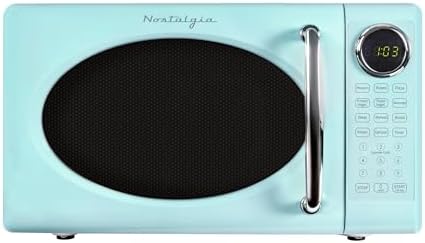


Brands like Nostalgia, Frigidaire, and Galanz build entire product lines around this exact look, and it’s the style that dominates “cute microwave”.
Vintage is a looser term people use for the same aesthetic, but it sometimes refers to actual older appliances rather than new retro-styled ones, worth clarifying before you shop secondhand.
Pastel and Kawaii-Minimalist Microwaves
Pastel and kawaii-minimalist microwaves drop the chrome entirely. Think flat matte pastel shells, sage green, blush pink, lavender — with simple button controls and no diner-style hardware.
This is the newer, quieter sibling of retro, and it fits a soft cottagecore or Japanese-minimalist kitchen far better than a chrome-handled model would.
If your room leans toward clean lines and muted color rather than nostalgic flair, this is the category to search, not “retro.”
Cute Microwave Comparison: Top Styles by Size, Wattage, and Price
| Style | Typical Capacity | Typical Wattage | Typical Price | Best For |
|---|---|---|---|---|
| Retro (chrome + enamel) | 0.7–1.1 cu ft | 700–1000W | $80–$140 | Dorms, first apartments, vintage kitchens |
| Pastel/kawaii minimalist | 0.7–0.9 cu ft | 700–900W | $70–$130 | Soft, minimalist decor, small counters |
| Standard compact (non-styled) | 0.7–1.2 cu ft | 700–1100W | $60–$120 | Budget shoppers who don’t care about looks |
| Retro + air fry combo | 0.9–1.2 cu ft | 900–1200W | $150–$250 | Buyers who want style and multi-function cooking |
Retro wins on personality and resale appeal. Comfee’s retro line alone comes in apricot, green, and red, and shows up repeatedly in “most stylish” picks.
Pastel wins if chrome hardware feels too loud for the room. The combo units cost more but solve the “I only have room for one appliance” problem entirely.
Wattage and Cooking Power: What You’re Trading for Style
A lower-wattage microwave is slower, not by a little, and not “it depends.” The wattage number directly sets how fast the magnetron heats your food, and most cute compact models land on the low end of that scale.
How Wattage Affects Cook Time
A 700W microwave takes noticeably longer to heat the same bowl of soup than a 1100W unit — often 30 to 50% longer, depending on the food.
That’s the real tradeoff behind almost every retro and pastel model, since compact styled units are built small and light, and a bigger magnetron doesn’t fit the case. It’s not a flaw.
It’s a size constraint you should expect going in, and it matters more for someone microwaving a full dinner plate than someone just reheating coffee.
Wattage Categories Explained (700W vs. 900W vs. 1100W+)
| Wattage Range | Speed | Typical Capacity | Best Match |
|---|---|---|---|
| 700W | Slowest — expect longer cook times | 0.7 cu ft | Single-serving reheats, dorm-rule compliance |
| 900W | Moderate | 0.9–1.0 cu ft | Small households, light daily cooking |
| 1000–1100W | Fast, close to full-size performance | 1.0–1.2 cu ft | Full meals, families, frequent cooking |
| 1200W+ | Fastest | 1.2+ cu ft | Combo/air fry units, heavy daily use |
Cute Microwaves for Dorm Rooms: Rules, Wattage Limits, and Sizing
Most colleges cap dorm microwaves at 700 watts, and that number isn’t arbitrary; it’s tied to how much load a shared dorm circuit can safely carry.
This is also, not coincidentally, the exact wattage most retro and pastel microwaves are built at. Shop by style in this category and you’re very likely already shopping inside the rules, though you should still confirm before you buy.
Typical College Wattage and Appliance Rules
- Most schools set a wattage cap around 700W for microwaves brought into dorm rooms, according to housing guidelines cited across multiple college resources.
- Many campuses allow only one microwave per room to avoid overloading shared circuits.
- Some housing offices require microwaves to be part of an approved combo unit (like a MicroFridge) rather than a standalone appliance — check your school’s specific policy before buying.
- Fire safety and electrical load are the two reasons cited most often for these limits, not the appliance’s size or appearance.
For the exact policy at your school, see dorm room appliance wattage rules.
Best Capacity for a Dorm Room (0.7 vs. 0.9 vs. 1.0+ cu ft)
| Capacity | Fits | Dorm Fit |
|---|---|---|
| 0.7 cu ft | Single mug, small bowl | Best for tight desks and shelves |
| 0.9 cu ft | Standard dinner plate | Good middle ground for one person |
| 1.0–1.2 cu ft | Large plates, bigger containers | Better for shared rooms or roommates who cook more |
For more on matching size to your actual counter or desk space, see the small microwave capacity.
Is a Cute Microwave Safe? Radiation, Noise, and Small-Space Placement
Yes, a cute microwave is exactly as safe as any other microwave sold in the US, because they’re all built to the same federal radiation standard regardless of color or shape.
The real question buyers are actually asking is whether it is fine to keep this small appliance three feet from where I sleep or sit, which has a specific, sourced answer.
FDA Radiation Safety Standards for Microwave Ovens
| Standard | Detail |
|---|---|
| Governing regulation | 21 CFR 1030.10, enforced by the FDA |
| Leakage limit | 5 milliwatts per square centimeter (mW/cm²), measured at roughly 2 inches (5 cm) from the oven surface |
| Falloff at distance | Emission drops to about 1/100th of that level by 20 inches away |
| Required safety feature | Two independent interlock systems that stop microwave production the instant the door opens or the latch releases |
| Practical takeaway | A microwave in good condition, kept even a couple of feet from a bed or desk, sits well below any level associated with harm |
This applies regardless of how small or styled the unit is; the standard doesn’t change for a pastel model versus a stainless steel one.
The one caveat: a damaged door seal, hinge, or latch can raise leakage, so a secondhand retro microwave bought for looks is worth inspecting closely before you plug it in.
Noise Levels in Compact and Retro Models
- Lower-wattage compact microwaves generally run quieter than large 1200W+ units, simply because the fan and magnetron are smaller.
- Retro-style models with a mechanical pull handle can be louder on open/close than push-button units, which matters in a shared dorm room at odd hours.
- Some compact models include a sound on/off setting specifically for shared spaces, letting you mute the completion beep.
- If noise is a dealbreaker, check for a listed “sound control” or “quiet mode” feature before buying — it’s not standard across every cute model.
Cute Microwave Brands Worth Buying (and Which to Skip)
Brands With a Reliable Retro/Pastel Lineup
- Comfee’s retro line in apricot, green, and red, for dorms
- Nostalgia specializes almost entirely in retro-styled small appliances, including a 1.1 cu ft, 1000W retro microwave with 12 preset settings.
- Galanz offers retro microwaves in a wider color range, including surf green, with an enamel exterior that resists visible fingerprints.
- Frigidaire’s retro line is compact (0.9 cu ft) for dorms because of its blend of style and basic function.
Warning Signs of a Poorly Made Cute Microwave
- A missing or unclear wattage listing on the product page — legitimate microwaves state this clearly, and an omission is a red flag.
- No visible UL or FDA compliance labeling, which every legally sold microwave in the US is required to have.
- Reviews repeatedly mention a loud buzzer with no way to disable it, a common complaint on some budget retro models.
- A door handle or hinge described as flimsy in multiple reviews — this is the exact failure point that can compromise radiation sealing over time.
Which Cute Microwave Should You Buy? (Decision Guide)
- Check your dorm or building’s wattage rule first. If it’s capped at 700W, narrow your search to that range before you fall in love with a specific color.
- Decide retro or pastel based on your room, not the internet’s favorite. Chrome and enamel read as vintage; flat matte color reads as minimalist.
- Match capacity to what you’ll actually cook. A single mug and a bowl of soup fit 0.7 cu ft fine; a full dinner plate wants 0.9 cu ft or more.
- Factor in noise if you’re sharing a room. Look specifically for a sound-off or quiet mode listed in the product specs.
- Confirm the safety basics before buying secondhand. A clean door seal and visible compliance label matter more than the color once you’re past the aesthetics.
Frequently Asked Questions
What is the cutest microwave you can buy?
That depends on your style lane: chrome-handled retro models from Nostalgia and Galanz lead the diner-style category, while flat matte pastel units lead the minimalist category. Neither is objectively “cutest”; it comes down to whether your room leans vintage or minimalist.
Are retro microwaves actually good?
Yes, for their intended use. They perform on par with similarly priced standard microwaves in the same wattage class — the retro shell doesn’t change the cooking performance, only the exterior.
What wattage microwave is best for a dorm room?
700W is the safest default, since it’s the most common wattage cap set by colleges. Confirm your specific school’s policy, since some allow up to 900W.
Do colleges allow microwaves in dorm rooms?
Most do, typically with a wattage cap around 700W and a one-per-room limit. Some require combo units instead of standalone microwaves, so check your housing policy directly.
Is a low-wattage microwave slower?
Yes, noticeably. A 700W unit can take 30 to 50% longer than a 1100W unit to heat the same amount of food.
What size microwave do I need for a dorm?
0.7 cu ft fits a mug or small bowl and suits tight desks; 0.9 cu ft handles a standard dinner plate and works better if you cook more than reheat.
Are pastel microwaves more expensive than regular ones?
Not significantly. Pastel and retro models typically run $70–$140, which overlaps heavily with standard compact microwave pricing in the same wattage range.
Is it safe to have a microwave close to my bed?
Yes, under normal conditions. The federal leakage limit is 5 mW/cm² at 2 inches from the unit, dropping to about 1/100th of that by 20 inches — well below any level linked to harm.
What brands make retro-style microwaves?
Comfee’, Nostalgia, Galanz, and Frigidaire all build dedicated retro lines with consistent color options and reliable reviews.
Can a cute microwave fit on a small counter without ventilation issues?
Yes, standard countertop microwaves in the 0.7–0.9 cu ft range don’t require special ventilation — just a few inches of clearance around the vents, which the manual will specify.
How loud are compact microwaves?
Generally quieter than full-size units due to smaller fans and magnetrons, though mechanical pull-handle retro models can be louder on opening and closing than push-button styles.
What’s the difference between retro and vintage microwave styles?
Retro refers to new microwaves styled after 1950s design, chrome handles, and enamel shells. Vintage more often refers to actual older appliances, which may not meet current safety or efficiency standards.
About the Author & Reviewer
Sarah Emirone, Author
Sarah researches and writes SafeKitchn’s dinnerware and kitchenware guides, with a focus on material safety, lead content, and manufacturer specifications. She cross-references product data sheets, safety certifications, and regulatory filings (including FDA and Prop 65 records) before publishing, and updates articles when new information becomes available.
James Daniels, Reviewer
James reviews SafeKitchn’s material safety content for scientific accuracy. He holds a B.Sc in inorganic chemistry and works as a materials researcher, with particular focus on the composition and safety behavior of glass, ceramic, and metal used in kitchenware.