

There is no evidence of a formal recall covering Corelle dinnerware. The question usually comes up because older, decorated Corelle pieces may contain lead in their printed patterns, and because some people have reported plates breaking.
Those are separate issues. A recall would normally mean a company or regulator has identified a specific safety problem and offered a remedy.
Lead concerns about older decorated dishes do not, by themselves, amount to a recall.
Written by Sarah Emirone | Reviewed by James Daniels, B.Sc, Inorganic Chemist & Materials Researcher | Updated September 2026 | See How We Test | Filed under: Buying, Care & Product Guides
Has Corelle Dinnerware Ever Been Recalled?
SafeKitchn could not find a Corelle dinnerware recall in the U.S. Consumer Product Safety Commission’s recall listings, the FDA’s recall and safety-alert resources, or Corelle’s own product information.
The CPSC maintains a searchable database of recalls and product safety warnings, and its current listings do not show a Corelle dinnerware recall.
Corelle’s FAQ likewise addresses lead, breakage, and warranty coverage, but does not announce a recall.
That does not mean every Corelle dish is risk-free. It means that, based on the available official records, no formal recall has been issued for Corelle dinnerware.
Recall vs Safety Warning vs Company Statement
- Recall: A formal action in which a company or regulator identifies a safety issue and generally offers a remedy, such as a refund, repair, or replacement.
- Safety warning: A public notice that flags a hazard but does not necessarily provide a remedy.
- Company statement: A manufacturer’s position on its product. Corelle’s statement that its vintage dishes are suitable for everyday use is a company statement, not an independent government finding.
- Independent testing: Results from a person or organization outside the manufacturer. These can be useful, but they do not create a recall or require a company to replace a product.
The distinction matters. If a product is recalled, the notice should identify the affected product and explain what remedy is available.
The CPSC’s recall database is the place to check for that kind of notice.
What CPSC and FDA Records Show
| Source checked | Search or review | Result | Date checked |
| CPSC recall listings | Search for Corelle dinnerware recalls | No Corelle dinnerware recall surfaced | Nov. 10, 2026 |
| FDA recalls and safety alerts | Search for Corelle dinnerware recalls | No Corelle dinnerware recall surfaced | Nov. 10, 2026 |
| Corelle’s official FAQ | Full-page review | Addresses lead, breakage, and warranty; no recall announced | Nov. 10, 2026 |
If you want to check another product yourself, see how to check a product recall.
Why So Many People Believe There Was a Recall
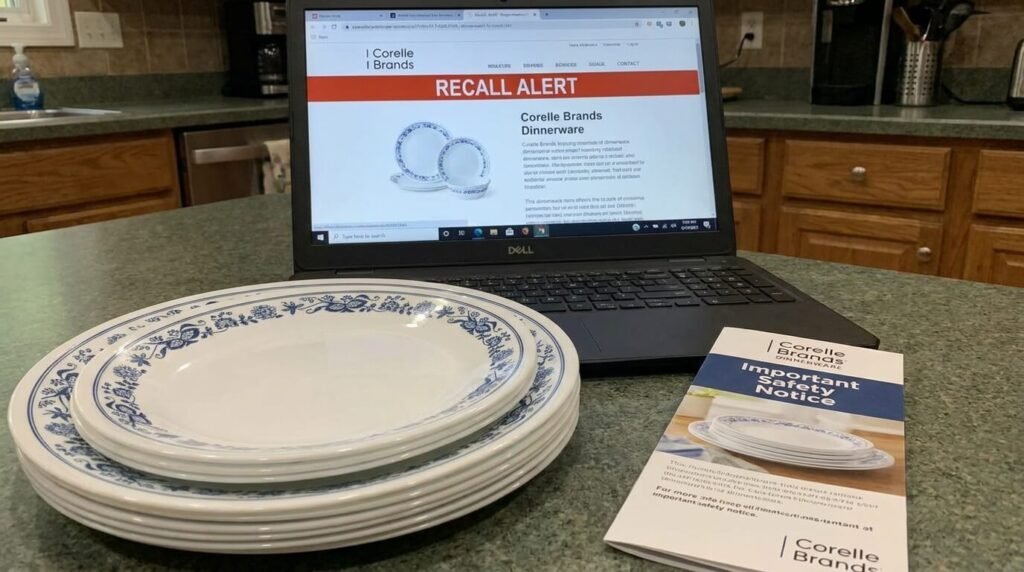
The confusion is understandable. Online posts about older Corelle often mix together lead testing, breakage complaints, and claims that a recall “should” have happened.
But none of those things is the same as a recall. A recall requires a formal action and usually a remedy; a concern about lead in old decorations, or a report that a plate broke, does not.
Which Corelle Dishes Raise Lead Concerns?
The main concern involves older Corelle dishes with printed decoration, particularly pieces made before 2000.
Corelle says that before 2000, a small amount of lead was used in the decorating process for many household products.
That does not mean every older Corelle plate releases lead into food. It means the decoration may contain lead, so the condition and use of the dish matter.
Pre-2000 and Pre-2005 Decorated Pieces
| Era | Decoration | Corelle’s position | What it means for you |
| Before 2000 | Printed patterns | Lead was used in decorating; Corelle says tested vintage patterns comply with current FDA lead-safety regulations | Treat as potentially lead-containing decoration |
| 2000 to 2005 | Printed patterns | Corelle’s current FAQ does not provide a separate public statement for this period | Follow the manufacturer’s care instructions and avoid damaged decorated pieces |
| After 2005 | Printed patterns | Corelle says its products meet applicable federal and state safety regulations and are routinely tested at third-party laboratories | Follow the maker’s care instructions |
Corelle says it routinely tests current Corelle products for lead and cadmium at internationally recognized third-party laboratories, and that the results confirm compliance with applicable federal and state safety regulations.
Plain White vs Decorated Corelle
| Feature | Plain white or cream | Decorated, pre-2000 |
| Painted decoration | None, apart from the backstamp | Printed pattern, often on the food surface |
| Corelle’s position | Current products comply with applicable regulations | Tested vintage patterns comply with current FDA lead-safety regulations |
| Practical concern | Lower | Depends on the decoration, condition, and use |
Corelle’s FAQ says its Vitrelle glass dinnerware is made from three layers of glass and that the company’s manufacturing process encapsulates decoration in glass at very high temperatures.
It says this is intended to reduce lead migration to food.
How to Tell If Your Corelle Is Vintage
- Turn the dish over and look at the backstamp.
- Check whether there is printed decoration on the food-contact surface.
- Find the pattern name if you can.
- Send clear photos of the front and back to Corelle’s Customer Care Center if you need help identifying it.
- If you cannot date the piece, treat it cautiously, especially if the decoration is worn.
Corelle says its backstamp has changed over the years and that current pieces are marked “Corelle Vitrelle Made in the USA.”
It also says customers can send photos of the front and back of a dish to its Customer Care Center for help identifying a pattern.
If you are stuck on the pattern, this guide explains how to identify your Corelle pattern.
What Corelle Has Said About Lead, in Order
Corelle’s current position is that vintage dishes made before 2000 were tested by an outside laboratory and comply with current FDA lead-safety regulations.
It says the lead used in pre-2000 decorations was encapsulated in glass and fired above 750°C.
The 2022 Statement: Tested Back to 1978
Corelle says it selected multiple vintage patterns dating back to 1978 for testing.
The company says the test looked at whether lead could leach from the food-contact surface in amounts above today’s acceptable lead-safety regulations.
Based on that testing, Corelle says the vintage products it tested comply with current FDA lead-safety regulations and can be used for everyday dinnerware.
Where the Statements Conflict
| Point | Corelle’s current FAQ |
| Cutoff year | Before 2000 |
| Recommended use | Everyday use is fine for the vintage patterns Corelle says were tested |
| Testing basis | Outside laboratory testing of multiple vintage patterns dating back to 1978 |
| How lead is described | A small amount used in decoration, encapsulated in glass and fired above 750°C |
The company’s statement is clear about what it says it tested. It does not, however, provide a public test report that would let an independent reader examine every pattern, every condition of use, or every possible result.
Lead in the Paint vs Lead in Your Food: Reading the Test Claims
A high reading for lead in a decoration does not automatically mean the plate is releasing a dangerous amount of lead into food. These are different measurements.
What XRF “ppm” Readings Measure
XRF stands for X-ray fluorescence. It is a way to measure the total amount of an element, such as lead, in a material or surface.
The CPSC says XRF technology can be used, with limitations, to test certain homogeneous materials, including crystal, ceramic, and other siliceous materials.
But an XRF reading does not, by itself, tell you how much lead will move from a dish into food.
What FDA Leaching Tests Measure
A leach test measures whether lead moves from the food-contact surface into a food-simulating liquid.
The FDA explains that lead can migrate from poorly made ceramicware into food or drink, and that its concern is the amount that leaches out.
That is why a lead-containing decoration and a passing leach result can both be true. The first tells you what is in the decoration; the second asks what, if anything, reaches the food.
Why Both Can Be True
Corelle’s explanation is that its decoration is sealed within glass and fired at high temperature, which it says reduces lead migration to food.
That explanation is plausible, but it does not settle every question. A test result depends on the particular piece tested, its condition, the test method, and the conditions of use.
A dish that has been scratched, chipped, or heavily worn may not behave the same way as a newer or better-preserved example.
What Neither Test Establishes
- A single XRF reading does not establish how much lead reaches food.
- A single leach test does not establish how a dish will perform after years of use.
- Neither test replaces medical advice if someone may have been exposed to lead.
- The FDA says no amount of washing, boiling, or other treatment can remove lead from pottery.
Should You Keep Using Vintage Corelle?
For older decorated Corelle, the cautious approach is to avoid using damaged pieces for food and to be especially careful with children, pregnant people, and acidic or hot foods.
Plain white or cream pieces without printed decoration are the simpler choice.
Corelle says the vintage pieces it tested can be used for everyday dinnerware.
The FDA, however, advises consumers to avoid using ceramicware with leachable lead for cooking, serving, or storing food or drinks, and says that damaged or excessively worn ceramicware deserves particular caution.
When replacing dishes, compare lead-free dinnerware options before buying.
Keep, Limit or Retire: Five Questions
- Is there printed decoration on the dish?
- Is that decoration on the surface that touches food?
- Is the decoration worn, scratched, or chipped?
- Do children or pregnant people use the dish?
- Do you serve acidic or hot foods on it?
| Situation | Sensible approach |
| Plain white or cream, no printed decoration | Keep using it |
| Decorated but intact, used occasionally by adults | Use with caution |
| Decorated and used by a child or pregnant person | Consider retiring it from food use |
| Decorated, worn, scratched, or chipped | Stop using it for food |
The FDA says children and developing fetuses can be affected by chronic exposure to lead at levels that may not cause obvious symptoms, and it advises talking with a healthcare professional about blood lead testing when a child may have been exposed.
Households With Children or Pregnancy
The simplest option is to use plain white or newer Corelle for children’s meals.
If a child or pregnant person has regularly eaten from older decorated dishes and you are concerned, speak with a doctor about whether blood lead testing is appropriate.
The CPSC says no safe blood lead level has been identified and that a simple blood test is the best way to find out whether a child has been exposed to lead.
How to Test Your Dishes at Home
Our guide on how to test dishes for lead at home covers kits in more detail. In short:
- Buy a lead test swab kit intended for ceramics or glass.
- Test the printed decoration on the food-contact surface, not the plain glass around it.
- Follow the kit’s instructions exactly.
- Treat a positive color change as a reason to stop using the piece for food.
- Treat a negative result as limited reassurance, not proof that the dish is safe.
The FDA says home lead-testing kits can change color when lead leaches onto the swab, and it strongly advises against using pottery with leachable lead for cooking, serving, or storing food or drinks.
Do Corelle Shattering Complaints Mean a Recall?
No. Breakage complaints do not establish a recall. Corelle says all glass is breakable and that its three-year Vitrelle warranty does not cover accidental breakage from impact.
Why Vitrelle Glass Can Break Suddenly
Corelle describes Vitrelle as a tempered glass made by thermally bonding two clear outer layers to a white or beige core layer.
The company says this construction makes the dinnerware durable, but it also acknowledges that all glass can break.
Corelle’s use and care instructions say not to use chipped, cracked, or severely scratched items because damaged pieces may break or shatter without warning.
It also warns against sudden temperature changes, such as adding liquid to a hot dish or placing a hot dish on a wet surface.
Corelle vs Pyrex: Two Different Records
| Dimension | Corelle Vitrelle dinnerware | Pyrex glass bakeware |
| Material | Three-layer laminated tempered glass | Glass bakeware |
| Recall record | No Corelle dinnerware recall found in SafeKitchn’s review | Check the CPSC database for the specific product and model |
| Company position | All glass is breakable; accidental breakage is not covered by the warranty | Follow the product-specific care instructions |
| Main concern | Impact damage and sudden temperature changes | Follow the product-specific care instructions |
It is best not to treat a breakage report as evidence of a defect without a manufacturer or regulator identifying a specific issue.
Corelle’s official guidance focuses on avoiding impact, sudden temperature changes, and use of damaged pieces.
Older Pyrex has its own lead questions, covered in vintage Pyrex lead concerns.
Warranty and Replacement
Corelle Vitrelle glass dinnerware carries a limited three-year warranty against breakage, chipping, and staining under normal household use. The warranty does not cover accidental breakage.
Corelle Coordinates carry a limited one-year warranty from the date of purchase.
If an item arrives broken, Corelle says to contact it through its online form and keep the product, since the company may ask for it back.
How to Check Any Product Recall Yourself
Search the CPSC’s recall listings and the FDA’s recalls and safety alerts using the brand and product name. Then compare the notice’s model, pattern, or date information with the item you own.
Searching CPSC, FDA, and Health Canada
- Search the CPSC’s recall database by company and product.
- Check the FDA’s recalls and safety alerts for food-contact products.
- In Canada, check Health Canada’s recalls and safety alerts database.
- Match the pattern, model, and date information before assuming a recall applies to your dish.
- Sign up for recall alerts if you want notices sent directly to you.
Spotting Fake “Recall Information” Pages
- Check that the page is on the manufacturer’s official domain.
- Look for a specific model, pattern, or date range.
- Look for a clear remedy, such as a refund, repair, or replacement.
- Be cautious with pages that use the brand name repeatedly but provide no official notice or remedy.
- Confirm the information on the manufacturer’s site or a government recall database.
Reporting a Problem
- Stop using the item if it is chipped, cracked, or severely scratched.
- Take photographs and keep any packaging or receipt.
- Contact Corelle through the contact form on its website.
- Report a safety problem to the CPSC through SaferProducts.gov.
- If you are worried about lead exposure, speak with a doctor.
Corelle says damaged items may break or shatter without warning, and it directs customers to its online contact form for product questions or concerns.
A Corelle dinnerware recall question is really a question about evidence: what a regulator has said, what the manufacturer has said, and what independent testing can and cannot show.
The same approach applies to pans, storage containers, and cutlery as much as plates. SafeKitchn’s kitchenware safety guides are the next place to go for pattern identification, home testing, and safer replacements.
Check the backstamp on your oldest Corelle plate tonight, then keep SafeKitchn bookmarked for the next dishware recall or lead alert.
About the Author & Reviewer
Sarah Emirone, Author
Sarah researches and writes SafeKitchn’s dinnerware and kitchenware guides, with a focus on material safety, lead content, and manufacturer specifications. She cross-references product data sheets, safety certifications, and regulatory filings (including FDA and Prop 65 records) before publishing, and updates articles when new information becomes available.
James Daniels, Reviewer
James reviews SafeKitchn’s material safety content for scientific accuracy. He holds a B.Sc. in inorganic chemistry and works as a materials researcher, with a particular focus on the composition and safety behavior of glass, ceramic, and metal used in kitchenware.