

Yes, Corelle mugs are microwave safe, but not for the reason most people assume.
Before you reheat your morning coffee, there is one fact worth knowing: Corelle mugs are made of stoneware, not the famous Vitrelle glass that makes Corelle plates nearly shatter-proof.
That material difference changes how the mugs behave in the microwave, what can go wrong, and whether Corelle’s warranty has your back if something breaks.
This guide covers the official manufacturer rules, the risks most articles miss, and a practical safety check you can do at home in 30 seconds.
Written by Sarah Emirone | Reviewed by James Daniels, B.Sc, Inorganic Chemist & Materials Researcher | Updated September 2026 | See How We Test | Filed under: Buying, Care & Product Guides
What Are Corelle Mugs Made Of? (Not What You Think)
Most Corelle owners are surprised to learn that Corelle mugs are stoneware or porcelain, not the Vitrelle glass used for plates and bowls.
Corelle’s own FAQ states this plainly: “The glass lamination process used for Corelle ware is ideal for making plates and bowls, but it unfortunately does not work well for cup or mug shapes.”
That is why every Corelle dinnerware set ships with Vitrelle glass vs stoneware: Corelle’s material difference is explained on plates alongside stoneware mugs, two completely different materials under one brand name.
Why Corelle mugs are stoneware, not Vitrelle glass
Vitrelle is a patented three-layer thermally bonded glass sandwich. It is lightweight, non-porous, and extremely resistant to chips and breaks under normal use.

- 4-PIECE SET: Set includes (2) 13-1/2-inch tumblers with solid glaze, each with a lid. This set can be paired with Corell…
- STONEWARE CRAFTSMANSHIP: Boasting artisanal effects and color variations in its handcrafted make, Corelle’s stoneware pi…
- CONVENIENCE IN A DISH: These stoneware travel mugs are great for all settings. Tumblers come with non-toxic silicone lid…
The lamination process requires flat or gently curved forms, which is why it works beautifully for plates and bowls.
Mug shapes with their curved walls, hollow handles, and joined seams cannot be produced using this method. Corelle therefore uses clay-based stoneware and glazed porcelain for its mugs, the same materials used broadly across the ceramic dinnerware industry.
This matters because stoneware behaves differently in the microwave than Vitrelle glass, and almost every competing article gets this wrong by applying Vitrelle’s properties to the mugs.
How does stoneware behave differently in the microwave than glass dinnerware
| Property | Corelle Vitrelle Plates/Bowls | Corelle Stoneware Mugs |
|---|---|---|
| Material | Triple-layer laminated glass | Clay-based stoneware or porcelain |
| Porosity | Non-porous | Porous at unfinished foot |
| Microwave certified | Yes | Yes |
| 3-year warranty | Yes | No — explicitly excluded |
| Risk if microwaved empty | Overheating /breakage | Overheating /breakage |
| Risk if microwaved wet | Low | High — glaze cracking is possible |
| Max recommended oven temp | 350°F (176°C) | 350°F (176°C) |
Are Corelle Mugs Microwave Safe? The Official Manufacturer Answer
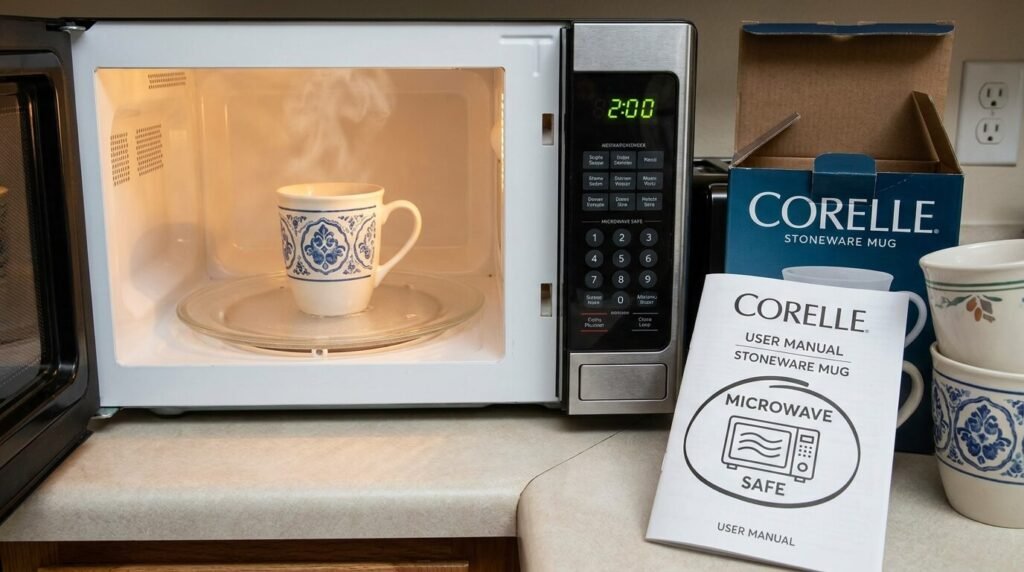
Yes. Corelle’s official safety page states: “Porcelain and stoneware mugs are microwavable.” The mugs are certified for reheating food and beverages in the microwave when used according to the manufacturer’s guidelines.
This is not a grey area. Corelle is explicit about it. For the full picture across all Corelle product types, see the complete Corelle microwave safety guide.

What Corelle’s official guidelines actually say (and what they don’t)
The official use-and-care page gives these hard limits for all Corelle mugs:
| Rule | Detail |
|---|---|
| Maximum heat (oven) | 350°F / 176°C in a preheated conventional oven |
| Microwave use | Permitted for reheating and serving |
| Empty vessel | Never microwave an empty mug |
| Wet/soaked mug | Never microwave a mug that has soaked in water |
| Browning element | Do not use under a microwave browning element |
| Toaster oven | Not permitted |
| Stovetop | Never — including for warming |
| Chipped or cracked mugs | Stop use immediately |
What the guidelines do not specify is time. Corelle does not publish a maximum microwave duration for mugs, which leads many users to overheat them.
The widely cited safe range is 2 to 5 minutes on moderate power for reheating a liquid, though shorter sessions are always preferable.
The warranty exclusion for Corelle mugs you need to know
Corelle’s 3-year warranty covers what it covers and what it doesn’t cover. Vitrelle glass dinnerware plates, bowls, and select accessories — against cracking, chipping, and breakage under normal household use for three years from purchase.
Stoneware and porcelain mugs are explicitly excluded from this warranty. The mugs are manufacturer-certified as microwave safe, but if yours cracks or breaks in the microwave, there is no warranty claim available.
| Product Type | Microwave Safe | Warranty Coverage |
|---|---|---|
| Vitrelle glass plates & bowls | Yes | 3-year breakage warranty |
| Stoneware / porcelain mugs | Yes | No warranty — explicitly excluded |
| MilkGlass dinnerware | Yes | Separate terms apply |
This does not mean the mugs are unsafe. It means stoneware is inherently more fragile than Vitrelle glass, and Corelle prices the warranty risk accordingly.
How to Safely Microwave a Corelle Mug
Corelle mugs are microwave safe when used correctly. Follow these steps every time to stay within the manufacturer’s guidelines:
- Check the mug is completely dry — including the base. If the mug came straight out of the dishwasher or was left standing in water, dry it fully before microwaving. See the soaking risk section below for why this step matters more than most people realise.
- Make sure the mug has liquid in it. Never microwave an empty stoneware mug. The liquid absorbs the microwave energy; without it, the mug absorbs it instead.
- Use medium power (50–70%) rather than full power, especially for longer heating sessions.
- Keep sessions short. Reheat in 60-to-90-second intervals rather than one long run. Stir between intervals to distribute heat.
- Use a dry potholder when removing the mug. Corelle’s own FAQ recommends this because stoneware can heat unevenly, and the exterior may be hotter than expected.
- Do not add cold liquid to a hot mug. Thermal shock can cause cracking. Let the mug cool before refilling.
Time and power guidelines for reheating beverages
| Beverage | Starting Temp | Recommended Time | Power Setting |
|---|---|---|---|
| Coffee (room temp) | ~70°F | 60–90 seconds | 70% |
| Tea (room temp) | ~70°F | 60–90 seconds | 70% |
| Coffee (refrigerator cold) | ~38°F | 90–120 seconds | 60% |
| Soup or broth | ~38°F | 2–3 min, stir halfway | 60–70% |
| Hot chocolate | ~70°F | 60 seconds | 70% |
Do not attempt to bring water to a boiling point in a Corelle mug. Stoneware is not designed to sustain that level of sustained high-heat exposure safely.
The hidden risk: microwaving a wet or soaked stoneware mug
This is the most underreported safety risk with Corelle mugs and the one most likely to cause a crack or breakage that feels sudden and inexplicable. Here is what actually happens:
- A Corelle stoneware mug has an unfinished foot — the small raised ring on the base is not fully glazed.
- That unfinished area is porous clay, which absorbs water when the mug soaks in a dishwasher pool, a sink, or even stands in a small puddle.
- When that mug goes into the microwave, the absorbed water inside the stoneware body superheats rapidly.
- Steam pressure builds inside the clay walls and glaze boundary.
- The result is glaze cracking from the inside out, or in severe cases, sudden breakage.
Corelle’s official use-and-care instructions state: “DO NOT allow stoneware products to soak/stand in water for an extended period of time; applied heat after soaking may cause glaze cracking.” Always dry the base of your Corelle mug completely before placing it in the microwave.
What You Should Never Do With a Corelle Mug in the Microwave
The following behaviours are prohibited by Corelle’s official safety guidelines. Each one can cause immediate or delayed breakage — sometimes with no visible warning before failure:
- Never microwave an empty Corelle mug. Without liquid to absorb the microwave energy, the stoneware absorbs it directly, causing rapid temperature rise that can crack or shatter the mug.
- Never use the microwave’s browning or grilling element with a Corelle mug. This exposes the mug to direct radiant heat it is not rated for.
- Never put a chipped, cracked, or crazed mug in the microwave. Even fine hairline cracks that are invisible during normal use become structural failure points under microwave heat stress.
- Never use a toaster oven as a substitute microwave for Corelle mugs. Toaster ovens use direct radiant heat rather than microwave radiation, and Corelle products are not rated for this.
- Never add cold liquid to a hot Corelle mug. The rapid temperature contrast can cause thermal shock cracking at the handle joint or base.
- Never place a hot Corelle mug on a wet or cold surface immediately after microwaving. Set it on a dry trivet, cloth, or cooling rack instead.
Why an empty Corelle mug must never go in the microwave
When a microwave runs, the energy it emits is absorbed by polar molecules, primarily water inside the food or drink.
With liquid present, the mug itself stays relatively cool because the drink absorbs heat. Without any contents, every watt of microwave energy is directed into the mug’s stoneware body.
Stoneware heats far faster than the microwave’s timer assumes, and localised overheating at thin points, particularly around the handle junction, can cause the mug to crack suddenly, sometimes several minutes after the microwave has stopped running.
Cracked or chipped mugs: when to stop microwaving and throw them out
Use this checklist before every microwave session. If the answer to any of these questions is yes, retire the mug from microwave use immediately:
- Is there a visible chip anywhere on the rim, body, or handle?
- Is there a hairline crack visible when you hold the mug up to the light?
- Does the glaze show a network of fine lines (crazing) across the surface?
- Did the mug previously crack in the dishwasher or near extreme heat?
- Does the mug rock or sit unevenly, suggesting the base has warped or cracked?
A cracked or chipped mug can survive normal use for some time before failing, which makes it feel safe when it is not. Under microwave heat stress, these structural compromises become unpredictable breaking points.
Are Vintage Corelle Mugs Microwave Safe?
Is vintage Corelle safe to use today is a fair question, particularly for mugs manufactured before 2000.
Vintage Corelle dinnerware used small amounts of lead in decorative glazes, a standard industry practice of that era. The relevant question is whether that lead can migrate into food or drink during microwave use.
The pre-2000 lead decoration issue
Corelle’s manufacturing process encapsulated lead-containing decorations within glass layers, which were fired at temperatures above 750°C before and after decoration was applied.
This encapsulation process was designed to prevent lead from reaching food-contact surfaces. Corelle has conducted food-surface contact testing on pre-2000 products and confirmed that the tested items comply with current FDA lead-safety regulations.
The FDA’s standard for lead migration from ceramics is 0.5 micrograms per millilitre for cups and mugs. Corelle’s vintage pieces tested below this threshold.
That said, the older the mug and the more wear on its decoration, the lower the confidence in that encapsulation remaining intact. Any vintage mug with visibly worn, scratched, or flaking decoration should be removed from regular food use and not microwaved.
How to test your old Corelle mug before microwaving it
- Visual inspection first. Hold the mug under a bright light and examine all decorated areas for chipping, scratching, fading with a metallic sheen, or areas where the glaze appears worn through. If any decoration looks compromised, stop here and retire the mug.
- Lead test kit check. Consumer lead test kits (available at most hardware and home goods stores) can be swabbed across decorated areas on the mug’s interior. A colour change indicates detectable lead at the surface. If the test is positive, do not use the mug for hot beverages.
- The 30-second microwave safety check. Fill the mug with 6oz (180ml) of cold water. Microwave on high for 30 seconds. Immediately feel both the water and the mug’s exterior wall. If the mug body is noticeably hotter than the water, the stoneware is absorbing microwave energy abnormally — a sign of possible mineral deposits, absorbed moisture, or internal glaze crazing. Retire that mug from microwave use. If the water is warmer than the mug, the mug is behaving correctly.
Corelle Mug vs Other Mugs: Which Is Safest for Microwave Use?
Corelle stoneware mugs are a reliable everyday microwave choice for reheating beverages, but they are not the toughest option available for high-heat tasks. Here is how they compare:
| Mug Type | Microwave Safe | Dishwasher Safe | Risk Level | Best For |
|---|---|---|---|---|
| Corelle stoneware | Yes | Yes (with care) | Medium — porous base risk | Everyday reheating |
| Standard ceramic | Usually (check label) | Usually | Medium | General use |
| Glazed porcelain | Yes | Yes | Low–Medium | Everyday use |
| Borosilicate glass | Yes | Yes | Low — most stable | High-heat tasks, boiling |
| Tempered glass | Yes | Yes | Low | High-heat tasks |
| Plastic (microwave-safe) | Label dependent | Label dependent | Variable | Short, low-power sessions |
| Metal / metallic rim | Never | Varies | High | Not microwave compatible |
For tasks like bringing water to a boil, making oatmeal, or extended high-power heating sessions, a borosilicate glass mug is a more forgiving choice than stoneware.
Are Corelle mugs dishwasher safe, too?
Yes — Corelle stoneware mugs can go in the dishwasher. However, the same porous foot that creates the microwave soaking risk also applies here. Follow these rules to avoid problems:
- Do not allow mugs to sit in standing water at the bottom of the dishwasher during or after the cycle.
- Remove mugs promptly after the drying cycle completes; do not leave them in a humid dishwasher overnight.
- Load mugs upright so the unfinished foot points down, away from direct spray that could force water into the base.
- Avoid soaking Corelle mugs in the sink before dishwashing — a quick rinse is sufficient.
For full details on stoneware care and the dishwasher, see Corelle dishwasher safety rules for stoneware mugs.
When to choose a different mug for high-heat microwave tasks
- You are boiling water or heating liquid above 180°F (a rolling simmer or boil) — use a borosilicate glass mug or a microwave-safe glass measuring cup instead.
- You are running the microwave at full power for more than 3 continuous minutes — the extended exposure raises the risk of the stoneware overheating.
- The mug has any visible glaze damage, crazing, or a chipped handle — do not risk it in the microwave regardless of brand.
- You are reheating very high-fat foods (butter, oil, cream-heavy drinks) — fats superheat faster than water and can exceed safe thresholds for stoneware more quickly than typical beverages.
For the top-rated alternatives, see the best microwave-safe mugs for high-heat tasks.
Frequently Asked Questions About Microwaving Corelle Mugs
Why does my Corelle mug get hotter than the drink inside?
If the mug body is noticeably hotter than the liquid it contains, the stoneware is absorbing microwave energy, which it should not do significantly in normal operation.
This usually indicates the mug has absorbed moisture through its porous base, has internal glaze crazing, or has mineral buildup. Run the 30-second test described above and retire the mug if it fails.
Can I microwave a Corelle mug with a metallic rim?
No. Any Corelle mug with gold, silver, or metallic painted decoration must not go in the microwave.
Metal causes arcing (sparking) in a microwave and can damage both the mug and the appliance. Check the base of your mug if it carries a “not for microwave use” symbol, which overrides any general brand guidance.
My Corelle mug cracked in the microwave — why?
The most likely causes are: (1) the mug had absorbed water through its unfinished base before being microwaved, causing internal steam pressure to crack the glaze; (2) the mug had an existing chip or hairline crack that failed under heat stress; or (3) the mug was heated empty. Any of these failure modes is preventable by following the guidelines in this article.
Do Corelle stoneware mugs absorb water in the dishwasher?
Yes — the unfinished foot on the base of Corelle stoneware mugs is porous and can absorb water if the mug stands in pooled water during or after a dishwasher cycle.
This absorbed moisture is the direct cause of glaze cracking when those mugs are subsequently microwaved. Dry the base completely before every microwave session.
Is the unfinished foot of a Corelle mug a microwave risk?
Only if the mug has absorbed water through that foot before being microwaved. In a dry mug, the unfinished base poses no additional microwave risk beyond any other stoneware.
The risk is specifically created by the sequence: soaking → microwave heating.
Are Corelle mugs oven safe as well as microwave safe?
Yes, with limits. Corelle stoneware mugs can be used in a preheated conventional oven up to 350°F (176°C).
They cannot be used under a broiler, in a toaster oven, on a stovetop, or near any direct heat source. Always place mugs in a fully preheated oven — never put them in a cold oven and heat alongside it.
Can I heat soup in a Corelle mug?
Yes — reheating soup, broth, or other liquids in a Corelle stoneware mug is a normal use case. Use 60% to 70% power, heat in 60-second intervals, and stir between sessions.
Avoid heating very high-fat soups (cream-based, butter-heavy) at full power for extended periods, as fats superheat significantly faster than water-based liquids.
About the Author & Reviewer
Sarah Emirone, Author
Sarah researches and writes SafeKitchn’s dinnerware and kitchenware guides, with a focus on material safety, lead content, and manufacturer specifications. She cross-references product data sheets, safety certifications, and regulatory filings (including FDA and Prop 65 records) before publishing, and updates articles when new information becomes available.
James Daniels, Reviewer
James reviews SafeKitchn’s material safety content for scientific accuracy. He holds a B.Sc in inorganic chemistry and works as a materials researcher, with particular focus on the composition and safety behavior of glass, ceramic, and metal used in kitchenware.