Your family uses dinnerware three times a day, every day. Over a year, that is over a thousand contact points between your food and whatever your plates are made from.
For most households, those plates have never been evaluated for safety beyond the label on the box — and that label, as this guide will show, often tells less than it appears to.
The non-toxic dinnerware category has grown significantly in recent years as awareness of lead in ceramics, cadmium in glazes, and microplastics in composite materials has filtered into mainstream health conversations.
The result is a market full of products making safety claims — “lead-free,” “food-safe,” “natural,” “eco-friendly” — that mean very different things and in some cases mean nothing at all from a regulatory standpoint.
This guide cuts through that. It covers the chemicals that actually matter, the safest materials ranked by risk, the regulatory standards with their real numeric thresholds, how to test what you already own, and how to identify the handful of brands that publish their safety testing rather than simply marketing around it.
The tone throughout is evidence-based and specific because vague reassurance is not useful when you are deciding what your family eats every day.
What “Non-Toxic Dinnerware” Actually Means — and What It Doesn’t
The phrase “non-toxic dinnerware” has no legal definition under US, UK, or EU food safety law.
Any manufacturer can print it on a box regardless of what their products contain or what independent testing has found. The same applies to “natural,” “eco-friendly,” “safe,” and “healthy.” These are marketing choices, not regulatory designations.
“Lead-free” is more meaningful, but still requires careful reading. Under FDA rules, “lead-free” means different things depending on whether a manufacturer is using it as a product claim or as a regulatory compliance statement.
“FDA compliant” does not mean zero lead — it means the product leaches lead below the FDA’s action threshold, which allows measurable amounts of lead in food contact surfaces.
The distinction between genuinely lead-free and lead-below-threshold-safe is the most important concept in this entire guide, and it is the one most consistently obscured by the industry.
See our safe kitchen guide for the broader context of how dinnerware safety fits into overall kitchen toxin reduction.
The Chemicals That Matter in Dinnerware — and Where They Come From
Three categories of harmful chemicals are relevant to dinnerware safety. They come from different materials, become a problem under different conditions, and require different solutions.
Understanding which chemical comes from which material type is the foundation for making genuinely informed purchasing decisions.
Lead — the primary concern in glazed ceramics
Lead has been used in ceramic glazes for centuries because it lowers the melting temperature of the glaze, produces a brilliant gloss finish, and helps colours appear vivid and stable.
Modern food safety regulations have significantly restricted its use, but lead has not been eliminated from the dinnerware supply chain.
It remains present in vintage pieces made before lead restrictions took effect, in imported ceramics manufactured in countries with less stringent regulations, and in some domestically produced artisan pottery where glaze composition is not formally tested.
Lead leaches from glazed surfaces into food through two primary mechanisms: acid contact and physical wear. Acidic foods — tomatoes, citrus, vinegar-based dressings, coffee, tea — draw lead out of glaze more aggressively than neutral foods.
Physical damage to the glaze surface, including chips, cracks, and the cumulative erosion of repeated dishwasher cycles, increases the rate of leaching by exposing more surface area and disrupting the vitrified layer that otherwise slows migration.
Children are particularly vulnerable because their developing bodies absorb ingested lead at a significantly higher rate than adults, and lead accumulates in the body over time with no safe lower threshold established by health authorities.
Cadmium — the colour pigment hiding in bright glazes
Cadmium compounds — primarily cadmium sulphide and cadmium selenide — have been used as ceramic glaze pigments for over a century because they produce exceptionally vivid red, orange, and yellow colours that are difficult to achieve through other means.
The same properties that make them visually appealing make them concerning from a food safety perspective: cadmium is a heavy metal classified as a human carcinogen by the International Agency for Research on Cancer, accumulates in the kidneys over time, and leaches from glaze surfaces through the same acid-contact and physical-wear mechanisms as lead.
The visual signal is reliable: the more intensely coloured a ceramic piece, particularly in the red, orange, and yellow spectrum, the higher the probability that cadmium compounds were used in the glaze.
Cadmium is often found in conjunction with lead in high-risk pieces, particularly vintage and imported ceramics with vivid decorative colours.
For any brightly coloured ceramic dinnerware without independent third-party testing confirmation, the safest approach is to use the pieces for display rather than food service.
Formaldehyde, BPA, and microplastics — non-ceramic material concerns
The non-ceramic dinnerware category has its own set of chemical concerns.
Bamboo dinnerware marketed widely as an eco-friendly alternative is almost always made from laminated bamboo strips held together with adhesive resins, the most common of which is melamine-formaldehyde resin.
When heated, this binder releases formaldehyde, a compound classified as a human carcinogen at sustained exposure levels.
Bamboo dinnerware without resin binders exists but is rare and significantly more expensive; check explicitly for “formaldehyde-free adhesive” claims before buying.
Plastic dinnerware — including pieces marketed as BPA-free — carries two related concerns. BPA (bisphenol A) was removed from most consumer plastics over the past fifteen years following evidence of hormonal disruption, but its most common replacements — BPS (bisphenol S) and BPF (bisphenol F) — share similar chemical structures and are suspected to have comparable endocrine effects.
Beyond bisphenols, all plastics shed microplastics when heated, scratched, or washed repeatedly.
Melamine dinnerware specifically releases melamine and formaldehyde when exposed to hot food or acidic liquids, which is why it carries a universal “not for use with hot food” designation from food safety authorities, regardless of its other claimed properties.
Safest Dinnerware Materials — Ranked by Risk Level
The table below ranks dinnerware materials from lowest to highest risk based on their chemical composition, leaching potential, and the conditions under which harmful substances are released.
All rankings assume reputable manufacturer and correct use — cheap or damaged versions of any material can perform worse than indicated.
| Material | Risk level | Why | Best for | Key caveat |
|---|---|---|---|---|
| Glass (tempered, borosilicate, Vitrelle) | Very low | Non-porous, no glaze, no heavy metal risk | All everyday use | Decorative coatings on coloured glass can contain metals |
| Stainless steel (18/10) | Very low | Non-reactive, no coating, well-studied | Cold and warm food service | Avoid prolonged acidic food storage |
| Porcelain/ bone china (certified) | Low | High-temp firing produces a dense, low-porosity body | Every day and formal dining | Decorated pieces require independent certification |
| Stoneware (certified brands) | Low–moderate | Safety depends entirely on clay quality and glaze | Everyday use | Budget or imported stoneware significantly higher risk |
| Glazed ceramic (certified) | Moderate | Glaze composition and firing temperature are critical | Use with certification only | Plain white is safer than coloured or decorated |
| Melamine/plastic | High for heated use | Formaldehyde and microplastic release under heat | Cold food only — not for heating | No safe heated use regardless of labelling |
Glass — the safest option with no meaningful caveats
Tempered glass, borosilicate glass, and Corelle’s Vitrelle triple-layer glass are the safest dinnerware materials for health available because they share a fundamental property: they have no glaze.
A glaze is a glass-like coating fused to the surface of a ceramic body, and glazes are where lead and cadmium live. Glass dinnerware has no separate coating.

- SPACE SAVING AND LIGHTWEIGHT: Half the space and half the weight of traditional ceramics – Corelle Vitrelle is ultra sli…
- BUILT TO LAST: Our unique, three-layer tempered glass is resistant to chips & cracks and 3x more durable than traditiona…
- STACKABLE: Vitrelle’s slim profile means it stacks neatly in your cupboard and in your dishwasher.
The food-contact surface is the glass itself, which is non-porous, inert, and contains no heavy metals in any form that can migrate into food.
Independent XRF testing on plain glass dinnerware consistently returns non-detectable levels of lead, cadmium, arsenic, and mercury.
The one caveat applies to decorative glass: coloured glass pieces or glass with painted-on decoration can carry the same glaze-related risks as ceramic. Clear or plain white glass carries none of those risks.
Stainless steel — safe for food service, not for prolonged acidic storage
Food-grade stainless steel in the 18/10 grade (18% chromium, 10% nickel) is non-reactive under normal food service conditions and well-studied as a safe material for plates, bowls, and cutlery.
There is some evidence that trace amounts of nickel and chromium migrate into food during prolonged contact with very acidic substances — tomato sauce stored overnight in a stainless bowl, for example — but the amounts are well below any established health threshold, even for people with nickel sensitivity.
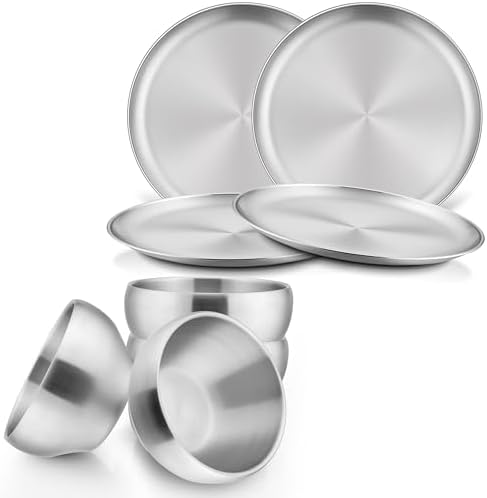
- FOOD-GRADE SAFE MATERIALS: HaWare plates and bowls are made of food-grade stainless steel, no chemical coating, no relea…
- THOUGHTFUL DESIGN: Smooth and rounded edges to avoid scratching children’s small hands, safer and more comfortable to us…
- SUITABLE SIZA AND KIDS FRIENDLY: The plates measure about 8 x 8 x 0.6 inches and the bowl capacity is about 12oz, which …
Stainless steel dinnerware is most common in institutional settings, camping, and children’s tableware, where its near-indestructibility is a significant practical advantage. For daily household food service, it is a thoroughly safe choice.
Porcelain and bone china — dense, safe, and elegant from reputable sources
Porcelain and bone china are both fired at very high temperatures — typically above 1,200°C — which produces a dense, vitrified ceramic body with low porosity.
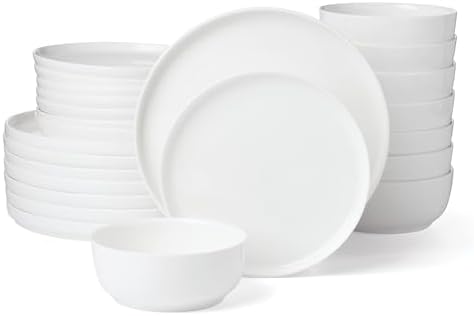
- WHY IT’S SPECIAL: Calling all casual perfectionists! Modern White dinnerware brings order and ease to every meal. It’s c…
- WHO IT’S PERFECT FOR: Anyone who wants dishes that look elegant, feel effortless, and work for everything from weeknight…
- WHAT’S IN THE BOX: This 24-piece dinnerware includes service for 8 with 8 dinner plates (10.5″Diameter), 8 accent plates…
This high-temperature firing is what makes quality porcelain safer than lower-fired earthenware: at those temperatures, the ceramic body and glaze fuse together more completely, reducing the microporosity that allows acid to penetrate and leach surface metals.
Plain white porcelain from reputable manufacturers — those that publish Prop 65 or LFGB compliance — is a consistently safe choice for everyday use.
Decorated porcelain requires more scrutiny: the high-fired body may be safe, but painted-on overglaze decorations are applied after firing at lower temperatures and may not be as thoroughly vitrified.
Stoneware — safe from certified brands, riskier at the budget end
Stoneware is fired at higher temperatures than earthenware but typically lower than fine porcelain, producing a dense, opaque ceramic that is durable and practical for everyday use.
Its safety profile depends almost entirely on two factors: the quality of the clay used and the composition of the glaze.
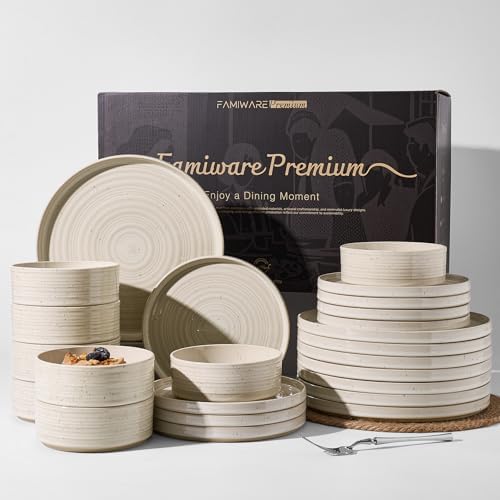
- FAMILY-SAFE STONEWARE – LEAD-FREE & NON-TOXIC: Crafted with lead-free, cadmium-free, and BPA-free glazes, this dinnerwar…
- HANDCRAFTED SPECKLED & SPIRAL GLAZE: Each piece is fired at 2340°F for 13.5 hours, creating a unique artisanal finish wi…
- DURABLE, CHIP & SCRATCH-RESISTANT CONSTRUCTION: Made from high-density premium stoneware that is thicker and stronger th…
Primary clay — extracted from deeper geological layers — is naturally lower in heavy metal contamination than secondary or tertiary clay, which is closer to the surface and more likely to carry environmental lead and cadmium.
Certified stoneware from brands that test to Prop 65 or LFGB standards and publish results is a safe everyday option. Budget stoneware from unverified overseas manufacturers is among the higher-risk purchases in the entire dinnerware market.
See our best non-toxic ceramic dinnerware sets guide for verified options across price points.
Glazed ceramic — safe with certification, uncertain without it
Glazed ceramic is the broadest and most variable category in dinnerware safety.
A high-quality glazed ceramic piece from a brand that tests to California Prop 65 standards and publishes the results is safe for daily food use.
An unverified imported glazed ceramic piece with bright colours and no published testing data presents genuine uncertainty. The difference between these two products can be invisible to the naked eye; they may look identical on a shelf.
The variables that determine safety — clay origin, glaze formulation, firing temperature, decorative pigment composition — are manufacturing choices that consumers cannot evaluate without testing data.
“In August 2025 (specifically August 13, 2025), the FDA issued an initial warning about imported cookware that may leach lead into food, eventually identifying 19 cookware products made from aluminium, brass, and aluminium alloys (Hindalium/Hindolium or Indalium/Indolium) from manufacturers in India and Pakistan. These products were sold through ethnic markets and retailers in California, New York, Illinois, Maryland, and other states, with the FDA adding products through multiple updates in September, October, and November 2025.”
For glazed ceramic, published third-party testing is not optional; it is the only basis for a confident safety assessment.
Melamine and plastic — not safe for heated food, regardless of labelling
Melamine dinnerware has no safe pathway for heated food use. When melamine resin is exposed to hot food, acidic food, or hot liquids, it releases melamine and formaldehyde into whatever it contacts.
This is not a brand-quality issue — it is a chemistry issue. The material itself behaves this way under heat, regardless of the manufacturer.
Melamine dinnerware is appropriate for cold food service — snacks, sandwiches, room-temperature salads — and is commonly used for young children at room-temperature mealtimes because of its near-indestructibility.
It should never be used for hot soup, heated food from a microwave, or any food that is hot when it is served onto the plate. The same guidance applies to plastic dinnerware of all types: cold use is acceptable, heated use is not.
Lead-Free vs Lead-Safe — the Distinction Every Buyer Needs to Understand
This is the most important concept in dinnerware safety, and it is the one most consistently glossed over by the industry and under-explained in the media. “Lead-free” and “lead-safe” are not the same designation. The difference has real numbers behind it.
| Term | Definition | What it guarantees | What it does NOT guarantee |
|---|---|---|---|
| Lead-free | No detectable lead at all | Zero lead in the product | Consistent with any regulatory standard, it is a product claim |
| Lead-safe | Lead is present but leaches below a regulatory threshold | Leachable lead is within the accepted regulatory limit | That no lead leaches — trace amounts are expected |
| FDA compliant | Leachable lead is below the FDA action level | Legal sale in the US market | Zero lead — FDA limits allow 0.5 ppm (flatware) and 0.25 ppm (small hollowware) |
| Prop 65 compliant | Leachable lead meets California’s stricter threshold | Meets the strictest US consumer standard | Zero lead — Prop 65 threshold is 0.226 ppm |
| LFGB certified | Meets EU/German food contact material standard | Stricter than the FDA; internationally recognised | Consistency between batches without ongoing testing |
What the FDA actually allows — the 0.5 ppm limit explained
The FDA sets what it calls “action levels” for leachable lead in dinnerware — not zero tolerances, but thresholds above which the agency takes regulatory action. For flatware (plates, serving dishes), the action level is 0.5 parts per million of leachable lead.
For small hollowware (cups, bowls), it is 0.25 ppm.
A product that leaches 0.4 ppm of lead per use is fully FDA compliant. A product labelled “FDA approved for food contact” can and does leach measurable lead into food at every meal.
California Prop 65 — the strictest US consumer standard
California’s Proposition 65, formally the Safe Drinking Water and Toxic Enforcement Act of 1986, sets a leachable lead threshold of 0.226 parts per million for consumer dinnerware, stricter than the FDA’s 0.5 ppm flatware limit.
Manufacturers who sell in California must comply with Prop 65 or display a specific warning label; those who claim Prop 65 compliance without that warning have been verified to meet the stricter threshold.
For a buyer navigating safety claims, “Prop 65 compliant” is the most meaningful US standard on a dinnerware label, not because Prop 65 guarantees zero lead, but because it requires the lowest verified leaching level of any US standard and because California enforces it actively through litigation and public disclosure.
Certifications That Actually Mean Something — and Greenwashing Terms That Don’t
The dinnerware safety certification landscape spans four significant standards, each administered by a different body and testing to different numeric thresholds.
Understanding how they compare allows you to evaluate any safety claim you encounter on packaging or a brand website.
| Standard | Overseeing body | What it tests | Leachable lead limit | Strength vs FDA |
|---|---|---|---|---|
| FDA compliance | US Food and Drug Administration | Leachable lead and cadmium from food-contact surfaces | 0.5 ppm (flatware) / 0.25 ppm (hollowware) | Baseline — the weakest US standard |
| California Prop 65 | California Office of Environmental Health Hazard Assessment | Lead, cadmium, and 900+ other chemicals in consumer products | 0.226 ppm | Stricter than the FDA; most meaningful US consumer label |
| EU/LFGB | European Food Safety Authority / German LFGB regulation | Lead and cadmium leaching from food-contact materials | Typically 0.1 ppm or lower, depending on piece type | Stricter than both the FDA and Prop 65 |
| NSF International | NSF (independent non-profit) | Broad food equipment and material safety standards | Varies by certification type | Rigorous independent verification is less common in consumer dinnerware |
Greenwashing terms to ignore entirely
The following terms appear routinely on dinnerware packaging and marketing and carry no regulatory definition, no independent verification requirement, and no enforceable safety standard:
- “Non-toxic” — No legal definition. Any product can use this term.
- “Food-safe” — A general descriptor with no binding standard; FDA compliance is implied but not guaranteed.
- “Natural” — No regulatory definition in the context of dinnerware materials or glazes.
- “Eco-friendly” — A marketing claim with no independent verification standard in the US.
- “Safe” — Meaningless as a standalone claim without specifying what standard it meets.
- “BPA-free” — Accurate but incomplete; does not address BPS, BPF, microplastics, or other material concerns.
The reliable signals on a dinnerware label are specific certification names with numeric standards attached — “Prop 65 compliant,” “LFGB certified,” “tested to ASTM C738-94.” Anything more vague than that is marketing language, not a safety guarantee.
High-Risk Dinnerware Categories — What to Examine Most Carefully
Not all dinnerware presents equal risk. Three categories consistently account for the majority of documented heavy metal exposure from dinnerware and warrant specific scrutiny.
Vintage and antique dinnerware — made before modern lead regulations
Ceramic dinnerware produced before the 1970s and 1980s was made in an era when lead in glazes was standard industry practice and regulatory oversight of leachable heavy metals in consumer products was minimal to nonexistent.
In one independent testing programme, 18 of 20 vintage dinnerware pieces tested positive for lead above current safety thresholds.
The risk is not limited to obviously decorative or ornate pieces — plain everyday dishes from mid-20th-century manufacturers commonly used lead-containing glazes for their technical properties, not only their aesthetic ones.
The practical guidance is straightforward: do not use vintage or antique dinnerware for regular food service without laboratory confirmation of safety.
If the pieces have sentimental value, display them. If you want to continue using them, send a sample to an EPA-accredited laboratory for leach testing before resuming food use.
At-home swab testing is insufficient for vintage pieces because older lead-containing glazes are often sealed beneath an overglaze layer that prevents the swab reagent from reaching the lead, producing a false negative.
Brightly coloured and decorated ceramics — red, orange, and yellow are the highest risk
The most reliable visual risk indicator in dinnerware is colour intensity, particularly in the warm spectrum.
Bright red, vivid orange, and intense yellow glazes have historically been achieved using cadmium compounds because those colours are chemically stable and visually saturated in ways that other pigments cannot match at ceramic firing temperatures.
Lead has been used similarly in certain overglaze decorations applied after the primary firing, where its lower melting temperature allows it to be used in detailed decorative painting that would not survive the higher-temperature primary firing.
This does not mean all coloured dinnerware is unsafe; it means coloured dinnerware without published independent testing results requires caution.
If you own or are considering brightly coloured ceramics without Prop 65 or LFGB certification, treat them as display pieces unless you can obtain laboratory verification.
The safest position for everyday food use is plain white or minimally decorated ceramics from brands that publish their testing.
Imported and unverified ceramics
The global dinnerware supply chain includes manufacturers operating under a wide range of regulatory environments.
In markets where lead in ceramic glazes is less regulated — or where regulations exist on paper, but enforcement is inconsistent — dinnerware reaching US and European consumers can carry significantly higher heavy metal content than domestic or EU-manufactured alternatives.
Market sampling data revealed that about 38% of ceramic dinnerware products did not meet market requirements in 2023 due to lead and cadmium.
When Safe Dinnerware Becomes Unsafe — the Damage-State Problem
Every guide on non-toxic dinnerware focuses on the purchase decision, which materials and brands to buy.
Almost none address the equally important question of when a piece of dinnerware that was safe when new becomes unsafe through use, damage, and age.
This is the question that matters for the dishes already in your cabinet.
Chips and cracks — when to retire a ceramic piece immediately
Physical damage to ceramic dinnerware disrupts the glaze layer that slows lead and cadmium migration and exposes the underlying ceramic body, where those metals may be present in higher concentrations.
The following conditions should trigger immediate retirement of a ceramic piece from food use:
- Any chip on a food-contact surface — including the interior of a bowl, the surface of a plate, and the rim where lips contact the piece during drinking
- Any visible crack, regardless of how fine, cracks allow acid penetration into the ceramic body beneath the glaze
- Crazing — the network of fine surface cracks that appears on some glazed ceramics as the glaze and ceramic body expand and contract at different rates over time
- Glaze discolouration or surface cloudiness that was not present when the piece was new, which can indicate glaze breakdown
- Any area where glaze is visibly flaking or lifting from the ceramic surface
The threshold for retirement is lower than most people apply in practice.
A small chip on the rim of an everyday mug is often treated as cosmetic damage, and the mug continues in use, but the rim is precisely where lips contact the piece repeatedly, making it one of the higher-exposure contact areas of any drinking vessel.
Dishwasher wear — how repeated cycles erode glaze integrity over time
Repeated dishwasher cycling subjects ceramic glaze to a combination of hot water, alkaline detergent, and mechanical agitation that is significantly more aggressive than hand washing.
Research confirms that dishwasher cycling erodes ceramic glazes measurably over time — increasing the micro-porosity of the surface and raising the leachable lead content of pieces that test within safe limits when new.
The effect accumulates: a ceramic piece that tests at 0.2 ppm leachable lead when new may test significantly higher after several years of daily dishwasher use, as the surface layer is progressively compromised.
For certified dinnerware from brands with published testing, this does not make dishwasher use unsafe; the testing is designed to simulate heavy-use conditions.
For older pieces, unverified imports, or any piece where safety has not been independently confirmed, hand washing is a meaningful risk-reduction practice.
The recommendation to hand-wash applies particularly to vintage pieces, any ceramic with decorative overglaze patterns, and pieces that are already showing surface wear.
How to Test Dinnerware for Lead at Home — and What Each Method Actually Tells You
If you own dinnerware of uncertain safety, vintage pieces, inherited dishes, or imported ceramics, buying without certification testing is a practical option.
Three methods are available with meaningfully different accuracy, cost, and what they actually measure.
| Method | What it detects | Accuracy | Cost | Best for |
|---|---|---|---|---|
| At-home lead swab | Surface lead presence | Low — false negatives are common if the lead is sealed | $5–$15 per test | Quick screening of new or lightly used pieces |
| XRF (X-ray fluorescence) | Total elemental lead content | High for presence; cannot measure leachability | $30–$80 via mail-in service | Confirming lead presence in suspected pieces |
| Laboratory leach test (ASTM C738-94) | Leachable lead — the regulatory standard | Highest — this is how manufacturers test for compliance | $50–$150 per piece | Definitive safety assessment; may damage the piece |
At-home lead swabs — quick but with meaningful limitations
At-home lead test swabs — the most widely available being EPA-recognised 3M LeadCheck swabs — work by applying a chemical reagent to a surface that produces a colour change in the presence of lead. The process is straightforward.
- Wash and thoroughly dry the piece you are testing.
- Break the swab to activate the reagent and apply it to the food-contact surface you want to test — the interior bottom of a plate or bowl, the interior of a mug.
- Rub the swab gently across the test area for 30 seconds.
- Read the colour: yellow or no change indicates a negative result; pink or red indicates lead detected.
- Test multiple areas — rim, interior, and any decorated surface separately.
The critical limitation of home swabs is false negatives. If lead is present in the glaze but sealed beneath an intact overglaze layer, the chemical reagent cannot reach it, and the test returns negative.
Vintage pieces with decorative coverings and some imports with multi-layer glaze applications are particularly prone to this limitation.
A negative swab result from a vintage or suspected-unsafe piece is not a reliable safety confirmation; it only means lead was not detected at the surface.
XRF testing — detects presence but not leachability
X-ray fluorescence testing uses a handheld or desktop device that fires X-rays at the surface of the material and measures the fluorescent energy emitted by different elements, identifying them precisely.
XRF is used by museum conservators, industrial safety assessors, and regulatory inspectors to rapidly identify the elemental composition of materials.
Mail-in XRF services are increasingly available to consumers and provide a report identifying lead, cadmium, arsenic, and dozens of other elements within days of receiving your piece.
The important limitation of XRF is that it measures the total amount of lead present in the material, not the amount that leaches into food under real-use conditions.
A piece with high XRF lead content may or may not leach that lead at harmful levels depending on the glaze composition, firing temperature, and surface integrity.
XRF is the right tool for confirming that lead is present when you suspect it; it is not the right tool for determining whether that lead is accessible to food.
See our complete guide to testing dinnerware for lead for a detailed walkthrough of all three methods.
Laboratory leach test (ASTM C738-94)
The ASTM C738-94 standard, formally titled “Standard Test Method for Lead and Cadmium Extracted from Glazed Ceramic Surfaces,” is the method used by manufacturers to verify FDA and Prop 65 compliance.
In this test, the piece is filled with a 4% acetic acid solution comparable in acidity to vinegar, and left for 24 hours at room temperature.
The solution is then analysed for lead and cadmium content, providing a measurement of how much of each metal leaches from the glaze surface under conditions that simulate sustained acidic food contact.
The acetic acid bath is designed to produce results that represent extremely heavy usage, far more aggressive than typical daily use, which means results that pass the standard represent a significant safety margin under normal conditions.
Responsible manufacturers test every glaze colour in every product line to this standard and publish the results. EPA-accredited laboratories that perform this test can be located through the EPA’s National Lead Laboratory Accreditation Programme.
The one practical limitation is that the test typically involves filling the piece with an acid solution, which may leave residue or cause discolouration, effectively ending the piece’s food use if positive results are found.
Brands That Publish Their Safety Testing — a Short List You Can Trust
The meaningful differentiator between genuinely safe dinnerware brands and brands that use safety language as marketing is transparency.
Brands that publish specific third-party testing results naming the standard tested, the testing laboratory, and the result, are making a verifiable commitment that marketing claims cannot replicate.
The list below is not exhaustive, but it represents brands that have made their testing data publicly available and whose results have been independently reviewed.
Price tier is included because safety should not require a premium budget.
| Brand | Material | Standard tested | Where to find results | Price tier |
|---|---|---|---|---|
| Corelle (Vitrelle) | Triple-layer glass | XRF — non-detectable lead, cadmium, arsenic, mercury | Corelle website; independent XRF reviews | Budget–mid |
| Fiestaware | Glazed stoneware | Lead-free since 1992; Prop 65 compliant | Homer Laughlin (manufacturer) website | Mid |
| East Fork | Glazed stoneware | Third-party testing; Prop 65 compliant | East Fork website; published test summaries | Mid–premium |
| Fable Home | Glazed ceramic | ASTM C738-94 leach test for every glaze colour | Fable testing page — publishes full results | Mid |
| Xtrema | Pure ceramic | Prop 65 compliant — tested every shipment for 15+ years | Xtrema website — all results posted | Mid–premium |
| Year & Day | Vitrified ceramic | Prop 65 compliant; Portuguese clay; supplier-verified | Year & Day website | Premium |
A note on brands not on this list: absence does not imply unsafety; many reputable brands test their products but do not make results easily accessible to consumers.
If a brand you are considering is not on this list, contact them directly and ask for their third-party testing results. A brand committed to safety will provide them.
A brand that deflects, responds with marketing language, or has no testing data available is telling you something.
Buying Checklist — Six Questions to Ask Before Any Dinnerware Purchase
Before committing to any set of dinnerware, work through these six questions. Each one filters a meaningful risk.
- Does the brand publish independent third-party testing results? Not a marketing claim — actual test results from a named laboratory tested to a named standard (Prop 65, LFGB, ASTM C738-94). If they do not publish results, ask them directly before purchasing.
- Is the piece glazed, and if so, is the glaze certified? Glass and unglazed stainless steel require no certification because there is no glaze to leach. Any glazed ceramic requires certification — plain white from a certified source, or a coloured/decorated piece with published leach test results for that specific colour.
- Does “lead-free” appear as a specific claim or just a vague implication? “FDA-compliant” allows trace lead. “Prop 65 compliant” is stricter. “LFGB certified” is stricter still. Ask which standard the lead-free claim is based on.
- Where is the piece manufactured, and does the brand name belong to the factory? Brands that name their manufacturing facility and country are more accountable than those that use vague “globally sourced” language. EU, US, and Japanese manufacturing generally operates under stricter quality control than unverified imports.
- Is the piece decorated, and if so, are the decorations on the food-contact surface? Decorations on the underside of a plate or on the outer wall of a cup are lower risk than decorations on the inner food-contact surface. Decorations that have been under-glaze (applied before the primary firing) are safer than overglaze decorations applied at lower temperatures after firing.
- What is your actual use case — will the piece be used for heated food? If yes, eliminate melamine, plastic, and any unverified ceramic immediately. If the piece will only ever hold cold food, the risk threshold is meaningfully lower, and a wider range of options becomes acceptable.
Frequently Asked Questions About Non-Toxic Dinnerware
What is the single safest dinnerware material?
Glass — specifically tempered glass, borosilicate glass, or Corelle’s Vitrelle — is the safest dinnerware material available. It contains no glaze, is non-porous, and presents no lead, cadmium, or heavy metal risk of any kind.
Clear or plain white glass is safer than decorated or coloured glass, which may carry coated pigments. Beyond glass, uncoated stainless steel (18/10 grade) is equally safe for food service and shares the same absence of glaze-related risk.
Is “FDA compliant” the same as lead-free?
No. FDA compliance means a product leaches lead below the FDA’s action level, which is 0.5 ppm for flatware and 0.25 ppm for small hollowware. These are not zero thresholds.
An “FDA-compliant” dinnerware product can and does leach measurable lead into food at every meal; it simply does so at a level the FDA considers acceptable under normal use conditions.
“Lead-free” as a specific product claim means no detectable lead. “Prop 65 compliant” means leachable lead tested below 0.226 ppm under the stricter California standard. These three designations are meaningfully different and should not be treated as equivalent.
Does microwaving food on ceramic increase lead leaching?
Yes — heat accelerates the migration of lead and cadmium from ceramic glazes into food.
The mechanism is straightforward: elevated temperature increases the mobility of ions in the glaze matrix, allowing lead and cadmium to migrate into food that is in contact with the surface at a higher rate than the same food at room temperature would drive.
Acidic food heated in a ceramic container — tomato sauce, a coffee-based drink — combines both leaching accelerants. For unverified or potentially unsafe ceramics, microwave use represents a meaningfully higher exposure than cold serving.
Are white dishes safer than coloured ones?
Generally, yes, for ceramic dinnerware. The heavy metal risk in ceramics is primarily associated with the pigments used to produce colours — cadmium compounds for reds, oranges, and yellows; lead in certain overglaze decorative colours.
A plain white glaze uses titanium dioxide and other pigments that carry a lower heavy metal risk.
This does not mean all coloured dinnerware is unsafe — it means plain white certified dinnerware carries fewer variables than coloured certified dinnerware, and unverified coloured dinnerware carries a meaningfully higher risk than unverified plain white.
For glass dinnerware, the colour-safety relationship is different: decorated or coloured glass carries coated pigment risks, while clear glass carries essentially none.
Should I throw away my chipped ceramic plates?
Yes, retire them from food use, particularly for hot or acidic food.
A chip on a ceramic food-contact surface disrupts the glaze layer that slows heavy metal migration, exposes the underlying ceramic body where metals may be concentrated, and creates a surface irregularity that traps food residue and becomes difficult to clean effectively.
Dishwasher washing of chipped ceramics can further degrade the surrounding glaze.
The practical rule is clear: any chip on the food-contact surface of any ceramic piece, particularly on the interior of bowls, the face of plates, and the rim of cups and mugs, should trigger retirement from food use.
Is melamine dinnerware safe for children?
Safe for cold food at room temperature, not safe for hot food.
Children’s melamine dinnerware is a practical choice for snacks, sandwiches, and cold meals because of its near-indestructibility; it does not shatter when dropped, which is a meaningful advantage in households with young children.
The safety boundary is clear and non-negotiable: melamine releases melamine and formaldehyde into food when it contacts hot food or hot liquids.
A bowl of hot porridge served on a melamine plate, a warm meal from the microwave plated onto melamine, or a child’s cup of hot chocolate in a melamine mug all represent unsafe uses.
For heated food, switch to tempered glass, stainless steel, or certified ceramic for children’s meals, regardless of how durable the melamine alternative might be.
See our best Corelle alternatives, and Corelle Vitrelle explained, for deeper coverage across the dinnerware safety category.