

Learning how to properly use the scoop plate for the elderly comes down to three things most people and caregivers skip: setup, motion, and what to do when the standard instructions don’t work.
The basic steps are simple enough: load the high side, scoop against the rim, but the real-world failure point isn’t the plate itself.
It’s that many elderly users, especially those with dementia, rotate the plate so the flat side faces them and try to scoop there instead, which defeats the whole design.
This guide covers the setup, the technique, the color choice that measurably affects how much someone eats, and the safety positioning that matters just as much as the plate.
Written by Sarah Emirone | Reviewed by James Daniels, B.Sc, Inorganic Chemist & Materials Researcher | Updated September 2026 | See How We Test | Filed under: Accessible & Adaptive Dining
What a Scoop Plate Does and Who It’s For
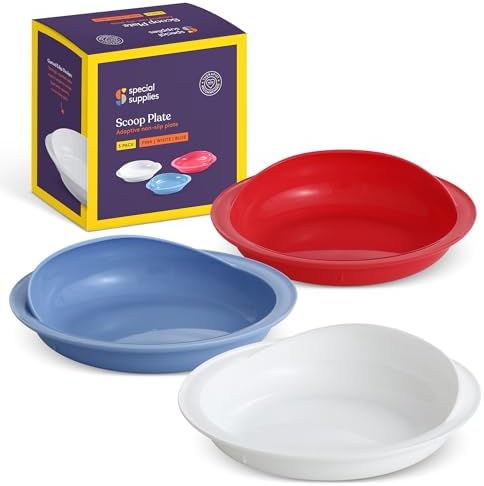
A scoop plate has one raised, curved side built into the plate itself, so a fork or spoon has something solid to push food against instead of chasing it across a flat surface.
Some versions add a suction base underneath to stop the whole plate from sliding.
How the Raised Rim and Suction Base Work
The raised rim runs along one section of the plate, sometimes half the circumference, sometimes the full ring, and creates a wall that the utensil can press food into.
Rather than a spoon skating across a flat plate and pushing food ahead of it indefinitely, the rim gives the food somewhere to stop, which is what makes one-handed scooping possible.



The suction base works through a vacuum seal between the base of the plate and the table, similar to how a suction-cup soap dish sticks to a shower wall.
Press down firmly on the plate before use to set the seal, and it will resist sliding even when someone is pushing against it with real force during scooping.
Conditions That Benefit Most From a Scoop Plate
- Tremor conditions like Parkinson’s disease, where a shaking hand needs a fixed surface to guide food onto the utensil, rather than relying on precision alone.
- Reduced grip or coordination from arthritis or a stroke, where holding a plate steady with one hand while eating with the other isn’t realistic.
- One-handed eating after amputation or paralysis on one side, where the plate itself has to stay still without a second hand to hold it.
- Dementia and Alzheimer’s, where confusion about how to use standard tableware makes a simplified, single-purpose surface easier to follow.
How to Use a Scoop Plate for the Elderly, Step by Step
Using a scoop plate correctly means getting the setup right before the first bite, then guiding the scooping motion in a way that actually uses the rim instead of working around it.
Setting Up the Plate Correctly
- Place the plate on a flat, stable surface, such as a table or tray, not a lap or an uneven surface, with the raised rim facing the person, not off to one side.
- Press down on the plate for several seconds if it has a suction base, checking that it doesn’t slide when nudged before adding food.
- Serve smaller portions than usual, positioned toward the raised side of the plate rather than spread evenly across the whole surface.
- Keep the plate close to the edge of the table, within comfortable reach, rather than centered, where the person has to lean forward to reach it.
Guiding the Scooping Motion
- Hand the person their utensil — ideally a built-up handle or weighted spoon if grip or tremor is also a factor — already positioned near the food.
- Guide the first scoop by pushing the utensil against the raised rim, letting the wall do the work of stopping the food rather than trying to scoop from an open edge.
- If a second hand is available, use it to steady the plate itself rather than the utensil, since the suction base handles most of that job already.
- Let the person repeat the motion independently once the pattern is clear — most people need the first one or two scoops modeled, not the whole meal.
Fixing the Most Common Scoop Plate Mistake: Plate Rotation
The plate rotation problem happens when someone turns the scoop plate so the flat side faces them, then tries to scoop from the side with no rim at all, and it’s the single most common reason a scoop plate stops working, even though nothing is broken.
Why Rotation Happens
For someone with dementia, the plate doesn’t register as having a “correct” orientation the way it would for someone without cognitive impairment.
They see food on a plate and reach for the nearest edge, and if that edge happens to be the flat side, they’ll push against it the same way they’d push against any plate edge, without recognizing that the raised side exists for a reason.
It’s not stubbornness or a lack of instruction. The design assumes the user will recognize which side is “the good side,” and that assumption doesn’t hold for a lot of the population these plates are made for.
How to Prevent It
- Choose a scoop plate with a rim that runs the full 360 degrees around the plate instead of just half, so there’s no flat side left to rotate toward.
- If a partial-rim design is already on hand, mark the raised side with a small piece of colored tape or a sticker as a visual cue, since color often registers when verbal instruction doesn’t.
- Anchor the plate with a non-slip mat in addition to any suction base, which makes rotation physically harder even if the person tries.
- Gently reposition the plate back to the correct orientation as needed during the meal rather than trying to explain why, since a calm physical correction works better than a verbal one for someone with dementia. For more on managing behavior like this at mealtime, see this adaptive mealtime strategies guide.
Choosing Plate Color for Better Food Recognition
Plate color changes how much food someone with dementia actually eats, and the effect is large enough to matter.
A study published in the journal Clinical Nutrition by researchers at Boston University found that people with advanced Alzheimer’s have reduced visual contrast sensitivity, meaning food and a plate can visually blend even when a caregiver sees a clear distinction.
When meals were served on high-contrast red plates instead of standard white ones, participants ate roughly 24% more food and drank about 84% more liquid.
The Contrast Sensitivity Research
The mechanism is straightforward: white rice on a white plate, or pale mashed potatoes on a light-colored dish, can be genuinely difficult for someone with advanced Alzheimer’s to distinguish from the plate itself, not because they’ve lost interest in eating, but because they can’t visually locate the food as a separate object.
A red plate creates enough contrast against most foods that the food registers as something distinct to reach for.
This isn’t a minor aesthetic preference; it’s closer to a functional accessibility fix, in the same category as high-contrast text for someone with low vision.
Best and Worst Color Combinations
| Food type | Best plate color | Plate color to avoid |
|---|---|---|
| Mashed potatoes, rice, pasta | Red, dark blue | White, cream |
| Meat, gravy, brown foods | White, light blue | Brown, dark red |
| Green vegetables | White, red | Green |
| Mixed plates (most meals) | Solid red or dark blue | Patterned or multicolor |
A solid red plate is the safest default choice for most meals, since it contrasts with the widest range of common foods.
Patterned plates work against the same goal a scoop plate is trying to achieve; they add visual noise exactly where the eye needs a clean line between food and surface.
Positioning for Safe Swallowing While Using a Scoop Plate
Body position during eating matters as much as the plate does, because a lot of the population using scoop plates, Parkinson’s, stroke, and dementia also face a real risk of swallowing difficulty.
Swallowing problems affect up to 40% of elderly people in care settings, and posture is one of the few risk factors a caregiver can control directly.
For a full breakdown of feeding technique alongside positioning, this full guide to dining aids for Parkinson’s disease covers both.
Correct Seated Posture
- Sit the person upright at roughly 90 degrees, whether in a chair or in bed with the head of the bed raised fully — never reclined during a meal.
- Keep the head neutral or with the chin very slightly tucked, since tilting the head back to eat or drink increases the risk of food or liquid entering the airway.
- Make sure feet are flat on the floor or a footrest rather than dangling, which supports better overall posture and swallowing control.
- Keep the person upright for at least 30 minutes after finishing the meal, since lying down too soon raises the risk of reflux and aspiration.
Warning Signs to Stop and Seek Help
- Coughing or throat-clearing during or right after a bite, especially with something as simple as a sip of water.
- A wet, gurgly voice quality right after swallowing, which can mean liquid is sitting near the airway instead of moving down normally.
- Visible struggle to start a swallow, or food seeming to sit in the mouth longer than usual before going down.
- Any of the above happening repeatedly across multiple meals is the point to stop relying on positioning adjustments alone and get a formal swallowing evaluation. For more on what those signs mean.
Scoop Plate vs. Other Adaptive Plate Options
A scoop plate isn’t the only option, and it isn’t always the right one. A plate guard and a divided plate solve different problems, even though all three get lumped together in most product listings.
Scoop Plate vs. Plate Guard vs. Divided Plate
| Feature | Scoop plate | Plate guard | Divided plate |
|---|---|---|---|
| Best for | One-handed scooping, tremor | Adding a rim to an existing favorite plate | Keeping foods separated, dementia confusion |
| How it works | Built-in raised, curved side | Clip-on rim attached to any standard plate | Fixed compartments, no scooping wall |
| Rotation risk | Lower with full-rim designs | Higher — clip covers only part of the rim | Not applicable, no orientation to lose |
| Cost | Moderate | Low | Moderate |
The scoop plate wins for anyone whose main problem is scooping mechanics. A plate guard wins if someone is attached to their own dishware and just needs a barrier added.
A divided plate wins when the goal isn’t scooping at all, but keeping mixed foods from overwhelming someone who gets confused by a plate that isn’t visually organized.
When to Combine a Scoop Plate With a Weighted Utensil
A scoop plate solves where the food goes once it’s on the utensil. It doesn’t solve a shaking hand.
For anyone with a visible tremor, pairing the plate with a weighted spoon or fork addresses both halves of the problem: the plate stabilizes the food, and the added weight in the utensil stabilizes the hand carrying it to the mouth.
Using one without the other usually means the caregiver ends up compensating for whichever half was left unaddressed. See this full weighted utensil buying guide for specifics on choosing one.
If mealtimes are still difficult after trying the setup, color, and positioning changes above, an occupational therapist can assess grip, coordination, and swallowing risk in a single visit and recommend specific adjustments. Ask a physician for a referral rather than continuing to troubleshoot alone.
Frequently Asked Questions
What is a scoop plate used for?
A scoop plate helps someone scoop food onto a utensil using only one hand, or with reduced grip and coordination, by giving the food a raised wall to push against.
It’s most often used for tremor conditions, one-handed eating, arthritis, and dementia.
How do you use a scoop bowl?
Place food toward the high, curved side of the bowl and push the utensil against that wall to scoop, the same technique used with a scoop plate. A suction base underneath keeps the bowl from sliding while scooping.
What is the best plate for the elderly with dementia?
A full-rim, high-contrast scoop plate in a solid color like red works best, since it prevents the plate-rotation problem common with partial-rim designs and helps the person visually distinguish food from the plate.
Why does my mom keep turning her plate around?
She’s likely not recognizing which side of the plate has the raised rim, which is common with dementia rather than a sign of stubbornness. A full 360-degree rim design or a non-slip mat that makes rotation physically harder usually solves it.
What is the difference between a scoop plate and a plate guard?
A scoop plate has the raised rim built into the plate itself, while a plate guard is a separate clip-on piece added to a regular plate.
A plate guard is cheaper and works with existing dishware, but only covers part of the rim, which raises the rotation risk.
How do you stop food from sliding off a plate for the elderly?
Use a scoop plate or plate guard with a raised rim, paired with a suction base or non-slip mat underneath to stop the plate itself from moving. Both pieces matter; a raised rim on a sliding plate still spills.
What is the best position for feeding an elderly parent?
Seated upright at 90 degrees with the chin neutral or slightly tucked, feet flat, and staying upright for at least 30 minutes after the meal. This posture reduces the risk of food or liquid entering the airway during swallowing.
About the Author & Reviewer
Sarah Emirone, Author
Sarah researches and writes SafeKitchn’s dinnerware and kitchenware guides, with a focus on material safety, lead content, and manufacturer specifications. She cross-references product data sheets, safety certifications, and regulatory filings (including FDA and Prop 65 records) before publishing, and updates articles when new information becomes available.
James Daniels, Reviewer
James reviews SafeKitchn’s material safety content for scientific accuracy. He holds a B.Sc in inorganic chemistry and works as a materials researcher, with particular focus on the composition and safety behavior of glass, ceramic, and metal used in kitchenware.