

Weighted silverware for tremors gets recommended constantly by occupational therapists, by Parkinson’s forums, and by the product pages selling it.
The pitch is always the same: add weight to a spoon or fork, and a shaking hand gets steadier.
Sometimes that’s true. A 2002 randomized controlled trial on Parkinson’s patients found no measurable drop in tremor amplitude when weight was added, and a Canadian health technology review later warned that weighted utensils “may not be effective for, and may actually worsen tremor in” some Parkinson’s patients.
Before buying a set, it’s worth knowing which tremor you’re actually dealing with because the answer changes depending on that.
Written by Sarah Emirone | Reviewed by James Daniels, B.Sc, Inorganic Chemist & Materials Researcher | Updated September 2026 | See How We Test | Filed under: Accessible & Adaptive Dining
How Weighted Silverware Is Supposed to Help With Tremors
The theory: added mass gives the hand something to push against, making small involuntary movements less noticeable at the spoon or fork tip.
It’s a mechanical idea, not a neurological one. The utensil isn’t calming the tremor; it’s changing how much that tremor shows up where food meets the mouth.
The proprioception and inertia theory
Extra weight does two things. It increases the force needed to move the utensil, which can dampen small, fast oscillations for the same reason a heavier pendulum swings more slowly than a light one.
And it gives the hand more proprioceptive feedback about where the spoon is in space, which steadies grip for some people. Neither effect treats the tremor; both just make it less disruptive at the point where food meets the mouth.
Why isn’t heavier automatically better
This is where most product pages stop talking. More weight doesn’t scale up the benefit past a certain point; it works against the person using it.
A heavier utensil takes more strength to lift and control, and for someone with reduced grip strength or arm fatigue, that added load can introduce new shake rather than canceling out the old one.
Weight is a tool with a working range, not a dial you turn up for better results.
Does the Research Actually Support Weighted Utensils?
The short answer: it’s mixed, and it splits hard along which condition you have; almost no buying guide says out loud.
A 2002 randomized controlled trial in Clinical Rehabilitation tested weighted vs. standard utensils in sixteen people with Parkinson’s disease and found no significant difference in tremor amplitude or frequency.
A follow-up study reviewed by the adaptive-eating-aids site Eatzii reached the same conclusion using laser sensors during an actual feeding task. It’s the closest thing this topic has to a controlled answer, and it says weight didn’t move the needle for Parkinson’s tremor specifically.
| Study / Source | Population | Finding |
|---|---|---|
| Meshack & Norman, Clinical Rehabilitation (2002) | 16 adults, Parkinson’s, RCT | No significant difference in tremor amplitude or frequency |
| Eatzii research review (laser sensor study) | Adults with Parkinson’s | No benefit in amplitude reduction, weighted vs. unweighted |
| CADTH health technology review (2015) | Mixed tremor population | Weight “may not be effective for, and may actually worsen tremor in some Parkinson’s patients; lightweight utensils outperformed heavy ones in one cited study |
| Puget Sound School of OT/PT study | 5 adults, essential tremor, weighted wrist cuffs | All 5 improved on at least one measure; effectiveness scaled with more weight |
| Domingo et al., comparative preference study (2019) | Adults with essential or Parkinson ‘s-related tremor | Weighted spoon and Liftware Steady spoon preferred equally; no statistically significant difference |
What the studies on Parkinson’s tremor found
Both controlled studies on Parkinson’s patients came back negative for tremor amplitude worth noting, since it contradicts most product descriptions.


The 2019 comparative study did find people preferred weighted spoons, but preference and measured tremor reduction are different things. Participants weren’t tested for whether their tremor actually got smaller, just which utensil felt better.
What the research on essential tremor and wrist weights found
Essential tremor has a more encouraging data point, though it comes from wrist weights rather than utensils.
The University of Puget Sound study found all five participants improved on at least one outcome measure when wearing a weighted wrist cuff, and the heavier the cuff, the more effective it was.
That’s a small study, but it’s directional support for weight specifically in essential tremor, which moves differently than Parkinson’s resting tremor.
Why patient preference and OT guidance differ from clinical trial results
Occupational therapists still recommend weighted utensils regularly, not a contradiction, just a different kind of evidence. OTs watch real eating performance across people whose tremor severity, grip strength, and fatigue vary constantly.
A utensil that doesn’t move a lab measurement can still help someone feel steadier or spill less. Clinical trials measure one narrow thing; daily mealtime success is wider and messier.
Essential Tremor vs. Parkinson’s Tremor: Why Weight Helps Differently
These are two different movement patterns, and that difference is why weighted utensils land well for some people and not at all for others.
| Factor | Essential Tremor | Parkinson’s Tremor |
|---|---|---|
| When it happens | During action — eating, writing, reaching | Mostly at rest; often eases during voluntary movement |
| Typical rhythm | Faster, finer oscillation | Slower, “pill-rolling” pattern |
| Response to added weight | More favorable — inertia dampens fast, fine movement | Mixed to unfavorable in controlled studies |
| Best-supported aid | Weighted wrist cuffs (small study, positive direction) | Active-stabilization devices (Liftware, Gyenno) |
Why does essential tremor tend to respond better to added weight
Essential tremor is a fast, fine action tremor, mechanically closer to what added inertia is good at dampening, the same physics behind why a heavy soup spoon feels more stable than a light one against a quick, small shake.
This is also the tremor type behind the more encouraging wrist-cuff data above.
Why Parkinson’s tremor is more unpredictable and weight-sensitive
Parkinson’s tremor is usually a resting tremor that eases during the actual reaching-and-eating motion, then returns once the hand stops moving.
That timing mismatch is part of why the controlled studies came back flat. The tremor isn’t necessarily most active when the spoon is moving toward the mouth, the only moment when added weight can act on.
Combine that with reduced grip strength and rigidity that often builds over time, and a heavier utensil risks adding fatigue without fixing the timing problem. For a deeper look at product picks suited to this condition, see the best weighted utensils for Parkinson’s disease.
How Much Weight Is Right? (Ounces Guide)
There’s a working range here, narrower than the marketing suggests: most effective weighted utensils sit between 4 and 8 ounces per piece, with the bulk of well-reviewed sets landing around 6 to 7.5 ounces.
| Weight Range | Best Fit | Notes |
|---|---|---|
| 4–6 oz | Mild tremor, first-time users | Easiest to adjust to; lowest fatigue risk; a sensible starting point |
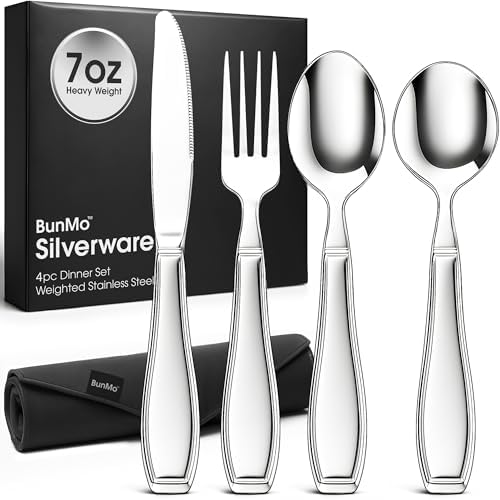
| 6–7.5 oz | Moderate tremor, most common | Standard weight for brands like BunMo and Vive; balances stability against fatigue |
| 8 oz+ | Severe tremor with adequate grip strength | Only appropriate if lighter weights weren’t enough and strength isn’t a limiting factor |
Signs you’ve gone too heavy
- Your arm feels tired by the middle of a meal, not just toward the end of it.
- The shake gets worse, specifically when lifting the utensil toward your mouth.
- You set the utensil down between bites to rest your hand.
- Gripping the handle takes visible effort or causes cramping within minutes.
Weighted Utensils vs. Other Tremor-Eating Solutions
Weighted utensils are the cheapest, most discreet option here. They’re not the most effective for every tremor type that goes to active-stabilization devices, for people whose tremor doesn’t respond to mass alone.
| Option | How It Works | Cost | Best For |
|---|---|---|---|
| Weighted utensils | Added mass dampens motion via inertia | $15–$40 | Essential tremor, mild-to-moderate severity |
| Weighted wrist cuffs | Weight is worn on the wrist instead | $20–$50 | Essential tremor; benefit scaled with weight in small study |
| Liftware Steady | Sensors detect and counteract tremor in real time | $295 starter + $20/attachment | Parkinson’s or severe tremor not helped by weight alone |
| Gyenno smart utensils | Motorized stabilization, claims up to 85% shake reduction | Comparable to Liftware | Severe Parkinson’s tremor; manufacturer-reported figures only |
Weighted utensils vs. weighted wrist cuffs
How weighted wrist cuffs compare for tremor control is worth a closer look for essential tremor, since the small Puget Sound study found cuff effectiveness increasing with more weight, the opposite of the utensil pattern.
A cuff also keeps your existing flatware in play, useful if you eat out often.
Weighted utensils vs. active-stabilization utensils (Liftware, Gyenno)
In the one study that put a weighted spoon head-to-head against the Liftware Steady spoon, participants preferred both about equally, with no statistically significant difference.
That’s useful precisely because it doesn’t pick a winner: a $20 weighted spoon and a $295 stabilization device landed in the same range of satisfaction.
For Parkinson’s tremor, where the weighted-utensil RCTs came back flat, active stabilization has a stronger case because it targets the tremor directly.
What to Look For When Choosing Weighted Silverware
- Start at 6 ounces, not 8. Most people don’t need the heaviest set on the shelf, and starting lighter leaves room to size up — sizing down is harder, since most sets aren’t adjustable.
- Check handle diameter separately from weight. A thick, ribbed, non-slip handle does work that ounces can’t, mattering more for Parkinson ‘s-related weakness than for essential tremor.
- Look for a deep-bowl or “soup spoon” option. Flat spoons are nearly unusable with liquids once a tremor is in play.
- Decide how much the look matters to you. Some sets pass as ordinary stainless steel at a restaurant table; others look unmistakably medical.
- Budget for an adjustment period before judging the product. Give a new set at least a week of regular meals before deciding it isn’t working.
Handle design and grip
A ribbed or textured handle does more for someone with reduced grip strength than extra ounces do; it cuts how hard the hand has to clamp down. Foam and silicone handles are the most common grip materials, and the easiest to retrofit onto utensils you already own.
Spoon depth and anti-spill features
A standard flat spoon loses liquid the moment a tremor hits mid-transit from bowl to mouth. A recessed, deep-bowl design holds more liquid against that disruption, a small change with an outsized effect on mealtime mess.
Adjustment period and what to expect in the first few meals
Expect the first few meals to feel slightly awkward, not instantly better. Most people need three to five meals before a heavier utensil stops feeling foreign in the hand.
If it still feels worse after a full week, the weight is wrong for you, not that weighted utensils as a category have failed.
Cost, Coverage, and Where to Buy
A full weighted set runs $15 to $40. Medicare typically won’t cover it unless billed as durable medical equipment through a documented occupational therapy plan.
Typical price ranges
| Price Range | What You Get |
|---|---|
| $15–$25 | Basic 3-piece sets, fixed weight, no travel case |
| $25–$35 | 4-piece sets with deep-bowl spoon, ribbed or foam handles, often a travel pouch |
| $35–$50 | Premium finishes, adjustable weight, or bundled rocker knife and travel case |
Insurance, Medicare, and HSA/FSA coverage
Medicare Part B can cover adaptive eating utensils as durable medical equipment, but only when prescribed and documented by an occupational therapist. Buying a set on your own won’t qualify.
HSA and FSA funds are a more reliable path: most providers treat them as an eligible expense without a prescription, though it’s worth confirming with your plan administrator first.
Other Strategies That Work Alongside Weighted Utensils
- A non-slip placemat keeps the plate from sliding while a shaking hand is also trying to control the utensil.
- Sitting close to the table with an elbow resting on its surface gives the arm a stable base, cutting down on shoulder-and-arm movement that can amplify a hand tremor.
- Using the non-dominant hand to steady the dominant wrist during the lift-to-mouth motion costs nothing and works for some people better than any product on this page.
- High-rimmed plates and bowls shorten how far food has to travel before it’s secure on the utensil.
- Eating more slowly, with smaller bites, reduces the speed and force a tremor has to fight against.
Table and posture adjustments
These cost nothing and stack with whatever utensil you’re using. A grounded elbow and a slightly extended wrist do measurable work on their own.
When to involve an occupational therapist
If you’ve tried a reasonable weight range and adjustment period without improvement, that’s the point to bring in an OT rather than keep guessing at products.
What an occupational therapist evaluation involves, what that assessment looks like, and an OT can also write the documentation needed for Medicare or insurance coverage if cost has been the holdup.
For a wider view of where weighted utensils fit alongside everything else on the market, the full range of adaptive eating aids beyond utensils is the place to start.
For a more direct read on which tremor type you’re actually managing, see the key differences between essential tremor and Parkinson’s tremor.
If you’re shopping right now, the fastest path to a good decision is matching weight to your tremor type rather than buying the heaviest option on the page. Start around 6 ounces, give it a full week, size up only if that isn’t enough.
Frequently Asked Questions
Do weighted utensils really help with tremors?
For essential tremor, the evidence leans positive, particularly for weighted wrist cuffs. For Parkinson’s tremor, two controlled studies found no measurable reduction in amplitude, even though many users still report feeling steadier.
How much weight should a utensil have for tremors?
Start around 6 ounces per piece. That’s the range most well-reviewed sets use, balancing stabilizing inertia against arm fatigue better than 8-ounce-plus options.
Are weighted utensils good for Parkinson’s disease specifically?
Controlled research says weight alone didn’t reduce tremor amplitude in Parkinson’s patients across two separate studies. Active-stabilization devices like Liftware have a stronger case here, since they target the tremor’s timing directly instead of relying on mass.
Can weighted utensils make tremors worse?
Yes, in some cases. A heavier utensil takes more grip strength and endurance to control, and for someone with Parkinson ‘s-related rigidity or weakness, that added load can introduce fatigue-driven shake rather than reducing it.
What’s the best alternative to weighted utensils?
For essential tremor, a weighted wrist cuff is the better-supported alternative. For Parkinson’s tremor, an active-stabilization utensil like Liftware Steady has more consistent reported results, though it costs significantly more.
How long does it take to adjust to using weighted utensils?
Most people need three to five meals before the extra weight stops feeling unfamiliar. If it still feels worse, not just new, after a full week, the weight is likely wrong for your grip, not the category.
Are weighted utensils covered by insurance or Medicare?
Medicare Part B can cover them as durable medical equipment, but only when prescribed and documented by an occupational therapist — a retail purchase won’t qualify on its own. HSA and FSA funds are usually the more reliable path.
Do occupational therapists recommend weighted utensils?
Yes, regularly, even though the controlled trials are mixed. OTs evaluate real mealtime performance and confidence across individual patients, a broader measure than the amplitude numbers a lab study tracks.
About the Author & Reviewer
Sarah Emirone, Author
Sarah researches and writes SafeKitchn’s dinnerware and kitchenware guides, with a focus on material safety, lead content, and manufacturer specifications. She cross-references product data sheets, safety certifications, and regulatory filings (including FDA and Prop 65 records) before publishing, and updates articles when new information becomes available.
James Daniels, Reviewer
James reviews SafeKitchn’s material safety content for scientific accuracy. He holds a B.Sc in inorganic chemistry and works as a materials researcher, with particular focus on the composition and safety behavior of glass, ceramic, and metal used in kitchenware.