

If you’re searching for wheat straw plates made in the USA, there’s something you need to know before you spend time comparing brands: no wheat straw plates are manufactured in the United States in any meaningful sense.
Every brand selling in this category, including the ones with American addresses on their websites, produces in China. That’s not a reason to stop reading. The material itself has real advantages, and some brands are more transparent and safer than others.
But the “made in USA” framing that shows up across product listings and review articles is misleading, and you deserve a clear answer before you buy.
For a full material comparison across all eco-friendly options, see our complete dinnerware materials safety guide.
Written by Sarah Emirone | Reviewed by James Daniels, B.Sc, Inorganic Chemist & Materials Researcher | Updated September 2026 | See How We Test | Filed under: Origin & Manufacturing
Are Any Wheat Straw Plates Actually Made in the USA?
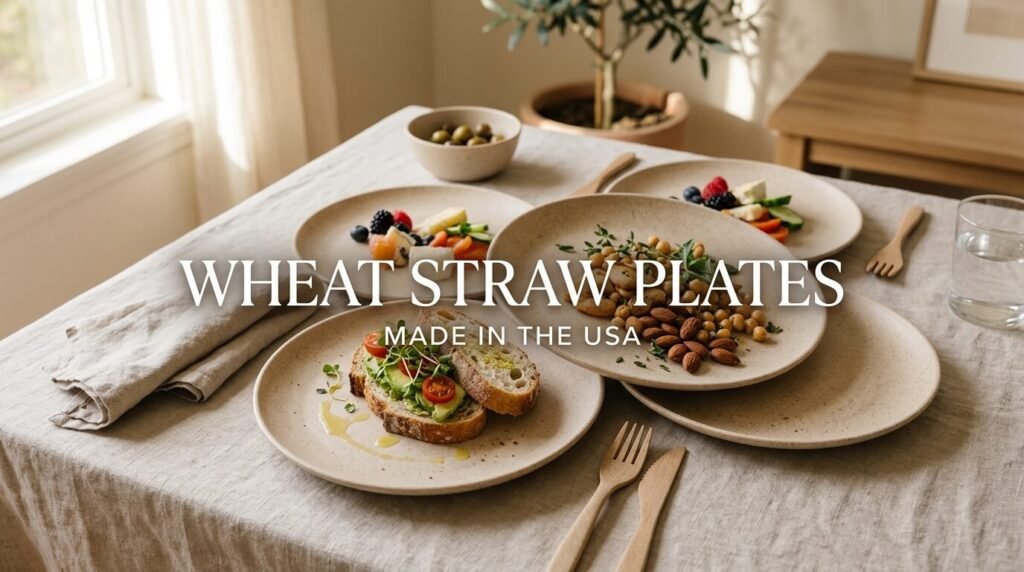
No. Not one brand currently selling wheat straw plates in the US market manufactures them domestically.
The two brands most commonly marketed as “American” — Greendish and Zlion — are US-owned companies with Chinese production facilities.
That distinction matters, and most articles covering this topic either bury it or skip it entirely.
US-Owned Brands That Manufacture in China: Greendish, Zlion, and What They Disclose
| Brand | HQ Location | Manufacturing Location | What They Disclose | Transparency |
|---|---|---|---|---|
| Greendish | Los Angeles, CA | China | Confirmed on their FAQ page: “responsibly made in China” | High — openly stated |
| Zlion | Boston, MA (founded 2016) | China (overseas) | Not prominently disclosed; requires research to confirm | Low |
| Most Amazon wheat straw brands | No US address | China | Often no disclosure at all | Very Low |
Every brand currently selling wheat straw plates in the US market manufactures in China. The difference between them is whether they say so clearly or make you dig for it. Greendish gets credit for stating it plainly on their FAQ. Zlion doesn’t.
If US manufacturing is non-negotiable for you, see our guide to eco-friendly dinnerware brands that are genuinely made in the USA.
Why No US Manufacturer Makes Wheat Straw Plates (And Whether That’s Likely to Change)
The reason is supply chain economics, not quality.


China produces roughly 17% of the world’s wheat and has built the agricultural processing and injection-molding infrastructure to turn wheat straw, a byproduct that would otherwise be burned or composted, into finished dinnerware at scale.
The US produces plenty of wheat, too, but the manufacturing infrastructure for this specific composite material doesn’t exist here yet. No domestic investment has moved in that direction as of mid-2026. Short answer: Don’t expect a US-made option in the near term.
Related: Do Wheat Straw Plates Stain?
What Are Wheat Straw Plates Actually Made Of?
Wheat straw plates are not purely plant-based. That’s the most common misconception about the material, and it matters for both safety and eco claims.
A wheat straw plate is a composite — roughly 50–70% processed wheat straw fiber mixed with a plastic binder, either polypropylene (PP) or polylactic acid (PLA).
The fiber gives it structure and reduces plastic content. The binder holds it together and determines how the plate performs under heat.
PP vs. PLA: The Two Binders Used in Wheat Straw Plates and Why It Matters
| Property | PP (Polypropylene) | PLA (Polylactic Acid) |
|---|---|---|
| % of plate composition | ~30–50% binder | ~30–50% binder |
| Microwave safe? | Yes — up to 120°C / 248°F | No — softens and warps at lower temps |
| Biodegradable /compostable? | Not biodegradable | Industrially compostable only (ASTM D6400 / EN13432) |
| Temperature limit | 120°C / 248°F | ~60°C / 140°F |
| Durability | Higher — more heat-stable | Lower — degrades faster under dishwasher cycles |
| Safety notes | FDA food-contact approved; well-studied | Plant-derived but still a plastic; not home-compostable |
For household use, PP-composite wheat straw plates are the more practical choice; they’re microwave-safe and more durable, even though they’re not biodegradable.
Most product listings don’t tell you which binder is used. If it’s not stated, contact the brand directly or assume PP if the plate is marketed as microwave-safe.
The “Biodegradable” and “Compostable” Claims: What They Actually Mean for Wheat Straw Plates
- PP-composite wheat straw plates are not biodegradable — polypropylene doesn’t break down in soil or water, regardless of how much wheat fiber surrounds it; the eco benefit is reduced plastic use, not end-of-life decomposition.
- PLA-composite plates are compostable, but only in industrial composting facilities — they require sustained temperatures above 55°C to break down, which a home compost pile doesn’t reach consistently.
- “Biodegradable” on product packaging without a certification is a marketing claim, not a verified fact — the certifications that actually confirm industrial compostability are ASTM D6400 (US standard) and EN13432 (EU standard).
- If the plate carries neither certification, the biodegradability claim has no third-party backing and should be treated with skepticism.
Are Wheat Straw Plates Safe? What the Research Actually Shows
For most people, yes — PP-composite wheat straw plates are safe for everyday use. But two documented concerns require honest disclosure: gluten migration risk for celiac households, and PFAS exposure in certain product types.
Neither is a reason to panic, but both are reasons to read the label more carefully than most people do.
The Celiac and Gluten Allergy Risk: What the 2025 Study Found
Multiple articles still claim wheat straw plates are safe for celiac disease because “gluten is in the grain, not the stalk.”
A 2025 study from the Karlsruhe Institute of Technology, published in the Journal of Agricultural and Food Chemistry, tested six different biodegradable food contact materials.
Wheat-bran-based plates transferred measurable gluten into both solid and liquid foods. The National Celiac Association’s current position (updated February 2026) states: “biodegradable tableware made from gluten-containing materials, such as wheat straw, should be regarded as unsafe for individuals with celiac disease unless the product is explicitly certified as gluten free.”
The Italian, Dutch, and Spanish Coeliac Societies now recommend full avoidance.
The distinction that matters: PP-composite wheat straw plates — where the fiber is processed and mixed with plastic — carry lower gluten risk than wheat-bran plates, where raw fiber has more direct food contact.
But “lower risk” isn’t the same as “certified safe.” If someone in your household has celiac disease, only use wheat straw plates that carry an explicit gluten-free certification on the packaging.
For the full breakdown of the research and which product types to avoid, see whether wheat straw plates are safe for celiac disease and gluten sensitivity.
PFAS, Microplastics, and Temperature Limits: The Other Safety Questions
- PFAS risk applies primarily to molded fiber wheat plates used in commercial foodservice — the kind used at stadium concessions or fast-casual restaurants, not the reusable PP-composite plates sold for home use; if you’re buying reusable home dinnerware, PFAS is a lower concern, but look for explicit PFAS-free labeling to confirm.
- Microplastic leaching at high heat is a PP issue, not a wheat straw-specific issue — the FDA recognizes microplastic contamination but doesn’t currently classify it as a health risk at the levels found in normal food contact use; the practical precaution is to avoid prolonged microwaving and never use these plates in a conventional oven.
- The temperature limit for PP-composite wheat straw plates is 120°C / 248°F — this covers reheating leftovers in a microwave but not cooking, and not high-heat dishwasher cycles on the bottom rack.
- FDA GRAS (Generally Recognized as Safe) status applies to the food-grade polypropylene resins used in reputable wheat straw composite plates — look for brands that explicitly reference FDA food-contact compliance.
Wheat Straw Plates vs. Bamboo vs. Melamine: Which Is the Better Choice?
PP-composite wheat straw plates are a better choice than melamine and safer than bamboo-melamine composites specifically. That’s the position based on available safety data, and it’s worth explaining why the bamboo comparison isn’t as simple as it looks.
Side-by-Side: Wheat Straw vs. Bamboo vs. Melamine Across Key Dimensions
| Property | Wheat Straw (PP) | Bamboo-Melamine | Melamine |
|---|---|---|---|
| Material composition | Wheat fiber + PP plastic | Bamboo fiber + melamine-formaldehyde resin | Melamine-formaldehyde resin |
| Microwave safe? | Yes (up to 120°C) | No — melamine migrates at heat | No |
| Dishwasher safe? | Yes (top rack) | Varies — melamine risk increases with heat | Yes, but degrades over time |
| Biodegradable? | No (PP binder) | No (melamine binder) | No |
| Gluten risk? | Low-moderate (PP composite) | None | None |
| PFAS risk? | Low (home reusable plates) | Low | Low |
| Durability | High | High | Very high |
| Price range | $20–$60 per set | $25–$70 per set | $15–$50 per set |
| Best for | Kids, outdoors, everyday use | Display, low-heat serving | Outdoor, commercial settings |
The Bamboo-Melamine Safety Warning You Need to Know Before Buying
Bamboo plates sound natural. Many are not, and the UK’s Food Standards Agency (FSA) flagged the risk. Bamboo tableware bonded with melamine-formaldehyde resin can migrate melamine and formaldehyde into food when exposed to high heat or acidic foods.
Research published by the National Institutes of Health confirms this instability at microwave temperatures. The keyword is “melamine-bonded” pure bamboo plates using food-safe alternative binders like cornstarch don’t carry the same risk.
But most budget bamboo plates on Amazon use melamine binders without disclosing it prominently. A wheat straw PP-composite plate is a safer microwave choice than a bamboo-melamine plate on this evidence.
Are Wheat Straw Plates Microwave and Dishwasher-Safe?
PP-composite wheat straw plates are microwave safe up to 120°C / 248°F. PLA-composite versions do not soften and warp at lower temperatures, and microwaving them risks both plate damage and plastic particle release.
If a product listing says “microwave safe” without specifying the binder, the safer assumption is PP. But confirm before buying.
Temperature Limits and When to Replace Your Wheat Straw Plates
- The maximum temperature for PP-composite plates is 120°C / 248°F — this covers standard microwave reheating but rules out oven use entirely and extended high-power microwave sessions.
- Dishwasher use should be top rack only — bottom rack temperatures in many dishwashers exceed the safe limit, and repeated high-heat cycles accelerate surface degradation.
- Replace plates when you see discoloration, surface roughening, or visible cracking — these are signs the composite is breaking down, and a degraded surface releases more particles into food than an intact one.
- PLA plates should not go in the dishwasher at all — the sustained heat of a dishwasher cycle is enough to warp them over repeated washes.
Best Use Cases: Where Wheat Straw Plates Work Well and Where They Don’t
- Kids and toddlers — unbreakable and lightweight, which makes them genuinely useful for households where dropped plates are a daily event; for a full comparison of child-safe options, see our best unbreakable plates for kids and toddlers.
- Outdoor and camping use — they hold up to outdoor conditions, don’t shatter on contact with rocks or concrete, and weigh less than ceramic alternatives.
- Adults with arthritis or limited grip strength — the weight difference compared to ceramic is real and noticeable; a full ceramic dinner plate weighs 400–600g; a comparable wheat straw plate weighs around 150–200g.
- RV and boat living — space-efficient, stackable, and durable under the kind of movement and vibration that breaks ceramics.
- Oven use — never; 120°C is the ceiling, and conventional ovens run at 175°C+ from the start.
- Celiac households — only if the specific product carries explicit gluten-free certification; without that certification, the risk is unverified.
The Best Wheat Straw Plate Options Available Right Now
No US-manufactured option exists. Given that, the right question shifts to: which available brands meet the minimum safety and transparency standards worth recommending?
The buying criteria are PP-composite (for microwave safety), BPA-free and PFAS-free labeling, food-contact certification, and honest disclosure of where the plates are made.
What to Look for When Buying Wheat Straw Plates: A Checklist
- Confirm the binder type — look for “PP” or “polypropylene” in the materials description; if the product only says “plant-based” or “eco-friendly” without specifying the binder, contact the brand before buying.
- Check for BPA-free and PFAS-free labeling — both should be stated explicitly, not implied; “non-toxic” alone is not specific enough.
- Require explicit gluten-free certification if anyone in your household has celiac disease — a general “wheat straw is processed” claim is not sufficient; look for a certified gluten-free mark on the packaging.
- Check the temperature rating — a reputable product states maximum temperature in °F or °C; if it doesn’t, that’s a gap in the product information that matters.
- Verify FDA food-contact compliance — reputable brands reference FDA food-contact regulations for their PP resins; this confirms the plastic used is food-grade, not industrial-grade.
- Check manufacturing transparency — the brand should disclose where the plates are made; if they won’t say, that tells you something.
US-Accessible Wheat Straw Plate Brands Worth Considering
| Brand | HQ | Manufacturing | Binder | Gluten-Free Cert? | Set Size | Price Range | Best For |
|---|---|---|---|---|---|---|---|
| Greendish | Los Angeles, CA | China (disclosed) | PP | Not stated — contact brand | 18–24 piece | $35–$55 | Families, transparency-focused buyers |
| Zlion | Boston, MA | China (undisclosed) | PP | Not stated | 28 piece | $30–$45 | Budget buyers are willing to research |
| Homienly | No US address | China | PP | Not stated | 40 piece | $45–$65 | Large households, sets for 8 |
| HXYPN | No US address | China | PP | Not stated | 18 piece | $25–$40 | Casual everyday use |
| SGAOFIEE | No US address | China | PP + starch | Not stated | 12 piece | $20–$35 | Colorful options, families |
Frequently Asked Questions
Are wheat straw plates safe for someone with celiac disease?
Not without explicit gluten-free certification. A 2025 study from the Karlsruhe Institute of Technology confirmed that wheat-based food contact materials can transfer gluten into solid and liquid foods, and the National Celiac Association now recommends avoiding them unless they carry a certified gluten-free label.
Are wheat straw plates actually biodegradable?
PP-composite wheat straw plates are not biodegradable — polypropylene doesn’t break down in soil or water.
PLA-composite versions are industrially compostable under ASTM D6400 or EN13432 certification, but not in a home compost pile. “Biodegradable” on packaging without one of these certifications is unverified.
Are wheat straw plates safer than bamboo plates?
PP-composite wheat straw plates are safer than bamboo-melamine plates specifically, because melamine-formaldehyde resin can migrate into food at high heat, a risk flagged by the UK’s Food Standards Agency and confirmed by NIH research.
Pure bamboo plates with food-safe binders are comparable to wheat straw PP plates in safety terms.
Can wheat straw plates go in the dishwasher?
PP-composite wheat straw plates can go on the top rack of a dishwasher; bottom rack temperatures often exceed the 120°C safe limit. PLA-composite versions shouldn’t go in the dishwasher at all, as the sustained heat warps them over repeated cycles.
How long do wheat straw plates last?
With top-rack dishwasher use and no oven exposure, PP-composite wheat straw plates typically last two to four years before surface degradation becomes visible.
Replace them when you see discoloration, roughening, or surface cracking. A degraded surface releases more particles into food than an intact one.
About the Author & Reviewer
Sarah Emirone, Author
Sarah researches and writes SafeKitchn’s dinnerware and kitchenware guides, with a focus on material safety, lead content, and manufacturer specifications. She cross-references product data sheets, safety certifications, and regulatory filings (including FDA and Prop 65 records) before publishing, and updates articles when new information becomes available.
James Daniels, Reviewer
James reviews SafeKitchn’s material safety content for scientific accuracy. He holds a B.Sc in inorganic chemistry and works as a materials researcher, with particular focus on the composition and safety behavior of glass, ceramic, and metal used in kitchenware.