

Can you put a toaster oven on top of a microwave? The honest answer isn’t yes or no; it’s “check one thing first,” and most people don’t know this.
Some people say never; others say it’s completely fine. Both are right, for different kitchens, because the deciding factor is where your specific microwave vents.
This guide walks through that check, why a toaster oven’s heat behaves differently than an air fryer’s, what the actual fire numbers say, and four alternatives if your setup turns out to be one of the risky ones.
Written by Sarah Emirone | Reviewed by James Daniels, B.Sc, Inorganic Chemist & Materials Researcher | Updated September 2026 | See How We Test | Filed under: Microwave & Appliance Specs
Is It Safe to Put a Toaster Oven on Top of a Microwave?
It depends on one specific, checkable detail: whether your microwave vents through its top panel. If it doesn’t, stacking a toaster oven there is one of the lower-risk small-appliance combinations in a kitchen.
If it does, you’re blocking the exact airflow the microwave needs to cool itself, and that’s a real problem, not a minor inconvenience.
The short answer
Most manufacturers don’t recommend it as a blanket rule, because they can’t know how your specific unit vents. But talk to anyone who’s actually done this for years, and the picture gets more mixed.
There are a bunch of people running a toaster oven on a side-vented or back-vented microwave with zero issues. The appliance matters more than the general rule.
Why the answer isn’t the same for every setup
- Microwaves vent heat through different locations depending on the model — some through the top, some through the back or sides only, and a few through a combination of all three.
- A toaster oven’s own clearance needs vary by wattage and design, with most manuals citing a minimum of 4 inches of open space around the unit.
- The microwave’s build material changes how much heat exposure it can take, since a stamped steel top tolerates sustained warmth far better than thin plastic trim.
- How often and how long you run the toaster oven changes the cumulative heat exposure, so occasional 10-minute reheats carry less risk than daily 45-minute roasts.
The One Detail That Decides This: Where Your Microwave Vents
Before anything else, weight, electrical load, and fire risk check this one thing, because it overrides most of the other factors on this page.
- Find your microwave’s vent location. Open the installation section of your microwave’s manual, which almost always includes a diagram showing vent placement, or physically inspect the unit for grille slots on the top panel versus the back and sides only. If you can’t find the manual, search the model number plus “installation guide” — most manufacturers post these as free PDFs.
- Match it against your toaster oven’s clearance spec. Check toaster oven clearance requirements by model for your specific unit, since the commonly cited 4-inch minimum varies with wattage and design. If your microwave vents from the top and your toaster oven needs 4 or more inches of clearance above it, the setup fails the check — full stop, regardless of how sturdy the stack looks.
Why Toaster Ovens Are a Bigger Heat Risk Than Other Small Appliances
A toaster oven radiates heat from more surfaces, for longer, than most other countertop appliances people consider stacking. That’s the reason it needs a more careful check than, say, a blender.
Surface temperatures during use
A toaster oven’s exterior top, sides, and especially the back near the heating elements, can reach 150°F to 500°F depending on the cooking setting.


Unlike a microwave, it works like a small conventional oven with exposed radiant heating elements, and that heat isn’t contained to the cooking cavity the way a microwave’s is.
It radiates outward in every direction, which is exactly why the surface underneath and around it matters so much.
How does this compare to stacking an air fryer?
For readers weighing stacking an air fryer on a microwave against a toaster oven instead, the two appliances behave differently enough that the same advice doesn’t cleanly apply to both.
| Factor | Toaster oven | Air fryer |
|---|---|---|
| External surface temp | 150°F–500°F, radiates from top, sides, and back | Generally cooler exterior; heat is mostly contained and vented through defined slots |
| Primary heat-escape path | Radiant heat from exposed elements, plus vents | Fan-driven convection through dedicated vents |
| Typical weight | 10–25 lbs | 8–20 lbs |
| Typical clearance needed | 4+ inches on all sides | 3–6 inches on all sides |
Weight, Stability, and Electrical Load
Weight is rarely the deciding factor here, but it still matters enough to check before assuming a sturdy-looking stack is a safe one.
Weight capacity and tipping risk
Most standard countertop microwaves can structurally support 20 to 50 pounds on their top surface, and a toaster oven weighing 10 to 25 pounds usually falls within that range.
The bigger risk isn’t the microwave collapsing; it’s the stack becoming top-heavy enough to tip if bumped, especially on a microwave with worn or uneven feet.
Check your specific microwave’s manual for a stated weight capacity if one exists; not all manufacturers publish one, since they don’t expect anything to sit on top in the first place.
Running both on the same circuit
Toaster ovens typically draw 1,200 to 1,800 watts, and microwaves draw 600 to 1,200 watts.
Take, for instance, a 20-amp kitchen circuit already carrying 35 amps of load from a microwave and two coffee makers. Adding a toaster oven pushed that combined load to 47.5 amps, well past what the circuit is rated to carry.
| Circuit rating | Safe wattage capacity | Toaster oven draw | Microwave draw | Combined risk |
|---|---|---|---|---|
| 15-amp (standard) | ~1,800W | 1,200–1,800W | 600–1,200W | Often exceeds capacity if both run at once |
| 20-amp (kitchen-rated) | ~2,400W | 1,200–1,800W | 600–1,200W | Usually safe alone, but add a third appliance, and it adds up fast |
What the Fire Data Actually Says About Toaster Ovens
Stacking isn’t the main driver of toaster oven fires, but the appliance category carries real, documented risk worth knowing before you decide where to put one.
Documented toaster oven fire numbers
Toasters and toaster ovens combined caused close to 3,000 fires and more than $27 million in property damage over a five-year reporting period, according to consumer-safety data compiled by personal injury firm Edgar Snyder & Associates.
That number covers the appliance category broadly, not stacking specifically. There’s no published data isolating fires caused by a toaster oven placed on top of a microwave.
What it does confirm is that toaster ovens run hot enough, often enough, to be a real fire category on their own, which is exactly why the vent-location check earlier in this article matters more for this appliance than it would for something like a blender.
What actually causes most of these fires
- Crumb buildup inside the toaster oven is one of the most common ignition points, since accumulated food particles sit close to the heating elements and dry out with repeated use.
- Unattended operation shows up repeatedly in fire reports, particularly when a toaster oven runs while someone leaves the room or the house.
- Flammable materials placed too close to the unit — dish towels, paper towels, cardboard packaging — catch heat radiating off the exterior even when the appliance itself is working correctly.
- Faulty wiring or a damaged heating element causes a smaller but still real share of incidents, which is why checking the cord and controls periodically is worth the two minutes it takes.
Can You Put a Microwave on Top of a Toaster Oven Instead?
No. Flipping the order doesn’t fix the problem; it just moves the heat source underneath instead of on top. For anyone weighing small kitchen appliance layout ideas, this reverse setup is worth ruling out early rather than testing it yourself.
Why the reverse setup isn’t safer
Putting the toaster oven on the bottom means its heat now rises directly into the microwave sitting above it, which is arguably worse than the original configuration since heat naturally moves upward.
The microwave’s vents, wherever they’re located, end up sitting in the toaster oven’s heat plume for the entire time it runs. This setup also makes the toaster oven harder to load and unload safely, since its door now opens well below eye level.
When it’s technically less risky
- If your microwave vents only from the back and never the bottom, having it sit above a heat source is marginally safer than having a top-vented microwave underneath one.
- A microwave with an all-metal base plate handles sustained heat from below better than one with a plastic or composite bottom panel.
- Short, occasional toaster oven use — a few minutes at a time — creates far less cumulative heat exposure than a microwave running most evenings.
4 Safer Alternatives to Stacking
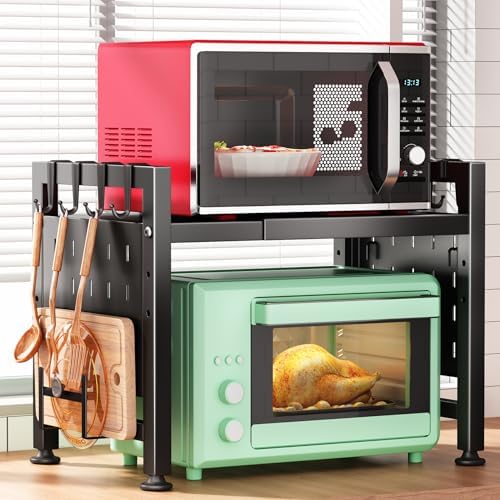
None of these requires a kitchen remodel. Start with toaster oven stands and under-cabinet mounts if you want a fixed solution, or compare all four options below.


| Alternative | Approx. cost | Footprint | Safety trade-off |
|---|---|---|---|
| Dedicated stand or shelf | $25–$90 | Small, wall-mounted or countertop | Keeps clearance intact if sized for your toaster oven’s vent needs |
| Under-cabinet mount | $40–$150 plus installation | None on the counter | Frees counter space entirely, but needs proper clearance below cabinets |
| Microwave-toaster oven combo unit | $200–$400 | Same as a single microwave | Removes the stacking decision by combining both functions |
| Separate counter zones | Free | Uses existing counter length | Cheapest option, but only works with a spare counter to begin with |
Dedicated stand or shelf
A stand sized specifically for your toaster oven’s clearance spec gives it open air on top and both sides, which a flat countertop next to the microwave can’t always guarantee in a narrow kitchen.
Under-cabinet mount
Mounting the toaster oven under a cabinet clears the counter completely, but only works if there’s enough vertical clearance between the unit and the cabinet above it. Cramming a toaster oven under a low shelf creates the same heat-trapping problem as stacking.
Microwave-toaster oven combo unit
These combine both cooking methods into one appliance about the size of a large microwave, which sidesteps the entire stacking question. Check microwave-toaster oven combo units if a single unit fits your kitchen better than running two.
Separate counter zones
Putting the toaster oven and microwave on opposite ends of the same counter, or on adjacent counters, costs nothing and solves the ventilation problem outright. The only real limit is whether your kitchen has that much counter space to begin with.
Not Sure Your Microwave’s Vent Location?
Check your manual or the physical unit itself against the two-step test above before deciding where anything goes. A microwave with hidden top vents and a toaster oven that needs 4 inches of clearance is a bad match, no matter how tidy the stack looks.
Frequently Asked Questions
Can you put a toaster oven on top of a microwave when it’s off?
Yes, with the power off and the unit not in use, the heat and ventilation risks drop close to zero, leaving only weight and stability to consider. Center the toaster oven fully on the microwave’s footprint so it can’t tip if bumped. Move it to open counter space before running either appliance.
Will stacking void my microwave’s warranty?
It can, since most manufacturer warranties exclude damage caused by blocking ventilation or using the appliance outside its documented placement instructions.
Check the installation section of your manual for language about obstructed vents. If a repair traces back to heat damage from something stacked on top, the manufacturer has grounds to deny the claim.
Is a microwave-toaster oven combo worth buying instead of stacking?
For most people dealing with this exact space problem, yes, a combo unit removes the decision entirely by putting both functions in one appliance the size of a large microwave.
You lose the ability to run both at once, which matters if you toast and reheat in the same meal. For everyone else, it’s the cleanest fix on this list.
Can a toaster oven damage a microwave’s plastic exterior?
Yes, sustained heat exposure from a toaster oven sitting on top can warp plastic housing and control panels over time, even if nothing fails immediately.
The damage tends to show up gradually as discoloration, warping, or a control panel that stops responding. A microwave with a metal or tempered glass top handles this better than one with plastic trim.
How do I know if my toaster oven is overheating?
Watch for a burning smell that isn’t coming from the food, a casing that’s hotter than usual to the touch, or a breaker that trips during normal use.
Any one of these on its own is worth investigating. Unplug the unit, let it cool, and check for crumb buildup near the heating elements before using it again.
Is it safer to stack a toaster oven than an air fryer?
Neither is safer across the board; it depends on your microwave’s vent location either way, but the toaster oven runs hotter on the outside, which raises the stakes if that check fails.
An air fryer’s heat stays more contained within its own housing. If your microwave vents from the top, both appliances fail the check, but the toaster oven fails it with a higher-temperature margin.
Can I use a heat-resistant mat to make stacking safer?
A mat reduces direct heat transfer to the microwave’s surface, but it does nothing about blocked ventilation, which is the actual mechanism behind most of the risk.
Treat a heat mat as a minor addition on top of a setup that already passes the vent-location check, not a fix for one that fails it. The airflow problem is structural, not thermal alone.
What’s the average lifespan of a toaster oven vs. a microwave?
A toaster oven typically lasts 3 to 5 years with regular use, while a microwave usually lasts 7 to 10 years. Stacking accelerates wear on both by adding heat and vibration stress; neither was built to handle.
That gap is part of why the microwave, the appliance more likely to take the damage, is also the one you’d replace less often.
About the Author & Reviewer
Sarah Emirone, Author
Sarah researches and writes SafeKitchn’s dinnerware and kitchenware guides, with a focus on material safety, lead content, and manufacturer specifications. She cross-references product data sheets, safety certifications, and regulatory filings (including FDA and Prop 65 records) before publishing, and updates articles when new information becomes available.
James Daniels, Reviewer
James reviews SafeKitchn’s material safety content for scientific accuracy. He holds a B.Sc in inorganic chemistry and works as a materials researcher, with particular focus on the composition and safety behavior of glass, ceramic, and metal used in kitchenware.