

People ask how hot does it get in a microwave, expecting a single number.
The real answer is three different numbers because the question is actually three questions that almost everyone conflates. The air inside the cavity stays near room temperature. The food can hit 212°F or higher.
And whether that food is safe to eat depends on a third set of numbers set by the USDA.
This article separates all three, covers the wattage confusion that sends most guides in the wrong direction, and explains the one temperature hazard, superheating, that the USDA specifically warns about but almost no temperature guide mentions.
Written by Sarah Emirone | Reviewed by James Daniels, B.Sc, Inorganic Chemist & Materials Researcher | Updated September 2026 | See How We Test | Filed under: Microwave & Appliance Specs
The Air Inside a Microwave Stays Near Room Temperature — Here’s Why
The air inside a running microwave cavity sits at roughly 40–50°C (104–122°F) during normal use. Not 350°F. Not 400°F. Closer to a warm car interior on a summer afternoon.
The microwave is not broken; that is exactly how it is supposed to work, because a microwave does not heat air at all.
How Microwaves Actually Heat — The Magnetron and Water Molecule Explanation
The component doing the work is a magnetron, which converts electrical power into electromagnetic waves at 2.45 GHz. Those waves pass straight through the food container and into the food itself, where they cause water, fat, and sugar molecules to vibrate.
That vibration is the heat. It comes from inside the food, not from the air around it.
Metal cavity walls reflect the waves back and forth. Air molecules do not absorb them efficiently. So the cavity air only warms secondarily from heat radiating off the food surface, and even after several minutes of operation, that air temperature tops out at 40–80°C in extended sessions.
The food can be scalding while the air a few inches away is barely warm.
What the Cavity Walls and Turntable Temperature Actually Reach
- The metal cavity walls stay close to ambient temperature during normal use, rising only when food splatters and burns onto the surface, which creates localized hot spots that can damage the coating over time.
- The glass turntable heats through contact with whatever is sitting on it, reaching 50–80°C (122–176°F) after extended heating — treat it as hot when removing food.
- The inner door surface generally stays below 50°C (122°F) in a properly functioning unit, because the door is designed to reflect rather than absorb microwave energy.
- The exterior cabinet warms slightly from the magnetron’s heat dissipation; if it feels uncomfortably hot to the touch, that is a ventilation problem, not normal operation.
- The cavity air itself peaks at 40–50°C under normal conditions — the same rough temperature range as a hot drink left sitting on a desk.
How Hot Does Food Get in a Microwave?
How hot the food gets depends entirely on what the food is made of. Water-based foods, such as soup, vegetables, rice, and most leftovers, are physically capped near 100°C (212°F) at atmospheric pressure because that is where water boils.

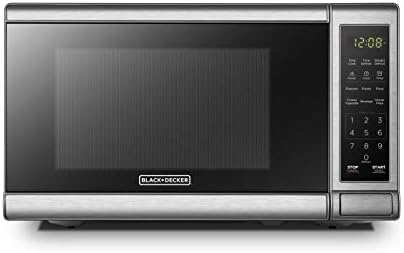

Foods high in fat or sugar face no such ceiling and can go well past it.
Temperature by Food Type — The Water, Fat, and Sugar Divide
| Food / Content Type | Temperature Range in Microwave | Key Note |
| Water (plain liquid) | Up to 100°C (212°F); can superheat to 101–105°C+ | Superheating risk — covered below |
| Soup, sauce, broth | 60–95°C (140–203°F) after typical heating | Steam heats the cavity air secondarily |
| Oatmeal, pasta, rice | 70–100°C (158–212°F) | Hot spots common; stir before eating |
| Meat and poultry | 70–90°C (158–194°F) achievable | Cold spots are common; a thermometer is required |
| Foods high in fat (butter, oil) | Can exceed 110°C (230°F) | Fats are not water-limited; fire risk if overheated |
| Foods high in sugar (jam, syrup, candy) | Can exceed 110°C (230°F) | Sugar burns are severe; heat in short intervals |
| Frozen foods (starting from 0°C) | 0–75°C range during defrost | Cold spots most dangerous category for food safety |
Hot Spots and Cold Spots — Why the Same Food Has Two Different Temperatures
Microwave energy does not spread evenly through the cavity. The waves reflect off the walls and create standing wave patterns, areas of high energy concentration called antinodes, and dead zones called nodes.
Food sitting at a node barely heats; food at an antinode heats fast. A plate of pasta can have one section at 90°C while the center is still at 40°C.
Turntables reduce this problem but do not eliminate it. The practical fix is to stir or rotate food partway through heating, then let it stand for 1–2 minutes before checking the temperature, heat keeps conducting through the food during that rest period.
Does Wattage Determine How Hot a Microwave Gets?
Wattage determines how fast food reaches temperature — not what maximum temperature it reaches. A 1,200-watt microwave and a 700-watt microwave will both bring a cup of water to 100°C.
The 1,200-watt unit gets there roughly 40–50% faster. That distinction matters when you are adjusting cooking times across different machines.
Wattage Ranges and What They Mean for Cooking Speed
| Wattage | Cooking Speed | Best For | Conventional Oven Rough Equivalent |
| 500–600W | Slow | Simple reheating only | ~300°F (149°C) |
| 700W | Standard | Every day heating and cooking | ~350°F (177°C) |
| 800W | Medium-high | Faster reheating; most recipes calibrated here | ~450°F (232°C) |
| 900W | High | Efficient for standard cooking tasks | ~525°F (274°C) |
| 1000–1100W | Very high | Fast cooking; premium home models | ~575°F (302°C) |
| 1200W+ | Commercial/Pro | Very fast; large-capacity units | ~625°F+ (329°C+) |
Important: These wattage-to-oven equivalencies are energy delivery comparisons used by recipe developers to calibrate cooking times, not temperature readings.
A 900W microwave does not create a 525°F environment inside the cavity. The cavity air stays at 40–50°C regardless of wattage. The equivalency describes how quickly the microwave delivers energy to food, not the temperature it creates around food.
Why Microwave Recipes Specify Wattage — and What to Do If Yours Differs
For how to find and use your microwave’s wattage, start with the label inside the door frame or on the back of the unit. Once you have it:
- Find your microwave’s wattage — it is printed on the inside of the door frame, the back of the unit, or in the owner’s manual.
- Compare your wattage to the recipe’s stated wattage; most recipes assume 700–750W as the baseline.
- If your microwave is more powerful — say 1,000W vs. a recipe written for 700W — cut the cooking time by about 30%.
- If your microwave is less powerful — say 600W vs. a recipe written for 700W — add 15–20% to the cooking time.
- After the first heating cycle, check food temperature with a thermometer rather than relying on the adjusted time estimate alone.
- Use the standing time — typically 1–2 minutes after the cycle ends — before taking the final temperature reading, because heat continues distributing through the food during that window.
What Temperature Is Hot Enough to Kill Bacteria in a Microwave?
A microwave can kill bacteria, but only if the food reaches the required internal temperature throughout the entire piece, not just in the hot spots.
The USDA Food Safety and Inspection Service (FSIS) sets the same minimum internal temperatures for microwave-cooked food as for conventionally cooked food.
The microwave method changes the equipment; it does not change the biology.
USDA Safe Minimum Internal Temperatures for Microwave-Cooked Food
Source: USDA Food Safety and Inspection Service
| Food Type | Minimum Safe Internal Temperature | Notes |
| Poultry (chicken, turkey, duck) | 165°F (74°C) | Check in multiple spots; one reading is not enough |
| Ground meats (beef, pork, lamb, veal) | 160°F (71°C) | Cold spots are most likely in the center of dense masses |
| Whole cuts of beef, pork, lamb, veal | 145°F (63°C) | Allow 3-minute rest before checking |
| Fish and shellfish | 145°F (63°C) | Check in the thickest portion |
| Egg dishes and casseroles | 160°F (71°C) | Stir partway through heating |
| Leftovers (all types) | 165°F (74°C) | Must reach 165°F throughout, not just at the surface |
For a full breakdown of each protein and the specific risks of undercooking in a microwave, see safe internal temperatures for microwaving meat.
Why the Microwave’s Uneven Heating Makes Food Thermometer Use Non-Negotiable
- Cold spots can harbor live bacteria even when the surrounding food reads at a safe temperature — the USDA FSIS explicitly states food must be checked at multiple locations, not just once in the thickest section.
- Standing time is required by the USDA after microwave cooking to allow heat to conduct through the food and eliminate thermal gradients before you take the final temperature reading.
- Food surface temperature runs lower in a microwave than in a conventional oven because the cavity air is cool — the outside of a microwave-cooked chicken breast can feel barely warm while the interior is at 165°F, which is the opposite of what most people expect.
- Frozen food is the highest-risk category because the distance from 0°C (32°F) to the safe minimum of 165°F (74°C) is greatest, and microwave hot spots create the most extreme temperature differentials in dense frozen items.
- Stuffed whole poultry should never be microwaved — the USDA specifically warns that stuffing inside a microwave-cooked bird may not reach 165°F even when the bird’s exterior tests as fully cooked.
What Is Microwave Superheating and Why Is It a Temperature Hazard?
Superheating is a documented phenomenon confirmed and warned against by the USDA FSIS, in which water in a microwave is heated above its normal boiling point of 212°F (100°C) without appearing to boil.
When that liquid is then disturbed by adding instant coffee, inserting a spoon, or simply lifting the container, it can erupt violently, ejecting near-boiling liquid in a sudden burst. Burns from this are real. They happen in home kitchens.
Why Superheating Happens and Which Conditions Trigger It
Normal boiling needs nucleation sites, microscopic surface irregularities where bubbles can form and escape.
A very clean, smooth container offers almost none. In a microwave, heat builds internally and unevenly rather than from the bottom up, the way a stovetop burner heats water.
The USDA FSIS notes that temperature “higher than 212°F (the boiling point of water) builds up an inch or two below the surface” while the surface appears completely still and calm.
The conditions most likely to produce superheating: a very clean glass or ceramic container (especially one just out of the dishwasher), pure water with nothing dissolved in it, starting at room temperature, and heating in a single long uninterrupted interval rather than short bursts.
None of those conditions is unusual. They describe a cup of water heated for a hot drink on a weekday morning.
How to Prevent Microwave Superheating — USDA-Recommended Steps
- Place a microwave-safe non-metallic object in the container before heating. The USDA FSIS specifically recommends a wooden stirrer, ice cream stick, or chopstick, which provides nucleation sites that allow normal bubble formation.
- Use a slightly older or roughened container rather than pristine smooth glass; the surface irregularities on a well-used mug work in your favor here.
- Heat liquids in 30–60 second intervals rather than one continuous run, and stir between each interval to release any sub-surface heat buildup.
- Skip containers that have just come out of the dishwasher — the cleaning process removes surface irregularities and leaves the vessel as smooth as it will ever be.
- When removing a heated liquid from the microwave, move it smoothly and without jarring or shaking the container before it has been stirred.
- If a liquid appears completely still after more than 2 minutes of heating, tap the side of the container gently from a distance before reaching in.
How Does Microwave Temperature Compare to a Conventional Oven?
A conventional oven heats air to the target temperature — typically 325–450°F (163–232°C) — and the food cooks by sitting inside that hot air.
A microwave cavity air stays at 40–50°C regardless of the power level. These are not two versions of the same process.
They are fundamentally different heat transfer mechanisms, which is why they produce different results on the same food.
Side-by-Side Comparison — Microwave vs. Conventional Oven
| Dimension | Microwave | Conventional Oven |
| Cavity air temperature | 40–50°C (104–122°F) | 163–260°C (325–500°F) |
| Max food temp (water-based) | ~100°C (212°F) | Can exceed 150°C (302°F) at surface |
| Max food temp (fat/sugar) | 110°C+ (230°F+) | 180–220°C+ (356–428°F+) |
| Heating mechanism | EM waves vibrate molecules internally | Hot air heats food from the outside in |
| Surface browning | No | Yes — above 140°C (284°F) threshold |
| Cooking speed | 3–10× faster for most foods | Slower; requires preheating |
| Evenness of heating | Uneven; hot spots and cold spots | More even, especially with convection fan |
| Energy efficiency | Higher — heats food directly | Lower — heats large air volume |
| Best use cases | Reheating, defrosting, boiling, steaming | Baking, roasting, browning, crisping |
Why Microwave Food Doesn’t Brown — The Surface Temperature Explanation
The Maillard reaction — the chemical process that creates browning, crust, and the flavour compounds associated with roasted or baked food — requires surface temperatures above approximately 140–165°C (284–329°F).
Because the microwave cavity air sits at 40–50°C, food surfaces never reach that threshold. The interior heats from the waves; the surface stays relatively cool.
That is why reheated food from a microwave can taste flat — not because the microwave is cooking it wrong, but because the surface chemistry that makes food taste roasted simply cannot happen without hot surrounding air.
Convection microwaves partially address this by adding a heated air fan that raises cavity air temperature and allows some surface browning.
For a full breakdown of what that actually delivers, see convection microwave vs standard microwave temperature differences.
Now that you know exactly what temperatures a microwave reaches and why, the next practical question is whether your containers can handle them.
Check our microwave-safe containers guide for material-by-material safety ratings, or see the complete kitchen appliance temperature comparison for side-by-side figures across every cooking method.
Frequently Asked Questions About Microwave Temperatures
Does a microwave have a temperature setting?
No, a microwave sets power level and time, not degrees. It delivers electromagnetic energy measured in watts, and the food reaches a temperature based on its composition, the wattage, and how long it runs. There is no equivalent to setting a conventional oven to 350°F.
How hot does the inside of a microwave get without food in it?
Without food, the cavity air stays very close to room temperature even after several minutes of operation. Running a microwave empty is not safe, though — the magnetron can be damaged when waves have no food to absorb them.
Can a microwave get hot enough to sterilize things?
A microwave can reach temperatures sufficient to kill most common foodborne bacteria at 165°F (74°C), but sterilization, destroying all microbial life, including heat-resistant spores, requires sustained temperatures that a standard microwave cannot reliably achieve. It is not a sterilization device.
Why does my food feel lukewarm on the outside but scalding inside?
Microwaves heat food from the inside out through molecular vibration, while the cavity air stays at 40–50°C and keeps the food surface relatively cool.
The center of a dense food item can reach boiling temperature while the outside feels only warm. Always cut into or stir food before eating to verify internal temperature.
What temperature should chicken reach in a microwave to be safe?
The USDA FSIS requires chicken and all poultry to reach 165°F (74°C) internally, regardless of cooking method. Check with a food thermometer in the thickest part, away from bone, and test in at least two locations because microwave heating is uneven.
Is superheating in a microwave actually dangerous?
Yes, the USDA FSIS confirms that water can heat above 212°F in a smooth container without appearing to boil, then erupt when disturbed, causing serious burns. It is not common, but it is not rare either. Placing a wooden stirrer in the cup before heating prevents it.
Why doesn’t food get crispy or browned in a microwave?
Browning requires surface temperatures above 140–165°C (284–329°F) to trigger the Maillard reaction. Microwave cavity air stays at 40–50°C, so food surfaces never get hot enough for that chemistry to occur.
Convection microwaves add heated air to partially close this gap.
How hot does a 700-watt microwave get compared to a 1,200-watt microwave?
Both heat water to the same maximum of approximately 212°F (100°C) — the 1,200-watt unit gets there roughly 40–50% faster for the same quantity.
For fatty or sugary foods that can exceed 212°F, higher wattage reaches those elevated temperatures faster, but the ceiling depends on the food’s composition, not the wattage.
Can a microwave reach 300 degrees Fahrenheit inside?
The cavity air will never reach 300°F (149°C) in a standard microwave. The food inside, such as butter, oil, jam, or candy, can reach 300°F or higher because fat and sugar are not limited by water’s boiling point.
Heat these foods in short intervals with close attention.
Is the outside of a running microwave dangerous to touch?
The exterior should feel only slightly warm — heat from the magnetron’s operation dissipates through the cabinet. If the exterior feels uncomfortably hot during or after use, that points to a ventilation problem or malfunction, and the unit should be inspected before further use.
About the Author & Reviewer
Sarah Emirone, Author
Sarah researches and writes SafeKitchn’s dinnerware and kitchenware guides, with a focus on material safety, lead content, and manufacturer specifications. She cross-references product data sheets, safety certifications, and regulatory filings (including FDA and Prop 65 records) before publishing, and updates articles when new information becomes available.
James Daniels, Reviewer
James reviews SafeKitchn’s material safety content for scientific accuracy. He holds a B.Sc in inorganic chemistry and works as a materials researcher, with particular focus on the composition and safety behavior of glass, ceramic, and metal used in kitchenware.