

Dating Libbey glass marks isn’t the exact science most guides make it sound like.
Flip a tumbler over, spot a cursive “L” inside a circle, and you’ll find plenty of articles ready to hand you a precise decade.
But the researchers who actually documented these marks, Julian Toulouse, Arthur Peterson, and museum researcher Wilson, don’t fully agree with each other on when Libbey introduced each version.
One source even admits its date is “presumably based on” a patent record check rather than confirmed physical evidence.
That doesn’t mean dating your piece is hopeless. It means the real answer involves a range, a bit of cross-referencing, and knowing what the numbers next to that L actually mean, which is where most guides stop short.
Written by Sarah Emirone | Reviewed by James Daniels, B.Sc, Inorganic Chemist & Materials Researcher | Updated September 2026 | See How We Test | Filed under: Identification & Authentication
A Quick History of the Libbey Glass Company
Libbey’s mark history only makes sense once you know the company moved states, changed names, and survived a bankruptcy sale; each shift left its mark on the trademarks themselves.
From New England Glass Co. to Toledo
The company started as the New England Glass Company in East Cambridge, Massachusetts, in 1818. William L. Libbey leased the operation in 1878 and renamed it W.L. Libbey and Son.
His son, Edward Drummond Libbey, signed a contract in 1888 to move the entire operation to Toledo, Ohio, where cheap natural gas made large-scale glass production far more affordable than it had been in Massachusetts.
The company took its current name, Libbey Glass Company, in 1892. By the late 1890s, it had grown into the largest glass producer in the world, the kind of scale that makes consistent trademark documentation genuinely difficult, since multiple factories and product lines were running simultaneously.
Why Libbey Started Marking Its Glass at All
Not every piece Libbey ever made carries a mark, and that’s worth knowing before you start searching for one that might not exist.



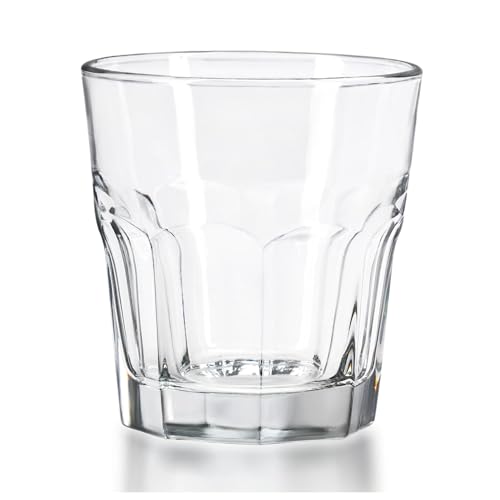

Marking mattered most for higher-value cut glass and fine tableware, where a maker’s signature functioned as a guarantee of authenticity and quality to buyers, for the same reason Libbey filed its first formal trademark application in 1896.
Every day, machine-made tumblers from later decades were marked more inconsistently, and some Libbey pieces from the 1900s simply left the factory with no signature at all, which is part of why pattern and shape sometimes matter as much as the mark itself.
Related: Libbey vs Anchor Hocking Comparison
The Early Marks: Sword, Eagle, and Script Signatures (1892–1910s)
Libbey’s earliest trademarks predate the familiar cursive-L-in-a-circle by decades, and they’re rare enough that finding one is a genuine event for a collector.
The Sword Mark
The sword mark consists of the word “Libbey” in script with a small sword beneath it, registered as U.S. Trade Mark No. 28,180 on April 21, 1896.
The original trademark application described it plainly: “the word ‘Libbey’ and the representation of a sword under said word.”
It stayed in use until roughly 1906, and possibly as late as 1910 on some pieces, before Libbey dropped the sword and kept just the script name, with the “L” and “y” nearly connected in a signature-like flourish.
The Eagle Trademark
The eagle trademark, a spread-wing eagle encircled by the words “Libbey Cut Glass Toledo O” — was Libbey’s first formal mark, used primarily from 1892 to 1896.
It was mostly stenciled onto art glass rather than acid-etched into cut glass, and genuine examples acid-etched onto cut pieces are extremely uncommon; a decanter that surfaced with this mark years ago is now regarded as a forgery rather than an authentic period piece.
The Three Main “L in a Circle” Eras — and Why Their Dates Are Disputed
Most Libbey pieces collectors encounter today carry one of three circular L-marks, and here’s the honest version of what each one tells you: a rough era, not a precise year.
Double Circle, Segmented Circle, and Single Circle Compared
| Mark | Commonly Cited Range | What It Looks Like |
|---|---|---|
| Double circle | 1920–1936 (introduced circa 1924) | Cursive capital “L” inside two concentric circles |
| Three-segmented circle | 1937–1954 | Cursive “L” inside a circle broken into three separate segments |
| Single circle | 1955–1980s | Cursive “L” inside one plain, unbroken circle |
Why Toulouse, Peterson, and Wilson Don’t Fully Agree
Julian Toulouse, writing in Bottle Makers and Their Marks (1971), places the introduction of the double-circle mark around 1924.
Arthur Peterson’s 400 Trademarks on Glass (1968) lists the three-segmented circle as introduced in 1937 — but notes this date is presumably based on a U.S. Patent and Trademark Office records check, not confirmed physical evidence from dated glass.
Museum researcher Wilson’s work adds a further complication: donations made to the Toledo Museum of Art in 1951 and 1969 sometimes had trademarks acid-etched onto them at the time of donation, even when the actual glass had been produced decades earlier.
A mark you’re looking at today might date the moment someone decided to label a piece, not the year it left the factory floor.
Treat the ranges above as reasonable working estimates, cross-check them against the piece’s pattern and shape, and don’t stake a purchase decision on a single year.
What the Numbers Next to the L Mark Actually Mean
Numbers stamped beside or inside the L mark are mold numbers, not date codes — and this is one of the most consistently misunderstood details in Libbey identification.
Collectors regularly find a small “3,” “17,” or “22” next to the cursive L and assume it must encode a production year somehow. It doesn’t.
Mold Numbers, Not Date Codes
A mold number identifies the specific mold used to produce that individual piece, which matters for factory quality control and tracking, not for dating.
Collectors researching this on their own have repeatedly confirmed the pattern with people who worked directly with the glass: a “3” beside the L on a heat-treated tumbler is a mold identifier, and pairs of numbers on either side of the L — like a “1” and a “4” flanking the mark — follow the same logic even when their exact internal meaning to Libbey’s factory system isn’t publicly documented.
How to Tell a Mold Number From Other Markings
- Check the position first — mold numbers typically sit directly beside the L mark, either just outside the circle or tucked within it, rather than appearing elsewhere on the base.
- Look for a single digit or a small pair of digits (1–2 digits each) rather than a longer string, since mold numbers are short by nature.
- Compare against known catalog dates for the pattern itself — a pattern with a documented 1955 introduction date narrows your era regardless of what any adjacent number says.
- Note that the mark itself often appears backwards when viewed from outside the glass, but reads correctly when you look down through the inside — a normal feature of how these marks were pressed into the mold, not a sign of a fake.
- If two identical L marks appear on the same piece, treat it as a manufacturing misprint rather than a meaningful second signature — several collectors have documented this exact double-L error without finding any deeper explanation for it.
How to Tell If a Libbey Signature Is Authentic
Not every Libbey mark you encounter is genuine, and the reason has nothing to do with the mark’s design; it’s about money. Signed pieces are worth more, and that gap creates a real incentive to fake a signature that was never there.
Why Forged Signatures Exist
Documented pricing trends show signed Libbey pieces command a 20 to 30 percent premium over the same unsigned piece.
That’s a meaningful enough gap that forged signatures have shown up on the market, added to genuine but unsigned period glass to boost its resale value.
This isn’t a hypothetical risk; it’s the specific, stated reason collectors are advised to study known authentic signed pieces before buying, so an unfamiliar or oddly placed mark doesn’t slip past them.
Authentication Checklist
- Compare the signature’s exact style, size, and placement against verified authentic examples of the same era before trusting an unfamiliar-looking mark.
- Check whether the cutting pattern, glass quality, and overall craftsmanship actually match the period the signature claims to be from.
- Treat a mark that looks unusually crisp or “too clean” on an otherwise worn, decades-old piece with extra scrutiny, since wear patterns on glass and mark condition should generally align.
- Remember that wear and location sometimes hide a genuine signature for years, so absence of an obvious mark doesn’t automatically mean the piece is unsigned or inauthentic — it may just be hard to spot.
What Is the Most Valuable Libbey Glass Pattern?
Brilliant Period cut glass from the 1890s through 1915 holds the top tier of value, with well-marked, high-quality pieces from this era selling for hundreds to thousands of dollars, but era alone doesn’t set the price; pattern rarity and condition do the rest of the work.
Value by Production Era
| Era | Approximate Years | General Value Range |
|---|---|---|
| Brilliant Cut Period | 1890s–1915 | Hundreds to thousands per piece |
| Art Glass Era | 1900s–1920s | Moderate to high, especially unusual colors |
| Depression-era transition | 1920s–1930s | Accessible, good value for quality |
| Mid-century modern | 1940s–1960s | Affordable, growing collector interest |
| Contemporary | 1970s–present | Generally low collectible value, functional daily use |
What Drives Value Beyond the Mark Alone
- Complete, matched sets command a real premium over individual orphaned pieces from the same pattern.
- Unusual or rare colors — sage green “Spanish Green,” for instance — draw stronger collector interest than clear glass in the same pattern.
- Named, documented patterns like Gem, Diana, or the Snow White tie-in line from 1937 carry more recognized value than unidentified designs.
- Condition matters as much as rarity — a small chip or a poorly executed restoration can cut a piece’s value dramatically, and restoration isn’t always obvious without close inspection.
Find and Verify Your Libbey Piece
Once you’ve narrowed down which era your piece likely falls into, getting your Libbey piece professionally appraised is the next step if you’re planning to sell or insure it, rather than just satisfy your own curiosity.
A professional appraiser can weigh pattern, condition, and mark authenticity together in a way that a single online date range can’t, especially for pieces that might fall into the higher end of the Brilliant Period value range.
Frequently Asked Questions
What does the Libbey L mark look like?
It’s a cursive capital “L,” usually found on the base of a piece, most often enclosed in some form of circle. The exact style — double circle, three-segmented circle, or single circle — narrows down the general era, though not to an exact year.
How old is my Libbey glass?
Start by matching your mark style to the general era it belongs to, then cross-check the pattern name against known catalog dates if possible.
Treat any single-year claim with some skepticism, since even the primary reference sources disagree on exact introduction dates.
What do the numbers on the bottom of the Libbey glass mean?
They’re mold numbers, identifying which specific mold produced the piece, not a date code. This is one of the most common misunderstandings in Libbey identification, confirmed repeatedly by collectors who’ve traced the pattern across multiple pieces.
Is all Libbey glass marked?
No. Marking was more consistent on higher-value cut glass and fine tableware, while some everyday machine-made pieces left the factory unmarked. A pattern match can sometimes identify an unmarked piece when the trademark itself is missing.
How can you tell if a Libbey signature is fake?
Compare the signature’s style and placement against known authentic examples, and check whether the piece’s overall quality matches the era the mark claims.
Signed pieces carry a documented 20 to 30 percent price premium over unsigned ones, which is the specific financial incentive behind forged signatures on the market.
What is the most valuable Libbey glass pattern?
Brilliant Period cut glass pieces from roughly 1890s–1915, especially well-marked and undamaged examples, generally command the highest prices. Rarity, completeness of a set, and unusual colors matter as much as the era itself.
Does Libbey glass have lead in it?
Some vintage Libbey pieces, particularly Brilliant Period cut glass, were made with leaded glass formulations common to that era.
For checking whether your Libbey glass contains lead, a simple at-home test kit can confirm this on any specific piece you’re concerned about using for food or drink.
What mark does modern Libbey glassware use today?
Contemporary Libbey tableware typically carries a molded cursive “L” along with “LIBBEY” and “DURA TUFF” text around the base, a permanent mark built directly into the mold rather than etched afterward.
This modern approach is far more consistent than the etched marks used throughout most of the 20th century.
About the Author & Reviewer
Sarah Emirone, Author
Sarah researches and writes SafeKitchn’s dinnerware and kitchenware guides, with a focus on material safety, lead content, and manufacturer specifications. She cross-references product data sheets, safety certifications, and regulatory filings (including FDA and Prop 65 records) before publishing, and updates articles when new information becomes available.
James Daniels, Reviewer
James reviews SafeKitchn’s material safety content for scientific accuracy. He holds a B.Sc in inorganic chemistry and works as a materials researcher, with particular focus on the composition and safety behavior of glass, ceramic, and metal used in kitchenware.