

If you are searching for cream Corelle dishes, there are three very different things you might actually be looking for, and most guides on this topic fail to distinguish between them.
You might be trying to identify a vintage set with a warm cream base that you inherited or found at a thrift store. You might be searching for a current Corelle option that is warmer in tone than the brand’s standard bright white.
Or you might want cream-colored dinnerware with Corelle’s durability, and be wondering whether such a thing exists today as a new purchase.
The answer to each of those searches is different, and getting the wrong answer wastes time and money.
This comprehensive guide covers all three clearly, which specific Corelle patterns have cream or warm-white bases, how the cream tone differs from Corelle’s standard white, what the safety picture looks like for vintage cream pieces, and what your options are for buying new.
Written by Sarah Emirone | Reviewed by James Daniels, B.Sc, Inorganic Chemist & Materials Researcher | Updated September 2026 | See How We Test | Filed under: Buying, Care & Product Guides
What “Cream Corelle” Actually Means — and Why the Term Is Ambiguous
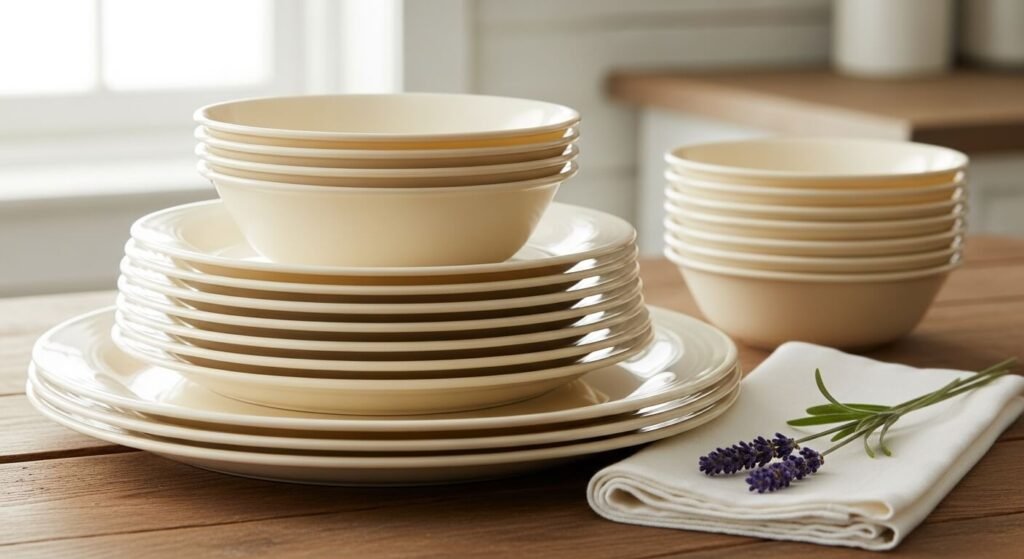
Corelle does not have a current product line officially called “cream.”
The term is a descriptive label buyers and collectors use to refer to Vitrelle glass pieces that appear warmer in tone than the brand’s standard bright white, either because the glass itself has a slight warm tint or because the pattern design incorporates a cream or ivory background as a deliberate aesthetic element.
This ambiguity matters because it creates two distinct product categories under the same search term. The first is base color: some Corelle Vitrelle glass pieces, particularly those produced in certain decades, have a naturally slightly warmer glass tone than the crisp, bright white of the current Winter Frost White collection.
The second is pattern design: certain Corelle patterns were explicitly designed with a cream or ivory background rather than pure white, making the cream tone a deliberate design choice rather than a glass characteristic.
Understanding which category you are looking at is the first step to finding what you actually want.
The Glass Color Question: Is Corelle White or Cream?
Corelle’s core Vitrelle glass is described by the brand itself as “bright white.” Winter Frost White — the plain, undecorated flagship collection in continuous production since 1970, features what Corelle describes specifically as a bright white finish rather than an off-white or cream tone.
This is confirmed in product documentation and is the standard against which other Corelle pieces are compared.
However, Winter Frost White is itself described by buyers and reviewers as having “a softer, slightly warmer tone” compared to Corelle’s Pure White, another undecorated collection, which reads as a starker, cooler white.
This is a distinct but real difference. Under certain lighting conditions and against certain backgrounds, Winter Frost White reads as very slightly warm rather than the coldest possible white.
This is why some buyers who see Winter Frost White in person describe it as “cream-adjacent” or “warm white” even though Corelle officially classifies it as white.
The practical implication: if you are looking for the warmest tone available in a currently produced, plain, undecorated Corelle set, Winter Frost White is your closest option.
It is not cream in the sense of a distinctly warm off-white, but it is warmer than the stark clinical white of some competing dinnerware brands.
For buyers who want genuinely cream-toned or ivory dinnerware with the Vitrelle glass construction, the answer lies primarily in vintage discontinued patterns.
Corelle Patterns With Cream or Warm-Tone Bases
Several specific Corelle patterns, most of them discontinued, used cream or warm off-white bases as a deliberate design element. These are the patterns most accurately described as “cream Corelle dishes.”
First of Spring — The Definitive Cream Base Pattern
First of Spring is the pattern most commonly cited when buyers describe cream Corelle.
It features a cream-colored Vitrelle glass base with a blue leaf border and small white flower accents, a design that reads as soft, traditional, and distinctly warmer in tone than Corelle’s typical white-base patterns.
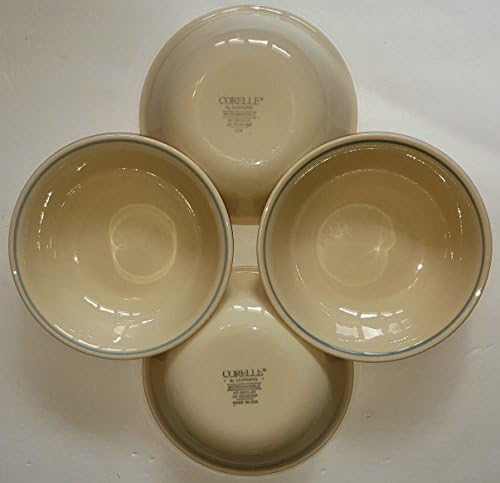
XRF testing documented and published by lead-safety researchers has confirmed that the glass base of First of Spring pieces is visibly cream-colored, not white, when photographed against a white background, a detail that distinguishes it clearly from patterns that merely have warm accents on a white base.
First of Spring was produced from approximately 1978 through 1993, placing it squarely in the era of Corelle’s 1980s design aesthetic, a period characterized by softer pastels, country-inspired motifs, and the deliberate use of cream and beige bases to create a warmer, more cottage-like table presentation.
It remains one of the most recognized cream-base Corelle patterns on the secondary market.
- Production period: Approximately 1978–1993
- Identifying features: Cream Vitrelle glass base; blue leaf border; small white flower accents; coupe-style plates
- Where to find: eBay, Etsy, estate sales, thrift stores; secondary market supply is moderate, given the long production run
- Secondary market pricing: Individual dinner plates typically $8–$18; sets of 4 dinner plates $30–$60, depending on condition
Blue Lily — Off-White Base With Blue Floral
Blue Lily is another discontinued pattern with a cream or off-white base rather than a bright white one. It features blue floral motifs on plates with an off-white ground.
Consumer descriptions and independent testing have confirmed the off-white character of the base glass, which reads as noticeably warmer than standard Corelle white.
Like First of Spring, it belongs to the era when Corelle was producing designs with warmer base tones to match the decor trends of the 1980s.
- Production period: Discontinued; produced from the late 1970s through 1990s
- Identifying features: Off-white base; blue lily flower motifs; traditional border-and-center design
- Where to find: eBay, Etsy, Replacements.com
The 1980s Cream Base Era: What to Look For
First of Spring and Blue Lily are specifically named examples of a broader design trend in Corelle’s 1980s output.
Vintage Corelle guides consistently note that patterns from the 1980s frequently feature cream or beige bases and broad decorative borders — a significant departure from the pure white bases that defined the 1970s Livingware patterns.
If you are browsing thrift stores or estate sales for cream-base Corelle without a specific pattern name in mind, examining the plate base under good lighting will tell you quickly whether the glass reads as cream or white.
Cream-base pieces from this era have a distinctly warmer, slightly yellowish-ivory tone compared to the cooler white of 1970s Corelle.
The 1980s production period is identifiable not just by the cream base but by other design characteristics: complex floral meshes, shallow rims, and soft pastel color palettes for the decorative motifs.
These patterns were a response to the “country cottage” interior design trend of the decade, which favored warm, soft tones over the bold, graphic aesthetic of 1970s kitchenware.
RELATED: Corelle Dishes with Green Flowers
RELATED: Corelle Dishes with Yellow Flowers
Lanea — A More Recent Warm White Option
For buyers who want a more recent vintage of warm-white Corelle with a formal pattern design, the Lanea collection offers an interesting middle option.
Produced from 2016 to 2018 as part of the Market Street New York line, Lanea was explicitly marketed as “warm white dinnerware” — one of the few times Corelle used “warm white” rather than “white” in the official product description.
It featured a round plate format with a gold-hued charger and platinum motif accents, positioning it as a dressier set suited for both everyday use and special occasions.
Lanea is now discontinued, but its relatively recent production dates mean secondary market supply is available, and pieces are in generally good condition. The warm white Vitrelle glass body, absent the charger, reads as a refined everyday cream-toned set.
- Production period: 2016–2018
- Identifying features: Warm white Vitrelle glass; gold-hued charger (sold with the place setting); platinum motif accents; both round and square plate formats available
- Where to find: eBay, Etsy, Replacements.com; good secondary market availability given recent production
The Aesthetic Case for Cream Over Bright White
The appeal of cream Corelle dishes over the standard bright white is grounded in real functional aesthetics, not just preference. Understanding why cream performs differently on the table helps buyers make a more deliberate choice.
Food Presentation
Bright white plates are the professional food photography standard precisely because they make food colors pop against a neutral, high-contrast background.
This works best for vividly colored foods, fresh salads, colorful stir-fries, and bright fruit plates.
For foods with softer, warmer tones, pasta in cream sauce, roasted root vegetables, bread, and pastry, a cream background provides less stark contrast and a more flattering, harmonious presentation.
Neither is objectively better; the right choice depends on what you typically serve.
Table Setting Compatibility
Bright white Corelle is the most versatile option for mixing with other tableware; it is neutral enough to pair with virtually any other color or material.
Cream dishes, by contrast, work better with warm-toned table accessories: linen napkins in natural or oatmeal tones, wooden serving boards, brass or gold-toned cutlery, and terracotta or sage green accent pieces.
Against cool-toned table settings, slate gray placemats, silver cutlery, steel-blue glassware, and cream dishes can read as mismatched rather than warm.
Decor Style Matching
Cream dishes suit specific kitchen aesthetics more strongly than bright white. Cottagecore, farmhouse, traditional, Tuscan, and English country kitchen styles all favor the warmer tone.
Modern minimalist, Scandinavian, and contemporary kitchen aesthetics are better served by the cooler, crisper bright white. If your kitchen features warm wood tones, exposed brick, natural fiber rugs, or antique-finish hardware, cream dishes will feel like a deliberate and cohesive choice.
If your kitchen is predominantly cool gray, matte black, or stainless steel, bright white will be the more harmonious option.
The Lead Safety Issue for Vintage Cream Corelle
Independent XRF testing of the First of Spring pattern — the most common cream-base Corelle — documented a lead reading of 128 ppm in the decorative elements of the pattern, specifically in the white flower decoration and the backstamp logo on the underside of the plate.
The test described the result as falling in the “Lead Safe” range — below the threshold considered high-risk for normal food contact use, but not zero.
The key point that most buying guides fail to make explicit: the lead found in vintage cream Corelle is in the decorative paint and glaze applied to the surface, not in the Vitrelle glass base itself.
The cream color of the glass body is not a source of lead. The decorative flowers, leaf borders, and backstamp markings are the relevant elements when discussing lead content in these pieces.
This has a practical implication for how you use vintage cream Corelle safely:
- The cream glass body itself is not a lead concern.
- The decorative elements on pieces with bright pigments — particularly white, red, or orange flowers — are where lead may be detectable.
- Normal food contact use on the plate surface presents a very low exposure risk from pieces in the Lead Safe testing range. The risk is meaningfully higher if: the decoration is chipped or worn; acidic foods are stored directly on the plate for extended periods; or the pieces are used for very young children or pregnant women.
- Corelle’s own guidance for all pre-2005 decorated pieces is that they should be used for display purposes only — a conservative standard that applies to cream-base decorated patterns as much as any other.
For current production cream-adjacent options, see the Winter Frost White collection or the Lanea set’s warm white designation; both are post-2005 and carry current lead-free certifications.
For a comprehensive guide to lead safety in dinnerware by material and brand, see our non-toxic dinnerware guide and how to test dishes for lead easily.
Where to Find Cream Corelle Dishes Today
The search for cream Corelle dishes spans both the new-purchase and secondary market. Here is where each option lives.
For New Purchases (Warmest Available Currently)
No currently produced Corelle Vitrelle set is officially marketed as cream or ivory. Your closest new-purchase options are:
- Winter Frost White — the warmest currently produced undecorated Vitrelle set; a softer tone than Pure White but still classified as white by Corelle. Available at full retail everywhere Corelle is sold: Amazon, Walmart, Target, corelle.com.
- Bella Faenza — a currently active Corelle pattern with an embossed tone-on-tone white surface design; its textural quality and muted surface treatment read warmer than flat bright white in many lighting conditions. Not cream, but the closest currently available decorated option.
If a genuinely cream or ivory tone is the priority and it must be a new purchase, you may need to look beyond Corelle’s range to ceramic or stoneware alternatives from brands like Gibson Elite or artisan stoneware producers that offer ivory glaze colorways with Corelle-adjacent durability.
For Vintage Cream Corelle
The secondary market is well supplied for the main cream-based patterns:
- eBay — largest volume of First of Spring, Blue Lily, and other 1980s cream-base listings; prices vary and require careful condition assessment from photos. Search specifically for pattern names rather than “cream Corelle” to find more targeted results.
- Etsy — better curated individual pieces; sellers often specialize in vintage kitchen goods and present pieces with accurate condition descriptions. Pricing is moderate.
- Replacements.com — the most organized source for discontinued Corelle by pattern name; lists individual piece availability with photos and condition ratings. Higher prices than eBay, but more reliable.
- Thrift stores and estate sales — cream-base 1980s Corelle appear regularly, given its long production run and wide original distribution. The warmth of the base glass is visible in person under store lighting, making identification easier than online photo assessment. See our companion guide on the most popular Corelle patterns for help identifying what you find.
If you find what appears to be cream Corelle at a thrift store or estate sale without a visible pattern name on the backstamp, photograph the piece against a white background, and the cream tone of the glass becomes immediately apparent in comparison. This simple test confirms whether the warm tone is a genuine base glass characteristic or simply the store lighting.
Frequently Asked Questions
Can I mix cream Corelle with white Corelle at the table?
Mixing cream-base vintage Corelle with bright white current Corelle at the same table setting will produce a visible mismatch in most lighting conditions — the cream tone and the bright white read as different colors rather than the same neutral in different patterns.
If a mixed table is the goal, the safest approach is to use Winter Frost White as the fill-in pieces alongside cream vintage patterns, as its slightly warmer tone is closer to the cream base than Pure White or current bright white collections would be.
What is the difference between cream Corelle and ivory Corelle?
In general consumer usage, “cream” and “ivory” are used interchangeably to describe the same warm off-white tone in Corelle dishes; there is no formal Corelle distinction between the two terms.
Both refer to the warmer-than-white base glass found in certain vintage patterns.
The Lanea collection (2016–2018) used “warm white” in its official description, which falls in the same category. None of these terms reflects an official Corelle product classification; they are descriptive labels used by buyers, collectors, and resellers to distinguish warmer-toned pieces from the brand’s standard bright white.
About the Author & Reviewer
Sarah Emirone, Author
Sarah researches and writes SafeKitchn’s dinnerware and kitchenware guides, with a focus on material safety, lead content, and manufacturer specifications. She cross-references product data sheets, safety certifications, and regulatory filings (including FDA and Prop 65 records) before publishing, and updates articles when new information becomes available.
James Daniels, Reviewer
James reviews SafeKitchn’s material safety content for scientific accuracy. He holds a B.Sc in inorganic chemistry and works as a materials researcher, with particular focus on the composition and safety behavior of glass, ceramic, and metal used in kitchenware.