

Corelle has produced yellow flower patterns across more than five decades, and the category contains more variation and more nuance than most buyers expect.
The most iconic yellow flower, Corelle, Butterfly Gold, is simultaneously the most collected and the most thoroughly lead-tested vintage pattern the brand has ever produced.
Independent XRF testing documented lead readings of 18,700 ppm on Butterfly Gold plates and 23,300 ppm on bowls — figures that place it among the highest-lead vintage Corelle patterns ever measured.
Later yellow flower patterns, produced from 2000 onward, were made to a completely different safety standard.
If you are shopping for Corelle dishes with yellow flowers, the era of production matters as much as the pattern name.
This guide maps every significant yellow flower Corelle pattern, gives you the complete safety picture for each, and tells you exactly what to look for, whether you are buying new, collecting vintage, or trying to identify a set you already own.
Written by Sarah Emirone | Reviewed by James Daniels, B.Sc, Inorganic Chemist & Materials Researcher | Updated September 2026 | See How We Test | Filed under: Buying, Care & Product Guides
Why Yellow Pigments Carry the Highest Lead and Cadmium Risk in Vintage Corelle
Before covering the individual patterns, one piece of context changes how you interpret every safety discussion that follows, and it is a fact that most guides on this topic either omit or bury.
In the ceramic and glass decoration industry of the 1960s and 1970s, achieving vivid, stable yellow tones in decorative pigments required one of two chemical pathways: lead chromate (a lead-based yellow pigment) or cadmium sulfide (a cadmium-based yellow pigment).
Both are toxic heavy metals. Both were used in decorative glazes and paints applied to consumer dinnerware during this era, often interchangeably depending on the specific shade of yellow required and the manufacturer’s formulation.
This is the reason that yellow, orange, and red decorative elements in vintage dinnerware consistently show the highest heavy metal readings in independent testing, higher, as a category, than blue, green, or purple elements, which used different pigment chemistry.
Lead Safe Mama researcher Tamara Rubin, whose XRF testing methodology uses the same instrumentation employed by the U.S. Consumer Product Safety Commission, has specifically noted that some Butterfly Gold pieces test primarily for cadmium in the yellow elements while others test primarily for lead, because both types of yellow pigment were used across the production run.
This is the most important safety fact for yellow Corelle specifically: the warmth and vibrancy of yellow decoration in vintage dinnerware is chemically inseparable from heavy metal pigments in the era before safer alternatives were developed and mandated.
All post-2005 Corelle decoration is produced to modern lead-free and cadmium-free standards. The concern applies exclusively to vintage decorated pieces.
Butterfly Gold — The Definitive Yellow Flower Corelle
Butterfly Gold is the pattern that defines yellow flower Corelle in the memory of anyone who grew up in a 1970s American kitchen.
It is the most recognized, most collected, and most lead-documented yellow flower pattern Corelle has ever produced, and understanding it fully requires separating three things that most guides conflate: the design history, the Pyrex coordination ecosystem, and the specific safety picture.
The Design and Production History: 1970–1988
Butterfly Gold was introduced in 1970 alongside the Corelle brand’s launch, making it one of the four founding patterns of the Corelle line alongside Winter Frost White, Spring Blossom Green, and Snowflake Blue.
The pattern was designed by Gregory Mirow and features stylized butterflies alternating with flower and wheat motifs arranged as a broad decorative border around the rim of white Vitrelle glass plates and bowls.
The color palette is warm gold and yellow — unmistakably of its era, when harvest gold and avocado green dominated American kitchen aesthetics.

The pattern ran through two distinct production phases. The original Butterfly Gold design ran from 1970 through the mid-1980s and was produced in what collectors describe as the classic format: a wide border with alternating butterfly and flower motifs, broad curved rims, and deep centers on the bowls.
A revised second iteration appeared in coordinating Pyrex pieces from 1979, but the Corelle dinnerware itself continued in its original format until approximately 1988.
The “Butterfly Gold” Name
Unlike Spring Blossom Green’s widely used collector nickname “Crazy Daisy,” Butterfly Gold has always been known by its official name both in Corelle’s original marketing and among collectors today.
This makes searching for it by name on secondary market platforms more reliable than it is for some other vintage patterns.
The Pyrex Coordination Ecosystem
One of Butterfly Gold’s most significant collector characteristics is its extensive coordinating Pyrex line. When Corelle launched its dinnerware in 1970, Pyrex simultaneously released a “Compatibles” line of ovenware and bakeware in the same patterns.
The Butterfly Gold Pyrex ecosystem includes mixing bowls, casserole sets, refrigerator storage containers, divided dishes, tumblers, mugs, a butter dish, napkin rings, and a spinning server with three compartments.
This coordinating ecosystem transforms Butterfly Gold from a dinnerware pattern into a complete vintage kitchen aesthetic, one that buyers reconstruct across both Corelle plates and Pyrex bakeware.
It is the reason Butterfly Gold commands broader collector interest than most Corelle patterns, and why complete matched sets across both product lines are significantly more valuable than Corelle pieces alone.
The Lead and Cadmium Safety Picture
This is the most critical information for anyone currently using vintage Butterfly Gold for daily food service, and the section where the specific documented figures matter more than general statements.
Independent XRF testing by Tamara Rubin of Lead Safe Mama documented the following readings across multiple Butterfly Gold pieces:
- Butterfly Gold dinner plate, decorative pattern elements: 18,700 ppm lead
- Butterfly Gold bowls, decorative pattern elements: 23,300 ppm lead
- Vintage Corelle blue and yellow floral dish with butterflies (similar pattern): 41,500 ppm lead plus detectable cadmium
- Some versions of the Butterfly Gold pattern were tested primarily for cadmium in the yellow elements rather than lead, because both lead-chromate and cadmium-sulfide yellow pigments were used across the production run
For context: The 90 ppm threshold applies only to paint/surface coatings, not to food, toys, or most other children’s items. For baby food and most children’s consumables, FDA standards are much stricter (10–20 ppb, which is 0.01–0.02 ppm).
The figures above, ranging from 18,700 to over 41,500 ppm across different pieces and versions, reflect the total heavy metal content in the decorative pigments, not the leachable quantity.
The regulatory question is leachable lead, not total content as measured by XRF. However, these figures explain why Corelle’s own guidance recommends all pre-2005 decorated pieces for display use only, not food service.
Three facts matter most for current Butterfly Gold owners:
- The Vitrelle glass base consistently tests lead-free and cadmium-free. The white glass underneath the decoration is safe. The heavy metals are in the decorative yellow, gold, and warm-toned elements applied to the glass surface.
- Every version of Butterfly Gold that has been tested has come back positive for either high lead or high cadmium. Tamara Rubin has specifically stated: “I have tested dozens in this design (from different years and different models of plates, bowls, etc.) and they have all been positive for either high levels of Lead or Cadmium.” This is not a single-batch finding — it is consistent across the production run.
- The highest-risk use scenarios are: serving acidic foods (tomato sauce, vinegar-based dishes, citrus) that rest in contact with the decorated border; using pieces with chipped or worn decoration that exposes more of the pigment layer; and use by or for young children and pregnant women, for whom any additional heavy metal exposure is more significant.
For a comprehensive guide to lead safety in Corelle by era and pattern, see our non-toxic dinnerware guide.
Sunblossoms — Yellow Flowers Done Safely (2000–2009)
Sunblossoms represents a completely different chapter of yellow flower Corelle — one produced entirely in the post-2000 era to a different safety standard than the vintage patterns.
Introduced in 2000 and produced through 2009, Sunblossoms is described in its official product documentation as featuring “whimsical and lighthearted” sunflowers and bumblebees in fresh yellows and earthy greens accented by highlights of black.
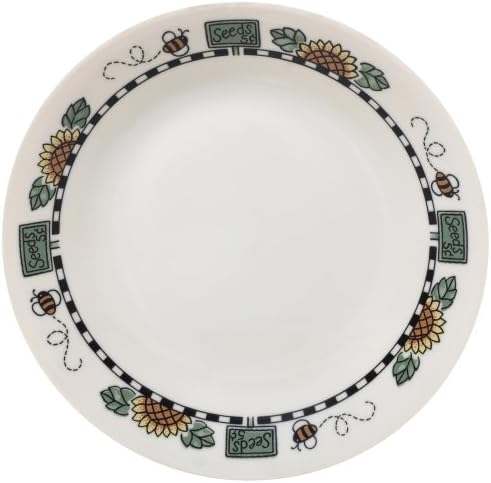
- Dishwasher safe for long lasting patterns
- Microwave and oven use for versatility
- Coordinate with popular corelle dinnerware patterns
The overall effect is cheerful, playful, and distinctly more casual than Butterfly Gold’s formal gold-border aesthetic — closer in spirit to contemporary illustrated botanical dinnerware than to the 1970s harvest-gold palette.
The design places full sunflower illustrations — petals, centers, stems, and leaves — as the primary motif rather than the stylized butterfly-and-flower border format of Butterfly Gold.
The addition of bumblebees gives it a garden-scene character that suits cottage, farmhouse, and nature-inspired table settings.
Why is the safety profile different?
Sunblossoms was produced entirely between 2000 and 2009. While this does not automatically guarantee lead-free status — the meaningful threshold is 2005, when tighter FDA and California Prop 65 standards became widely enforced — pieces from the later years of this production run (approximately 2005–2009) would have been manufactured under the more stringent standards.
Pieces from the 2000–2004 portion of the run should be treated with more caution. For any Sunblossoms piece, check the backstamp date if visible before assuming full lead-free certification.
Because of its relatively recent production run, Sunblossoms has a well-supplied secondary market.
Replacements.com lists the pattern with individual piece availability, and eBay has consistent Sunblossoms listings at moderate prices — typically $8–$20 per dinner plate and $40–$80 for fuller sets.
- Production period: 2000–2009
- Identifying features: Full sunflower illustrations with bumblebees; yellow, green, and black palette on white Vitrelle; playful, whimsical character
- Best aesthetic match: Cottage, farmhouse, garden-themed kitchens; buyers who want yellow flower dinnerware with a less formal character than Butterfly Gold
- Secondary market: eBay, Etsy, Replacements.com — good availability
Sunshine — Yellow Sunflowers in the Traditions Line
The Sunshine pattern is part of Corelle’s Traditions Livingware line and features yellow sunflower and light green foliage motifs painted as a border around the plate rim.
It is visually similar in format to the classic 1970s border-only patterns but belongs to a later production era, aligning with the Traditions line that Corelle developed as a continuation of the Livingware format.


The sunflower motif in Sunshine is more naturalistic than the stylized flowers of Butterfly Gold — the petals are rounded and detailed rather than graphic and flat, giving the pattern a softer, more cottage quality.
The color palette stays in warm yellow and soft green without the deep gold tones of Butterfly Gold.
Independent valuations place Sunshine pattern sets at $5–$50, depending on set size and condition, making it one of the more affordable yellow flower Corelle patterns on the secondary market.
Its relative obscurity compared to Butterfly Gold means supply is less predictable; it appears at thrift stores and estate sales, but with less frequency than the more widely distributed 1970s patterns.
- Identifying features: Naturalistic yellow sunflower motifs with light green foliage; rim border format; softer and more cottage in character than Butterfly Gold
- Where to find: eBay, thrift stores, estate sales; Replacements.com for individual pieces
Other Notable Corelle Patterns with Yellow Flower Elements
Several additional Corelle patterns include yellow flowers as part of a broader multi-color design rather than as the dominant visual element.
Wildflower (1977–1984) — Multi-Color Including Yellow
Part of Corelle’s 1977 Expressions Livingware line, the original Wildflower pattern features large red, orange, and yellow flowers and buds alongside tiny blue flowers and green foliage, all placed at or near the plate center rather than as a rim border.
The yellow elements appear as flower petals and bud accents rather than as the dominant color, making this a multi-color botanical pattern that happens to include yellow rather than a yellow flower pattern in the way Butterfly Gold is.
Note: This is not the same as the current Wildflower Scatter pattern available on corelle.com today, which is a contemporary production with a completely different design arrangement and no lineage to the 1977 original.
See our guide on the newest Corelle patterns for the current pattern.
April (1979–1982) — Small Green and Yellow Clusters
April features small flower clusters in green and yellow tones — a softer, more restrained design than both Butterfly Gold and Wildflower. The yellow in April is a lighter, more muted tone and appears as part of a combined green-and-yellow palette rather than as a warm gold.
It is a less commonly encountered pattern in thrift stores due to its shorter production run (three years versus Butterfly Gold’s 18).
Indian Wildflowers — Botanical Multi-Color
Indian Wildflowers is a multi-color botanical pattern that includes yellow flower elements alongside other natural colors in a loose, illustrated botanical arrangement.
It is specifically catalogued in collector resources as a yellow-inclusive Corelle floral pattern, though yellow is one of several colors in the design rather than its defining palette.
Identifying Vintage Yellow Flower Corelle: A Practical Guide
Buyers who encounter yellow flower Corelle at thrift stores, estate sales, or on secondary market platforms without knowing the pattern name can use the following approach to identify what they have found.
Step-by-Step Identification
- Check the backstamp first. The underside of the plate carries the production era marker. “Corelle Livingware” or “Corelle by CorningWare” indicates a 1970s–1980s piece. “Corelle” with a modern wordmark and “Made in Corning, NY” indicates post-2000 production. The backstamp is the fastest way to establish the production era before any other assessment.
- Assess the yellow tone. Butterfly Gold uses a deep, warm, slightly amber-toned gold — the color of harvest gold kitchen appliances from the 1970s. Sunblossoms uses a fresher, cleaner yellow closer to a natural sunflower. Sunshine sits between the two — warmer than Sunblossoms but less amber than Butterfly Gold.
- Identify the motif type. Butterfly Gold pairs yellow flowers with gold butterflies as an alternating rim border — the butterfly is always present alongside the flower. Sunblossoms uses sunflowers with bumblebees as central illustrated elements. Sunshine uses sunflowers as a rim border without butterflies.
- Identify the plate format. All three main yellow flower patterns use the round plate format. Butterfly Gold uses the rimmed format typical of 1970s Corelle (a distinct flat outer rim around the eating surface). Sunblossoms uses the coupe format (a continuous curve from edge to center with no flat rim) that became standard in later Corelle production.
- Cross-reference online. The most reliable pattern libraries are Corelle Corner (corellepatterns.com — a collector-maintained reference) and Replacements.com, which lists every documented Corelle pattern by name with photographs.
The Lead Safety Summary for Yellow Corelle Patterns
The safety picture for yellow flower Corelle patterns is clearer — and more serious — than for any other color category in Corelle’s vintage range.
| Pattern | Production Era | Lead/Cadmium Status | Recommended Use |
|---|---|---|---|
| Butterfly Gold | 1970–1988 | 18,700–23,300+ ppm lead documented; some pieces cadmium-positive | Display only per Corelle guidance |
| Wildflower (original) | 1977–1984 | Pre-2005; yellow/orange elements carry heavy metal risk | Display only per Corelle guidance |
| April | 1979–1982 | Pre-2005; assume lead/cadmium in yellow decoration | Display only per Corelle guidance |
| Sunshine (Traditions) | Post-1990s | Check backstamp; post-2005 pieces meet current standards | Verify the backstamp date before food use |
| Sunblossoms | 2000–2009 | Post-2005 pieces certified lead-free; pre-2005 pieces require verification | Post-2005 pieces are safe; verify 2000–2004 pieces |
| Indian Wildflowers | Varies | Check the backstamp era | Verify backstamp; post-2005 safe |
The key principle for yellow specifically
Yellow and orange pigments used in vintage dinnerware decoration relied on lead chromate or cadmium sulfide chemistry, both heavy metals, to achieve their warm, saturated tones.
This is not a Corelle-specific issue; it applies to yellow-decorated vintage dinnerware across all manufacturers and materials of this era.
The combination of yellow and warm-toned orange decoration is the highest-risk color palette in vintage Corelle by a significant margin, with Butterfly Gold testing at readings that are among the highest documented in any consumer Corelle pattern across all colors.
Post-2005 Corelle production uses pigment formulations that meet current lead-free and cadmium-free certification standards regardless of color.
Current yellow-accented Corelle patterns, including the Wildflower Scatter reissue, which incorporates soft yellow tones, are produced to modern safety standards.
Where to Find Corelle Dishes with Yellow Flowers
For New Sets with Yellow Accents
No current Corelle collection is officially named a “yellow flower” pattern in the way Butterfly Gold was. The current Wildflower Scatter — available on corelle.com — incorporates soft yellow flower accents as part of a multicolor scattered floral arrangement, is produced to current lead-free standards, and represents the closest currently produced option.
The Aurus Collection (sold through celloworld.com and other platforms) and similar contemporary patterns may also include yellow accents, though these are non-Corelle options.
For a new Corelle set specifically, check corelle.com’s current pattern directory for any active collections featuring yellow botanical elements.
For Vintage Yellow Flower Sets
- eBay — the largest volume of Butterfly Gold listings across all piece types, including the coordinating Pyrex ecosystem. Prices vary significantly; assess condition and decoration integrity carefully from listing photos.
- Etsy — better-curated individual vintage pieces; sellers often specialize in 1970s kitchenware and present Butterfly Gold pieces in an accurate condition context. Pricing is moderate, and presentation quality is generally higher than eBay’s.
- Replacements.com — the most organized source for discontinued Corelle by pattern name; lists individual piece availability with photos and condition ratings. Higher prices than marketplace platforms, but the most reliable condition descriptions. Lists both Butterfly Gold and Sunblossoms with individual piece availability.
- Thrift stores and estate sales — Butterfly Gold appears regularly, given its long production run (18 years) and wide original distribution. The warm gold tone of the border decoration is immediately recognizable in person. Sunblossoms appear less frequently but surface at estate sales from households that used them through the 2000s. See our guide to the most popular Corelle patterns for help identifying what you find.
If you find what appears to be Butterfly Gold at a thrift store and want to confirm the identification, look for the alternating butterfly-and-flower motif in the border. If butterflies are present alongside the yellow flowers, it is almost certainly Butterfly Gold. I
f the design features sunflowers with bumblebees and no butterflies, it is Sunblossoms. The butterfly is the fastest visual identifier between the two most common yellow flower Corelle patterns.
Frequently Asked Questions
What is the Corelle pattern with yellow flowers and butterflies?
The pattern is Butterfly Gold, introduced in 1970 alongside the Corelle brand’s launch and produced through approximately 1988.
It features alternating stylized butterflies and flower motifs in warm gold and yellow tones arranged as a border around white Vitrelle glass plates and bowls.
It is the most recognized and most collected yellow flower Corelle pattern and coordinated with a full Pyrex Butterfly Gold line of ovenware and bakeware.
Is vintage Butterfly Gold Corelle safe to use?
Independent XRF testing documented 18,700 ppm lead on Butterfly Gold dinner plates and 23,300 ppm on bowls — with some versions of the pattern testing positive for cadmium rather than lead in the yellow decoration.
These figures are among the highest documented in any consumer Corelle pattern. Corelle’s own guidance recommends all pre-2005 decorated pieces for display use only.
The Vitrelle glass base tests lead-free; the heavy metals are in the decorative yellow and gold pigments applied to the surface.
What is the Corelle pattern with sunflowers?
Two Corelle patterns feature sunflowers. Sunblossoms (2000–2009) is the most explicitly sunflower-named, featuring full sunflower illustrations with bumblebees in yellow, green, and black on white Vitrelle glass.
The Sunshine pattern from the Traditions Livingware line also features yellow sunflowers and light green foliage motifs in a rim border arrangement.
Butterfly Gold’s flowers are stylized rather than naturalistically sunflower-shaped, though they are often described as sunflower-like in appearance.
Is Sunblossom’s Corelle safe to use?
Sunblossoms was produced from 2000 to 2009. Pieces from the post-2005 portion of this run are produced under current lead-free and cadmium-free certification standards and are safe for daily food use.
Pieces from the 2000–2004 portion of the run should be verified by backstamp date before food use; the meaningful safety threshold is 2005, when tighter standards became standard across the industry.
Check the underside of the piece for a production date if available.
Did Corelle ever reissue Butterfly Gold?
Not directly. Corelle has not produced an official Butterfly Gold reissue in the way it produced a Spring Blossom Green reissue for current sale.
The current Wildflower Scatter pattern incorporates yellow flower elements in a contemporary scattered arrangement, but it is not a Butterfly Gold interpretation; it is a distinct design with no direct visual or pattern lineage to Butterfly Gold.
All currently sold Corelle patterns with yellow accents are produced to modern lead-free standards.
How do I tell Butterfly Gold from Sunblossoms at a thrift store?
The fastest visual identifier is the butterfly. Butterfly Gold includes stylized butterfly motifs alternating with flowers throughout the border — if you see butterflies alongside the yellow flowers, it is Butterfly Gold.
Sunblossoms uses bumblebees rather than butterflies, and the sunflower illustration is more naturalistic and centered rather than a formal border.
The plate format also differs: Butterfly Gold uses the rimmed plate format with a distinct flat outer rim; Sunblossoms uses the coupe format with a continuous curved surface.
About the Author & Reviewer
Sarah Emirone, Author
Sarah researches and writes SafeKitchn’s dinnerware and kitchenware guides, with a focus on material safety, lead content, and manufacturer specifications. She cross-references product data sheets, safety certifications, and regulatory filings (including FDA and Prop 65 records) before publishing, and updates articles when new information becomes available.
James Daniels, Reviewer
James reviews SafeKitchn’s material safety content for scientific accuracy. He holds a B.Sc in inorganic chemistry and works as a materials researcher, with particular focus on the composition and safety behavior of glass, ceramic, and metal used in kitchenware.