There’s something genuinely appealing about glass dinnerware that looks clean, feels light, and doesn’t demand much upkeep.
Arcopal dinnerware has quietly earned a loyal following by delivering exactly that: a French-made opal glass tableware option that works just as well for a weekday breakfast as it does for a casual dinner with guests.
Produced under the Arc International group, Arcopal built its reputation on lightweight glass dishes that are durable enough for daily household use, safe for food contact, and easy to maintain.
This guide covers what Arcopal is made of, whether it’s safe, how it compares to other brands, and what makes vintage collections worth collecting.
What Is Arcopal Dinnerware?
History of the Arcopal Brand
Arcopal is a French glassware brand with roots in the mid-twentieth century, produced under the umbrella of Arc International, one of the world’s largest glass manufacturers, headquartered in Arques, France.
Arc International also produces Luminarc, a sister brand that many households will recognize. Arcopal was specifically developed as an everyday tableware line, built around opal glass technology that gave it a distinct opaque white finish, unlike typical clear glassware.
From France, Arcopal products were distributed globally and became a staple in European and international households throughout the 1960s, 1970s, and beyond.
What Materials Are Used in Arcopal?
Arcopal dishes are manufactured from opal glass, a tempered glass material engineered to be opaque, smooth-surfaced, and more resistant to everyday wear than standard clear glass.
The tempering process involves controlled heating and rapid cooling that strengthens the glass at a structural level, improving both its break resistance and chip resistance compared to ordinary glassware.
The result is a white opal glass product that resembles the appearance of porcelain or milk glass while retaining the practical advantages of tempered glass.
The opalware technology used by Arc International to produce Arcopal is what gives these dishes their characteristic bright white, opaque glass finish.
Common Arcopal Products
Arcopal’s product range covers all the essentials of household dining. The core lineup includes dinner plates, salad plates, soup bowls, dessert bowls, serving bowls, cups, mugs, and serving platters, often sold as coordinated dinnerware sets sized for four or six people.
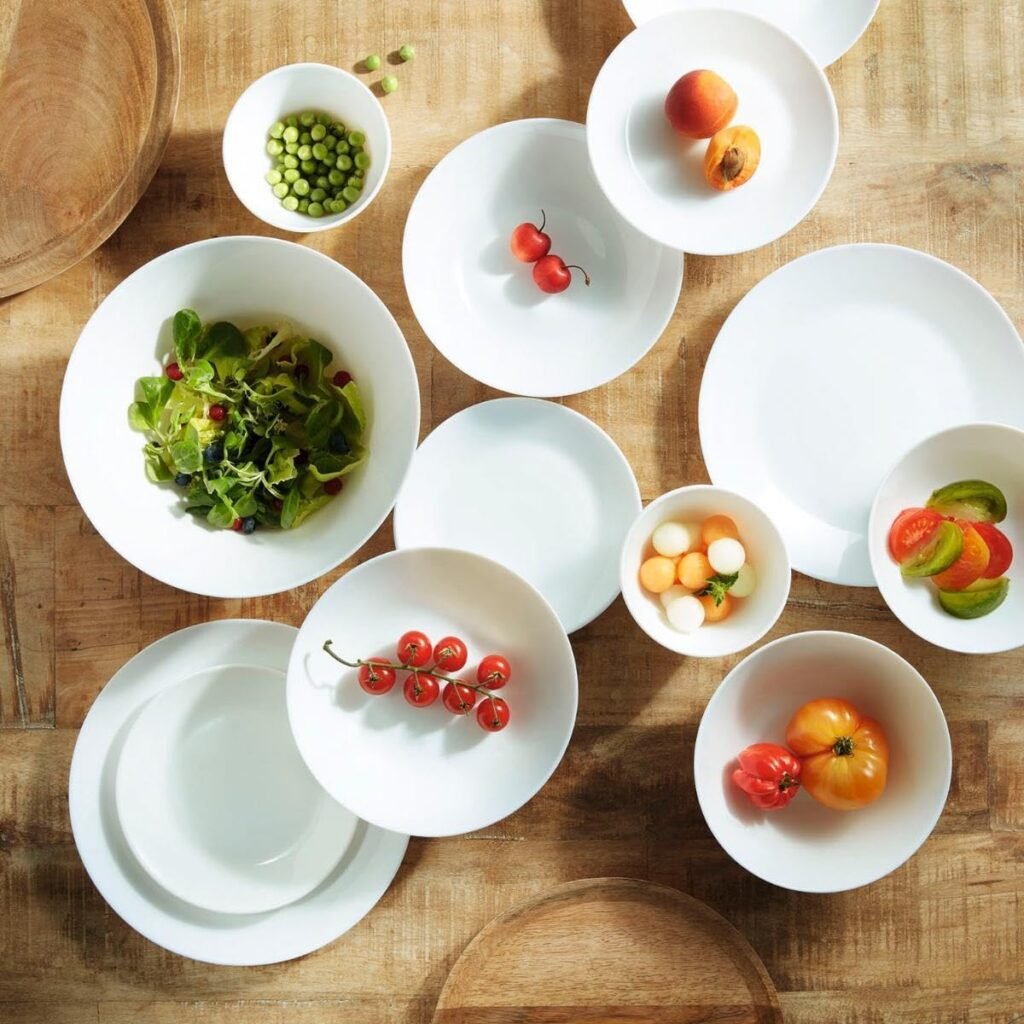
Arcopal also produced breakfast sets, tea sets, and coffee sets, particularly popular in the European market.
The stackable design of Arcopal plates and bowls was a deliberate feature, making them practical for both everyday kitchen storage and for households managing multiple place settings without generous cabinet space.
Why Arcopal Dinnerware Is Popular
Lightweight Yet Durable Design
One of the first things people notice about Arcopal is how light the dishes feel. This is the core appeal of opal glass as a dinnerware material — it delivers the clean, smooth finish of glass tableware without the weight of ceramic or stoneware plates.
The tempered glass construction adds structural durability to that lightweight profile, meaning these dishes handle the repetitive demands of daily family dining without chipping at the edges the way heavier ceramic dishes often do.
For households where dishes go through heavy daily use, that combination of lightweight handling and glassware durability is genuinely useful.
Minimalist and Elegant Appearance
Arcopal’s white opal glass finish gives the dishes a clean, minimalist look that works well in a wide range of kitchen and dining aesthetics.
The opaque glass finish resembles porcelain from a distance, lending the table a polished appearance without the cost or fragility associated with fine china.
Plain white Arcopal sets in particular carry a simple elegance that makes them versatile — they look appropriate for casual everyday meals and informal dinner settings alike.
The tableware aesthetics of Arcopal have also aged well, which contributes to the ongoing interest in both new and vintage collections.
Space-Saving Stackability
Stackable dinnerware is a practical priority for many households, and Arcopal was designed with this in mind.
The uniform thin profile of Arcopal plates allows them to stack compactly and evenly, taking up considerably less cabinet space than comparable ceramic or stoneware alternatives.
For apartments, smaller kitchens, or any household where storage space is genuinely limited, this stackability is a meaningful day-to-day advantage.
It also makes Arcopal sets easier to store when not all pieces are in active use, such as when serving pieces or extra place settings sit in reserve between gatherings.
Everyday Dining Convenience
Arcopal was designed as everyday tableware, and that practical orientation shows in how the dishes actually perform during daily use.
The non-porous glass surface doesn’t absorb food pigments, odors, or bacteria the way porous ceramic surfaces can over time, which keeps the dishes hygienic and looking clean with standard washing.
The smooth surface also makes cleaning straightforward — food residue doesn’t cling to the material the way it can on rougher ceramic glazes.
For households that use their dishes three meals a day and want minimal fuss in between, Arcopal delivers exactly that kind of practical everyday dining convenience.
Affordability Compared to Porcelain
Arcopal offers a porcelain-adjacent appearance at a fraction of the cost.
While fine porcelain dinnerware from brands like Lenox or Limoges requires a significant investment and careful handling, Arcopal achieves a similar visual impression, white, smooth, and clean-lined, using opal glass technology at a far more accessible price point.
This made Arcopal particularly popular as a household staple across Europe and beyond, where families wanted dinnerware that looked good without the anxiety of using expensive china at the everyday table.
That affordability relative to the visual quality it delivers remains a strong part of Arcopal’s appeal.
Is Arcopal Dinnerware Safe?
Lead-Free and Food-Safe Properties
Contemporary Arcopal dinnerware produced under Arc International meets modern food contact safety standards. The opal glass material is lead-free and does not leach chemicals into food or beverages during normal use.
This is a meaningful distinction from vintage ceramics or glassware that may have been produced using older glazing or decorating methods that don’t meet current safety requirements.
For standard Arcopal dishes used as intended — for serving and eating food — the material itself poses no food safety concern under normal household conditions.
BPA-Free Material Composition
Because Arcopal dishes are made from opal glass rather than any plastic-based material, they are naturally BPA-free.
There’s no plastic component in the glass body of these dishes, which means none of the chemical migration concerns associated with BPA-containing plastics applies to Arcopal.
This makes them a straightforward choice for households that are specifically looking to avoid plastic in their everyday tableware — particularly for hot food and beverages, where plastic dishware is more likely to release trace compounds into food.
Microwave and Dishwasher Safety
Arcopal glass dinnerware is generally microwave-safe and dishwasher-safe, which is a significant practical advantage for daily household use.
The tempered glass construction tolerates repeated dishwasher cycles without degrading the material, and the non-porous surface resists the kind of surface wear that can affect ceramic glazes over time in a dishwasher environment.
For microwave use, standard plain Arcopal dishes handle heating without issue, though, as with any glass product, dishes with metallic decorative elements should be kept out of the microwave.
Always confirm the specific product’s markings before microwaving.
Heat Resistance and Thermal Shock Performance
Arcopal’s tempered glass construction gives it reasonable heat resistance for everyday use, handling hot food, warm beverages, and standard dishwasher temperatures without issue.
However, like all glass dinnerware, Arcopal is not designed for extreme thermal shock scenarios.
Moving a dish directly from a freezer to a hot oven, or pouring boiling liquid into a cold glass dish, creates rapid temperature differentials that can stress and crack even tempered glass.
Arcopal is engineered for everyday dining heat conditions, not for cookware-level temperature extremes.
Arcopal vs Other Dinnerware Brands
Arcopal vs Corelle
Arcopal and Corelle are the two most commonly compared lightweight glass dinnerware options, and they’re genuinely similar in some key ways: both use tempered glass technology, both produce thin and stackable everyday dishes, and both offer a white, minimalist aesthetic.
The main difference lies in the glass technology: Arcopal uses opal glass, which is opaque and resembles milk glass or porcelain, while Corelle uses Vitrelle, a triple-layer laminated clear glass that’s extraordinarily thin.
Corelle tends to be slightly lighter and thinner, while Arcopal’s opal glass finish gives it a visually warmer, more porcelain-like appearance.
For a detailed side-by-side look, see an in-depth review of Arcopal vs Corelle that covers both brands thoroughly.
Arcopal vs Ceramic Dinnerware
Compared to traditional ceramic dinnerware, Arcopal has a clear weight advantage — opal glass dishes are noticeably lighter than equivalent ceramic plates and bowls.
Ceramic dinnerware offers better heat retention for keeping food warm at the table, and some ceramic pieces have a more artisanal, handcrafted aesthetic that glass tableware doesn’t replicate.
Arcopal’s non-porous glass surface, however, is more hygienic over time than ceramic glazes that can craze or develop micro-cracks where bacteria accumulate.
For everyday household dining, Arcopal’s easier cleaning and lighter weight give it practical advantages over most ceramic options.
Arcopal vs Porcelain
Porcelain dinnerware sits at the premium end of the market and brings a level of visual refinement — translucency, fine-edged profiles, decorative detail that Arcopal doesn’t attempt to match.
Where Arcopal resembles porcelain in general appearance, it doesn’t replicate the fine china dining experience that porcelain delivers.
That said, Arcopal is far more practical for daily use: it’s lighter, more resistant to chipping, easier to care for, and significantly more affordable.
Porcelain is the better choice for formal dining and special occasions; Arcopal is the better choice for the other three hundred meals a year.
Arcopal vs Melamine
Melamine dinnerware is plastic-based, lightweight, and virtually unbreakable — popular for outdoor dining, children’s tableware, and casual settings where breakage risk is high.
Arcopal is not as impact-resistant as melamine, since glass will still shatter under sufficient force in a way that melamine won’t.
However, Arcopal is glass rather than plastic, which means it’s BPA-free by material nature, doesn’t absorb food odors or stain the way melamine can over time, and is safe for microwave use in ways that melamine is not.
For indoor everyday household dining, Arcopal is the more hygienic and versatile choice.
Which Material Is Better for Everyday Use?
For most households, Arcopal opal glass strikes an effective balance between practicality and appearance for everyday tableware.
It’s lighter than ceramic and stoneware, safer and more hygienic than melamine for regular indoor use, more affordable than porcelain, and visually cleaner than many casual ceramic options.
Corelle is its closest competitor in the everyday glass dinnerware category, with differences primarily in glass technology and aesthetic finish.
The right choice depends on your specific household priorities, but for everyday family dining that requires minimal maintenance and solid durability, Arcopal is a well-rounded option.
Advantages and Disadvantages of Arcopal Dinnerware
Main Benefits
Arcopal’s most practical advantages all flow from its opal glass construction. The lightweight handling reduces fatigue during daily use and makes the dishes accessible for elderly users and children.
The non-porous glass surface is inherently hygienic; it doesn’t harbor bacteria in surface cracks or absorb food pigments the way porous ceramic surfaces can.
Cleaning is straightforward: the smooth glass surface releases food residue easily and tolerates dishwasher cycles reliably.
The modern aesthetics of the white opal glass finish are clean and versatile, complementing a wide range of kitchen styles without demanding careful coordination with other tableware or decor.
Potential Drawbacks
The main drawback of Arcopal, as with all glass dinnerware, is its behavior under strong physical impact.
A significant drop onto a hard tile floor will shatter an Arcopal dish in a way that a ceramic or stoneware plate might not. The glass, while tempered, doesn’t have the impact resilience of denser materials.
Compared to porcelain or fine china, Arcopal also has limited luxury appeal; it reads as practical everyday tableware rather than a premium dining statement.
On vintage pieces, pattern fading on older floral designs is a documented concern, particularly on pieces that have been through years of dishwasher use with high-heat drying cycles.
Vintage Arcopal Dinnerware
Popular Vintage Arcopal Patterns
Vintage Arcopal is perhaps best known for its floral dinnerware patterns, which were widely popular from the 1960s through the 1980s.
The Veronica pattern, a delicate floral motif on white opal glass, is one of the most recognized and sought-after vintage Arcopal designs.
The Scania pattern features a similar floral approach with a slightly more graphic style, while the Lotus and Daisy patterns offer other variations on the retro floral theme.
These mid-century dining aesthetics have aged well with the current interest in vintage kitchen nostalgia, making them attractive to collectors and to households that simply enjoy the charm of retro kitchenware daily.
Are Vintage Arcopal Dishes Collectible?
Yes — vintage Arcopal has developed a genuine collector following, particularly for complete sets in the more popular floral patterns.
Arcopal collectors actively seek out full sets of the Veronica, Scania, Lotus, and Daisy patterns in good condition, and these appear regularly on online auction platforms and at vintage kitchenware dealers.
The Arcopal resale market is active enough that specialist retailers like Replacements Ltd. catalog Arcopal pieces to help collectors find replacement items for incomplete sets.
Values vary by pattern rarity, condition, and completeness — a pristine, complete set in a sought-after pattern commands a meaningful premium over individual pieces.
Safety Concerns With Older Arcopal Pieces
This is an important consideration for anyone using vintage Arcopal dishes regularly.
Older Arcopal pieces, particularly those with decorative on-glaze patterns or metallic accents produced before modern food safety standards became standard practice, may contain lead or cadmium in the decorative elements.
The opal glass body of the dish itself is generally safe, but the decorative prints applied to older pieces may not meet current FDA food contact standards.
If you’re regularly eating from vintage Arcopal dishes rather than displaying them, it’s worth testing older decorated pieces for lead, or limiting vintage use to display rather than active dining.
How to Identify Authentic Arcopal Dinnerware
Authentic Arcopal dinnerware is identified through backstamp identification on the base of each piece.
Genuine Arcopal dishes typically carry the Arcopal logo stamped on the bottom, often accompanied by an “Arcopal France” mark indicating the country of origin.
The Arc International branding connection is also reflected in some pieces.
When buying vintage Arcopal, look for the base stamp as the primary authentication method; pattern matching against known Arcopal vintage catalogs is a secondary approach for identifying specific designs.
Pieces without any base marking or with markings inconsistent with known Arcopal branding should be treated with caution in the vintage market.
Caring for Arcopal Dinnerware
Proper Cleaning Methods
Arcopal’s non-porous glass surface makes it one of the easiest dinnerware materials to clean.
Standard dishwasher cycles work well for most pieces, and hand washing with warm, soapy water and a soft sponge handles anything that needs more immediate attention.
The key cleaning precaution is to avoid abrasive cleaning tools — steel wool, abrasive sponge pads, or harsh scouring powders — that scratch the glass surface.
Surface scratches on opal glass accumulate over time and dull the clean white finish that makes Arcopal visually appealing, so treating the surface with gentle cleaning tools preserves the appearance of the dishes over the long term.
Preventing Chips and Breakage
Chips and breakage in Arcopal dishes are primarily caused by impact — dropping, knocking against faucets or other dishes during washing, or stacking carelessly without allowing dishes to settle properly.
Handling dishes over a padded or soft surface when washing by hand reduces the drop risk.
Avoiding hard impacts during stacking, particularly at the rim edges, which are more vulnerable to chipping than the body of the dish, helps prevent the edge damage that gradually weakens the structural integrity of the glass.
Any dish that develops a visible chip or crack should be retired from use, as the damaged area becomes a stress concentration point for further breakage.
Storage Tips for Long-Term Use
Arcopal’s stackable design makes storage straightforward, but a few practices extend the lifespan of the dishes.
Using felt or cloth separators between stacked plates prevents the glass surfaces from scratching against each other during storage, particularly important if the stack will be moved or if dishes sit in storage for extended periods.
Storing dishes in a stable cabinet position where they won’t be knocked over or compressed by other items reduces the accumulation of stress on the glass.
For vintage Arcopal that’s being stored rather than used, wrapping individual pieces in soft cloth before stacking provides meaningful protection for both the glass and the decorative surface.
Maintaining Decorative Patterns
The decorative patterns on Arcopal dishes, particularly vintage floral motifs, require some care to maintain over time.
High-heat dishwasher drying cycles are the main culprit for accelerating pattern fading on printed opal glass surfaces. Using a lower heat drying setting or air-drying Arcopal dishes after dishwasher washing significantly slows this degradation.
Avoiding prolonged soaking of decorated pieces also helps maintain the integrity of the surface decoration.
On vintage pieces where pattern preservation is a priority, hand washing is the most reliable method for extending the life of the decorative finish as long as possible.
Conclusion
Arcopal dinnerware has earned its place in kitchens around the world by combining lightweight glass technology with practical everyday functionality.
The opal glass construction delivers a clean, minimalist appearance that works across a wide range of dining settings, backed by the durability and food safety advantages of tempered glass.
Whether you’re drawn to a modern white set for daily household use or hunting for a complete vintage Veronica pattern collection, Arcopal offers genuine value at both ends of that spectrum.
It’s worth noting that questions like ” Is Gemco the same as the Corelle brand? often come up in similar research, reflecting how many household glass brands share overlapping heritage.
Arcopal stands clearly on its own as a French glassware legacy worth understanding.