If you have ever turned a piece of glassware upside down looking for a clue about where it came from or who made it, you already understand why glass markings identification matters.
Those small logos, etched signatures, molded symbols, and stamped codes are not random: they are the language glassmakers use to identify their work.
Whether you are a collector hunting antique glassware at an estate sale, a buyer trying to verify a piece of Murano glass, or simply curious about the Pyrex dish in your cabinet, learning to read glass markings gives you real answers about origin, age, material, and value.
This guide walks you through everything you need to know.
Written by Sarah Emirone | Reviewed by James Daniels, B.Sc, Inorganic Chemist & Materials Researcher | Updated September 2026 | See How We Test | Filed under: Identification & Authentication
What Are Glass Markings?
Definition of Glass Markings
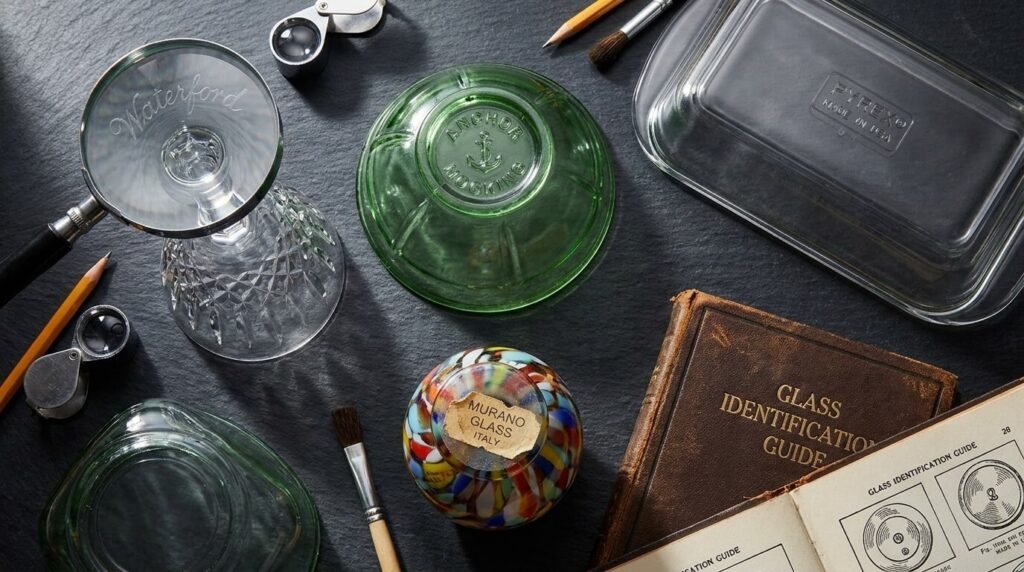
Glass markings are identifying symbols, logos, etchings, stamps, or molded impressions placed on glassware by manufacturers, artists, or regulatory bodies. They appear in several forms.
Acid-etched marks use chemical processes to frost a logo or text directly into the glass surface. Embossed markings are raised symbols molded into the glass during production.
Engraved signatures are cut by hand or wheel into finished pieces. Pressed glass symbols appear as part of the mold design itself. Each type of marking tells a different part of the story of who made it, where, and when.
Why Glass Manufacturers Use Markings
Manufacturers place glass markings on their products for several practical reasons. Brand identification is the most obvious; a maker’s mark like the Waterford trademark or the Baccarat signature tells buyers immediately who produced the piece.
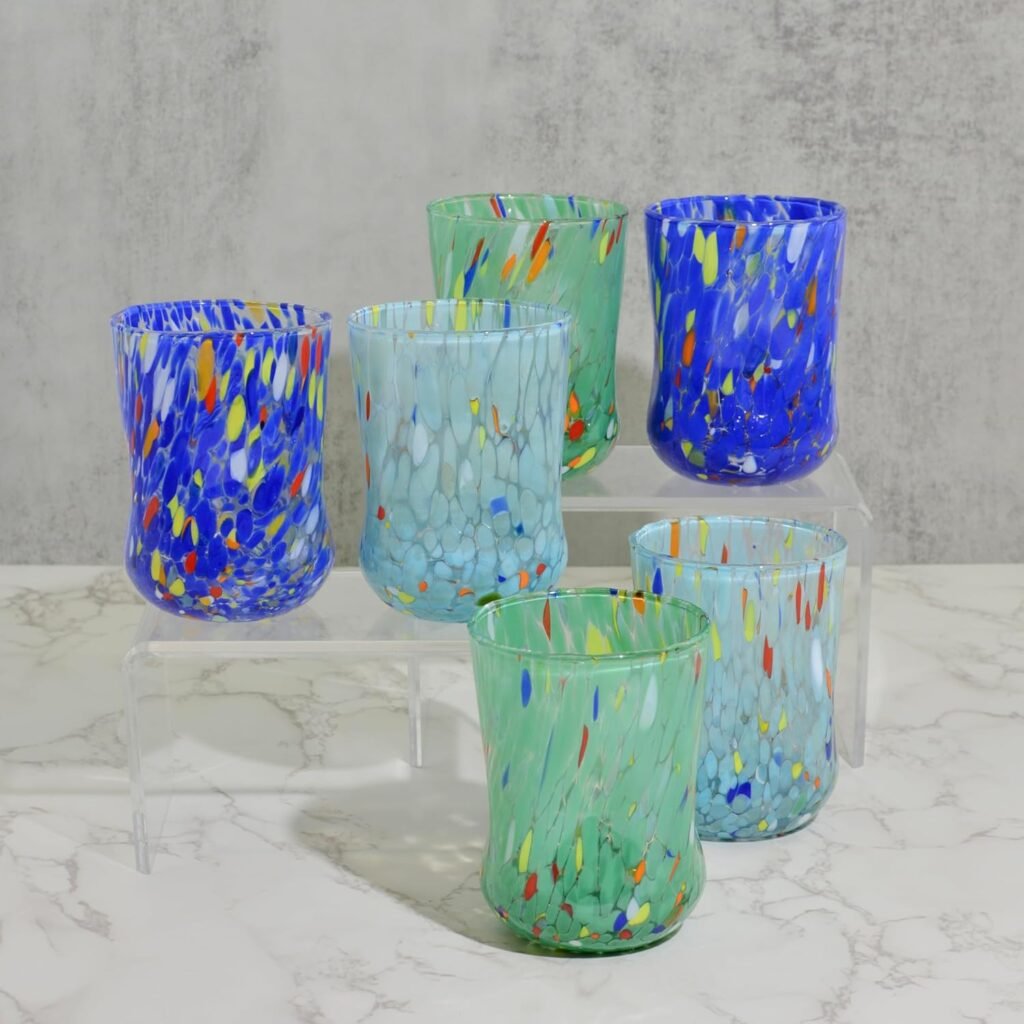
Authentication is equally important, especially for luxury crystal brands where counterfeits are common. Quality assurance marks sometimes indicate production standards met during manufacturing.
Country-of-origin labeling, like a ‘Made in France’ mark on Baccarat crystal, satisfies both legal import requirements and consumer expectations around provenance and value.
Where Glass Markings Are Usually Found
Most glass markings appear on the base or bottom of the piece, which is always the first place to check. On bottles, look at the bottle base and the heel, just above where the base meets the side wall.
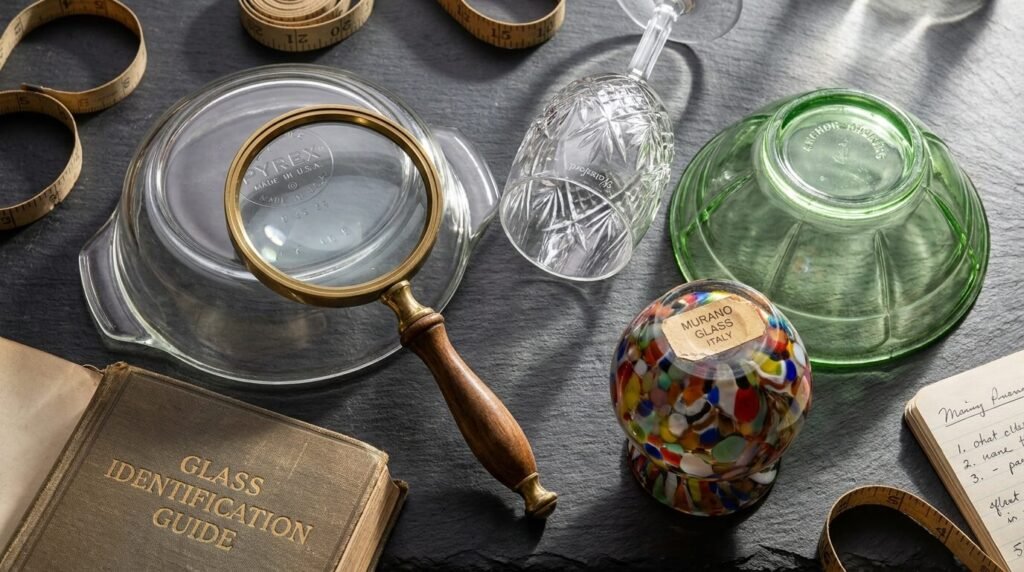
Stemware like wine glasses typically carries marks on the foot, the flat circular base the glass stands on. Some decorative pieces carry acid-etched marks on the side or along the rim.
Murano glass pieces sometimes have paper labels attached rather than permanent marks, and sticker residue can indicate where an original label once sat.
Common Types of Glass Markings
Acid-Etched Marks
Acid-etched marks are produced by applying acid to the glass surface through a stencil or mask, leaving a frosted, matte impression of a logo, text, or signature.
This technique is widely used by luxury crystal brands — Lalique acid signatures are among the most recognized in the world of art glass, typically appearing as ‘R. LALIQUE’ or simply ‘LALIQUE FRANCE’ etched cleanly onto the base.
Because acid etching is difficult to replicate convincingly, it serves as a reliable authentication method for high-end signed glassware.
Molded Manufacturer Logos
Molded manufacturer logos are created during the glass production process itself — the logo or symbol is built into the mold, so every piece produced from that mold carries the same embossed marking.
The Anchor Hocking mark, an anchor overlapping an H, is a well-known example of this type. Owens-Illinois marks appear on the base of countless vintage bottles in this embossed format.
These manufacturer logos are permanent, raised slightly above or recessed below the glass surface, and cannot be added to or removed after production.
Engraved Signatures
Engraved signatures are applied to finished glass pieces by hand, using a rotating wheel or diamond-tipped tool. This technique is common in studio glass and fine art glass contexts.
The Daum Nancy mark, for example, is typically wheel-engraved or acid-signed on French Art Nouveau pieces.
Glass artist signatures from contemporary makers like Dale Chihuly appear as hand-engraved text, often with unique variations between pieces that reflect genuine handwork.
Engraved signatures on collectible and studio glass add substantial value and are central to glass authentication.
Foil Labels and Stickers
Many glassware manufacturers, particularly in the mid-20th century, used paper or foil labels rather than permanent marks.
Murano glass labels are a well-known example. Authentic Murano pieces often carry a paper or foil sticker identifying the maker, but these labels detach easily over time.
When a label is missing, sticker residue on the glass surface can still indicate where an original label was placed, which is useful context for label authentication.
Absence of a permanent mark does not automatically mean a piece is not authentic, but it does make identification harder.
Pressed Glass Symbols
Pressed glass is manufactured by pressing molten glass into molds, and the markings on pressed glass pieces are part of the mold design.
These glass symbols can include manufacturer initials, pattern names, patent numbers, or registration marks embedded in the design itself.
Fenton glass, Hazel-Atlas glass, and Depression-era pressed glassware all carry these kinds of molded symbols.
The symbols are typically found on the base but sometimes appear within the decorative pattern on the side of the piece, making careful examination of the entire surface worthwhile.
How to Identify Glass Markings
Understanding Manufacturer Logos
Start by examining the base of the piece under good lighting. A magnifying glass helps with small or worn marks.
Manufacturer logos on glassware often combine letters, symbols, and numbers. The Owens-Illinois mark, for instance, pairs a symbol with a date code and plant number that together reveal exactly when and where a bottle was made.
Cross-referencing what you see against a glass identification guide or a glassmark reference database narrows down the manufacturer quickly.
Knowing what common logos look like, the Anchor Hocking anchor, the Fenton oval, and the Hazel-Atlas H-over-A — makes recognition much faster.
Identifying Country-of-Origin Marks
Country-of-origin marks became legally required on imports into the United States under the McKinley Tariff Act of 1891, which means any piece marked ‘Made in France,’ ‘Made in England,’ or similar phrases was almost certainly produced after that date.
This is genuinely useful for antique glass dating. Baccarat crystal carries a ‘Made in France’ mark alongside its logo stamp. Murano glass from Italy may carry ‘Made in Italy’ alongside a Venetian glass maker’s mark or paper label.
The presence, absence, or specific phrasing of a country-of-origin mark helps narrow a piece’s production era significantly.
Reading Vintage and Antique Glass Symbols
Vintage and antique glass symbols require a different approach than modern markings. Many older pieces predate standardized marking systems entirely, meaning identification relies on physical characteristics alongside any marks present.
Pontil marks the scars left on the base of hand-blown glass where the glassblowing rod was attached are key identifiers.
A rough pontil indicates early handmade production, while a ground pontil suggests a more refined finishing process used on finer antique glassware.
The style and condition of any mold seams, the glass color, and the overall weight and texture all contribute to reading a piece correctly.
Using Online Glass Mark Identification Resources
Several reliable digital resources support glass markings identification research. The Corning Museum of Glass maintains extensive educational materials on glass history and manufacturing..
Online glassmark reference databases compiled by collector communities catalog thousands of manufacturer logos, bottle markings, and crystal signatures with comparison images.
The Glass Encyclopedia and collector society websites are also valuable starting points. When using these resources, search by the shape of the mark rather than trying to name it first.
Describe what you see, and let the database match it to known manufacturers.
Comparing Markings With Known Glass Brands
One of the most practical identification methods is direct comparison. Collector books and glass catalog references publish high-resolution images of authentic markings from major brands — Waterford, Baccarat, Fenton, Hazel-Atlas, and others.
Comparing a mark on an unidentified piece directly against documented examples reveals both matches and discrepancies.
Counterfeit glass marks tend to have slightly inconsistent depth, irregular edges, or imprecise proportions when compared side by side with genuine examples.
This comparison method is what specialist appraisers use, and it is accessible to careful collectors with the right reference materials.
Famous Glass Brands and Their Markings
Pyrex Glass Markings
Pyrex is one of the most recognized names in glass cookware, and Pyrex markings have changed across different production eras in ways that help date pieces.
Early American Pyrex produced by Corning carries a circular stamp with ‘PYREX’ and ‘MADE IN U.S.A.’ Vintage Pyrex from the mid-20th century often features bold, colored patterns alongside the base stamp.
The borosilicate composition of original Pyrex — heat-resistant glass designed for laboratory and kitchen use — is a material characteristic that distinguishes it from later soda-lime versions.
Pyrex markings paired with pattern style and glass composition together confirm a piece’s production era.
Anchor Hocking Marks
Anchor Hocking is a major American glass manufacturer whose marks appear on kitchenware, Depression glass, and vintage bottles.
The primary Anchor Hocking mark is an anchor symbol overlapping the letter H, molded directly into the glass base.
Earlier pieces may carry an anchor alone or the text ‘HOCKING GLASS’ before the company merger in 1937. Anchor Hocking also produced Fire-King ovenware, which carries its own distinct markings.
Identifying genuine Anchor Hocking glass matters because the brand produced several collectible Depression glass patterns, and knowing the mark helps confirm authenticity and production dates.
Fenton Glass Signatures
Fenton Art Glass produced some of America’s most collectible carnival glass and art glass from 1905 until the company closed in 2011.
Fenton glass signatures evolved — earlier pieces were unmarked, while the oval ‘Fenton’ logo in script was introduced in 1970.
This makes pieces from before 1970 harder to identify through marks alone, requiring pattern identification against Fenton glass pattern books and catalogs.
The iridescent finish characteristic of Fenton carnival glass is a physical identifier in itself. Later limited edition and collector pieces often carry additional signatures or numbered markings that add to their value.
Murano Glass Labels
Murano glass from the Venetian island of Murano is among the most imitated glassware in the world, which makes label authentication critical.
Authentic Murano glass carries labels from specific studios Venini, Barovier and Toso, and others, often as adhesive foil stickers since permanent marks are less common in this tradition.
The Murano Glass Consortium introduced a ‘Vetro Artistico Murano’ trademark to help buyers identify genuine handcrafted pieces.
Free-blown glass characteristics — slight asymmetry, a visible pontil scar, and the quality of the glass itself — support label identification when the label is missing or damaged.
Waterford and Crystal Markings
Waterford Crystal carries some of the most recognizable crystal markings in the luxury market. The Waterford trademark — a seahorse or the word ‘Waterford’ acid-etched onto the base — identifies genuine Irish crystal.
Crystal stemware marks on Waterford pieces are typically found on the foot of the glass, etched finely enough that they require close inspection.
Waterford lead crystal is also identifiable through its refractive quality — the way it bends and scatters light with particular brilliance is a physical characteristic of genuine lead crystal.
Pieces marked ‘Waterford Crystal Ireland’ with the full etched signature are the most reliably authenticated.
Vintage and Antique Glass Identification
How Older Glassware Was Marked
Before standardized marking systems, older glassware was identified through applied glass seals — separate blobs of molten glass pressed onto bottles carrying a maker’s emblem or date.
These applied seals are common on 18th and early 19th-century bottles and are reliable age indicators. As industrial glass manufacturing developed through the 19th century, mold-blown glass with embossed markings became standard.
Factory stamps and embossed markings on bottle bases became more systematic by the late 1800s, giving collectors a reasonably reliable dating framework when combined with glass color analysis and manufacturing style.
Identifying Depression Glass Marks
Depression glass was produced in large quantities in the United States during the 1920s through 1940s, and identifying it relies on a combination of pattern recognition and manufacturer marks.
Major Depression glass producers include Hazel-Atlas, Anchor Hocking, Federal Glass, and Indiana Glass. The Hazel-Atlas mark — an H sitting above an A — appears on the base of many pieces and is one of the most commonly encountered vintage glass symbols from this era.
Depression glass identification also depends heavily on pattern matching against documented catalogs, since many patterns were produced by multiple manufacturers in similar colors.
Signs of Antique Glassware
Beyond markings, several physical characteristics indicate genuine antique glassware. Pontil scar analysis is one of the most useful tools — the type and finish of the pontil mark on the base reveals production method and era.
Authentic antique glass often shows slight irregularities in thickness, small bubbles or impurities in the glass itself, and a surface wear pattern consistent with age rather than artificial distressing.
Glass color can also date a piece — certain colors like aqua and amber were common in specific eras due to the minerals available in glass production at the time. UV glass testing reveals uranium glass, which fluoresces bright green under ultraviolet light.
Missing or Worn-Off Glass Markings
Not every piece of valuable antique glassware carries a visible marking. Labels detach, embossed marks wear smooth through decades of washing, and some historic pieces were never marked at all.
When glass markings are absent or unclear, identification shifts to physical examination — weight, translucency, color, manufacturing characteristics, and pattern comparison against documented examples.
Consulting a glass appraisal specialist is particularly worthwhile when markings are ambiguous. Reproduction glass made to imitate antiques is a real concern, and physical characteristics combined with provenance documentation together make the strongest authentication case.
Glass Markings vs Crystal Markings
Differences Between Glass and Crystal Identification
Standard glass and crystal glass identification requires understanding the material difference first.
Crystal glass — particularly lead crystal — contains a significant percentage of lead oxide or other metalite minerals, which gives it greater density, higher refractive quality, and a distinctive ring when tapped.
Standard soda-lime glass does not have these properties. The markings themselves may look similar, but the physical context around them differs.
Crystal markings from Baccarat or Waterford appear on material that feels heavier and sparkles more intensely than standard glass, and that material difference is part of the authentication picture.
Lead Crystal Identification Marks
Lead crystal carries specific markings that distinguish it from standard glass. Baccarat crystal, for example, uses an acid-etched logo stamp showing a goblet with ‘Baccarat France’ in a circular design.
The Baccarat signature on high-end pieces may also include an engraved serial number for individual piece tracking. Waterford lead crystal marks include the acid-etched seahorse trademark.
These crystal markings are paired with material characteristics, optical clarity, glass refractive quality, and the clear ringing tone produced when the rim is lightly struck to confirm genuine lead crystal versus standard or reproduced glass.
How Material Composition Affects Markings
The composition of glass affects what marking methods are practical and durable. Lead crystal’s density makes it ideal for deep wheel-cut decoration and precise acid etching, which is why luxury crystal brands like Baccarat and Waterford favor these techniques.
Borosilicate glass used in Pyrex and laboratory glassware is harder and more chemically resistant, so its markings tend to be molded rather than etched.
Soda-lime glass, the most common commercial composition, accommodates embossed markings well during mold production.
Understanding what type of glass a piece is made from helps predict where and how markings are likely to appear.
Decorative Glass vs Fine Crystal
Decorative glass and fine crystal serve different markets and carry different marking conventions. Art glass from studios and individual artists, including Daum Nancy art glass, Lalique decorative pieces, and contemporary studio glass, prioritizes the artist’s signature as the primary identifier.
Fine crystal from luxury brands like Baccarat, Waterford, and Steuben Glass uses corporate marks, acid signatures, and sometimes numbered series identifiers.
The distinction matters for collectors because fine crystal brand authentication follows different verification steps than studio glass authentication, and the resources used for crystal brand authentication guides versus artist signature records differ accordingly.
How to Tell if Glassware Is Valuable
Rare Manufacturer Marks
Certain manufacturer marks are significantly rarer than others and carry corresponding value.
Early Fenton marks from before the oval logo era, Tiffany Favrile marks on authentic Tiffany art glass, and Steuben signatures on pre-1930s pieces are among the most sought-after in the American collectible glass market.
Daum Nancy marks on Art Nouveau glass command strong prices at auction, as do early Lalique signatures — particularly pieces signed ‘R.
Lalique’ rather than simply ‘Lalique,’ which indicates pre-1945 production. Rarity of the mark itself, combined with rarity of the piece design, drives the most significant value premiums.
Limited Edition and Collector Signatures
Limited edition porcelain and glass releases carry special markings that directly communicate collectible status. Numbered series marks — where a piece is identified as, say, number 47 of 500 — document scarcity in a verifiable way.
Collector signatures from glass artists like Dale Chihuly, whose Chihuly glass pieces carry hand-engraved signatures, add authentication value that cannot be replicated.
Bernardaud-style artistic collaborations in glassware similarly carry documentation of the creative partnership.
These limited edition glass markings should always be verified against artist records or manufacturer documentation before purchase, particularly at significant price points.
Age and Production Era Indicators
Antique glass dating through markings requires cross-referencing several indicators at once.
The style of the mark matters: typefaces, logo designs, and marking methods changed across decades, and a glass identification guide documents these changes for major manufacturers.
Bottle dating codes from Owens-Illinois, for example, encode the plant number and production year directly into the base marking.
Glass date codes follow systems that, once understood, reveal precise production windows.
Combined with physical aging characteristics, surface wear, natural patina, and manufacturing irregularities, consistent with the claimed era mark-based dating becomes quite reliable.
Condition and Authenticity Factors
Condition significantly affects glass value, and glass authentication must account for both the marking and the piece’s physical state.
Chips, cracks, repairs, or replaced parts diminish value even on pieces with genuine and rare marks.
Glass restoration work, while sometimes invisible to the naked eye, can be detected by specialists and affects appraisal value.
Reproduction glass made to imitate antiques is an ongoing concern; counterfeit glass marks are sometimes added to modern reproductions, and examining the consistency of wear between the mark and the rest of the piece helps detect these fakes.
Authentic antique glass shows consistent aging throughout, not selectively around the mark.
Conclusion
Glass markings identification is a skill that builds with practice, reference, and hands-on examination.
Those small etchings, embossed symbols, and engraved signatures carry real information about who made a piece, where, when, and with what level of craftsmanship.
Whether you are authenticating a Lalique vase, dating a Depression glass plate, or verifying that a bottle of Murano glass is genuinely Venetian, understanding glass marks gives you a foundation for confident, informed decisions.
The more familiar you become with how different manufacturers marked their work across different eras, the easier identification becomes over time.
Research reputable glass brands and their documented marking histories before purchasing anything significant.
Use glass identification guides, glassmark reference databases, and collector society resources to cross-reference what you find.
When a piece matters either financially or as a long-term collectible investment, verify antique and collectible glass through a qualified glass appraisal specialist before committing.
Glass markings rarely lie when you know how to read them, but they do require the right knowledge to interpret correctly.
About the Author & Reviewer
Sarah Emirone, Author
Sarah researches and writes SafeKitchn’s dinnerware and kitchenware guides, with a focus on material safety, lead content, and manufacturer specifications. She cross-references product data sheets, safety certifications, and regulatory filings (including FDA and Prop 65 records) before publishing, and updates articles when new information becomes available.
James Daniels, Reviewer
James reviews SafeKitchn’s material safety content for scientific accuracy. He holds a B.Sc in inorganic chemistry and works as a materials researcher, with particular focus on the composition and safety behavior of glass, ceramic, and metal used in kitchenware.