

Pick up an old crystal vase at an estate sale, and you’ll likely find something etched, stamped, or stickered on its base. That’s no accident.
Crystal markings are how manufacturers communicate authenticity, origin, and material quality, and for collectors, buyers, and curious homeowners alike, learning to read them is genuinely useful.
The difference between genuine crystal and ordinary glass can be subtle, and the markings are often the fastest way to find out what you’re actually holding.
This article walks through what crystal markings mean, how to find them, what the major brands use, and how to verify authenticity with confidence.
Written by Sarah Emirone | Reviewed by James Daniels, B.Sc, Inorganic Chemist & Materials Researcher | Updated September 2026 | See How We Test | Filed under: Identification & Authentication
What Are Crystal Markings?
Definition of Crystal Markings
Crystal markings are symbols, logos, stamps, acid etchings, engraved signatures, or adhesive labels applied to crystal glass products to identify the manufacturer, material type, and production origin.
They function as a product’s identity, similar to a hallmark on silver or a maker’s mark on antique furniture. Some markings are permanent, etched directly into the glass during or after production.
Others are applied as foil stickers or paper labels that can wear off over time. Either way, their purpose is the same: to tell you who made it, what it’s made from, and whether it meets a recognised quality standard.
Why Crystal Manufacturers Use Markings
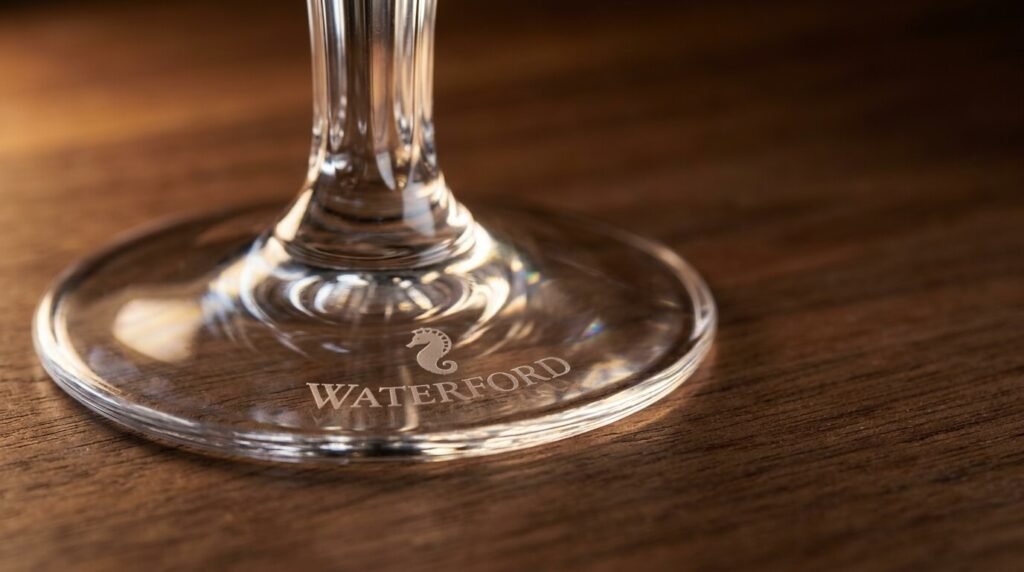
For crystal manufacturers, markings serve several practical purposes at once. Brand identification is the obvious one, a Waterford crystal mark or a Baccarat signature immediately communicates prestige and heritage.
But beyond brand recognition, markings also function as authenticity verification tools, helping consumers and collectors distinguish genuine crystal from decorative glass imitations.
Quality assurance is another driver: some marks specifically indicate that a piece meets defined international crystal standards, including lead oxide content thresholds.
For high-end and limited edition collections, a clear maker’s mark also protects the manufacturer’s intellectual property and supports product authentication in secondary markets like auctions and estate sales.
Where Crystal Markings Are Usually Located
The most common place to find crystal markings is on the base or foot of a piece — the flat bottom of a wine goblet, the underside of a crystal decanter, or the base ring of a vase.
On crystal stemware, check the foot of the stem where it meets the base. Bowls and serving pieces typically carry marks on their underside.
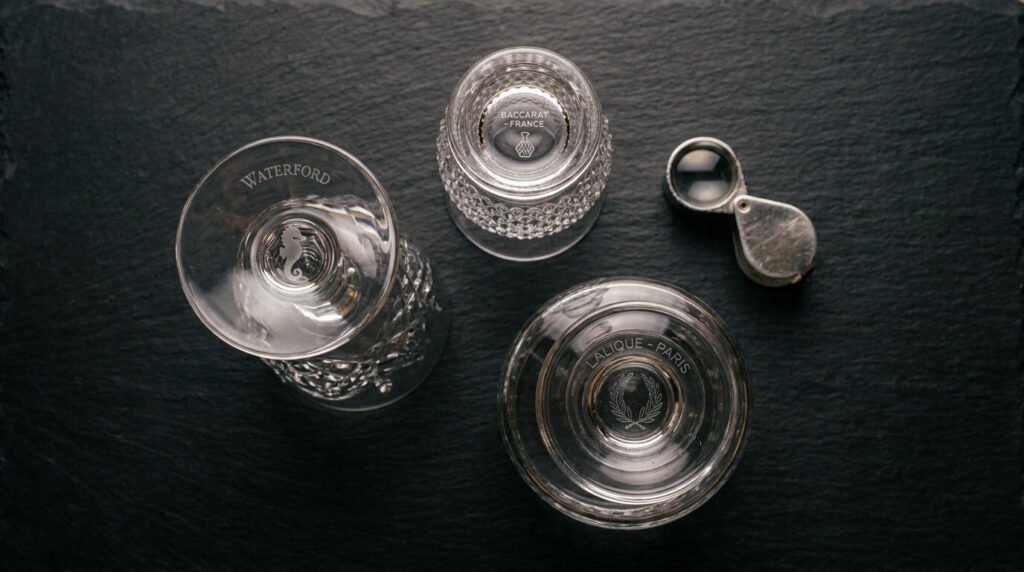
Some manufacturers also include markings on retail packaging rather than the piece itself, which is why original boxes are worth keeping for collectable crystal.
Labels and stickers are usually found in the same locations, but may have been removed by previous owners.
Difference Between Crystal Markings and Decorative Patterns
It’s easy to confuse manufacturer markings with decorative etching, especially on heavily patterned pieces. The distinction is functional versus aesthetic.
Crystal markings are identification tools — logos, signatures, or stamps that tell you who made the piece and what it’s made from.
Decorative patterns like diamond cut designs, starburst patterns, or floral etching are artistic elements applied to enhance the visual appeal and sparkle effect of the piece.
Both can be etched into the glass, but a brand logo on the base serves a completely different purpose than an ornamental design on the body of the piece.
Common Types of Crystal Markings
Acid-Etched Markings
Acid etching is one of the most reliable and durable marking methods used by crystal manufacturers.
The process involves applying a chemical compound, typically hydrofluoric acid or an acid-based paste, to a specific area of the glass surface, creating a frosted or matte logo or text that’s permanently embedded into the material.
Because the mark is part of the glass itself rather than applied on top of it, acid-etched markings can’t be rubbed off or removed without damaging the piece.
Waterford and several other premium Irish crystal and European crystal brands have used acid etching as their primary identification method for decades. It’s considered one of the strongest indicators of a genuine, high-quality product.
Engraved Logos and Signatures
Engraving involves physically cutting into the crystal surface to create a mark, typically a brand logo, signature, or text. This can be done by hand using traditional engraving tools or by machine for consistent precision.
Hand-engraved signatures are particularly common on handcrafted crystal and limited edition pieces, where an individual craftsperson’s mark adds both authenticity and personal value.
Lalique crystal, for example, is known for its engraved or moulded signatures that are considered important authenticity indicators.
Engraved marks are permanent and typically found on the base of the piece, though they can appear elsewhere depending on the manufacturer’s convention.
Foil Stickers and Labels
Not all crystal markings are permanent. Many manufacturers — particularly for mid-range and retail crystal products — use foil stickers or paper labels as their primary marking method.
These are typically applied to the base or side of the piece and include the brand logo, country of origin mark, and sometimes material information like “24% lead crystal” or “lead-free crystal.”
The downside is obvious: stickers can be removed, fall off over time, or be replaced with fraudulent labels. For vintage crystal identification, missing stickers are extremely common and don’t automatically indicate a fake piece — they often simply reflect age and handling.
Molded Manufacturer Marks
Some crystal and glass manufacturers incorporate their identification marks directly into the mould used to produce the piece.
This means the manufacturer stamp or logo is formed as part of the glass itself during the production process — typically appearing as a slightly raised or indented mark on the base.
Pressed glass and some categories of decorative glass use this technique extensively. Moulded marks are permanent and relatively tamper-proof, making them reliable for identification purposes.
They tend to be less visually refined than acid-etched marks, but they’re durable and consistent across production runs.
Laser-Etched Crystal Markings
Laser etching is a more modern marking method that uses focused laser beams to create precise, permanent marks on the crystal surface. It produces clean, highly detailed logos and text without the chemical process involved in acid etching.
Laser-etched markings are increasingly common on contemporary crystal products and offer excellent consistency across large production volumes.
For collectors, laser etching on a piece can sometimes help date it — its presence generally indicates post-1990s manufacture, which is useful context when assessing vintage crystal or antique crystal authenticity.
What Do Crystal Markings Mean?
Manufacturer Identification
The most straightforward function of a crystal marking is to tell you who made the piece. Brand logos and signature marks are the primary tools here. Waterford uses its distinctive “W” and seahorse motifs.
Baccarat crystal carries its name in a precise font with an interlocking design.
Swarovski crystal is identified by its swan logo. These brand logos are legally protected trademark symbols, and legitimate manufacturers use them consistently across their product lines.
Knowing the major brand marks is the starting point for crystal identification — and cross-referencing a mark against documented manufacturer stamps is how collectors verify whether a piece genuinely originates from the brand it claims.
Lead Crystal vs Lead-Free Crystal Markings
Some crystal markings communicate material composition directly. Under European standards, the term “crystal” on a product label indicates a specific lead oxide content: full lead crystal must contain at least 24% lead oxide, while crystal superieure requires at least 10%.
Products meeting these thresholds may be labelled accordingly. Lead-free crystal identification marks typically use alternative terms like “crystallin” or explicitly state “lead-free.”
In the US, the distinction is less strictly regulated in labelling, so international standards are often more informative. Understanding these material indicators matters for both safety-conscious buyers and collectors evaluating brilliance and optical clarity.
Country of Origin Markings
Country of origin marks are often found alongside brand logos and tell you where the piece was manufactured. “Made in Ireland” on crystal stemware points strongly toward Waterford or another Irish crystal producer.
“Made in France” is associated with luxury French crystal brands, including Baccarat and Lalique.
Czech crystal — sometimes referred to as Bohemian crystal — typically carries Czech Republic origin marks, while Austrian crystal is commonly associated with Swarovski.
These origin markings matter because certain countries carry reputational weight in the crystal world, and they help collectors trace the geographic heritage and manufacturing tradition behind a piece.
Quality and Authenticity Indicators
Some crystal markings go beyond basic identification and communicate quality tier. Limited edition crystal pieces often carry numbered marks — “No. 47 of 500,” for example — which directly affect collector value.
Handcrafted crystal may bear an individual artisan’s initials or a “handmade” designation alongside the brand mark. Premium collections within larger brands sometimes carry additional authenticity marks or certificates that accompany the piece.
These layered marking systems reflect the manufacturer’s attempt to communicate not just who made the piece, but how it was made and where it sits within the broader product hierarchy.
Related: How to Identify Ajka Crystal
How to Identify Genuine Crystal Using Markings
Reading Manufacturer Logos
Start with the base of the piece and look for any etched, engraved, or stamped marks.
Compare what you find against documented manufacturer logos from reputable reference sources — crystal brand websites, collector guides, and auction house databases all maintain records of known marks.
Pay attention to detail: genuine brand logos have precise, consistent proportions. Slight variations in font, sizing, or symbol placement can indicate a counterfeit.
For older pieces, account for the fact that logos evolve — Waterford’s mark, for example, has gone through several iterations since the brand’s revival in 1947.
Understanding Crystal Labels and Stickers
When a sticker is present, read it carefully. Legitimate crystal labels typically include the brand name, country of origin, and material information.
High-quality foil labels from premium manufacturers are precisely printed with consistent colours and clean edges. Poorly aligned printing, cheap foil material, or labels that feel flimsy compared to what the brand typically uses are worth questioning.
That said, labels alone are not definitive proof of authenticity — they can be replicated or transferred from genuine pieces to fakes. Always consider labels alongside other physical characteristics of the piece.
How Authentic Crystal Brands Mark Their Products
Established crystal brands apply their marks with consistency and precision. Acid-etched logos are clean and uniform. Engraved signatures follow documented stylistic conventions.
Moulded marks are sharp and well-defined. The positioning of marks is also consistent within a brand’s product range — Waterford marks appear in the same location across their stemware collections, for instance.
When examining a piece, consider the overall quality of the marking itself.
A poorly executed etching on a piece claiming to be premium Irish crystal is itself a red flag, separate from whether the logo design is correct.
Signs of Fake or Counterfeit Crystal
Counterfeit crystal is a genuine concern in secondary markets.
Warning signs include missing marks on pieces that should have them, etching that looks shallow, smudged, or inconsistent with known brand standards, labels that don’t match official brand typography, and inconsistencies between the claimed origin and the piece’s physical characteristics.
Low optical clarity, poor light refraction, and unusually light weight relative to the claimed material are physical red flags that support marking-based doubts.
When significant money is involved, professional product authentication through a recognised antique appraiser or auction house is always worth the cost.
Famous Crystal Brands and Their Markings
Swarovski Crystal Markings
Swarovski crystal is Austrian crystal known globally for its precision-cut decorative pieces, jewellery components, and figurines.
The brand’s primary authenticity mark is the swan logo, introduced in 1988 — pieces produced before this date carry an edelweiss flower mark instead.
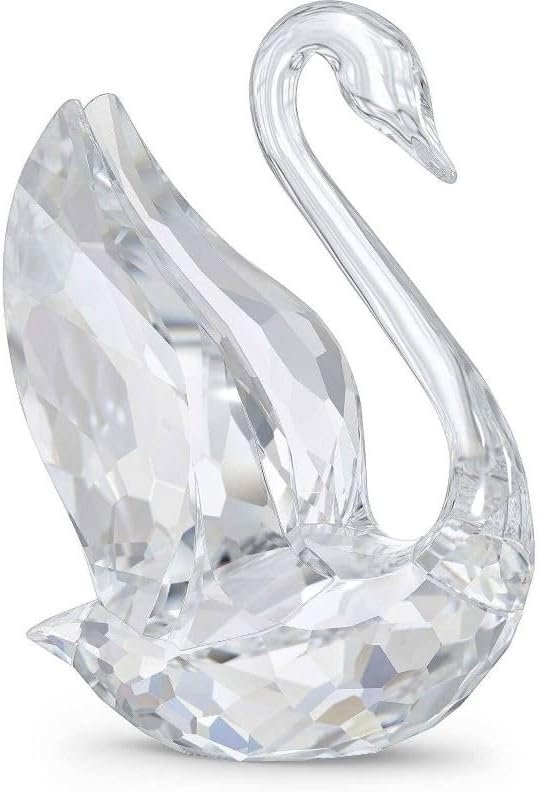
Swarovski also uses a “SC” or “SWAROVSKI” text mark depending on the product line and era. For collectors, the transition from edelweiss to swan is a useful dating tool.
The brand’s crystal markings appear on the base of figurines and decorative pieces, and often come with a certificate of authenticity for premium collections.
Waterford Crystal Marks
Waterford is probably the most recognisable name in Irish crystal. The brand uses acid-etched markings that have evolved through several distinct periods.

Pre-1950s pieces from the original Waterford factory (established 1783, closed 1851) carry no marks — any piece claiming Waterford origin from that era without independent provenance should be treated with caution.
The modern Waterford brand, revived in 1947, uses a clear “Waterford” script mark and, from the 1980s onward, added a seahorse logo. The acid-etched mark is typically found on the base of all stemware, decanters, and giftware pieces in their current range.
Baccarat Crystal Signatures
Baccarat crystal is French crystal with a manufacturing history stretching back to 1764, making it one of the oldest active crystal houses in the world.
The brand’s signature mark — typically “Baccarat France” in a precisely engraved or etched format — is consistently applied to the base of genuine pieces.
Older Baccarat pieces may carry a paper label rather than a permanent mark, and some early pieces have no mark at all. The brand also uses an interlocking “B” logo on certain product lines.
Baccarat’s crystal is renowned for its optical clarity and exceptional light refraction, which serve as secondary identification tools alongside the formal markings.
Lalique Crystal Markings
Lalique is a French luxury crystal and glass brand with roots in the Art Nouveau movement, founded by René Lalique in 1888.
The brand’s markings have gone through several phases: early pieces carry “R. LALIQUE” marks (pre-1945), while post-war and contemporary pieces use simply “Lalique France” in engraved or moulded form.
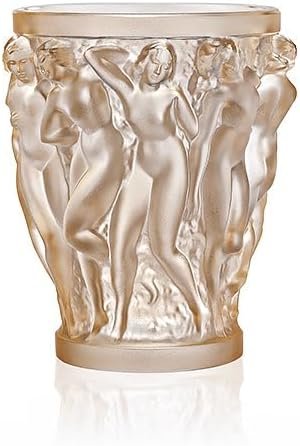
The absence of the “R.” initial is a useful dating indicator — it suggests post-1945 production.
Lalique’s decorative glass and crystal vases, figurines, and jewellery pieces are among the most heavily collected in the luxury glassware market, and markings play a central role in establishing value and provenance.
Mikasa and Other Popular Crystal Brands
Mikasa crystal is a well-known tableware brand that produces accessible, everyday crystal stemware and dinnerware sets.
Mikasa marks typically appear as foil stickers on the base of pieces, often including “Mikasa Crystal” or “Mikasa Fine Crystal” text alongside country of origin information.

Other notable brands with documented marking conventions include Riedel (Austrian, typically uses foil labels), Lenox (American, uses etched marks on premium lines), and Stuart Crystal (British, acid-etched marks on the base).
Each of these brands maintains consistent marking standards that collectors and buyers can cross-reference against brand documentation.
Do Crystal Markings Indicate Lead Content?
Understanding Lead Crystal Standards
Whether a piece qualifies as “crystal” under international standards depends on its lead oxide content.
The EU Council Directive 69/493/EEC defines four categories: full lead crystal (minimum 30% lead oxide), lead crystal (minimum 24% lead oxide), crystal superieure (minimum 10%), and crystallin (no lead requirement but other composition standards apply).
These thresholds determine what terminology manufacturers are legally permitted to use on their product labels in European markets.
A piece labelled “24% lead crystal” is communicating specific compositional information that affects its brilliance, refractive index, and weight — all characteristics that distinguish it from standard decorative glass.
Markings That Suggest Lead Crystal
Several marking conventions suggest lead crystal composition. The explicit percentage — “24% lead crystal” or “30% lead crystal” — is the clearest indicator.
Older pieces may simply state “full lead crystal” or “lead crystal” without a specific percentage, reflecting labelling norms of their production era.
Country of origin can also be a soft indicator: European crystal from established producing regions like the Czech Republic, France, Ireland, and Germany is more likely to be traditional lead crystal, though this is not definitive without direct labelling.
The weight and brilliance of the piece itself provide physical confirmation alongside any marking.
Lead-Free Crystal Identification
As awareness of lead safety has grown, most premium crystal manufacturers have shifted toward lead-free formulations that maintain optical quality without lead oxide.
Lead-free crystal identification markings typically include terms like “lead-free crystal,” “crystallin,” or “titanium crystal” — the latter referring to pieces where titanium dioxide replaces lead oxide to achieve comparable brilliance.
Swarovski, for example, has used lead-free formulations for its decorative crystal for many years and marks its products accordingly.
For buyers purchasing crystal for regular food or drink use — decanters, wine goblets, and the like — lead-free crystal is the recommended choice regardless of its brilliance relative to lead alternatives.
Why Lead Content Matters
Lead content matters for three distinct reasons depending on who’s asking. For safety-conscious buyers, particularly those using crystal decanters or stemware regularly, lead oxide can leach into beverages — especially acidic ones like wine or spirits stored over time.
For collectors, lead crystal’s higher refractive index produces the superior brilliance and sparkle effect that defines the premium crystal aesthetic, making lead content a quality indicator in that context.
For appraisers and authenticators, understanding lead content helps accurately categorise pieces and assign values aligned with international crystal classification standards.
Crystal Markings by Region and Country
European Crystal Hallmarks
European crystal carries some of the most structured and legally defined marking conventions in the world.
EU regulations require that crystal products sold within member states meet specific compositional standards before they can use protected terminology on labels.
European crystal hallmarks often combine brand logos with material designations, lead content percentages, and country of origin marks.
The “Made in Germany,” “Made in France,” and “Made in the Czech Republic” designations carry particular weight in the crystal-collecting community, given the deep manufacturing traditions associated with each region.
Bohemian crystal from the Czech Republic is especially notable for its centuries-long glassmaking heritage.
Czech Crystal Identification Marks
Czech crystal — historically known as Bohemian crystal — represents one of the oldest and most celebrated glassmaking traditions in Europe.
Czech manufacturers use a range of marking conventions, from foil stickers indicating “Bohemia Crystal” or “Czech Crystal” to acid-etched marks on higher-end pieces.
The “Bohemia” name is used by multiple manufacturers and is not a single brand, so it functions more as a regional descriptor than a specific maker’s mark.
Buyers collecting Czech crystal should look for additional manufacturer-specific marks alongside regional identifiers, and should be aware that “Bohemian style” glass produced outside the Czech Republic may use similar aesthetic conventions without carrying genuine regional origin.
Italian Crystal Labels
Italian crystal has a strong tradition in both decorative glass art and luxury tableware, with Venice and Murano being the most internationally recognised production centres.
Murano glass — technically a form of decorative glass rather than crystal in the strict lead-oxide sense — carries its own marking conventions, including the “Vetro Artistico Murano” trademark certification for authentic pieces.
Italian crystal labels for tableware products typically follow similar conventions to other European producers, combining brand names, material designations, and “Made in Italy” origin marks.
The Murano certification mark is particularly important for buyers navigating a market where imitations are common.
Austrian and French Crystal Markings
Austrian crystal is synonymous globally with Swarovski, whose precision-cut decorative pieces carry the swan logo as their primary authenticity mark.
French crystal markings are dominated by Baccarat and Lalique — two brands whose documented marking conventions are extensively researched by collectors and appraisers.
Both Austrian and French crystal manufacturers apply their marks with a level of precision and consistency that makes counterfeit detection relatively straightforward for experienced collectors.
The “Made in France” designation on crystal products carries significant prestige and collector interest in international secondary markets.
Vintage American Crystal Signatures
American crystal production has its own distinct history, with manufacturers like Heisey, Cambridge Glass, Fostoria, and Tiffin producing collectable glassware throughout the early and mid-20th century.
These brands used a variety of marking methods — Heisey’s “H within a diamond” mark is among the most recognised American glass signatures.
Many pieces from this era were marked with paper labels that have since been lost, making physical characteristics and pattern identification essential tools for American vintage crystal identification.
Replacement services and collector networks maintain detailed pattern catalogues that assist in attribution.
Vintage and Antique Crystal Markings
How Older Crystal Pieces Were Marked
Marking practices have changed significantly over the centuries. In earlier production eras — the 18th and early 19th century — crystal was rarely marked at all.
Brand identity was established through pattern recognition and dealer relationships rather than direct product marketing.
By the late 19th century, more manufacturers began adopting consistent marking practices as consumer markets developed and brand competition increased.
Paper labels became common in the mid-20th century, alongside the more durable acid etching that premium brands adopted. Understanding this historical evolution helps collectors interpret the presence or absence of markings on older pieces.
Common Antique Crystal Symbols
Antique crystal symbols vary considerably by manufacturer and era, but some appear frequently enough to be worth knowing. The Heisey diamond-H is a classic American example.
Lalique’s “R. LALIQUE” script identifies pre-1945 French pieces. Early Waterford pieces carry no marks at all, as noted.
Pressed glass manufacturers from the American Brilliant Period (roughly 1876–1917) sometimes used moulded marks that are identifiable through specialist reference guides.
Antique appraisal services and museum glass collections maintain comprehensive records of historical marks that serve as the primary reference tool for serious collectors.
Missing or Worn-Off Markings
Absent markings are among the most common challenges in vintage crystal identification. Labels fall off over decades of use, handling, and washing.
Some pieces were never marked by their manufacturer. Others have had marks deliberately removed.
For collectors, missing marks don’t automatically disqualify a piece — they shift the identification burden onto physical characteristics, pattern recognition, and comparative analysis against documented examples.
Acid-etched and engraved marks are far more resistant to wear than sticker-based ones, which is one reason permanent marking methods are considered more reliable for pieces intended to retain long-term collector value.
Dating Vintage Crystal Through Marks
Crystal markings can be useful dating tools when you understand how a brand’s marks evolved.
Lalique’s shift from “R. LALIQUE” to “Lalique France” happened in 1945. Swarovski’s edelweiss-to-swan transition occurred in 1988. Waterford introduced its seahorse logo in the 1980s.
These documented transitions create dateable reference points.
For pieces where the mark style doesn’t match any documented period, or where a newer-style mark appears on a piece with obviously aged characteristics, the inconsistency itself becomes meaningful information, potentially indicating a later reproduction or a misattributed piece.
Crystal Markings vs Regular Glass Markings
Differences Between Crystal and Glass Identification
Crystal identification differs from general glass identification in both method and purpose.
Premium crystal manufacturers invest significantly in consistent, high-quality marking systems because their products command prices that justify authentication efforts.
Regular glass — soda-lime glass used in everyday household products is rarely marked with more than a basic manufacturer code or country of origin stamp, if it’s marked at all.
The sophistication of a marking system is itself a quality signal: detailed acid-etched logos and documented brand conventions are the territory of luxury glassware and genuine crystal, not mass-produced decorative glass.
Weight, Clarity and Sound Comparison
Beyond markings, the physical characteristics of crystal and regular glass differ in ways that support identification. Lead crystal is noticeably heavier than standard glass of comparable size, due to its lead oxide content.
It also has superior optical clarity, holding a piece up to light reveals prismatic light refraction and sparkle that soda-lime glass simply doesn’t produce.
The sound test is a well-known method: tap a crystal piece gently with a fingernail, and it produces a clear, resonant ring that sustains for a moment.
Regular glass produces a shorter, duller sound. These physical tests complement marking-based identification rather than replacing it.
Why Regular Glass Often Lacks Detailed Markings
Ordinary decorative glass and household glassware typically lack the detailed marking systems found on crystal because the economics don’t support it.
Applying acid-etched logos or consistently engraved marks to mass-produced glass adds production cost for products sold at low margins.
Regular glass also doesn’t carry the authentication concerns that make detailed marking worthwhile for crystal buyers of everyday glass aren’t typically investigating provenance or worrying about counterfeit products.
The relative absence of marking sophistication on regular glass is therefore both a cost decision and a reflection of the very different market context these products occupy.
Decorative Glass vs Fine Crystal
Decorative glass and fine crystal can look strikingly similar to an untrained eye; both can be beautifully designed, cut, and presented. The differences lie in composition and craftsmanship.
Fine crystal, particularly lead crystal, has a refractive index that produces genuine brilliance unavailable in standard glass compositions. Handcrafted crystal shows subtle variation that distinguishes it from machine-pressed glass.
And the marking system that accompanies genuine fine crystal is documented, consistent, and verifiable, reflecting a manufacturer’s investment in product integrity that mass-market decorative glass doesn’t replicate.
How to Verify Crystal Authenticity Beyond Markings
Sound Test for Crystal
The sound test is one of the most accessible ways to support crystal identification without any specialist equipment. Hold the piece securely and tap the rim gently with a fingernail or a pencil.
Genuine crystal — especially lead crystal — produces a clear, bell-like ring that sustains for a perceptible moment after the tap. The higher the lead oxide content, the more resonant the tone tends to be.
Standard glass produces a shorter, flatter sound that dissipates quickly. While not definitive on its own, the sound test is a quick and informative first step alongside examining any markings present.
Light Refraction and Sparkle
Hold a piece of crystal up to natural or direct light and observe what happens to that light as it passes through.
Genuine crystal glass, particularly lead crystal, has a high refractive index that bends and disperses light into prismatic colours, creating the distinctive sparkle effect associated with premium crystal.
This effect is significantly more pronounced in a genuine crystal than in regular glass.
Faceted crystal pieces maximise this property through their cut surfaces. The brilliance you observe under light is a direct function of the glass composition and one of the strongest physical signals of genuine crystal quality.
Weight and Thickness Analysis
Crystal, particularly lead crystal, is denser and heavier than regular glass. A piece of genuine lead crystal will feel noticeably heavier in the hand than a comparable piece of soda-lime glass the same size.
Conversely, crystal is often thinner-walled than ordinary glass because its strength allows for finer construction a quality indicator in handblown crystal and luxury stemware.
Weight combined with thinness is therefore a useful combination to assess: heavier than expected, yet finer in construction than ordinary glass, points toward genuine crystal glass rather than a cheaper imitation.
Professional Appraisal Methods
When the stakes are high, an estate collection, an auction purchase, or a potentially significant antique crystal piece, a professional appraisal is the most reliable path to authentication.
Expert appraisers combine marking analysis with physical assessment, pattern matching against documented collections, and, in some cases, laboratory glass composition analysis.
Auction houses like Sotheby’s and Christie’s maintain specialist departments for decorative arts and glass. Antique dealers who specialise in glassware and crystalware can also provide informed assessments.
For vintage crystal with potentially significant collector value, a professional appraisal protects both buyers and sellers.
Common Myths About Crystal Markings
“All Crystal Has a Sticker”
Many people assume that if a piece of crystal is genuine, it will have a sticker on the bottom. That’s not the case. Plenty of authentic crystal from established manufacturers uses acid-etched or engraved marks rather than labels.
Older pieces may have had stickers that have since been removed or fallen off naturally. And some historical pieces were never stickered to begin with.
A missing sticker is not evidence that a piece is fake — it shifts the identification work to other physical and marking-based characteristics, but it doesn’t disqualify the piece from being genuine.
“No Mark Means Fake Crystal”
The absence of a crystal marking does not mean a piece is fake.
Many genuine, high-quality vintage crystal pieces carry no marks whatsoever, either because they predate consistent marking practices, because their marks have worn away, or because the original manufacturer simply didn’t apply marks to that product line.
What an absence of markings does mean is that crystal identification must rely on other methods: physical characteristics, pattern recognition, and provenance documentation.
It raises questions rather than providing answers, and those questions deserve proper investigation rather than automatic dismissal.
“Lead Crystal Always Has Clear Labels”
Lead crystal doesn’t always come with explicit lead content labels, particularly on older or vintage pieces.
Labelling requirements have evolved, and pieces produced before modern consumer safety regulations may not include the specific percentage disclosures that contemporary products carry.
Similarly, pieces that have had their original stickers removed won’t carry lead content information even if the piece itself is genuine lead crystal.
Physical tests, such as weight, sound, and brilliance, combined with any available provenance documentation, are more reliable indicators than waiting for an explicit label.
“Expensive Crystal Always Has Engraved Logos”
Price and marking method don’t have a simple relationship. Some very expensive collectable crystal carries no permanent marking at all, particularly historical pieces from eras before consistent marking practices.
And some mid-range contemporary crystal uses acid-etched logos more prominently than some premium brands that rely on documented provenance rather than on-piece markings.
The quality and method of a crystal marking tells you about the manufacturer’s conventions and the era of production — not necessarily about the piece’s market value or quality tier in isolation.
Caring for Crystal With Delicate Markings
Protecting Acid-Etched Marks
Acid-etched marks are the most durable type of crystal marking and don’t require special protection under normal handling.
However, abrasive cleaning with steel wool, harsh scrubbing pads, or abrasive cleaner products can gradually wear down the frosted surface of an etched mark, reducing its clarity over time.
Gentle hand washing with a soft cloth is the recommended approach for any crystal with markings you want to preserve in clear condition.
Dishwasher use, while often technically tolerable for the crystal itself, accelerates dishwasher damage to surface markings over repeated cycles.
Cleaning Crystal Without Damaging Labels
Foil stickers and paper labels are vulnerable to water damage and should be treated carefully during cleaning.
If a piece has an original label you want to preserve, particularly for collectible crystal where original markings contribute to value, avoid submerging the labelled area and hand-wash gently.
Cleaning crystal without damaging labels means keeping the labelled surface as dry as possible and patting rather than rubbing it. If a label has already detached, store it flat in an archival sleeve alongside any documentation for the piece rather than discarding it.
Storage Tips for Collectible Crystal
Safe storage of collectible crystal protects both the physical piece and its markings.
Display cabinets with padded shelving prevent contact damage and keep pieces stable. Avoid stacking pieces directly on top of each other — the base of one piece resting on the rim of another risks chipping both.
UV light exposure over time can affect some adhesive labels and cause subtle surface changes to certain glass compositions; positioning display cabinets away from direct sunlight is a simple preventive measure.
Wrapping pieces individually in acid-free tissue for long-term storage protects both surface quality and any remaining original labels.
Maintaining Vintage Crystal Value
For vintage crystal, preserving original markings in whatever form they exist is directly connected to maintaining collector value.
An antique crystal piece with a clear, legible original maker’s mark commands more interest and typically higher prices than an identical piece without identification.
Keep original boxes and any accompanying documentation, certificates of authenticity, receipts, or provenance records. Avoid glass restoration or polishing that could affect marking clarity.
And if you’re considering chip repair on a collectible piece, consult a specialist first to ensure the repair method won’t compromise the piece’s authenticity or marking integrity.
Frequently Asked Questions (FAQ)
Where Are Crystal Markings Usually Found?
Crystal markings are most commonly found on the base or foot of the piece, the flat underside of plates, the foot of stemware, or the base of vases and decanters.
Check the base first, then the foot ring if present. Some pieces carry marks on packaging rather than on the glass itself.
How Can You Tell if Crystal Is Real?
Combine marking examination with physical tests. Look for a clear, well-executed manufacturer’s mark.
Test the sound of genuine crystal rings clearly when tapped. Check light refraction for prismatic sparkle. Assess weight relative to size.
When in doubt on a high-value piece, consult a professional appraiser.
Do All Crystal Pieces Have Markings?
No. Many genuine crystal pieces, particularly vintage and antique ones, carry no marks either because they predate consistent marking practices or because original labels have been lost.
Missing marks don’t indicate fake crystal; they require alternative identification methods.
What Does “24% Lead Crystal” Mean?
It means the piece meets the European standard for “lead crystal” classification, containing at least 24% lead oxide by composition. This level of lead oxide enhances the refractive index, brilliance, and weight of the glass compared to standard soda-lime formulations.
It’s a material quality designation, not a safety recommendation for regular drink use.
Are Vintage Crystal Markings Valuable?
Yes, in two senses. A clear, original maker’s mark adds collector value to a vintage crystal piece by confirming attribution and provenance.
It also has practical research value a legible marking is the starting point for dating a piece and determining its market worth through reference guides and antique appraisal.
Can Crystal Markings Wear Off Over Time?
Foil stickers and paper labels absolutely can and frequently do fall off or degrade over decades of use and washing.
Acid-etched and engraved marks are far more durable and typically remain legible for the life of the piece under normal use.
Harsh, abrasive cleaning is the primary risk to permanent marks.
Conclusion
Final Understanding of Crystal Markings
Crystal markings are one of the most reliable tools available for identifying genuine crystal, understanding its origins, and verifying its material composition.
Whether you’re handling a piece of Waterford stemware, a Lalique vase, or an unmarked vintage find at an estate sale, knowing what to look for — and what the marks mean transforms a guessing game into an informed assessment.
Markings don’t tell the whole story on their own, but they’re consistently the most useful starting point.
Key Buyer and Collector Takeaways
Learn the major brand symbols before you shop: Swarovski’s swan, Waterford’s seahorse, Baccarat’s engraved signature, Lalique’s script marks.
Understand the difference between lead crystal and lead-free crystal labelling, particularly if you’re using crystal for regular food and drink service.
Verify authenticity using markings alongside physical tests rather than relying on either alone. And treat missing marks as the beginning of an investigation, not the end of it.
Final Recommendation
Examine markings carefully before purchasing any crystal piece, particularly in secondary markets where misattribution and counterfeits are genuine risks.
Research the documented marking conventions of brands you’re interested in, using manufacturer websites, collector guides, and auction house reference databases.
For collectible pieces, preserve original labels, boxes, and documentation, as they contribute meaningfully to long-term value. And when you’re uncertain about a significant piece, invest in a professional appraisal. The cost is almost always worth it.
About the Author & Reviewer
Sarah Emirone, Author
Sarah researches and writes SafeKitchn’s dinnerware and kitchenware guides, with a focus on material safety, lead content, and manufacturer specifications. She cross-references product data sheets, safety certifications, and regulatory filings (including FDA and Prop 65 records) before publishing, and updates articles when new information becomes available.
James Daniels, Reviewer
James reviews SafeKitchn’s material safety content for scientific accuracy. He holds a B.Sc in inorganic chemistry and works as a materials researcher, with particular focus on the composition and safety behavior of glass, ceramic, and metal used in kitchenware.