

Many think that Spill proof coffee cups for the elderly” is a generic sippy cup roundup with coffee mentioned in passing. That’s a problem, because most spill proof cups on the market are built for water and juice, not hot coffee or tea, and people mix things up so badly here.
For example, a 4mm spout for someone with swallowing difficulty needs different engineering than a 12mm spout for someone with mild arthritis.
This guide sorts both questions out: which cups actually handle hot liquid safely, and which lid matches which condition.
Written by Sarah Emirone | Reviewed by James Daniels, B.Sc, Inorganic Chemist & Materials Researcher | Updated September 2026 | See How We Test | Filed under: Accessible & Adaptive Dining
Are spill proof cups actually safe for hot coffee and tea?
No, not most of them. The lid technology in the majority of “spill proof” products on the market is built and tested for cold drinks, and using one for hot coffee can fail in ways that aren’t obvious until it does.
Why most spill proof cups on the market are built for cold drinks only
Straw lids and basic valve lids are explicitly flagged by manufacturers as unsuitable for very hot beverages. The reason is mechanical: thermal expansion under heat can compromise a plastic lid seal over time, and a valve built for the pressure of a shaken water bottle isn’t necessarily built for steam pressure from near-boiling liquid.
Most consumer sippy-style cups marketed as “spill proof” are designed around the cold-drink case gym bottles, juice cups, travel water bottles because that’s where the bulk of the market sits.
The exceptions are vacuum-insulated stainless steel tumblers with twist-top or magnetic slide lids, built specifically for hot beverages from the start.
Contigo’s Autoseal mugs and Yeti tumblers with a magnetic slider both fall into this category wide-mouth screw-top designs rated for sustained hot liquid contact, not retrofitted cold-drink hardware. If the product description doesn’t explicitly say it’s rated for hot drinks, assume it isn’t.
What happened when a memory care resident was given hot coffee in the wrong cup
A caregiver posted on the AgingCare.com forum describing a relative in memory care who was served hot coffee in an unlidded cup and ended up with blisters from the spill.



The facility’s response afterward was to change protocol staff were instructed not to serve her hot coffee at all unless it had cooled first, and a lidded cup became standard for her meals going forward.
That’s not a hypothetical risk. It’s what happens when a cognitively impaired person handles hot coffee in an unsuitable container the exact scenario this category of product exists to prevent.
The fix wasn’t complicated: a lidded cup and a check on serving temperature. But it took an incident for someone to notice the gap.
Lid types compared: straw, spout, valve, and twist-top
The lid mechanism determines both how safely a cup handles hot liquid and how much control the user has over flow.
Straw vs spout vs valve vs twist-top: heat rating, flow control, and ease of use
| Lid type | Hot drink rated | Flow control | Ease of use | Hygiene |
|---|---|---|---|---|
| Straw lid | Not recommended for very hot drinks | Moderate, sip-to-drink | Good for limited wrist mobility | Harder to clean — straw accumulates residue |
| Spout lid (sippy-style) | Varies by product, check rating | High — controlled by spout opening size | Good for most tremor and grip issues | Moderate — fewer parts than straw |
| Valve/push-button | Varies, often not heat-rated | High — one-handed operation | Easiest for severe grip weakness | Good — fewer crevices than straw |
| Twist-top / screw-top | Best heat rating, designed for hot drinks | Lower — requires tilting to drink | Requires more hand strength to twist | Best — simplest mechanism, fewest seals |
Twist-top wins for hot drinks specifically because the wide-threaded closure minimizes air exchange and holds up under sustained heat exposure better than any valve or straw mechanism.
Spout lids win for flow control and tremor management, but only the ones explicitly rated for hot use should go anywhere near coffee.
Spout and valve opening size: the 4mm vs 12mm distinction
A 4mm spout opening is recommended for dysphagia and severe tremors because the narrow opening slows flow rate and reduces aspiration risk liquid going down the wrong way, which can lead to aspiration pneumonia.
A 12mm spout suits milder tremors or arthritis, where faster, more natural drinking matters more than tight flow control.
This isn’t a minor spec buried in a product description. It’s the difference between a cup appropriate for a confirmed swallowing disorder and one that creates real risk for that person.
If dysphagia is part of the picture, the decision shouldn’t come from a product page, a speech-language pathologist can assess the actual swallow pattern. For mild tremors or arthritis without a swallowing concern, 12mm is the more practical daily choice.
Choosing by condition: tremors, dysphagia, dementia, and stroke
Different conditions call for different combinations of lid type, handle design, and weight not a single universal “elderly cup.”
Condition-to-cup matching guide: five conditions and the right lid/handle combination
| Condition | Primary challenge | Best lid type | Best handle | Why |
|---|---|---|---|---|
| Tremor / Parkinson’s | Involuntary shaking during lifting | Spout (12mm) or twist-top, weighted base | Handleless or single contoured grip | Weighted base dampens shake; rigid handles can fight against tremor motion |
| Dysphagia (swallowing difficulty) | Risk of aspiration from uncontrolled flow | Spout (4mm) only | Double handle for stability | Narrow spout controls flow rate; consult an SLP before choosing |
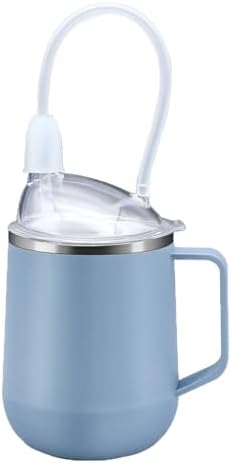
| Dementia / Alzheimer’s | Confusion with unfamiliar objects | Twist-top resembling normal mug | Double handle, high-contrast colour | Familiar appearance reduces resistance; visibility supports intake |
| Post-stroke (one-handed) | Limited use of one hand | Push-button valve, one-handed operation | Single large handle or hand-in slot | Valve allows full control without needing a second hand |
| Arthritis | Pain gripping and pressing small mechanisms | Spout (12mm) with large opening | Double wide handle | Larger spout and handle reduce force needed on stiff joints |
Why weighted cups help tremors but aren’t necessary for every condition
A weighted base helps specifically with tremor-driven spills, not grip weakness in general. The added mass works through inertia it resists the involuntary shaking and dampens how much that motion translates into liquid sloshing toward the rim.
This is why weighted cups show up repeatedly in Parkinson’s-specific recommendations.
For arthritis or general age-related weakness without tremor, a weighted base adds bulk without solving anything the problem there is grip force, not motion control, and a lighter cup with a wider handle does more good.
Matching the feature to the actual mechanism behind the spilling beats buying “the heaviest one” on principle.
The same logic applies to lightweight mugs and drinkware for Parkinson’s disease weighted bases carry over from regular mugs to spill proof cups.
Dignity and appearance: cups that don’t look medical
A cup that looks like adaptive equipment gets refused more often than one that looks ordinary, and this is a real factor in whether the product actually gets used rather than left in a cupboard.
Which spill proof cups pass as ordinary travel mugs
- Contigo Autoseal mugs look like any commuter travel mug, with a slide-lock lid and no visible valve or spout — the easiest option for someone resistant to anything that looks “special.”
- Yeti tumblers with a magnetic slider lid carry the same advantage — recognisable, widely used by people of every age, and the spill-proof mechanism is invisible at a glance.
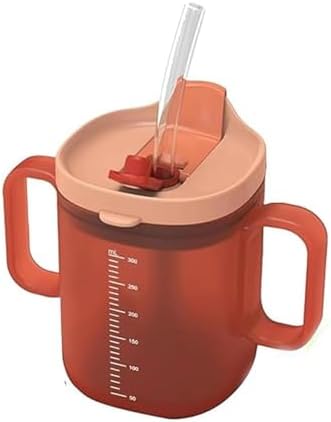
- Ornamin two-handled cups and Kennedy cups read as clearly adaptive equipment — visible spout, two prominent handles, a shape unlike anything from a regular kitchen cupboard — which matters for users who notice and resist that distinction.
- Plain stainless steel tumblers without printed branding blend in best for someone who doesn’t want to be singled out at a family table or in a communal dining room.
How to introduce a spill proof cup without resistance or embarrassment
- Start with the most ordinary-looking option available, ideally one that could pass as a regular travel mug, rather than the most medical-looking product on the market.
- Introduce it during a low-stakes moment, not immediately after a spill, since that timing can make the cup feel like punishment rather than a practical switch.
- Frame it around a shared reason — “this keeps coffee hotter longer” works better than “this is so you don’t spill,” because it centres a benefit rather than a deficit.
- Let the person handle and test it themselves before committing to daily use, since fit varies enough between products that a quick trial avoids buying the wrong one twice.
- Switch everyone’s cup at the table if possible, particularly in a shared household, so the change doesn’t single out one person.
- Revisit the choice if it’s consistently refused — a different lid type often solves resistance that looks like stubbornness but is really about appearance.
Material safety and care: dishwasher, microwave, and heat limits
Silicone, plastic, and stainless steel: which holds up to hot coffee safely
- Stainless steel handles hot coffee best of all three materials — vacuum-insulated tumblers keep drinks hot longer with no heat-degradation concern in the body, though the lid mechanism still matters separately.
- BPA-free plastic (Tritan and similar) tolerates warm drinks but isn’t built for repeated near-boiling exposure — even Tritan, which passes elevated-temperature testing, isn’t rated for sustained contact with liquid near boiling point.
- Silicone is not recommended for hot coffee — silicone cups and “nosey cups” are flagged as inappropriate for hot beverages due to potential chemical leaching at higher temperatures, even though they’re fine for cold drinks.
- Melamine cups should never go in the microwave, since melamine can leach compounds into food and drink above roughly 70°C.
Dishwasher safety and cleaning requirements for daily use
- Most stainless steel and BPA-free plastic spill proof cups are dishwasher safe, though manufacturers often recommend top-rack placement to protect the lid’s seal over repeated wash cycles.
- Straw lids need disassembly and separate cleaning — straws and valve components accumulate residue faster than other lid types, particularly with sweetened drinks, and require more frequent deep cleaning than a simple twist-top.
- Spout and valve lids should be checked regularly for wear — silicone seals and hinge parts degrade or warp with repeated washing, and a seal that’s lost its shape stops sealing properly even though the cup looks fine.
- Care homes washing at commercial dishwasher temperatures should confirm the manufacturer’s maximum heat rating, since some plastics and silicones degrade faster under high-temperature institutional cycles than a standard home dishwasher.
Verified spill proof coffee cups for elderly adults: specs at a glance
Product reference table: name, lid type, hot-drink rated, spout size, handle type, price tier
| Product | Lid type | Hot drink rated | Spout/opening size | Handle type | Price tier |
|---|---|---|---|---|---|
| Contigo Autoseal Travel Mug | Slide-lock twist-top | Yes | N/A — sip opening | Single, optional | Mid |
| Ornamin Double Handle No-Spill Cup | Spout | Check specific product | 12mm | Double handle | Budget–mid |
| Kennedy Cup | Spout | Generally not rated for hot | 4mm or 12mm depending on model | Single or double | Budget |
| Greens Steel BEAST Tumbler | Straw + lid | Yes, double-insulated steel | N/A — straw | Contoured single handle | Mid |
| Munchkin Miracle 360 (adult-sized) | 360° valve rim | Not rated for hot | Valve, no spout | None | Budget |
| Yeti Rambler with MagSlider | Magnetic slide-top | Yes | N/A — sip opening | None | Mid–premium |
What occupational therapists and speech-language pathologists recommend
- Match the spout size to the actual swallow pattern, not the diagnosis label — two people with Parkinson’s can have very different swallowing function, and an SLP assessment is more precise than a general product guide.
- Prioritise a removable, fully cleanable lid for daily use — OTs flag hygiene as a recurring issue with sippy-style lids that trap residue in hard-to-reach channels.
- Reassess the cup as the condition changes — a cup that worked six months ago may no longer fit a progressing condition, particularly with Parkinson’s or dementia.
- Don’t substitute a sippy cup for proper dysphagia management — for confirmed swallowing disorders, a spout cup is one tool among several; severe cases may need thickened liquids or a different feeding approach under dysphagia-safe eating and drinking aids.
Know which type fits the situation? Hot-drink-rated spill proof cups or dysphagia-safe spout cups or see the full adaptive drinkware guide for elderly adults to compare mugs, cups, and bottles side by side.
Frequently asked questions: spill proof coffee cups for the elderly
Are spill proof sippy cups safe for hot coffee or tea?
Most aren’t straw lids and basic spout lids are typically built and rated for cold drinks only, and using them with hot coffee can compromise the seal over time.
Vacuum-insulated stainless steel tumblers with twist-top or magnetic slide lids, like Contigo Autoseal or Yeti with a MagSlider, are explicitly rated for hot beverages.
What is the best spill proof cup for an elderly person who drinks hot coffee daily?
A vacuum-insulated stainless steel tumbler with a twist-top or magnetic slide lid, such as the Contigo Autoseal. It’s rated for sustained hot liquid contact, keeps the drink warmer longer than a ceramic mug, and looks like an ordinary travel mug rather than adaptive equipment.
What spout size is best for someone with swallowing difficulties?
A 4mm spout, because the narrow opening slows the flow rate and reduces aspiration risk. This should be confirmed by a speech-language pathologist for anyone with a diagnosed swallowing disorder, since the right flow rate depends on the specific swallow pattern, not just the general condition.
What cup is recommended for someone with Parkinson’s who keeps spilling their coffee?
A weighted-base cup with a spout rated for hot drinks and a 12mm opening, unless dysphagia is also present, in which case a 4mm spout takes priority.
The weighted base works through inertia to dampen tremor-driven spilling during the lift, which a lightweight cup can’t replicate.
Can spill proof cups be used by people with dementia?
Yes, and a twist-top design that resembles an ordinary mug tends to work better than a visibly medical-looking spout cup, since unfamiliar objects can cause confusion or resistance.
A double handle and high-contrast colour also help with grip stability and visibility at the table.
Are silicone spill proof cups safe for hot liquids?
No, silicone cups, including silicone “nosey cups,” are generally not recommended for hot coffee or tea because of potential chemical leaching at higher temperatures.
Silicone is fine for cold drinks, but stainless steel or properly heat-rated BPA-free plastic is the safer choice for anything hot.
Are adult sippy cups dishwasher and microwave safe?
Most stainless steel and BPA-free plastic versions are dishwasher safe, typically on the top rack to protect the seal.
Melamine cups should never go in the microwave, and straw or valve lids need regular disassembly and cleaning since residue builds up in the small components faster than in a simple twist-top.
How do I get my elderly parent to accept using a spill proof cup?
Start with the most ordinary-looking option, ideally one that passes as a regular travel mug rather than something visibly adaptive, and introduce it during a calm moment rather than right after a spill.
Framing it around a benefit staying hotter longer works better than framing it around the spilling itself.
About the Author & Reviewer
Sarah Emirone, Author
Sarah researches and writes SafeKitchn’s dinnerware and kitchenware guides, with a focus on material safety, lead content, and manufacturer specifications. She cross-references product data sheets, safety certifications, and regulatory filings (including FDA and Prop 65 records) before publishing, and updates articles when new information becomes available.
James Daniels, Reviewer
James reviews SafeKitchn’s material safety content for scientific accuracy. He holds a B.Sc in inorganic chemistry and works as a materials researcher, with particular focus on the composition and safety behavior of glass, ceramic, and metal used in kitchenware.