

Most people searching for lightweight mugs for the elderly are thinking about weight. That’s the right instinct, but only half the question.
A 180g plastic mug with two large handles is safer for someone with Parkinson’s than a 150g ceramic mug with a single narrow grip, even though it weighs more.
The condition matters as much as the number on the scale. This guide covers both: what weights actually make sense given the physical realities of ageing hands, and which mug type fits which condition.
Written by Sarah Emirone | Reviewed by James Daniels, B.Sc, Inorganic Chemist & Materials Researcher | Updated September 2026 | See How We Test | Filed under: Accessible & Adaptive Dining
What “lightweight” actually means for elderly mug users
“Lightweight” on a product listing means nothing without context. Here’s what the numbers actually tell you.
The real numbers: standard mug weights vs. what elderly adults can safely lift
Hand grip strength declines significantly with age. Research published in PLOS ONE found that men aged 80 and over average around 23.7 kg of grip strength — roughly 46% lower than men aged 30–39.

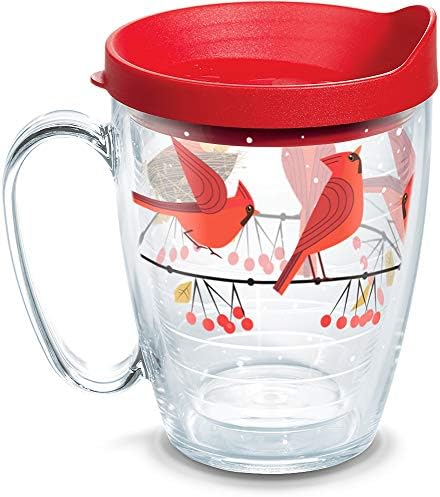
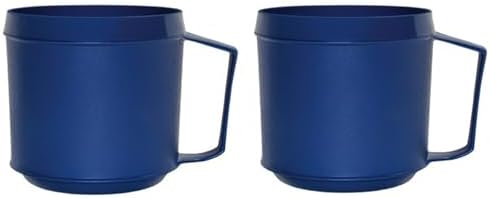
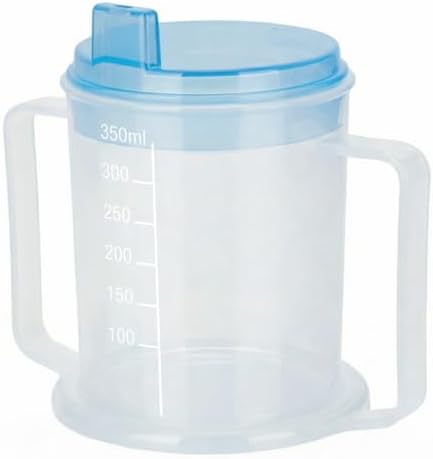

For women over 80, the average drops to approximately 16.4 kg. Those numbers sound like plenty for lifting a mug. But grip strength is peak force, not sustained force, and holding a full mug at arm’s length is a different demand than a split-second squeeze on a dynamometer.
A standard ceramic mug weighs 250–400g empty. Fill it with 250ml of liquid, and the total reaches 500–650g. A lightweight plastic mug at 100–180g empty with the same liquid comes in at 350–430g, meaningfully easier for a weak wrist.
The practical threshold: under 200g empty is the benchmark for a genuinely lightweight mug.
Why the lowest weight isn’t always the best choice: when grip architecture matters more
A 150g single-handle ceramic mug can be harder to hold than a 250g double-handle plastic mug — because the handle design distributes load across more joints. A narrow handle that fits two fingers forces the small hand joints to carry everything.
A wide double handle that four fingers slide through spreads the load and reduces strain per joint.
Weight is the starting point. The handle design often closes the decision. For the full adaptive drinkware guide for elderly adults, covering cups, beakers, and specialist drinking aids beyond mugs, that guide goes into more detail.
Choosing by condition: which mug type fits which physical challenge
The most common mistake is treating all physical challenges as the same problem. They aren’t.
Condition-to-mug type matching guide: arthritis, tremors, stroke, dementia, weak grip
| Condition | Primary challenge | Best mug type | Why | Weight priority |
|---|---|---|---|---|
| Arthritis (hands/wrists) | Pain and stiffness in finger joints | Double-handle, wide clearance | Distributes load; avoids pinching small joints | Under 180g empty |
| Parkinson’s / essential tremor | Involuntary hand movement | Weighted-base double-handle + spout lid | A weighted base dampens tremor through inertia | Heavier base helps — see below |
| Post-stroke (one hand) | Single-hand grip only | Hand-in slot or large palm-support handle | Full palm/wrist bears the load without a finger grip | Under 200g empty |
| Dementia / Alzheimer’s | Reduced visual contrast, confusion with lids | Open-top double-handle, high-contrast colour | Easier to see; lid mechanisms add confusion | Under 180g empty |
| General weak grip | Reduced overall hand strength | Double-handle lightweight plastic or melamine | Two grip points halve the per-hand load | Under 200g empty |
The counterintuitive case for weighted mugs in Parkinson’s and essential tremor
For most elderly users, lighter is better. For tremor sufferers, a weighted-base mug is often the right choice — which contradicts the premise of a lightweight guide, so it’s worth explaining directly.
The Parsons ADL Weighted Two Handle Mug is the most cited OT-recommended option for this condition. It has a 285g weighted base and two large handles sized for four adult fingers.
The weight works through inertia — the mass resists involuntary shaking and reduces the amplitude of the tremor as it travels toward the rim.
A very light plastic mug gives shaking hands nothing to work against and spills more.
This applies to Parkinson’s disease and essential tremor only. For post-stroke weakness or arthritis without tremor, a weighted base adds difficulty without benefit. The mugs for Parkinson’s disease and essential tremor guide covers specific product specifications in more detail.
Handle design: the single most important feature to get right
Single handle vs double handle vs hand-in slot vs handleless: when each wins
| Handle type | Best for | Limitations |
|---|---|---|
| Single handle (standard) | Mild grip weakness, general use | Narrow clearance strains finger joints; poor for arthritis or tremors |
| Double handle | Arthritis, general weakness, dementia | Requires both hands; heavier overall |
| Hand-in slot (palm support) | Post-stroke (one hand), very weak grip | Fewer style options; less common |
| Handleless/wide-body | Very mild weakness, travel tumblers | No mechanical support; hot surfaces without insulation |
What to check in a handle before buying: clearance, diameter, and grip position
- Handle clearance — the gap between the handle and the mug body should fit at least three adult fingers comfortably, with knuckles not touching the mug body, because that contact point is where arthritis pain concentrates during use.
- Handle diameter — a thicker handle (2–3cm) reduces the force needed to maintain grip; narrow handles fatigue arthritic finger joints faster.
- Handle position — handles centred on the mug body balance the weight better than handles placed at the top third, which tips the centre of gravity toward the wrist.
- Base width — a wider base lowers the centre of gravity and matters most for users with tremors or reduced visual tracking.
Material comparison: plastic, ceramic, melamine, and stainless steel
Weight, heat retention, safety, and dishwasher compatibility by material
| Material | Typical empty weight | Heat retention | Burns hands? | Microwave safe | Dishwasher safe | Break risk |
|---|---|---|---|---|---|---|
| Plastic (double-wall) | 100–180g | Good | Low | Varies | Yes | Very low |
| Ceramic (standard) | 250–400g | Moderate | Moderate | Yes | Yes | High |
| Melamine | 120–180g | Low | Low | No | Yes (low temp) | Very low |
| Stainless steel (double-wall) | 170–280g | Excellent | Low | No | Yes (body) | Very low |
Are melamine mugs safe for elderly people? What you need to know
- Melamine is safe for warm drinks — the Rosa Lifestyle Two-Handled Melamine Mug (126g) is one of the lightest care-home options available and manageable for very weak hands.
- Melamine must not go in the microwave — at temperatures above 70°C, melamine compounds can migrate into the drink; this is a hard rule, not a caution.
- For care homes with microwave access, melamine is appropriate if staff control the heating; for elderly adults living independently who might microwave drinks unsupervised, double-wall plastic or ceramic is safer.
- Care home dishwashers often run too hot — many residential dishwasher cycles exceed melamine’s safe temperature limit; check the manufacturer’s maximum against the facility cycle before ordering in bulk.
No-spill lids and insulation: what slower drinkers actually need
Lid types for elderly users: spout, sippy, slide, and open-top with spill guard
- Spout lid — a small drinking port the user tips toward; good for mild tremors but requires wrist flexion that arthritis sufferers often find painful.
- Sippy/valve lid — the user draws liquid through a controlled valve; suitable for dysphagia (swallowing difficulty) where flow control matters, but needs coordination to activate.
- Slide lid — the user pushes a tab to open a drinking port; the Boscul Two Handled Mug uses this design, which works for users who can manage a sliding motion but struggle with buttons or pressure valves.
- Open-top with wide base — no lid, but a low centre of gravity reduces tipping risk; appropriate for supervised settings or users with mild weakness and no tremors.
Insulation: why double-wall matters when someone takes 45 minutes to finish a cup
A standard ceramic mug drops from 70°C to below 40°C in under 15 minutes. For elderly drinkers with dementia or post-stroke fatigue, that means finishing a cold cup every time.
A double-wall insulated mug keeps drinks above 55°C for 45–60 minutes. If the person you’re buying for regularly leaves cups unfinished, insulation is worth trying before assuming it’s a thirst issue.
Dementia-specific considerations: colour, contrast, and visibility
For the dementia care products guide across tableware, cutlery, and environmental aids, that guide goes beyond mugs. But for mugs specifically, colour is the feature most buyers overlook.
Why red and high-contrast mugs increase drink intake in dementia patients
Research cited in DailyCaring’s adaptive utensils resource found that red adaptive tableware increased liquid intake in Alzheimer’s patients by 84% and food intake by 24%.
The mechanism is contrast detection: dementia impairs the brain’s ability to distinguish objects against similar backgrounds. A white mug on a white tablecloth effectively disappears — the person doesn’t reach for something they can’t clearly see.
Red on a light surface creates the strongest contrast of any standard mug colour. For a dementia patient who appears to be drinking less, a high-contrast mug — particularly red — is worth trying before assuming the problem is thirst.
Other design features that help cognitively impaired elderly drinkers
- No lid — press buttons and slide mechanisms add a decision step that cognitively impaired users often cannot navigate independently; open-top is simpler in supervised settings.
- Solid, bright colour with no pattern — busy patterns obscure the liquid level, and the rim; a solid colour interior lets the user see the drink clearly.
- Double handles — two symmetric handles remove the decision about which side to grip, which matters when spatial reasoning is impaired.
- Unbreakable material — ceramic breaks are a documented hazard in memory care; plastic or melamine is the right call.
Verified lightweight mugs for the elderly: weight, handles, and specs at a glance
Product reference table: name, empty weight, handle type, material, microwave/dishwasher safe, price tier
| Product | Empty weight | Handle type | Material | Microwave | Dishwasher | Price tier |
|---|---|---|---|---|---|---|
| Rosa Lifestyle Two-Handled Mug | 126g | Double | Melamine | No | Yes (low temp) | Budget |
| Independence 2-Handle Plastic Mug | ~140g | Double | Plastic | Yes | Yes | Budget |
| HealthGoodsIn Dual Handle Mug | ~320g | Double | Ceramic | Yes* | Yes | Budget |
| Boscul Two-Handled Mug (300ml) | ~200g | Double + slide lid | Ceramic | Check listing | Yes | Mid |
| Parsons ADL Weighted Two Handle | 285g (base) | Double + spout lid | Plastic | No | Yes (194°F max) | Mid |
| CURVD Ergonomic Ceramic Mug | ~280g | Wide single ergonomic | Ceramic | Yes | Yes | Mid–premium |
What OTs recommend and what to ask a healthcare professional before buying
- Prioritise handle clearance first — OTs assess whether the patient can engage the handle without recruiting inflamed joints, which changes the recommendation more than weight alone.
- Match the lid to the swallow pattern — for patients with dysphagia, a speech and language therapist should advise on flow control before a lid type is chosen.
- Trial before committing — buying one mug and observing whether the patient uses it independently is more reliable than ordering twelve on spec.
- Check care home temperature limits — confirm the facility’s dishwasher cycle temperature against the mug’s maximum before bulk ordering melamine.
For the full range, read our guide on adaptive eating plates.
Buying as a family member or caregiver: what to ask and what to avoid
For the best practical gifts for elderly parents, a mug sits in an awkward gift category; it needs to be used every day, and getting it wrong means it sits in a cupboard.
Six questions to ask before buying a mug for an elderly person
- Which hand do they use, and can they use both? — Post-stroke users may be one-handed; if so, a hand-in slot or palm-support handle is more useful than a standard double-handle design.
- Do they have tremors, or is it grip weakness? — These need opposite solutions; tremors benefit from a weighted base, and grip weakness benefits from the lightest option available.
- Where will the drink be heated? — If they microwave drinks unsupervised, rule out melamine and verify which plastic mugs are confirmed microwave safe at the product level.
- Who does the washing up? — If they wash up themselves, a lightweight plastic or melamine mug is easier to handle wet than a heavy ceramic; if a carer washes up, dishwasher compatibility matters more.
- Do they have dementia or visual impairment? — If yes, prioritise colour and contrast; a bright red mug that’s slightly heavier will be used more than a pale lightweight one that’s hard to see.
- Do they drink in bed or in a recliner? — for users who drink lying back, a spout or valve lid prevents the tipping spill that an open-top mug creates in that position.
Common mistakes family members make when buying adaptive mugs
- Buying ceramic because it feels normal — ceramic mugs are 250–400g empty, far heavier than plastic or melamine alternatives; familiar weight matters less than whether the person can lift it safely.
- Choosing a mug that looks medical — a mug that looks like hospital equipment gets left on the shelf; design matters for daily use, and the Boscul specifically addresses this.
- Buying the same mug for two people with different conditions — two people in the same household, one with arthritis and one with tremors, need different mugs; the condition-matching table above is the right starting point.
Know which type fits the person you’re buying for? Use the spill-proof coffee cups guide for elderly adults for a broader comparison, or go straight to lightweight dinnerware for arthritis if that’s the specific condition.
Frequently asked questions: lightweight mugs for the elderly
How heavy is a standard ceramic mug, and what weight is safe for elderly people?
A standard ceramic mug weighs 250–400g empty; filled with 250ml of liquid, the total reaches 500–650g.
Under 200g empty is the practical threshold for genuinely lightweight — at that weight, a full cup of tea comes in around 350–450g, which is manageable for most adults with mild to moderate grip weakness.
What is the best mug for someone with Parkinson’s disease or essential tremor?
A weighted-base double-handle mug with a spout lid — the Parsons ADL Weighted Two Handle Mug is the most commonly recommended OT option for this condition.
The 285g weighted base dampens tremor through inertia, reducing spills more effectively than a lightweight mug that gives shaking hands nothing to resist.
Are double-handle mugs better than single-handle mugs for elderly people?
For most elderly users, yes, double handles distribute the load across both hands and remove the finger-joint strain a narrow single handle causes.
The exception is one-handed users post-stroke, who may manage better with a hand-in-slot mug or a single handle large enough for a full palm grip.
Are melamine mugs safe for elderly people to use for hot drinks?
Melamine is safe for hot drinks at normal serving temperatures. The hard rule is that melamine must never go in the microwave above 70°C, as melamine compounds can migrate into the drink.
For anyone who microwaves drinks unsupervised, double-wall plastic or ceramic is the right material.
What colour mug is best for someone with dementia?
Red, on a light-coloured surface. Research cited by DailyCaring found red adaptive tableware increased liquid intake in Alzheimer’s patients by 84%.
Dementia impairs contrast detection, and red on white creates the strongest visual separation of any standard mug colour, which directly affects whether the person reaches for the cup at all.
Are adaptive mugs dishwasher safe at care home temperatures?
Most are, but melamine is the exception. Many residential care dishwashers run at temperatures that exceed melamine’s safe limit, damaging the material over time.
Check the manufacturer’s maximum temperature against the facility’s cycle before ordering in bulk.
What do occupational therapists recommend for elderly patients who struggle with mugs?
OTs prioritise handle clearance and grip architecture over weight, and match lid type to the patient’s swallow pattern — particularly for patients with dysphagia, where flow control has clinical implications.
A full OT assessment identifies whether the person is one-handed, has tremors, or has visual impairment, since each point to a different solution.
What should I buy an elderly parent who keeps dropping or spilling their drinks?
First, identify whether the problem is grip (dropping) or tremor (spilling mid-lift) — they need opposite solutions. For dropping, a double-handle lightweight plastic or melamine mug under 180g is the first thing to try.
For spilling during movement, a weighted-base mug with a spout or slide lid addresses the tremor and the open-top risk together.
About the Author & Reviewer
Sarah Emirone, Author
Sarah researches and writes SafeKitchn’s dinnerware and kitchenware guides, with a focus on material safety, lead content, and manufacturer specifications. She cross-references product data sheets, safety certifications, and regulatory filings (including FDA and Prop 65 records) before publishing, and updates articles when new information becomes available.
James Daniels, Reviewer
James reviews SafeKitchn’s material safety content for scientific accuracy. He holds a B.Sc in inorganic chemistry and works as a materials researcher, with particular focus on the composition and safety behavior of glass, ceramic, and metal used in kitchenware.