

If you searched “types of crockery” from the US, the term probably threw you a little. Americans call this dinnerware.
Crockery is the British, Australian, and Indian word for the same plates, bowls, and cups, and that’s not a small detail: it’s why almost everything ranking for this term right now comes from Indian home-decor stores or hotel-training blogs, not American kitchen sites.
Six materials cover almost everything you’ll find under that label: porcelain, bone china, stoneware, earthenware, melamine, and glass, and they differ in ways that actually matter: how porous the clay is, what it costs, whether lead shows up in the glaze, and whether you can put it in the oven.
Below is the breakdown, with the porosity numbers, FDA limits, and price ranges that usually get left out.
Written by Sarah Emirone | Reviewed by James Daniels, B.Sc, Inorganic Chemist & Materials Researcher | Updated September 2026 | See How We Test | Filed under: Buying, Care & Product Guides
Crockery vs. Dinnerware vs. Tableware: What’s Actually Different?
Crockery, dinnerware, and tableware aren’t three names for the same pile of dishes, though they get used that way constantly.
Crockery is the narrowest term for ceramic dishes specifically. Dinnerware is the American word for the same thing. Tableware is the broadest term, covering crockery, glassware, cutlery, and serving pieces.
Why “Crockery” Means Something Different Depending on Where You’re Reading This
If you grew up saying “dinnerware,” you’re American.
If “crockery” sounds completely normal, you’re probably reading this from the UK, Australia, or India.
Neither version is wrong. They’re just regional, the same way “flatware” and “cutlery” split along the same line for forks and spoons.
Crockery, Dinnerware & Tableware — Quick Definitions
Crockery — Ceramic dishes only: plates, bowls, cups, and serving pieces made from fired clay (porcelain, bone china, stoneware, or earthenware).
Dinnerware — The American equivalent of crockery. Same items, different name, sometimes stretched to include melamine and glass.
Tableware — Everything on the table: crockery or dinnerware, plus glassware, flatware (cutlery), and serving utensils.
The 6 Main Types of Crockery by Material
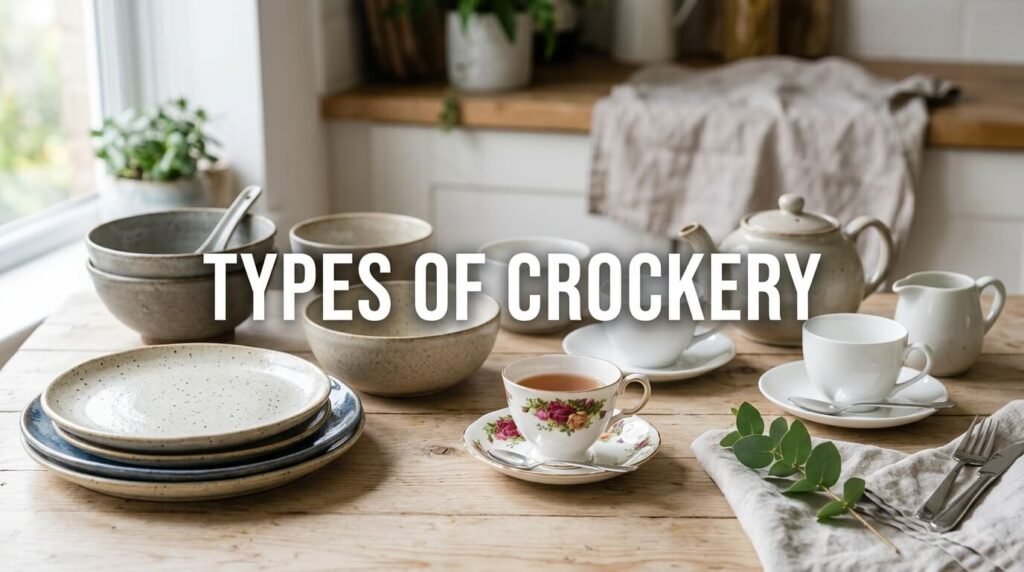
Six materials make up almost every piece of crockery you’ll come across, and the differences between them aren’t cosmetic. They decide whether a plate survives a dishwasher cycle or chips on the third use.
Porcelain
Porcelain is kaolin clay mixed with feldspar and quartz, fired at 1,200°C to 1,400°C (2,200°F to 2,550°F) until it turns glass-like all the way through.
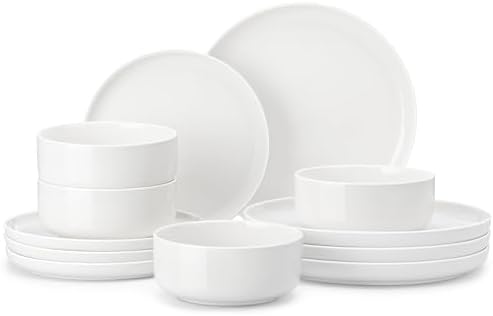
- WHAT WILL YOU RECEIVE: 12 pieces dinnerware sets includes 4 x 10.25 inch dinner plates,4 x 8.25 inch salad plates and 4 …
- DURABLE AND STURDY: Crafted through high-temperature firing at 1400 degrees Celsius, our porcelain plates and bowls sets…
- LEAD FREE GLAZE: MALACASA dishware sets easy to clean, stain resistance, and odor-free, Enjoy your meals with confidence…
That high fire is what gives porcelain its near-zero water absorption and the thin, translucent look it’s known for.
It costs more than stoneware to produce because the firing window is narrower and warping is a real risk — but it holds up to daily use better than its delicate look suggests.
Bone China
Bone china starts as porcelain clay with bone ash mixed in, usually 30% to 50%, fired at a slightly lower temperature than pure porcelain.
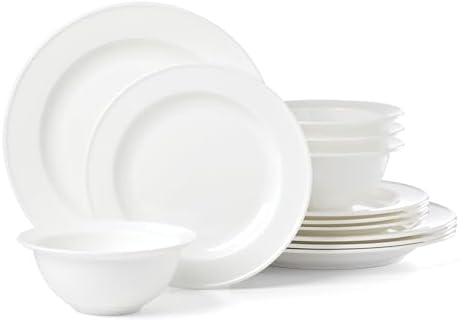
- WHY IT’S SPECIAL: Studio 1414 is expertly designed and passionately perfected to be your for-anything, for-forever dinne…
- WHO IT’S PERFECT FOR: Anyone who wants dishes that look elegant, feel effortless, and work for everything from weeknight…
- WHAT’S IN THE BOX: This 12-piece dinnerware set includes service for 4 with 4 dinner plates (10.98″Diameter), 4 accent p…
The bone ash is what makes it lighter and more chip-resistant than regular porcelain, which sounds backwards given how fragile it looks on a shelf.
It’s also the most expensive of the six materials, less because of the ingredients, more because of how many pieces don’t survive the kiln.
Stoneware
Stoneware fires at 1,200°C to 1,300°C (2,192°F to 2,372°F), hot enough to vitrify the clay body without needing the fine, pure kaolin porcelain requires.

- [What’s in the box?] This dinnerware set includes 4*10” dinner plates, 4*8” salad plates, 4*6” cereal bowls
- [Safe and Durable] Lareina is committed to providing you with high-quality exquisite ceramic products. High temperature …
- [ashionable Charm Dinnerware Set] This dinnerware set, crafted by our professional designers, embodies a natural style. …
That’s why it’s heavier and cheaper to produce than porcelain while still holding up to daily dishwasher cycles. Some stoneware reaches full vitrification, and some doesn’t, and the difference matters enough to get its own section below.
Earthenware
Earthenware fires at the lowest temperature of the four ceramics, around 1,000°C to 1,150°C (1,832°F to 2,102°F), and never fully vitrifies. That leaves it porous, which is why every piece needs a complete glaze to hold liquid without weeping through the clay underneath.

- HANDCRAFTED WITH UNIQUE BEAUTY: Every plate and bowl in our collection is expertly handcrafted by skilled artisans, show…
- SAFE TO USE AND DURABLE: Unlike many ceramic products, our dinnerware is made with completely lead-free and cadmium-free…
- STACKABLE & EASY TO CLEAN: Our dinnerware set is designed to be stackable. making it ideal for space-saving storage in y…
It’s also the base material behind plenty of collectible dinnerware lines, where glaze color and authenticity are tightly linked, see authenticating vintage Fiestaware glaze colors for how that plays out with one of the best-known vitrified earthenware brands.
Melamine
Melamine isn’t ceramic at all. It’s a hard, lightweight plastic resin molded to look like dinnerware.

- [Melamine Dinnerware for 4] This melamine dinnerware set includes 4 x 11-inch dinner plates, 4 x 8 1/2-inch salad plates…
- [Dishwasher Safe] This unbreakable dinnerware set is easy to hand wash, also dishwasher safe (top rack recommend), pleas…
- [Multipurpose] This set of melamine dinner plates from Yinshine is ideal for both indoor and outdoor events, including b…
It survives drops that would shatter porcelain, which is exactly why it shows up on every outdoor restaurant patio and kids’ table in the country.
The catch: it isn’t microwave-safe, and heating it can let small amounts of resin migrate into food, so it’s a serving material, not a cooking one.
Glass
Glass crockery covers everything from basic soda-lime plates to tempered and borosilicate pieces built to handle the oven.
The untempered kind is cheap and clear but cracks under sudden temperature swings, while tempered glass survives the freezer-to-oven jump that would shatter a regular glass dish.
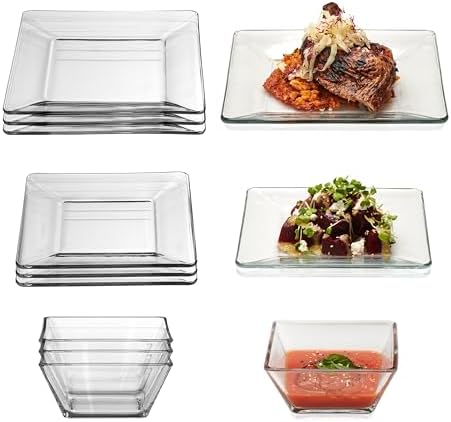
- Square Glass Dinnerware Set: Make your dining space look good with this glass dishes dinnerware set – this 12-piece, 37 …
- Glass Dinner Collection: Set the table to perfection with our clear glass dinnerware set; this full glass dinnerware set…
- Sturdy and Stackable: Designed to be thick and sturdy, our glass plates do not break easily; the stackable dish sets, sa…
It’s the one material here where checking the specific product matters more than the material name — “glass” alone tells you almost nothing about heat tolerance.
Crockery Material Comparison: Durability, Porosity & Cost
Material names tell you the family. Water absorption tells you how the thing actually behaves once it’s sitting in your cupboard for five years, whether it stains, whether a chip turns into a crack, and whether it survives a hot dishwasher cycle.
Water Absorption and Durability by Material
| Material | Water absorption | What does that mean day to day |
| Porcelain/bone china | Under 0.5% | Fully vitrified — no pores to stain, no glaze layer to crack away from the body |
| Stoneware (fully vitrified) | Under 0.5% | Behaves like porcelain; check the listing, since not all stoneware reaches this point |
| Stoneware (semi-vitrified) | 0.5%–3% | Needs an intact glaze to stay food-safe — a chipped rim exposes a slightly absorbent body |
| Earthenware | 10%–15% | Porous without a full glaze; the most vulnerable to staining, weeping, and freeze-thaw cracking |
Corelle is the exception that makes the rule clearer: it isn’t stoneware, porcelain, or earthenware at all, and that’s the point. See Corelle’s Vitrelle glass-ceramic, which sidesteps the porosity problem entirely for a material that doesn’t fit any of the four rows above.
Price Comparison by Material
Price follows the order of firing complexity, not raw material cost.
| Material | Typical price, 16-piece set (service for 4) | Price tier |
| Melamine | $20–$40 | Cheapest |
| Earthenware | $25–$50 | Budget |
| Glass | $25–$50 | Budget |
| Stoneware | $35–$80 | Mid-range |
| Porcelain | $40–$120 | Mid to premium |
| Bone China | $80–$250+ | Premium |
Bone china costs more, not because the ingredients are pricier, but because more pieces crack or warp in the kiln before one survives to the shelf.
Is Crockery Safe? Lead, Cadmium & FDA Limits by Material
Most modern crockery is safe. The risk that does exist isn’t spread evenly across materials — it’s concentrated in specific conditions, and the FDA has put actual numbers on where that line sits.
FDA Lead and Cadmium Leaching Limits, Explained
Fire King’s own lead-testing history is a useful reference point here, because it shows what “meeting FDA limits” looks like in practice rather than in theory.
The FDA sets different leaching limits depending on the kind of piece: flatware like plates and bowls can release up to 3 milligrams of lead per liter, while cups, mugs, and pitchers, anything you drink hot, acidic liquid from repeatedly, are held to a tighter 0.5 milligrams per liter.
The risk almost always sits in the glaze or the decoration painted over it, not in the clay body underneath.
A properly fired glaze binds the lead into the surface permanently; an underfired one, or hand-painted decoration applied on top of the glaze instead of bonded into it, is where lead actually reaches food.
Which Crockery Materials Carry the Most Risk
| Category | Risk level | Why |
| Traditional/imported terracotta | HighestThe | FDA has specifically flagged unverified imported terracotta, especially from Mexico, even when labeled “lead-free” |
| Vintage or hand-painted ceramics | High | Older kilns and overglaze decoration weren’t always fired to bind lead fully |
| Modern industrial earthenware, stoneware | Low | Machine-applied glazes, fired and tested to FDA standards before sale |
| Porcelain, bone china | Lowest | Fully vitrified body plus tightly controlled glaze application |
| Melamine, glass | No lead risk | Not ceramic — different safety concerns apply, mainly heat tolerance |
Brand-level testing backs this up directly. How IKEA’s stoneware lineup tests against these same FDA limits shows non-detect results for cadmium on the pieces independently scanned what you’d expect from modern industrial stoneware rather than the high-risk categories above.
Is Crockery Oven-, Microwave-, & Dishwasher-Safe?
Oven, microwave, and dishwasher safety vary so much by material that the question really has to be split apart piece by piece. Vitrified porcelain and bone china clear all three; earthenware and melamine fail at least one.
Safety by Material
| Material | Oven safe | Microwave safe | Dishwasher safe |
| Porcelain | Yes (unless metallic trim) | Yes (unless metallic trim) | Yes |
| Bone china | Yes (unless metallic trim) | Yes (unless metallic trim) | Yes |
| Stoneware | Usually — check the glaze rating | Yes | Yes |
| Earthenware | No, unless specifically rated | No | Yes, with care |
| Melamine | No | No | Yes, top rack |
| Glass | Only if tempered or borosilicate | Yes | Yes |
Warning Signs to Check Before You Microwave or Bake With It
- Any metallic trim — gold, silver, or platinum banding — means no microwave, full stop, regardless of what the base material underneath can handle.
- A hairline crack in the glaze on earthenware means the piece has already started absorbing moisture, and heating it further can widen that crack.
- “Oven-safe to 350°F” printed on the bottom of a piece is a real limit, not a suggestion — exceeding it on stoneware risks thermal shock cracking.
- Melamine that’s warped, discolored, or scratched has likely been microwaved before by someone who didn’t know better, and that resin breakdown doesn’t reverse.
Which Type of Crockery Is Best for Your Situation?
Home kitchens and commercial kitchens need different things from a plate, and the material that wins for one is rarely the material that wins for the other.
Best Crockery for Home, Everyday Use
- Stoneware is the strongest everyday pick for most households — heavy enough to feel substantial, vitrified enough to skip hand-washing, and cheap enough that a chipped piece isn’t a financial event.
- Porcelain works well if the same set doubles as your good dishes, since it looks formal without the bone china price tag or the fragility.
- Melamine makes sense specifically for outdoor meals, kids’ plates, and anywhere breakage is a real, frequent risk rather than a remote one.
- If you’re shopping for individual baking dishes rather than a full set, IKEA’s current in-stock ramekin alternative is a useful reference point for what a single affordable stoneware piece should cost.
Best Crockery for Restaurants & Hotels
- Vitrified porcelain or fully vitrified stoneware is the standard commercial pick, since it survives industrial dishwasher cycles and stacking abuse that would chip earthenware within a month.
- Bone china stays reserved for fine dining specifically because its higher price only makes sense where breakage rates are low and the formal look earns its cost.
- Melamine remains the default for outdoor seating, banquet service, and buffet lines, where volume and drop risk matter more than appearance.
- For patio or outdoor-event service where weight is also a concern, wheat straw plates as a non-ceramic alternative are worth a look alongside melamine.
Related: Restaurant Crockery and Cutlery
If a specific brand brought you here — IKEA, Fiestaware, Corelle, or Fire King — the material breakdown above is the backdrop those pages build on. Each one gets into the lead-testing data, pricing, and care details for that exact brand, instead of the material in general.
FAQ
What is the strongest type of crockery?
Bone china, despite looking the most fragile of the six. Its bone-ash content makes it more chip-resistant than plain porcelain, which is why it survives daily handling in fine-dining settings.
Is bone china better than porcelain?
Bone china is more durable and more expensive; porcelain is close behind in strength at a lower price. Choose bone china for formal sets you’ll handle carefully, porcelain for daily use that still needs to look refined.
What is vitrified crockery?
Vitrified means the clay body has turned glass-like all the way through during firing, leaving under 0.5% water absorption. Porcelain and bone china are always vitrified; stoneware sometimes is, and earthenware never fully gets there.
Is melamine crockery safe to use?
Yes, for serving, melamine is shatter-resistant and dishwasher-safe on the top rack. It isn’t safe in the microwave or oven, since heat can cause the resin to migrate into food.
What is the difference between stoneware and earthenware?
Stoneware fires at 1,200°C to 1,300°C and vitrifies, making it non-porous without needing a perfect glaze. Earthenware fires lower, around 1,000°C to 1,150°C, stays porous, and depends entirely on its glaze to hold liquid.
Does crockery contain lead?
Modern industrial crockery from major manufacturers generally doesn’t pose a lead risk, since FDA leaching limits apply before sale. The real risk concentrates in traditional or imported terracotta and hand-painted vintage pieces, not in standard porcelain or stoneware.
Which type of crockery is best for everyday use?
Stoneware, for most households — durable, dishwasher-safe, and inexpensive enough that breakage doesn’t sting. Porcelain is the better pick if the same set needs to look formal occasionally.
What is the cheapest type of crockery?
Melamine and basic earthenware sets typically start around $20 to $25 for a service for four. Bone china sits at the opposite end, often $80 to $250 or more for the same size set.
About the Author & Reviewer
Sarah Emirone, Author
Sarah researches and writes SafeKitchn’s dinnerware and kitchenware guides, with a focus on material safety, lead content, and manufacturer specifications. She cross-references product data sheets, safety certifications, and regulatory filings (including FDA and Prop 65 records) before publishing, and updates articles when new information becomes available.
James Daniels, Reviewer
James reviews SafeKitchn’s material safety content for scientific accuracy. He holds a B.Sc in inorganic chemistry and works as a materials researcher, with particular focus on the composition and safety behavior of glass, ceramic, and metal used in kitchenware.