

If you’ve already worked through identifying authentic Fiesta colors old vs new, you know vintage dinnerware safety questions rarely have a single answer, and Fire King is no exception.
Pull a jadeite bowl out of a thrift store box, and the question everyone asks is the same: Is Fire King lead free?
The honest answer splits in two. Plain, undecorated Fire King jadeite has tested consistently low, around 20 parts per million, across independent XRF testing. Painted and decorated pieces are a different story entirely, with some patterns testing as high as 19,300 ppm.
The brand isn’t the variable that matters here. The decoration is. This article walks through the real test data, the regulatory benchmark that actually applies, and which of your specific pieces are fine to use today.
Written by Sarah Emirone | Reviewed by James Daniels, B.Sc, Inorganic Chemist & Materials Researcher | Updated September 2026 | See How We Test | Filed under: Material Safety & Lead Testing
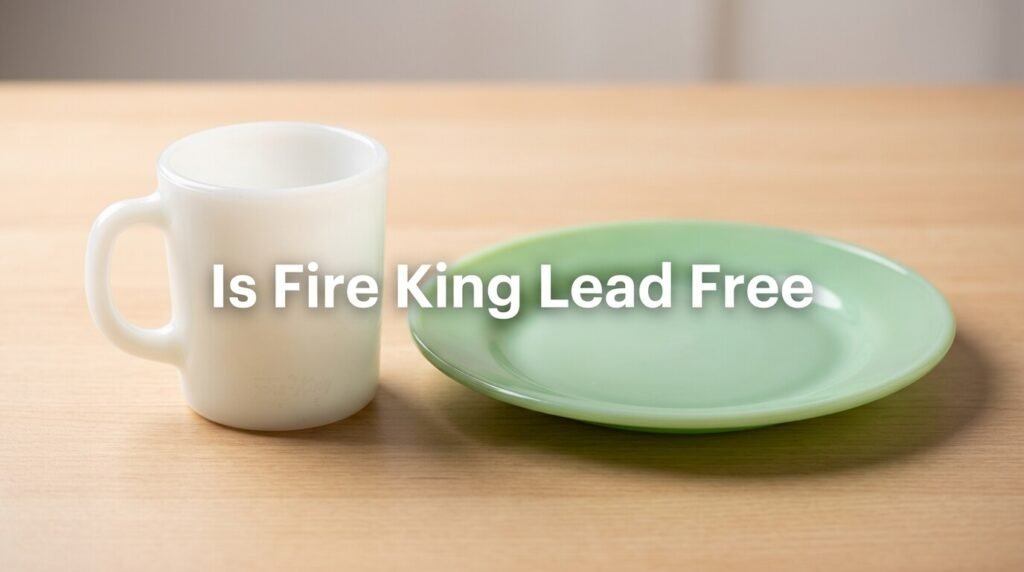
Is Fire King Lead Free?
The short answer: it depends on plain vs painted, not on the brand
Fire King glass itself is close to lead free in its plain, undecorated form. The lead risk that does exist with Fire King sits almost entirely in painted decorations, decals, and trim, not in the glass body underneath them.
Plain Fire King jadeite: consistently low lead, around 20 ppm
Independent XRF testing of plain, unpainted Fire King jadeite the green Restaurant Ware bowls, mugs, and plates with no pattern or decoration has repeatedly come back around 20 ppm for lead.
That’s a fraction of any regulatory threshold that applies to dishware, and it holds consistently across multiple tested pieces, not just one lucky sample.
| Piece type | Lead result | Source |
|---|---|---|
| Jadeite Restaurant Ware bowl | ~20 ppm | XRF testing, Lead Safe Mama |
| Plain milk glass custard cup | Low; no decoration to carry lead | Collector reports |
| Jane Ray plain jadeite plate | Consistent with Restaurant Ware results | XRF testing |
Painted and decorated Fire King: where the real risk sits
Painted markings and decorative patterns are where lead concentrates. A Fire King Tulip pattern bowl tested at 19,300 ppm, nearly a thousand times higher than the plain pieces sitting right next to it on the same shelf.
Lead gives paint its brightness and helps colors bond to glass, which is exactly why decorated dishware from this era so often tests high in the decoration and low everywhere else.
What counts as “safe”: the CPSIA 90 ppm standard, applied
“Safe” needs a number attached to mean anything. The Consumer Product Safety Improvement Act sets 90 ppm as the lead limit for children’s items, and it’s the most useful benchmark available for evaluating Fire King, even though the law was never written with vintage dishware in mind.
The 90 ppm children ‘s-item limit and why it’s the most useful benchmark
The CPSIA’s 90 ppm limit applies specifically to products made for children, not adult dinnerware. Plain Fire King jadeite at roughly 20 ppm clears that bar with room to spare.
Painted pieces at thousands of ppm don’t come close, which is exactly why the distinction between plain and painted matters more than any other factor in this conversation.
There’s no federal lead limit for adult dishware — what that actually means
No federal regulation sets a maximum lead level for dishware intended for adults.
That gap means a piece can legally sell with high lead content in its decoration as long as it isn’t marketed for children, and it’s part of why so much vintage glassware and ceramic dinnerware, including pieces covered in Fiesta dinnerware lead-free, went decades without independent testing of any kind.
Real XRF test results: plain glass vs painted pieces
X-ray fluorescence testing is the method the U.S. Consumer Product Safety Commission itself uses to detect heavy metals, and independent testers have applied it directly to Fire King pieces over the past several years.
The split between plain and painted shows up clearly once the actual numbers sit side by side.
Plain jadeite and milk glass test results
| Piece | Decoration | Lead result (ppm) |
|---|---|---|
| Jadeite Restaurant Ware bowl | None | ~20 |
| Jane Ray jadeite saucer | None | Consistent with Restaurant Ware |
| Plain milk glass mug | None | Low; no decoration to test |
Painted, decaled, and trim-decorated piece test results
| Piece | Decoration | Lead result (ppm) |
|---|---|---|
| Tulip pattern berry bowl | Painted decal | 19,300 |
| Milk glass mug and tray set | Painted trim | High; flagged unsafe |
| Gold-trimmed egg plate | Gold rim trim | Elevated, decoration-concentrated |
Does the era matter? Vintage, 2000 reissue, and modern Fire King
Era matters less than decoration, but it isn’t irrelevant. Anchor Hocking produced original Fire King from 1942 to 1976, revived Jade-ite in 2000, and has periodically reissued patterns since, and the marking system on each piece tells you which production run you’re holding.
Vintage production (1942–1976): the original lead question
Original Fire King came from an era with no lead regulation for dishware of any kind, which is exactly why testing matters more than the production date alone.
A piece marked with the Anchor Hocking anchor-and-H logo, used from 1962 onward, places it within the vintage window, but that marking tells you the age, not the lead content. For the complete marking timeline, see how to identify vintage Fire King jadeite by mark and era.
The 2000 Jade-ite reissue and modern Anchor Hocking production
| Era | Production years | Lead profile | How to identify it |
|---|---|---|---|
| Original vintage | 1942–1976 | Plain pieces test low; painted pieces vary widely | Anchor-and-H logo (1962+); block-letter marks pre-1962 |
| 2000 reissue | 2000 | Made under modern manufacturing oversight | “2000” stamped directly on the base |
| Current production | Ongoing, limited runs | Manufactured to current safety standards | Recent date codes; sold through current retail channels |
How to test your own Fire King for lead
Testing your own pieces removes the guesswork, and there are two practical ways to do it, depending on how certain you need to be.
At-home lead swab test kits: what they can and can’t tell you
For a full walkthrough of swab kits and what they reliably detect, see how to test dishware for lead at home.
- Buy a lead test swab kit from a hardware store — these react with a color change when lead is present on a surface.
- Rub the swab on the painted or decorated area specifically, not just the plain glass body.
- Wait for the color change the kit specifies, usually within 30 seconds to a few minutes.
- Treat a positive result as a confirmed risk, but treat a negative result with caution. Swab kits can be misled by a sealed layer beneath a glaze layer.
Professional XRF testing: when it’s worth it
XRF testing gives you an actual ppm number instead of a yes-or-no color change, and it’s worth the cost for a piece you plan to use daily or sell as tested-safe.
Independent testers like Lead Safe Mama publish results for specific patterns, so checking an existing database before paying for a test is worth doing first.
Fire King vs Pyrex: which has less lead?
Before assuming Fire King automatically wins this comparison, it helps to know how vintage Pyrex lead-free actually breaks down because the answer follows the same plain-versus-painted logic.
Neither brand has an advantage once decoration enters the picture.
Why does the comparison only hold up for plain, undecorated pieces
| Category | Lead result | Takeaway |
|---|---|---|
| Fire King, plain | ~20 ppm | Safe by any applicable standard |
| Fire King, painted | Up to 19,300 ppm | Risk concentrated entirely in decoration |
| Pyrex, plain | Comparably low | Matches Fire King’s plain-glass profile |
| Pyrex, painted | 15,000–100,000 ppm in some patterns | Often higher than Fire King’s painted pieces |
Where Pyrex and Fire King share the same risk profile
Brand reputation isn’t a reliable safety signal for either one.
The mechanism is identical; lead-based paint bonds well to glass and produces bright, durable colors, which is why decorators reached for it regardless of which company’s name ended up on the bottom of the piece.
The variable worth tracking is whether a specific piece carries paint or a decal, not which logo it carries.
What this means for how you actually use your Fire King
All of these point to a practical sorting rule you can apply to your own kitchen shelf right now.
Safe for regular food use: plain, unpainted, unmarked-by-decoration pieces
- Plain Jadeite Restaurant Ware bowls, mugs, and plates with no pattern.
- Solid-color milk glass pieces with no painted trim or decal.
- Jane Ray’s pattern pieces since the pattern is molded into the glass rather than painted on.
- Any piece that’s tested at or near 20 ppm through XRF or a reliable swab test.
Display only or test first: painted, decaled, or heavily trimmed pieces
- The Tulip pattern and any piece with a painted decal design.
- Gold-rimmed or trimmed pieces, since metallic trim paint tests especially high.
- Any piece with visible painted lettering, numbers, or graphics.
- Pieces you haven’t tested yet and use daily. Test before continuing, especially for acidic foods.
Frequently asked questions about Fire King and lead safety
Is it safe to eat off vintage Fire King jadeite every day?
Yes, if the piece is plain and undecorated, testing has consistently shown around 20 ppm lead, well within any applicable safety standard. Painted or decaled pieces are a different matter and shouldn’t go into daily food rotation untested.
Check for any painted patterns before deciding.
Is the painted Fire King dangerous to own?
Owning it isn’t dangerous; using it for food without testing it is the real concern. A painted Tulip pattern bowl tested at 19,300 ppm, almost entirely concentrated in the decoration rather than the glass underneath. Display it or test it before putting food on it regularly.
Can I put Fire King in the microwave?
Plain Fire King jadeite is generally fine in the microwave since the glass itself carries minimal lead. Painted or decal pieces are riskier in the microwave because heat can accelerate leaching from compromised paint.
When in doubt, microwave food on a plain piece instead.
Is the Fire King oven safe at high temperatures?
Yes — Fire King was specifically engineered as borosilicate glass for oven use up to 425°F. That heat resistance is a separate property from lead content, so oven safety doesn’t tell you anything about whether a specific piece is lead-free.
Check decoration status separately from heat tolerance.
Does Fire King glow under a blacklight like uranium glass?
No, not typically. Vintage jadeite made by McKee and Jeannette glows under black light because those companies used uranium in their glass formula. Fire King’s jadeite didn’t rely on uranium the same way, so a blacklight glow usually points toward a different manufacturer.
Is the 2000 Jade-ite reissue safer than original vintage pieces?
The 2000 reissue was manufactured under modern Anchor Hocking oversight and is stamped “2000” directly on the base, which makes it easy to separate from original 1942–1976 production.
It isn’t inherently “safer” on the plain glass body, since vintage plain jadeite already tests low. The real safety variable is still decoration, not the production year.
Is the new Fire King made today completely lead free?
Current production runs are manufactured to modern safety standards, which generally means lower lead tolerances across the board, including in any printed or applied decoration.
That said, “completely lead-free” is a stronger claim than most manufacturers make in writing. Check the specific product listing or test the piece if you want certainty.
Should I throw away my painted Fire King dishes?
Not necessarily many people keep painting Fire King for display rather than throwing it out. Switch it to decoration instead of food use, or test the specific piece with a swab kit before deciding either way.
Throwing it out is only necessary if you specifically need it for daily food use and it tests high.
Is Fire King really safer than Pyrex?
Only when you’re comparing plain pieces to plain pieces, both brands test similarly low on undecorated glass.
Once decoration enters the picture, Pyrex’s painted exteriors have tested as high as 100,000 ppm in some patterns, occasionally higher than Fire King’s painted pieces.
The brand name isn’t the variable that matters; the decoration is.
About the Author & Reviewer
Sarah Emirone, Author
Sarah researches and writes SafeKitchn’s dinnerware and kitchenware guides, with a focus on material safety, lead content, and manufacturer specifications. She cross-references product data sheets, safety certifications, and regulatory filings (including FDA and Prop 65 records) before publishing, and updates articles when new information becomes available.
James Daniels, Reviewer
James reviews SafeKitchn’s material safety content for scientific accuracy. He holds a B.Sc in inorganic chemistry and works as a materials researcher, with particular focus on the composition and safety behavior of glass, ceramic, and metal used in kitchenware.