If you’ve been looking at Pillivuyt bakeware and wondering whether the price is justified, the short answer is yes, but not for the reasons most product pages give you.
The real answer is in material science. Pillivuyt is hard-paste porcelain, fired twice at extreme temperatures, and it behaves differently in your oven than ceramic, stoneware, or glass.
This guide covers what it’s made of, how it compares to Emile Henry and Le Creuset, which dishes to buy for what you cook, and the honest math on whether spending $80–$180 on a single baking dish makes sense.
What Is Pillivuyt Bakeware? Porcelain, Ceramic, or Something Else?
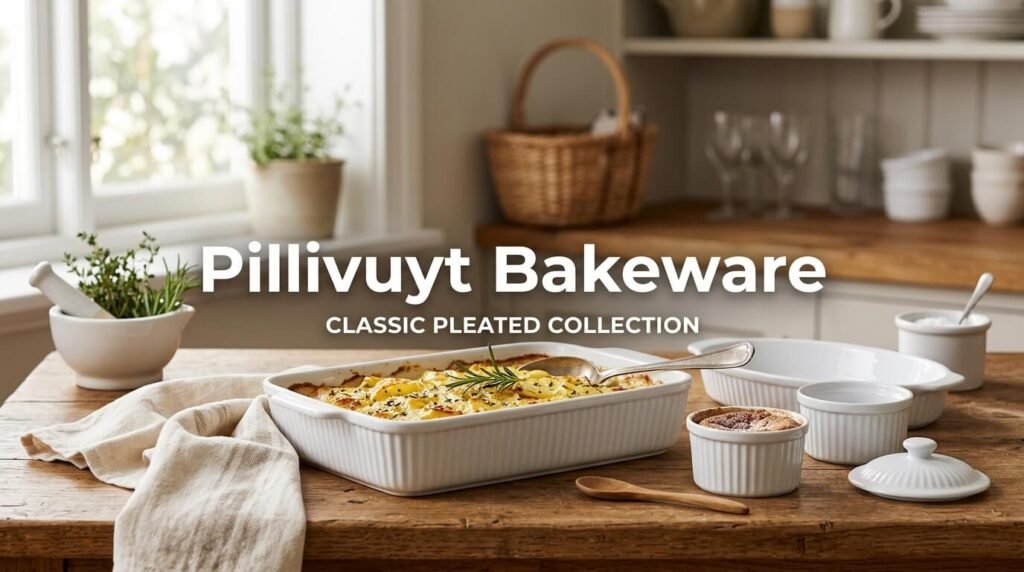
Pillivuyt is hard-paste porcelain, not ceramic, not stoneware, not earthenware.
Hard-paste porcelain is made from kaolin clay and petuntse (a feldspathic rock), fired at temperatures that cause the materials to vitrify, fusing into a glassy, near-zero-porosity structure.
It’s the densest, hardest class of baked clay products. Earthenware and stoneware fire at lower temperatures and retain measurable porosity, which affects how they absorb heat, hold flavors, and clean up after use.
Pillivuyt has manufactured this specific class of porcelain in Mehun-sur-Yèvre, France, since 1818.
Hard-Paste Porcelain vs Earthenware vs Stoneware: Why the Distinction Matters for Baking
| Material | Firing Temp | Porosity | Thermal Shock Resistance | Durability |
|---|---|---|---|---|
| Hard-paste porcelain (Pillivuyt) | ~2,552°F | Near-zero | Excellent | Mohs 7 hardness |
| Stoneware (Emile Henry) | ~2,100–2,300°F | Low | Good | Moderate |
| Earthenware (Le Creuset ceramic) | ~1,800–2,000°F | Moderate | Fair | Lower |
| Borosilicate glass (Pyrex) | N/A | Zero | Poor | Brittle |
The gap between porcelain and the others shows up in real use: Pillivuyt won’t absorb last week’s garlic into your apple tart, can go from freezer to a preheated 550°F oven without cracking, and won’t craze or stain after years of heavy cooking.
How Pillivuyt Fires Its Porcelain: The Two-Stage Process That Changes Everything
Pillivuyt runs two separate firings, not one:
- First firing at ~1,795°F (bisque stage): The raw porcelain body hardens into bisqueware — firm, still slightly porous, not yet finished.
- Second firing at 2,552°F (glaze stage): Glaze is applied, and the piece re-enters the kiln at a much higher temperature. The glaze and body vitrify together — silica partially melts, pores close, and the surface becomes an extraordinarily dense, glass-like shell.

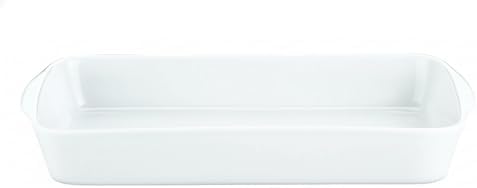

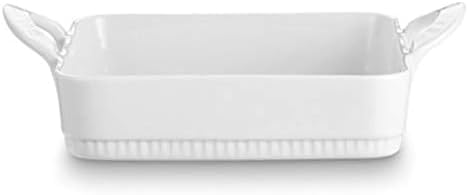
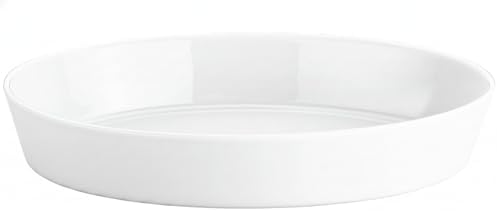
The result scores a 7 on the Mohs hardness scale. A steel kitchen knife scores around 5.5; a diamond scores 10. Pillivuyt’s glaze is harder than steel, which is why metal utensils won’t scratch it and why pieces from 1926 are still in documented daily use.
Decorated pieces go through a third firing that traps pigments permanently under the glaze so they can’t fade, scratch, or leach.
Pillivuyt Bakeware Performance: What It Actually Does in the Kitchen
The practical result of that manufacturing process is bakeware that distributes heat evenly, handles thermal shock, releases food cleanly, and cleans up fast. These aren’t claims, they’re consequences of the material’s physics.
Even Heat Distribution: Why Thin Walls Beat Thick Walls for Gratins and Tarts
Pillivuyt’s walls are deliberately thin and uniform. That matters for gratins, tarts, and anything needing a specific textural result, a moist interior, and bubbly golden crust on top.
Thick-walled dishes absorb heat unevenly, creating temperature gradients that produce overcooked edges and underdone centers. Pillivuyt’s thin, dense walls conduct heat quickly and evenly from all sides, so the gratin bottom stays rich and the top caramelizes at exactly the right moment.
Freezer to Oven: The Thermal Shock Resistance That Other Bakeware Materials Can’t Match
- You can move a Pillivuyt dish directly from a -4°F freezer to a fully preheated 550°F oven — no resting step required.
- The double-fired vitrified structure expands and contracts at a controlled, uniform rate with no internal stress points where cracking starts.
- This makes prepare-ahead cooking genuinely practical: assemble a gratin, freeze it, bake it from frozen without transferring dishes.
- Emile Henry and Le Creuset ceramics are also thermal-shock resistant but have lower maximum temperatures and higher porosity, which affects performance over repeated freeze-bake cycles.
- One rule that applies to all ceramics: don’t set a scorching-hot dish on a cold, wet surface. Use a trivet.
The Non-Porous Surface: Why Pillivuyt Is Considered the Original Non-Stick Bakeware
The 2,552°F glaze firing creates a surface with near-zero porosity, almost no microscopic holes for food to grip. Baked-on residue releases after a brief soak rather than requiring scrubbing. No synthetic coating is involved.
The surface is hard, glazed porcelain, not PTFE or silicone, so it won’t degrade with use or scratch off into food. The non-stick property is a structural consequence of the material, not something applied on top.
Temperature Guide and Safety Specifications for Pillivuyt Porcelain
Oven, Broiler, Microwave, Freezer, Dishwasher: Complete Compatibility Specs
| Appliance / Use | Safe? | Notes |
|---|---|---|
| Oven | ✓ Yes | Up to 550°F (288°C) |
| Broiler | ✓ Yes | All pieces; keep food moist to aid in cleanup |
| Microwave | ✓ Yes | Exception: gold, silver, or platinum-decorated pieces — hand-wash only, no microwave |
| Freezer | ✓ Yes | Down to -4°F (-20°C) |
| Dishwasher | ✓ Yes | All undecorated and standard pieces |
| Direct freezer-to-oven transfer | ✓ Yes | No intermediate resting period required |
| Stovetop / direct flame | Conditional | Toulouse flameproof casseroles and Ulysses collection only |
Can Pillivuyt Be Used on a Stovetop or Grill? The Direct-Heat Exception
Standard Pillivuyt bakeware is not for stovetop or open-flame use. The Toulouse Flameproof Casseroles work on gas and electric stovetops.
The Ulysses Collection is induction-compatible and designed for direct heat. Standard bakers can go on a grill with a small amount of liquid or fat in the bottom. If induction compatibility is your main requirement, Ulysses is the specific answer — not the general range.
Is Pillivuyt Lead-Free? Food Safety and Prop 65 Compliance Explained
Pillivuyt porcelain contains no detectable lead or cadmium in food-contact testing and complies with California Prop 65 standards.
Trace amounts of both elements are naturally present in porcelain clay and decorative pigments, but the high-temperature firing process hardens the glaze to the point where migration into food is undetectable.
All current production pieces are safe for food contact, including decorated collections.
Pillivuyt Bakeware Product Guide: Which Dish Is Right for What You Cook
Oval Bakers vs Rectangular Bakers vs Gratin Dishes: Choosing by Shape and Volume
For help matching dish capacity to serving count, see Pillivuyt gratin dish size.
| Dish Type | Best For | Capacity Range |
|---|---|---|
| Oval Baker (deep) | Roasts, cassoulet, chicken, lasagna | 1 qt – 3.5 qt |
| Rectangular Baker | Lasagna, baked pasta, sheet-style casseroles | 1.5 qt – 4 qt |
| Oval-Eared Gratin | Gratins, baked eggs, individual portions | 6 oz – 2.5 qt |
| Round Gratin | Potato gratin, cobbler, roasted vegetables | 1 qt – 1.5 qt |
Soufflé Dishes, Ramekins, and Tart Dishes: Pillivuyt’s Specialty Formats
- Soufflé dishes: The straight, smooth walls allow the soufflé to climb without resistance during baking. The pleated exterior is a Pillivuyt signature, in production for generations.
- Ramekins: The porcelain holds heat long enough to finish a custard after it leaves the oven — part of how you get properly set crème brûlée without overcooking it.
- Tart dishes: Pastry releases cleanly from the non-porous surface, and dough can go from freezer to oven directly in the dish, reducing shrinkage compared to greased metal tins.
For a focused breakdown of soufflé vessel specs, see the best bakeware for soufflés.
Pillivuyt Collections at a Glance: Toulouse, Canopée, Classic, Ulysses, and More
| Collection | Style | Standout Feature |
|---|---|---|
| Classic | Traditional white, pleated | Signature pleats; in production since 1818 |
| Toulouse | Traditional with kiln-door handles | Flameproof casseroles — stovetop safe |
| Canopée | Contemporary pleats | Modern proportions with heritage detail |
| Ulysses | Sleek, minimal | Induction and stovetop compatible |
| Sancerre | Clean, unadorned white | Everyday use aesthetic |
Pillivuyt vs Le Creuset vs Emile Henry: The Honest Bakeware Comparison
The comparison most buyers are making is between different material categories, not different versions of the same thing. Pillivuyt is hard-paste porcelain. Emile Henry uses Burgundy clay — a stoneware-type ceramic fired at lower temperatures.
Le Creuset’s ceramic range is earthenware with an enamel coating. These materials behave differently under heat, clean differently, and age differently. For a broader side-by-side across all French bakeware options, see our French Porcelain brands and Pillivuyt vs Apilco comparison guide.
Material Differences That Actually Affect How Your Food Cooks
| Brand | Material | Max Oven Temp | Thermal Shock | Weight | Induction |
|---|---|---|---|---|---|
| Pillivuyt | Hard-paste porcelain | 550°F | Excellent | Light-moderate | Ulysses only |
| Emile Henry | Stoneware ceramic | 480°F | Good | Moderate-heavy | No |
| Le Creuset ceramic | Earthenware | 500°F | Fair | Moderate | No |
| Le Creuset cast iron | Enameled cast iron | 500°F | Poor (sudden changes) | Heavy | Yes |
When you compare Pillivuyt to Emile Henry, you’re comparing hard-paste porcelain to stoneware ceramic — materials that behave differently under heat, in the sink, and over decades of use. Neither is wrong. But they’re not the same thing with different logos.
When to Choose Pillivuyt and When to Choose Something Else
- Choose Pillivuyt if you want a single piece that goes from freezer to oven to table to dishwasher with no caveats, and you expect to use it for 20+ years.
- Choose Emile Henry if you prefer warmer, colored aesthetics and mostly bake in the 300–400°F range, where the temperature gap between brands is irrelevant.
- Choose Le Creuset cast iron if you need stovetop-to-oven in one vessel — that’s what cast iron does that standard porcelain doesn’t.
- Choose Pyrex or basic ceramic if you bake infrequently, and price is the real constraint.
- Don’t choose Pillivuyt if you want color variety — Pillivuyt’s palette is predominantly white, and that’s a genuine limitation.
Is Pillivuyt Bakeware Worth the Price? The Long-Term Value Breakdown
The price looks high until you run the actual numbers. At $120 for an oval baker, most people compare it to a $30 glass dish or a $45 ceramic casserole. But that comparison assumes both dishes last as long. They don’t.
Price Per Year of Use: How Heirloom Bakeware Changes the Cost Calculation
This framework applies to any premium kitchenware decision. See the heirloom kitchen investment for the full method.
| Dish | Price | Realistic Lifespan | Cost Per Year |
|---|---|---|---|
| Pillivuyt oval baker | $120 | 40+ years (documented) | $3.00/yr |
| Mid-range ceramic casserole | $45 | ~8 years (crazing, chips) | $5.63/yr |
| Glass bakeware (Pyrex) | $25 | ~4 years (thermal breakage risk) | $6.25/yr |
Who Should Buy Pillivuyt Bakeware (and Who Should Not)
Buy it if:
- You cook regularly — more than twice a week — and use your bakeware hard. The material advantage compounds with frequency.
- You want oven-to-table presentation without a separate serving dish, which cuts real time and cleanup.
- You’re buying a gift with an $80–$150 budget and want something that will still be in use in 30 years.
Don’t buy it if:
- You want induction-compatible bakeware outside the Ulysses collection specifically.
- You want colored bakeware. Pillivuyt’s identity is white porcelain.
- You cook rarely, and the upfront cost doesn’t make sense even with the long-term math behind it.
How to Care for Pillivuyt Bakeware: Everything You Need to Know
Pillivuyt’s care requirements are simpler than most bakeware. For the full list of dos and don’ts below:
Cleaning Baked-On Food from Porcelain Without Damaging the Glaze
- Let the dish cool to room temperature before submerging — not because Pillivuyt will crack, but because thermal stress on any material is cumulative.
- Fill with warm water and soak for 5–10 minutes. Baked-on food releases on its own from the non-porous surface.
- Use a non-abrasive sponge or soft brush. The glaze resists metal utensils, but fine-grit abrasives like steel wool will dull it over time.
- Rinse and dry, or put it in the dishwasher. Either works for standard pieces.
What to Avoid: The Three Things That Can Damage Pillivuyt Porcelain
- Dropping it on a hard floor. The only realistic failure mode in normal use — no ceramic material is impact-proof regardless of hardness rating.
- Steel wool or abrasive scouring pads. Repeated abrasive cleaning will eventually dull the surface, even on Mohs 7 glaze.
- A very hot dish placed directly on a cold, wet counter. Use a trivet. This is good practice with any ceramic, not a Pillivuyt-specific quirk.
Frequently Asked Questions About Pillivuyt Bakeware
How do you pronounce “Pillivuyt”?
It’s pronounced “pee-lee-vwee” — the final t is silent, standard French. The brand acknowledges the name is a stumbling block for English speakers, but the bakeware is considerably easier to use than it is to say.
Is Pillivuyt bakeware made in France?
Yes. All production takes place at the historic factory in Mehun-sur-Yèvre, France. Pillivuyt is one of the last manufacturers to maintain 100% French production and develops its own porcelain compound on-site.
Can Pillivuyt porcelain go in the dishwasher?
Yes, all standard and undecorated pieces are dishwasher safe. Pieces with precious metal decoration (gold, silver, platinum trim) should be hand-washed.
What is the maximum oven temperature for Pillivuyt bakeware?
550°F (288°C) for all standard bakers and gratin dishes. They can also be used under the broiler, with some moisture in the dish, recommended for cleanup.
Does Pillivuyt contain lead?
No detectable lead or cadmium in food-contact testing, per Prop 65 standards. The high-temperature firing process prevents any migration into food, including in decorated pieces.
How does Pillivuyt compare to Emile Henry bakeware?
Different materials entirely — Pillivuyt is hard-paste porcelain fired at 2,552°F; Emile Henry uses Burgundy stoneware clay at lower temperatures.
Pillivuyt has a higher max oven temp, harder surface, and better thermal shock resistance. Emile Henry has more color options and a lower price.
Can I use Pillivuyt bakeware on a gas stovetop?
Only the Toulouse Flameproof Casseroles and Ulysses Collection are designed for direct heat. Standard bakers are oven-only (plus grill, with liquid in the bottom).
What is the best Pillivuyt dish for making gratins?
The oval-eared gratin dish. The shallow depth maximizes the browning surface area, the thin walls distribute heat evenly, and the ear handles make it easy to carry from oven to table.
Is Pillivuyt bakeware a good wedding or housewarming gift?
One of the better options at this price point is functional, beautiful, and specific enough to feel considered. A gratin dish or oval baker will still be in use decades from now.
Does Pillivuyt bakeware chip easily?
Not under normal use. The Mohs 7 hardness rating puts the glaze above steel, and Pillivuyt pieces resist chipping from utensils and everyday contact. The practical risk is dropping on a hard surface, which applies to any ceramic.