

If you’ve picked up a vibrant piece of Fiestaware at an estate sale, inherited a set from a relative, or spotted a cobalt-blue plate at a thrift shop, you’ve probably asked: Can vintage FiestaWare go in the dishwasher?
The honest answer has two parts. Post-86 Fiestaware made from 1986 to the present is fully dishwasher safe. Vintage Fiestaware produced between 1936 and 1972 is not, and the reason goes beyond chipping or fading.
The glaze on vintage pieces contains lead and, in some colors, cadmium or uranium oxide. Dishwashers actively accelerate the breakdown of those compounds. This guide explains exactly why, how to identify which era your pieces belong to, and how to clean them safely.
Written by Sarah Emirone | Reviewed by James Daniels, B.Sc, Inorganic Chemist & Materials Researcher | Updated September 2026 | See How We Test | Filed under: Buying, Care & Product Guides
The Short Answer Depends on When Your Fiestaware Was Made
The year your piece was produced determines everything about how you should clean it.
Fiestaware has two distinct production eras separated by a 14-year gap (1973–1985, when the original line was discontinued), and the chemistry of the two eras is fundamentally different.
Vintage Fiestaware (1936–1972): Not Dishwasher Safe
Vintage Fiestaware produced by Homer Laughlin China Company between 1936 and 1972 is not dishwasher safe.
The glazes used to achieve those saturated mid-century colors — cobalt, ivory, turquoise, yellow, red — were formulated with lead silicates and, depending on the color, cadmium sulfide or uranium oxide. Dishwashers compound the risk in three ways:
- Alkaline detergents attack the glaze chemistry. Modern dishwasher pods and powders run at pH 10–12, which is corrosive enough to dissolve lead-silicate bonds in vintage ceramic glaze — a process that begins before any visible damage appears.
- High water temperatures accelerate leaching. Dishwashers operate at 120–160°F, well above the threshold that increases metal migration rates from ceramic surfaces into adjacent food and water.
- Repeated cycles cause cumulative degradation. Even a single dishwasher run that produces no visible damage still degrades the glaze at a molecular level, making subsequent leaching events more likely.
Post-86 Fiestaware (1986–Present): Fully Dishwasher Safe
Fiestaware relaunched in 1986 in partnership with Bloomingdale’s, and every piece produced since that year is lead-free, cadmium-free, and specifically engineered to withstand machine washing.


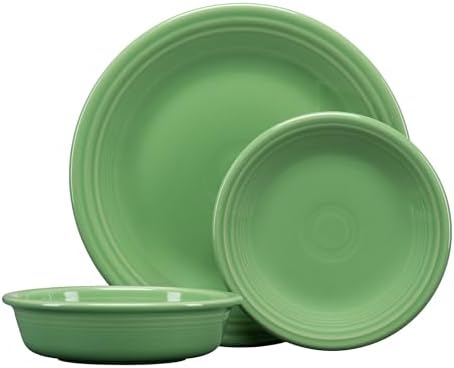
Post-86 Fiesta uses vitrified ceramic with modern food-safe glazes that meet current FDA standards. You can wash Post-86 pieces in the dishwasher on any standard cycle without safety concerns.
For the complete story on the modern line, see the complete guide to Post-86 Fiestaware.
How to Tell If Your Fiestaware Is Vintage or Modern
The critical first step before washing any Fiestaware piece is confirming which era it belongs to. Most pieces can be dated accurately in under two minutes using the backstamp on the bottom.
Reading the Backstamp: The Fastest Way to Date Your Piece
Turn the piece upside down and examine the bottom. Follow these steps in order:
- Look for the word “lead-free.” Any piece with “Lead-Free” stamped on the bottom is Post-86 and dishwasher safe. Stop here — no further identification needed.
- Check for an ink stamp vs. an incised mark. Vintage pieces (pre-1973) typically have an in-glaze ink stamp or an impressed mark. Post-86 pieces have a cleaner embossed or printed backstamp, often including a registration number.
- Read the manufacturer name format. Early vintage pieces are marked “Genuine Fiesta HLC USA” in a ring or arc. The specific font, layout, and ring style changed across decades and have been documented by collector societies.
- Note the absence of any mark. Some very early pieces (1936–early 1940s) have minimal or no ink markings — only impressed letters. If you cannot find “lead-free” anywhere, treat the piece as vintage regardless of its apparent condition.
- Cross-reference against a collector database. The Homer Laughlin China Collectors Association (HLCCA) publishes detailed backstamp chronology guides for each era.
Color as a Dating Clue When There Is No Backstamp
If the backstamp is worn, absent, or unclear, the color itself provides strong dating evidence. Post-86 colors were largely different from the original vintage palette, though some were reintroduced. Use this reference:
| Color Name | Original Production Years | Era | Notes |
|---|---|---|---|
| Original Red (Radioactive Red) | 1936–1943, 1959–1972 | Vintage only | Uranium oxide glaze; not reproduced post-86 |
| Cobalt Blue | 1936–1951 | Vintage only | High lead content documented |
| Ivory | 1936–1951 | Vintage only | Lead-based glaze |
| Original Yellow | 1936–1969 | Vintage only | Lead and cadmium compounds |
| Turquoise | 1937–1969 | Vintage only | Lead-based; reintroduced post-86 as a different formula |
| Forest Green | 1942–1959 | Vintage only | Lead-based glaze |
| Rose | 1951–1959 | Vintage only | Lead-based |
| Gray | 1951–1959 | Vintage only | Lead-based |
| Chartreuse | 1951–1959 | Vintage only | Lead-based |
| Medium Green | 1959–1969 | Vintage only | Highest production-era lead readings in some tests |
| Antique Gold | 1969–1972 | Vintage only | Lead-based; late production run |
| Turf Green | 1969–1972 | Vintage only | Lead-based; late production run |
See the complete vintage Fiestaware color identification guide for full production timelines and reformulated post-86 equivalents.
Why the Dishwasher Is Dangerous for Vintage Fiestaware — Not Just for the Glaze
Most care guides stop at “the dishwasher can damage the glaze.” That framing undersells the actual risk. The problem with dishwashing vintage Fiestaware is primarily chemical, not cosmetic.
How Alkaline Detergents and High Heat Break Down Lead Glaze
Understanding the lead content in vintage Fiestaware glazes starts with glaze chemistry.
Vintage Fiestaware glaze is a silicate matrix — essentially a glass-like coating where lead oxide is chemically bonded into a silica network to produce the glaze’s characteristic depth and color saturation.
That silica-lead bond is stable under neutral conditions, which is why hand washing with mild dish soap poses a much lower risk than machine washing.
Dishwasher detergents are strongly alkaline — typically pH 10 to 12. At that pH range, the silicate network in the glaze begins to dissolve through alkaline hydrolysis: the solution breaks Si-O-Pb bonds, releasing lead ions and creating microscopic surface defects that increase glaze permeability during subsequent food contact.
Dishwashers operate at 120–160°F, and heat accelerates that reaction significantly. Each dishwasher cycle chemically degrades the glaze in ways that measurably increase lead availability, even when the piece looks perfectly intact afterward.
Why “It Looks Fine” Doesn’t Mean It’s Safe to Dishwash
A visually intact glaze is not a reliable safety indicator for dishwasher use. This is the single most important misconception to correct.
Independent XRF (X-ray fluorescence) testing of vintage Fiestaware, including research by lead-safety advocate Tamara Rubin, has documented lead levels of 74,700–108,300 ppm in vintage cobalt and cream pieces with no visible glaze damage.
For context, the FDA’s current limit for leachable lead from flatware is 3 ppm.
The mechanism explains why appearance is misleading: alkaline attack and the resulting lead ion release happen at the molecular level, not the visual level.
The glaze can appear smooth, glossy, and undamaged while still releasing measurable lead into acidic foods — tomato sauce, citrus juice, vinegar-based dressings during normal use.
The dishwasher doesn’t need to chip or crack the glaze to increase the risk. It simply accelerates the microscopic degradation that leads to greater leaching over time.
Crazing, Chips, and Scratches Multiply the Risk Dramatically
While visual condition is not a pass/fail safety test, visible damage does significantly amplify leaching risk. If your vintage piece already shows any of the following, it should not be used for food service at all — regardless of cleaning method:
- Crazing — a network of fine cracks in the glaze surface — exposes raw ceramic body and dramatically increases the surface area available for chemical interaction.
- Chips or cracks along the rim or foot ring expose unglazed clay, which is porous and can harbor bacteria as well as accelerate glaze degradation at the chip boundary.
- Scratch marks from metal utensils or stacking without protection create micro-channels in the glaze surface that increase both lead leaching and bacterial contamination.
- Fading or color shift in the glaze often signals that alkaline exposure has already begun eroding the glaze matrix — a sign of prior chemical degradation.
Which Vintage Colors Carry the Highest Lead and Cadmium Risk
Not all vintage Fiestaware glazes carry identical risk profiles. The specific colorant chemistry determines which hazard is present and at what concentration.
Original Red and the Uranium Oxide Story
The most historically notable vintage Fiestaware color is original red — sometimes called “radioactive red” — produced from 1936 to 1943 and again from 1959 to 1972.
The pre-1943 formula used uranium oxide as the primary colorant, which created the distinctive orange-red hue. When uranium was restricted to government use for nuclear research under the Manhattan Project in 1943, Homer Laughlin pulled the color.
It returned in 1959 using a different formula, though collector sources differ on the exact post-1959 colorant composition.
Radiation levels in original uranium-glaze pieces are measurable but low — the Nuclear Regulatory Commission has historically classified them as below threshold for health concern in ordinary use.
The more significant risk in red Fiestaware, as with all vintage colors, is lead content in the overall glaze matrix rather than uranium specifically.
Color-by-Color Risk Reference Chart
| Color | Production Years | Primary Hazard | Risk Level | Recommended Use |
|---|---|---|---|---|
| Original Red (pre-1943) | 1936–1943 | Uranium oxide + lead | High | Display only |
| Original Red (post-1959) | 1959–1972 | Lead-based glaze | High | Display only |
| Cobalt Blue | 1936–1951 | Lead (very high ppm documented) | High | Display only |
| Ivory | 1936–1951 | Lead-based glaze | High | Display only |
| Original Yellow | 1936–1969 | Lead + cadmium | High | Display only |
| Medium Green | 1959–1969 | Lead-based glaze | High | Display only |
| Turquoise | 1937–1969 | Lead-based glaze | High | Display only |
| Forest Green | 1942–1959 | Lead-based glaze | High | Display only |
| Rose | 1951–1959 | Lead-based glaze | Medium–High | Display only |
| Gray | 1951–1959 | Lead-based glaze | Medium–High | Display only |
| Chartreuse | 1951–1959 | Lead-based glaze | Medium–High | Display only |
| Antique Gold | 1969–1972 | Lead-based glaze | Medium | Hand wash; intact pieces only |
| Turf Green | 1969–1972 | Lead-based glaze | Medium | Hand wash; intact pieces only |
Note: “Medium” risk does not indicate safety for regular food use; it reflects fewer documented extreme-concentration test results compared to high-risk colors. All vintage pieces should be hand-washed and kept away from acidic foods, regardless of color.
How to Safely Hand-Wash Vintage Fiestaware
Hand washing is the correct cleaning method for all vintage Fiestaware. Done properly, it preserves both the glaze integrity and the piece’s collectible value.
Step-by-Step Hand Washing Method
- Fill a basin with lukewarm water — not hot. Temperature stress can worsen existing crazing; keep water below 110°F.
- Add a small amount of pH-neutral dish soap. Standard gentle dish soaps (Dawn, Seventh Generation Free & Clear) are near-neutral pH and safe for vintage glaze. Avoid antibacterial or “ultra-grease-cutting” formulas, which use higher-alkalinity surfactants.
- Wash one piece at a time using a soft cloth or non-abrasive sponge. Never stack pieces while washing — contact between pieces causes chipping.
- Rinse thoroughly with lukewarm water to remove all soap residue.
- Dry immediately with a soft, lint-free cloth. Air drying in a rack risks water spots and leaves pieces in contact with hard surfaces, increasing chip risk.
- Inspect the glaze after drying under good light. Check for new crazing, scratches, or dull patches that may indicate glaze degradation.
What to Avoid — Soaps, Tools, and Habits That Damage the Glaze
- Avoid dishwasher pods, tablets, or powder, even if you plan to hand-wash in the dishwasher basin manually — the residue from prior machine cycles is alkaline enough to damage vintage glaze on contact.
- Avoid steel wool, scrubbing pads, or abrasive sponges — they create surface scratches that increase leaching surface area and degrade the glaze finish permanently.
- Avoid soaking vintage Fiestaware in water for extended periods — prolonged water exposure softens the bond between the glaze and the clay body, accelerating future crazing.
- Avoid sudden temperature changes — moving a piece directly from cold storage to hot water can crack already-crazed glaze or initiate new crazing in otherwise intact pieces.
- Avoid stacking wet pieces — water trapped between stacked dishes extends glaze exposure time and increases chip risk on rims and feet.
Caring for Post-86 Fiestaware in the Dishwasher
Post-86 Fiestaware is engineered for machine washing and holds up well to regular dishwasher use. A few habits extend its life and prevent cosmetic wear.
Placement, Cycle, and Detergent Tips for Modern Fiesta
- Load plates vertically in the lower rack with adequate space between pieces — contact between glazed surfaces during the wash cycle causes micro-scratches over time.
- Place mugs and bowls on the top rack where water pressure and heat are lower, reducing the chance of stress fractures in handles.
- Use standard cycle heat settings — Post-86 Fiesta does not require gentle or delicate cycles, but the high-heat dry setting is unnecessary and slightly reduces glaze life over the years of use.
- Use standard enzyme-based dishwasher detergent — Post-86 glaze handles the alkaline environment without issue because the vitrified clay body and modern glaze formulation are chemically resistant.
- Dark-colored Post-86 glazes show metal transfer marks (grey streaks from cutlery) more easily — these can be removed with a non-abrasive cleaner like Bar Keepers Friend.
Signs That Even Modern Fiestaware Needs Hand Washing
- Any piece with gold or metallic accent decoration — metallic luster glazes degrade in dishwashers regardless of the base ceramic’s safety rating.
- Pieces with visible chips or cracks — even non-lead modern ceramics with structural damage should not be dishwashed, as water intrusion into cracks can worsen them.
- Limited-edition or special-release pieces — these sometimes use decorative techniques (decals, lustres, hand-painted details) that are not formulated for machine washing; check the backstamp or product listing.
How to Test Your Vintage Fiestaware for Lead at Home
If you are uncertain whether a piece is vintage or Post-86, or if you want confirmation before using any vintage piece for food service, lead testing is a practical option.
XRF Testing vs. At-Home Lead Swab Kits — What Actually Works
| Feature | XRF (X-ray Fluorescence) Testing | At-Home Lead Swab Kit |
|---|---|---|
| Accuracy | Lab-grade; detects lead at sub-ppm levels | Qualitative (positive/negative); threshold ~600 ppm |
| Cost | $25–$75 per piece at testing labs; some public health depts offer free testing | $10–$30 for a pack of multiple swabs |
| Availability | Specialty labs, some museum conservation departments, and public health agencies | Hardware stores, Amazon, home improvement retailers |
| Ease of Use | Requires appointment or mail-in; non-destructive | 60-second swipe test; slight surface contact required |
| Result Format | Quantitative ppm reading by element | Color change: red/pink = lead present |
| Best For | Collectors, families with young children, anyone wanting precise data | Quick screening before deciding to test more thoroughly |
Both methods are non-destructive at the glaze level when used correctly. For pieces you intend to use regularly for food service, XRF testing provides the most actionable data.
What to Do If Your Test Comes Back Positive
- Remove the piece from food service immediately. A positive result means measurable lead is present — do not continue using it for eating, drinking, or food storage.
- Do not attempt to seal the glaze with food-safe coatings as a workaround — sealants do not eliminate lead risk and are not approved for ceramic dinnerware by the FDA.
- Consider display-only status. Vintage Fiestaware with confirmed lead content is still beautiful, historically significant, and safe to display, handle, and collect — it simply should not contact food or liquids.
- Store it safely if you have children. Lead dust from chipped or crazed vintage ceramics is a contact hazard for young children — store confirmed lead-positive pieces in a closed cabinet out of reach.
How to Store Vintage Fiestaware to Prevent Glaze Damage
Good proper storage for vintage ceramic dinnerware is the single most effective way to protect glaze integrity between uses.
Stacking Safely Without Chipping
- Place a soft felt pad, paper plate, or coffee filter between each stacked piece — unprotected glazed-to-glazed contact causes micro-chipping on rims and feet with every retrieval.
- Stack plates and bowls by size only — stacking different-diameter pieces concentrates weight unevenly and risks cracking smaller pieces at the base.
- Limit stack height to 6–8 pieces maximum — pressure from tall stacks causes rim compression and increases chip frequency at the contact points.
- Store mugs and pitchers upright, not inverted — inverted storage puts the handle joint under repeated stress and concentrates weight on the rim.
Display vs. Daily Use — Making the Right Call for Your Pieces
The decision to display versus use vintage Fiestaware daily comes down to the piece’s condition, color, and your household composition.
For collectors whose pieces show crazing, chips, or very high-risk colors (original red, cobalt, ivory, yellow), display-only is the conservative and appropriate choice.
Pieces in excellent condition in medium-risk late-vintage colors (Antique Gold, Turf Green) can reasonably be used for dry food service — crackers, bread, non-acidic items if hand-washed carefully and inspected regularly.
If you have children under six in the household, the FDA’s guidance on lead exposure for young children warrants a display-only policy for all confirmed vintage pieces, regardless of condition.
Before You Wash Another Vintage Piece: If you are not certain whether your Fiestaware is vintage or Post-86, use the backstamp identification steps above to confirm the era.
For any vintage piece you intend to use for food service, consider screening it first with lead test kits for vintage dinnerware before the next meal.
Frequently Asked Questions About Vintage Fiestaware and Dishwashers
Is any vintage Fiestaware safe to put in the dishwasher?
No. All Fiestaware produced between 1936 and 1972 contains lead in the glaze, and dishwasher detergents actively accelerate lead leaching through alkaline hydrolysis — a chemical reaction that occurs even before visible glaze damage.
There is no vintage color or era exception to this rule.
What year did Fiestaware stop using lead in its glaze?
The original vintage line was discontinued in 1972–1973. When Homer Laughlin relaunched Fiestaware in 1986 (the “Post-86” line), the new formulation was lead-free and cadmium-free. Any piece made between 1973 and 1985 does not exist, as the line was not in production during that period.
How do I know if my Fiestaware is vintage?
Check the bottom of the piece for the words “Lead-Free” — if present, it is Post-86 and safe. If absent, check for the backstamp style: vintage pieces use an ink-stamped or impressed “Genuine Fiesta HLC USA” mark without a lead-free declaration. When in doubt, treat the piece as vintage.
Is the uranium in vintage red Fiestaware dangerous?
Pre-1943 original red Fiestaware used uranium oxide as a colorant, and pieces do emit low-level radiation.
The Nuclear Regulatory Commission has historically classified these radiation levels as below the threshold for ordinary handling and display.
The more significant health concern with vintage red is the lead content in the overall glaze matrix, which affects all vintage colors, not uranium specifically.
Does handwashing vintage Fiestaware also pose a lead risk?
Hand washing with pH-neutral dish soap and lukewarm water poses a much lower risk than dishwashing because neutral-pH soap does not attack lead-silicate bonds the way alkaline dishwasher detergents do.
Lead leaching into wash water during hand washing is minimal compared to machine washing, provided you use a gentle soap and avoid long soaks.
Can vintage Fiestaware go in the microwave?
Vintage Fiestaware should not be microwaved. For a full explanation of heat risks and appliance compatibility by era, see our guide on whether vintage Fiestaware is microwave-safe.
How do I remove stains from vintage Fiestaware without damaging the glaze?
Soak a soft cloth in a solution of warm water and white vinegar (1:1 ratio), then apply it to the stain for no more than 5 minutes. Avoid prolonged vinegar contact, as its acidity can interact with the glaze.
For stubborn mineral or tea stains, a paste of baking soda and water applied with a soft cloth and rinsed immediately is the safest abrasive-free option.
Are there any vintage Fiestaware colors that are dishwasher safe?
No vintage Fiestaware color is dishwasher safe. The risk is not color-specific — it is glaze-system-wide. Every piece in the 1936–1972 line used a lead-containing glaze matrix regardless of colorant.
The colorant (uranium, cadmium, lead-based pigments) varies by color, but the underlying glaze in all vintage pieces is incompatible with dishwasher detergent chemistry.
If my Post-86 Fiesta says “lead free,” does that mean zero lead?
“Lead-free” on Post-86 Fiestaware means the piece meets FDA standards for leachable lead, specifically that lead release does not exceed 3 ppm under standardized testing conditions.
The glazes are formulated without intentional lead addition, and Homer Laughlin has consistently stated that Post-86 Fiesta contains no lead in the food-contact glaze. It is the most accurate safety designation available under current regulatory standards.
Can I sell or donate vintage Fiestaware I no longer want to use?
Yes. Vintage Fiestaware is legal to sell, donate, and collect. There are no regulatory restrictions on transferring ownership.
If you are donating to a thrift store or selling to a collector, disclosing that the pieces are vintage (pre-1973) and may contain lead is an honest and appreciated practice, particularly if the buyer might not know how to identify the era.
About the Author & Reviewer
Sarah Emirone, Author
Sarah researches and writes SafeKitchn’s dinnerware and kitchenware guides, with a focus on material safety, lead content, and manufacturer specifications. She cross-references product data sheets, safety certifications, and regulatory filings (including FDA and Prop 65 records) before publishing, and updates articles when new information becomes available.
James Daniels, Reviewer
James reviews SafeKitchn’s material safety content for scientific accuracy. He holds a B.Sc in inorganic chemistry and works as a materials researcher, with particular focus on the composition and safety behavior of glass, ceramic, and metal used in kitchenware.