

Some Fiestaware is radioactive, but whether that matters to you depends entirely on which piece you have, what year it was made, and how you use it.
The question “Is Fiestaware radioactive?” has a clear answer for vintage red pieces made before 1943: yes, measurably so, due to uranium oxide in the glaze.
For modern FiestaWare produced since 1986, the answer is a flat no.
This article gives you a complete breakdown by color, era, and use case, including two risks most sources conflate: radiation dose and chemical leaching. They are different hazards with different triggers, and you need to understand both.
Written by Sarah Emirone | Reviewed by James Daniels, B.Sc, Inorganic Chemist & Materials Researcher | Updated September 2026 | See How We Test | Filed under: Material Safety & Lead Testing
Why Is Some Fiestaware Radioactive? The Uranium Glaze Explained
Uranium oxide was a standard industrial colorant in ceramic glazes for much of the 20th century.
It produced vivid, stable colors, particularly the deep orange-red that became Fiestaware’s signature look, which were difficult to achieve with other pigments.
The practice was widespread across the ceramics industry, not unique to Homer Laughlin, the West Virginia company that makes Fiesta.
In the 1930s, uranium was an inexpensive, commercially available compound, and its radioactive properties were not considered a consumer safety concern. It was used in glassware, jewelry, and dinnerware alike.
The role of uranium oxide in ceramic coloring — especially the “radioactive red.”
Uranium oxide (UO₂): a heavy metal compound used as a ceramic colorant that imparts orange, red, yellow, and green hues depending on concentration and firing conditions.
The “Fiesta red” — more accurately an orange-red — became the brand’s most iconic color precisely because of uranium oxide.
ORAU’s Museum of Radiation and Radioactivity documents that the uranium content in original red Fiestaware glaze could reach up to 14% by weight, making it measurably the most radioactive color in the lineup.
Other colors, including ivory and some greens, also contained uranium oxide but at substantially lower concentrations.
Natural uranium (1936–1943) vs. depleted uranium (1959–1972): what’s the difference in radioactivity?
| Era | Uranium Type | U-235 Content | Relative Radioactivity | Notes |
|---|---|---|---|---|
| 1936–1943 | Natural uranium | ~0.72% U-235 | Highest | Red and ivory colors most affected |
| 1943–1959 | None used | — | Zero (uranium in glaze) | U.S. government seized stocks for Manhattan Project |
| 1959–1972 | Depleted uranium | <0.3% U-235 | Lower than pre-war, still detectable | Post-war red resumed with less radioactive material |
| 1973–1985 | No production | — | — | Line discontinued |
| 1986–present | None | — | Zero | Modern line; fully reformulated |
The key distinction: depleted uranium has had most of its U-235 removed, making it less radioactive than natural uranium, but it still contains uranium-238, which has a half-life of 4.5 billion years.
This means any piece made with either type remains as radioactive today as the day it was glazed.
Which Fiestaware Colors and Years Are Actually Radioactive?
Not all vintage Fiestaware is radioactive, and not all colors carry equal risk. The radioactive pieces are primarily limited to specific colors produced in specific windows. Here is the complete reference by color and era:
| Color | Years Produced | Uranium in Glaze? | Risk Level | Notes |
|---|---|---|---|---|
| Red (original) | 1936–1943 | Yes — natural uranium, up to 14% by weight | HIGHEST | Most sought by collectors; highest radiation readings |
| Ivory | 1936–1951 | Yes — lower concentration than red | Moderate | Often overlooked; still detectable on Geiger counter |
| Red (reintroduced) | 1959–1972 | Yes — depleted uranium | Moderate | Less radioactive than pre-war red |
| Yellow | 1936–1969 | Yes — uranium oxide used for color | Low–Moderate | Also contains high lead levels (see below) |
| Light Green | 1936–1951 | Yes — trace uranium | Low | |
| Cobalt Blue | 1936–1951 | No uranium | Low (radiation) | High lead content in glaze (separate hazard) |
| Turquoise | 1937–1969 | No uranium | Low (radiation) | Lead present in vintage glaze |
| Rose, Chartreuse, Forest Green | 1951–1959 | No uranium | Low (radiation) | Lead still present in these vintage glazes |
| Modern (all colors) | 1986–present | No | NONE | Fully reformulated; lead-free and uranium-free |
The original red (1936–1943): highest uranium content — up to 14% of glaze by weight
Pre-war Fiesta red is the most radioactive commercially produced dinnerware in American history.
ORAU researchers have measured readings from these pieces that register clearly above background levels on a Geiger counter — in some documented tests, exceeding 18 microsieverts per hour.


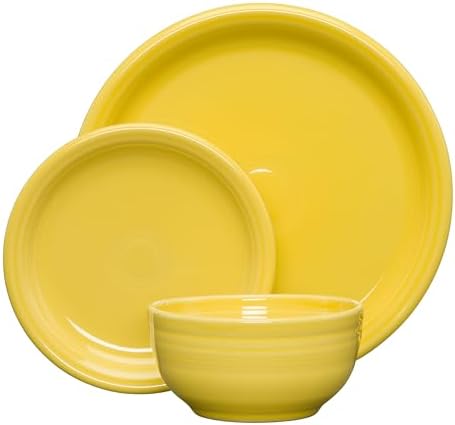
This is the piece that earned the nickname “radioactive red” and the one the EPA has specifically addressed in its guidance on antique radioactive items.
Ivory and other colors (1936–1951): also contain uranium, but at lower levels
Ivory FiestaWare is the second most radioactive color, but it is frequently overlooked because collectors and safety guides focus on red.
ORAU’s museum collection confirms uranium was used in the ivory glaze, with radioactivity “easily detectable,” though substantially below the red pieces.
If you have vintage ivory, treat it with the same precautions as red: test it, and don’t use it daily for food.
Modern Fiestaware (1986–present): completely uranium-free and lead-free
- All Fiestaware produced from 1986 onward contains zero uranium in its glaze formulation.
- Homer Laughlin eliminated lead from all glazes during the 1986 relaunch and has maintained lead-free production since.
- Modern Fiesta meets FDA standards and California Proposition 65 disclosure requirements for lead content.
- The 1986 reformulation also switched from semi-vitreous to fully vitrified clay, making modern pieces microwave-safe, dishwasher-safe, and structurally denser.
- Some modern colors have tested positive for trace arsenic and cadmium at levels independent testers consider non-hazardous, but no modern piece contains uranium.
How Much Radiation Does Vintage Fiestaware Actually Emit?
The radiation emitted by vintage red Fiestaware is real measurable with a Geiger counter, but it is low relative to established safety thresholds when the piece is undamaged and used normally.
The Oak Ridge Associated Universities (ORAU) conducted a detailed analysis of radiation exposure from red Fiestaware.
Their findings, consistent with the NRC’s NUREG-1717 assessment, estimate that using radioactive FiestaWare as your sole set of dishes every day would result in approximately 40 mrem of radiation exposure per year.
The U.S. Nuclear Regulatory Commission sets the annual limit for the general public at 100 mrem per year from licensed radioactive sources. By that benchmark, daily use falls within the public limit, though the EPA takes a more conservative position (see below).
| Exposure Source | Approximate Annual Dose |
|---|---|
| Daily use of red Fiestaware (estimate) | ~40 mrem/year |
| Single chest X-ray | ~10 mrem per scan |
| Natural background radiation (U.S. average) | ~300 mrem/year |
| NRC public exposure limit | 100 mrem/year |
| Transatlantic flight (round trip) | ~5 mrem |
The three radiation pathways: external dose, ingestion from leaching, and dust inhalation
The NRC’s NUREG-1717 identifies three distinct exposure routes for uranium in dinnerware. Understanding them matters because each has a different risk driver and mitigation:
- External dose — radiation passes from the glazed surface through the air and contacts your skin. This is the lowest-risk pathway for intact pieces. Alpha particles cannot penetrate a sheet of paper or skin; beta and gamma emissions are measurable but low.
- Ingestion through leaching — uranium, lead, or cadmium dissolves from the glaze into food or liquid in contact with the dish surface. This is a higher-risk pathway because ingested alpha emitters can irradiate the esophagus and digestive lining. This pathway is dramatically increased by acidic foods and glaze damage.
- Dust inhalation — relevant primarily if glazed pieces are sanded, ground, or broken in a way that creates fine particulate. Not a concern for intact, handled pieces.
Why cracked or crazed glaze changes the risk calculation entirely
Crazing refers to the fine network of surface cracks that develops in vintage ceramic glazes over time. It is common in Fiestaware made before 1973, and increases risk through the leaching pathway.
- Cracked or crazed glaze exposes the underlying clay body, dramatically increasing the surface area available for uranium, lead, and cadmium to dissolve into liquids.
- Hot liquids (coffee, soup, tea) and acidic foods (tomato sauce, citrus juice, vinegar-based dressings) accelerate leaching from crazed surfaces.
- Any piece with visible cracks, chips, or heavy crazing should not be used for food or beverages. This applies regardless of radiation level — the leaching risk is the primary concern for damaged pieces.
- Crazed pieces that are otherwise intact can be displayed safely; the risk is specifically food contact with a damaged surface.
Radioactivity vs. Lead and Cadmium: The Overlooked Hazard in Vintage Fiestaware
Most discussions of Fiestaware safety focus on radiation, but for practical food use, the lead and cadmium content in vintage glazes may represent a more immediate health concern than the radiation dose.
These are separate chemical hazards governed by different mechanisms, and they apply to colors that contain no uranium at all.
Independent XRF (X-ray fluorescence) testing conducted by lead-safety researcher Tamara Rubin documented the following lead levels in vintage Fiestaware pieces.
Vintage dinnerware is not regulated for total lead content detectable by XRF:
| Color | Documented Lead Level (ppm) | Modern Safe Threshold (for reference) |
|---|---|---|
| Vintage Yellow | ~563,800 ppm | 90 ppm (items for children, modern standard) |
| Vintage Cobalt Blue | ~295,200 ppm | 90 ppm |
| Vintage Turquoise | ~289,400 ppm | 90 ppm |
| Vintage Red (post-1943) | High cadmium (8,000+ ppm) + lead | — |
| Modern Fiestaware | Non-detect or trace (<100 ppm) | Compliant |
For a complete analysis of lead and cadmium content in vintage Fiestaware glazes, the data by color and testing methodology is covered in detail.
Acidic foods (tomato sauce, citrus, vinegar) dramatically increase leaching from all vintage glazes
- Acidic foods with a pH below 4.5 are particularly effective at dissolving heavy metals from ceramic glazes, including lead, cadmium, and uranium compounds.
- Storing leftover tomato sauce, citrus juice, or vinaigrette in vintage Fiestaware — even briefly — creates measurable leaching conditions.
- Heat accelerates the leaching rate: hot coffee in a vintage mug poses a greater risk than cold water in the same piece.
- The longer food is in contact with a damaged or highly acidic piece, the greater the cumulative exposure.
Why the lead hazard applies to vintage cobalt blue, yellow, and turquoise — not just red
This is the critical point most buyers miss when they learn that cobalt blue or turquoise vintage Fiestaware contains no uranium: those pieces are not automatically safe.
Lead was a standard glaze ingredient across all vintage Fiestaware colors from 1936 through the early 1970s.
The cobalt blue and turquoise pieces documented above at nearly 300,000 ppm lead, are not radioactive, but they carry a heavy metal leaching risk that the radiation-focused discussion entirely obscures.
The correct framing is: vintage Fiestaware of any color made before 1973 should not be used daily for food without understanding both its radiation status and its lead/cadmium content.
What the EPA, FDA, and NRC Actually Say About Using Radioactive Fiestaware
Three federal agencies have addressed this question, and their positions are complementary rather than contradictory. They reflect different institutional risk thresholds, precautionary guidance vs. evidence-based harm assessment.
| Agency | Official Position | Basis |
|---|---|---|
| U.S. EPA | Advises consumers to avoid using radioactive-glazed ceramics for food, drink, or storage | Precautionary standard; radioactivity in antiques guidance |
| U.S. FDA | States that uranium oxide in vintage Fiestaware emits “very low levels of radioactivity that would not pose a health risk” | Evidence-based assessment of dose levels |
| U.S. NRC | Estimates ~40 mrem/year for daily use; public limit is 100 mrem/year | NUREG-1717 systematic dose assessment |
The EPA’s guidance is stricter because it applies a precautionary principle: even where documented harm is low, avoid unnecessary exposure from a non-essential source.
The FDA’s statement reflects the actual measured dose relative to known harm thresholds. Both positions are technically accurate.
The practical implication: the EPA says don’t use it for food; the FDA says the radiation dose alone is unlikely to hurt you. The heavy metal leaching data tilts the decision toward the EPA’s position for daily use.
NRC NUREG-1717: the detailed dose analysis for uranium in dinnerware
The NRC publication Systematic Radiological Assessment of Exemptions for Source and Byproduct Materials (NUREG-1717) is the most detailed quantitative analysis of uranium in consumer ceramics.
It identifies the three exposure pathways described above and provides dose estimates for each. The document is publicly available and is the primary source for the ~40 mrem/year estimate cited across most credible treatments of this topic.
Health physicists at ORAU used this framework and their own measurements to confirm that, for intact pieces, external dose alone falls within the NRC public limit.
No documented case of illness from Fiestaware use — but what that does and doesn’t mean
There is no recorded instance of a consumer becoming ill from using or manufacturing radioactive Fiestaware. That is an accurate statement, and it is genuinely reassuring.
However, it does not resolve the question for daily food use. Chronic low-level heavy metal exposure — particularly lead — causes harm that presents years or decades later without a clear causal link to any single source.
The absence of documented illness reflects the difficulty of attributing harm to one low-level exposure source among many, not the confirmed safety of unlimited use.
How to Tell If Your Fiestaware Is Radioactive: Dating, Colors, and Backstamp Guide
The fastest way to determine whether your piece is potentially radioactive is to work through these identification steps in order.
For a complete vintage Fiestaware backstamp and dating guide, detailed mark variations by decade are documented with images.
- Examine the backstamp. Turn the piece over and look at the mark on the base. Pre-1973 vintage Fiestaware typically has an ink-stamped logo in lowercase letters, or a molded imprint. Post-1986 modern pieces have a raised molded mark, usually with uppercase lettering, and often include “Lead Free.” If your piece has no mark, check the color and shape against collector references.
- Check the color against the radioactive color table above. Red (any era before 1973) and ivory (1936–1951) are the primary radioactive colors. If your piece is turquoise, cobalt blue, or chartreuse, it is likely not radioactive — though it may contain lead.
- Inspect the glaze condition. Look for crazing (fine surface cracks), chips, or flaking. Damaged pieces should not be used for food, regardless of radiation status.
- Test with a Geiger counter if uncertain. If color and date are ambiguous, a Geiger counter will give you a definitive answer in seconds.
Using a Geiger counter: what to expect and what the numbers mean
Place the detector directly against the surface of the piece and take a reading. Background radiation in most homes reads between 0.05 and 0.2 microsieverts per hour.
A vintage red Fiestaware plate will typically read significantly above background; documented readings range from several hundred CPM up to 18+ microsieverts per hour on original pre-war pieces.
A reading meaningfully above the local background from a red or ivory piece confirms uranium content. Modern pieces should read at or near the background.
Other radioactive vintage dinnerware brands to watch for (Vistosa, Harlequin, Franciscanware)
The uranium-oxide glaze practice was not unique to Fiestaware. Any vintage orange-red ceramic from the 1930s–1970s should be treated as potentially radioactive until tested. Confirmed radioactive brands include:
- Vistosa (Taylor, Smith & Taylor) — direct competitor to Fiestaware, same uranium-red glaze
- Harlequin (Homer Laughlin) — Fiestaware’s sibling line; also used uranium in some colors
- Franciscanware / Early California (Gladding McBean) — orange-red glazes with uranium content
- Caliente (Paden City Pottery) — documented uranium in orange colorway
- Edwin M. Knowles — uranium-glazed pieces documented by ORAU
For a broader reference of other vintage dinnerware brands with uranium glazes, the full list with documented testing data is covered separately.
Is It Safe to Use, Collect, or Display Vintage Radioactive Fiestaware?
The answer is not a single yes or no — it depends on the specific use scenario. Here is a complete decision matrix:
| Scenario | Piece at Risk | Risk Level | Recommendation |
|---|---|---|---|
| Daily food use — intact piece | Pre-1943 red or ivory | AVOID | EPA guidance: do not use for food. Lead + radiation risk combined. |
| Occasional food use (a few times/year) | Pre-1943 red or ivory | Moderate | NRC dose would be a small fraction of annual limit; heavy metal exposure is the greater concern. |
| Display only (not touching food) | Any vintage piece | Low | Safe for display; no food contact, minimal external dose. |
| Storage (non-food items) | Any vintage piece | Low | Safe for storing keys, decorative items, etc. |
| Selling or reselling | Any vintage piece | N/A — disclose | Ethical and legal best practice is to note radioactive/lead status in listings. |
| Children using it | Any vintage Fiestaware pre-1973 | AVOID | Children are more vulnerable to lead and radiation; do not use for food or drink. |
| Household with pregnancy | Pre-1943 red or ivory | AVOID | Uranium and lead exposure carry specific fetal risk; remove from food use. |
| Cracked or chipped piece | Any vintage piece | AVOID | Leaching risk is significantly elevated; do not use for food regardless of radiation level. |
For those who want safer alternatives to vintage dinnerware for daily use, modern fully vitrified options without heavy metal concerns are widely available.
Safe handling tips if you choose to keep and use vintage Fiestaware
- Never store acidic foods (tomato-based dishes, citrus, vinegar) in vintage pieces, even temporarily.
- Do not use vintage pieces in the microwave — heat accelerates leaching from the glaze.
- Hand-wash only; dishwasher cycles with high heat and detergent can degrade vintage glazes over time and increase leaching surface area.
- Inspect pieces regularly for new crazing, chips, or cracks; retire any piece showing glaze damage.
- Consider vintage pieces as occasional-use items rather than daily tableware.
What to do if your piece is chipped, cracked, or shows crazing
- Remove the piece from food service immediately.
- Do not sand, grind, or break it in a way that creates dust — uranium and lead dust are inhalation hazards.
- Wrap in newspaper or place in a sealed bag for storage or disposal.
- Contact your local household hazardous waste (HHW) program — many accept radioactive consumer items. Do not place uranium-glazed ceramics in standard recycling.
- If keeping for display, store in a location not accessible to children and away from where food is prepared.
You Have the Facts — Here’s the Decision Framework
If your piece is vintage red or ivory, made before 1943, the uranium content is at its highest. The EPA advises against food use. For display, the external dose is low. Keep it out of the kitchen.
If your piece is vintage red, made 1959–1972: Depleted uranium — lower radioactivity than pre-war pieces, but still detectable. The same practical guidance applies to food use.
If your piece is any other vintage color (blue, yellow, turquoise, green) made before 1973: No uranium, but lead levels in vintage glazes are extremely high by modern standards. Not radioactive — but still not recommended for daily food use with acidic foods.
If your piece is modern (1986–present): Completely safe. No uranium, no lead. Use it daily.
Not sure which era your piece is from? Start with the vintage Fiestaware backstamp and dating guide (link above) or complete vintage Fiestaware color and value guide before deciding on use.
Frequently Asked Questions About Fiestaware and Radioactivity
Is the new Fiestaware from stores today radioactive?
No. Homer Laughlin completely reformulated Fiestaware’s glazes in 1986, removing all uranium and lead. Any piece purchased new from a retailer today is uranium-free, lead-free, and microwave- and dishwasher-safe.
Can I serve food on vintage Fiestaware?
The EPA advises against using radioactive-glazed ceramics for food or drink.
For intact vintage red or ivory pieces, the radiation dose alone is within the NRC’s public limit for occasional use, but lead and cadmium leaching risk, especially with acidic foods, is a separate concern that applies even to non-radioactive vintage colors.
How much radiation would I get from using red Fiestaware every day?
ORAU and NRC estimates put daily use of radioactive red Fiestaware as the sole dish set at approximately 40 mrem per year — below the NRC’s 100 mrem/year public limit, but above zero.
The EPA’s guidance is to avoid exposure from non-essential sources regardless of whether it falls within the limit.
I found Fiestaware at a thrift store — is it safe?
Check the backstamp and color first. If it’s post-1986 (uppercase molded mark, modern colors), it’s safe.
If it’s vintage red, ivory, or any pre-1973 piece in original colors with a lowercase ink stamp, treat it as potentially radioactive and lead-bearing.
Test with a Geiger counter if you want confirmation before using it for food.
Is it dangerous to have radioactive Fiestaware in my house?
For display purposes — pieces not in contact with food — the external radiation dose from vintage Fiestaware is low and not considered a health risk by health physicists.
The risk is specific to food use, especially with damaged pieces. Keep vintage radioactive pieces out of reach of children as a precaution.
Is vintage Fiestaware safe for children to use?
No. Children are more vulnerable to both lead toxicity and radiation exposure than adults. Vintage Fiestaware of any color made before 1973 should not be used for food or drink by children.
The lead levels documented in vintage cobalt blue, yellow, and turquoise glazes alone — regardless of uranium — make them unsuitable for children’s use.
How should I dispose of damaged radioactive Fiestaware?
Do not sand or break it in a way that creates dust. Wrap it securely and contact your local household hazardous waste (HHW) facility — many accept uranium-glazed ceramics. Do not place it in standard recycling or crush it in a trash compactor.
Is all vintage orange/red dinnerware radioactive?
Largely yes, any vintage orange-red ceramic from the 1930s through early 1970s is likely to contain uranium oxide. The practice was industry-wide.
For Vaseline glass and uranium in antique collectibles, uranium was similarly used in glassware of the same era and produces the same type of measurable radioactivity.
About the Author & Reviewer
Sarah Emirone, Author
Sarah researches and writes SafeKitchn’s dinnerware and kitchenware guides, with a focus on material safety, lead content, and manufacturer specifications. She cross-references product data sheets, safety certifications, and regulatory filings (including FDA and Prop 65 records) before publishing, and updates articles when new information becomes available.
James Daniels, Reviewer
James reviews SafeKitchn’s material safety content for scientific accuracy. He holds a B.Sc in inorganic chemistry and works as a materials researcher, with particular focus on the composition and safety behavior of glass, ceramic, and metal used in kitchenware.