

If you’ve ever wondered whether your IKEA plate is oven safe, the honest answer is: it depends on exactly which collection you own.
Most IKEA plates are not oven safe but several specific collections are, and putting the wrong one in the oven can crack or shatter it.
This guide breaks down every major IKEA plate collection, tells you exactly what each material can handle, and shows you how to check the bottom of your plate before you ever turn on the oven.
Written by Sarah Emirone | Reviewed by James Daniels, B.Sc, Inorganic Chemist & Materials Researcher | Updated September 2026 | See How We Test | Filed under: Buying, Care & Product Guides
Are IKEA Plates Oven Safe?
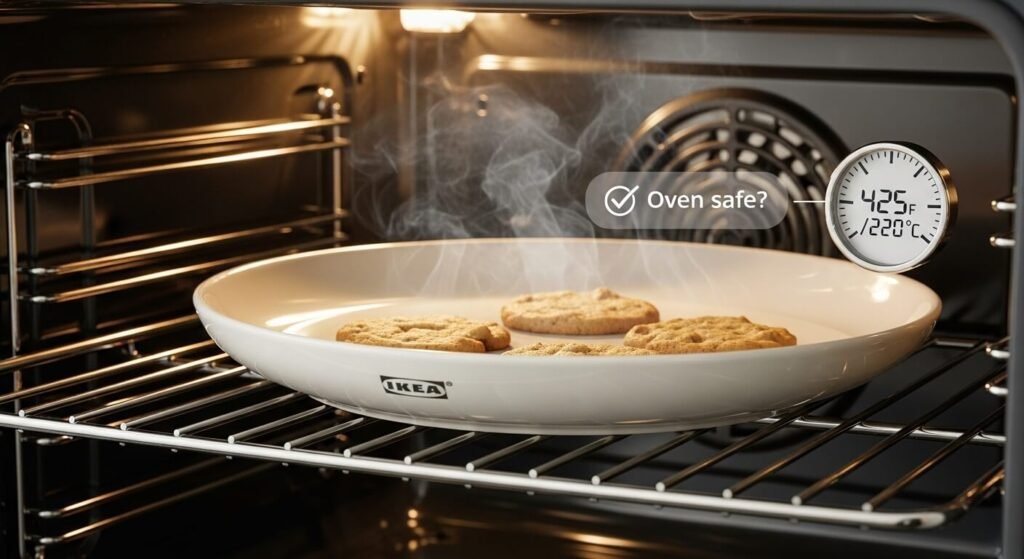
The quick answer: Most IKEA Plates Are Not Oven Safe.
Most IKEA dinner plates are designed for serving and microwave reheating — not sustained oven heat.
Only collections made from stoneware, oven-rated feldspar porcelain, or tempered glass carry an official oven-safe rating. If your plate doesn’t have the oven-safe symbol on the base, treat it as oven-unsafe regardless of how heat-resistant it feels.
What Makes a Plate Oven Safe vs. Microwave Safe — The Key Difference
The distinction matters more than most people realise. A microwave heats food using electromagnetic waves that pass through the plate rather than heating it directly, with temperatures rarely exceeding 100°C (212°F).
An oven uses sustained dry radiant and conductive heat that can climb to 250°C (482°F) or higher, applying that heat directly to the plate material for extended periods.
A plate can be perfectly safe in a microwave and still crack, craze, or shatter in an oven because the failure threshold is entirely different.
Why IKEA Labels Some Plates Microwave-Safe but Not Oven-Safe
IKEA assigns the microwave-safe symbol to plates whose glazes and materials don’t absorb microwave energy and don’t release harmful substances at reheating temperatures.
The oven-safe symbol is a separate, stricter certification — it means the material, glaze, and construction have been tested to withstand high sustained heat without structural failure.
Seeing “microwave safe” on the base of your IKEA plate tells you nothing about whether it can go in the oven. These are two independent ratings.
For a broader overview of what goes into each material type, see our guide to which types of dishes are safe for oven use.
IKEA Plate Materials and Oven Safety — What Each Type Can Handle
The material your IKEA plate is made from determines its oven limit. IKEA uses five main materials across its dinnerware lines, and each behaves differently under sustained heat.
Stoneware (GLADELIG, DINERA, DRAGON) — Oven Safe Up to 280°C/536°F
Stoneware is a dense, high-fired ceramic that handles thermal stress far better than standard porcelain. IKEA’s stoneware collections — including GLADELIG and DINERA — are rated oven safe to 280°C (536°F) and can go directly from the oven to the table.
| Collection | Material | Max Oven Temp | Notes |
|---|---|---|---|
| GLADELIG | Stoneware | 280°C / 536°F | Air fryer safe; oven-to-table use |
| DINERA | Stoneware | 230–280°C / check | Verify individual product label |
| DRAGON | Stoneware | 280°C / 536°F | Check product page for bowl/plate |
Feldspar Porcelain (IKEA 365+ Baking Dishes) — Oven Safe Up to 280–300°C
Feldspar porcelain is IKEA’s premium clay body, used in the IKEA 365+ bakeware range. The baking dishes — specifically the ovenproof variants — are rated to 280–300°C (536–572°F).
Note that IKEA 365+ dinner plates (flat, for serving) carry a different rating from the 365+ baking dishes — the dinner plates are microwave safe but not oven safe.
| Collection | Material | Max Oven Temp | Notes |
|---|---|---|---|
| IKEA 365+ Baking Dish | Feldspar porcelain | 280–300°C / 536–572°F | Ovenproof; confirms on product page |
| IKEA 365+ Dinner Plate | Feldspar porcelain | Not rated | Microwave safe only |
Tempered Glass (LÄTTVIKTIG) — Oven Safe to 280°C With Caveats
IKEA’s LÄTTVIKTIG range uses tempered borosilicate-style glass rated to 280°C (536°F). It is oven safe, but with firm usage rules:
- Never place a cold glass dish directly into a pre-heated hot oven — bring the dish and oven up to temperature together.
- Never place on a direct flame or stovetop burner.
- Inspect for chips or cracks before each use — damaged tempered glass can fail unpredictably under heat.
- Allow the dish to cool on a dry surface, not directly on a cold countertop, to avoid thermal shock on the way down.
Standard Porcelain / Vitrified China (FÄRGRIK, FLITIGHET) — NOT Oven Safe
FÄRGRIK and FLITIGHET are IKEA’s most popular everyday dinner sets. Both are made from standard vitrified porcelain — the same type used in most restaurant tableware. They are not oven safe. Placing them in a hot oven risks:
- Crazing (fine cracks in the glaze) from the thermal expansion difference between the glaze and clay body.
- Full fracture if moved from cold storage to a hot oven rapidly.
- Glaze discolouration or milky patches from prolonged heat exposure.
These plates are microwave safe and dishwasher safe — oven use is not supported.
Non-Tempered Glass Plates (Certain OFTAST Items) — NOT Oven Safe
OFTAST includes both tempered and non-tempered glass items. The non-tempered glass variants are not oven safe and should never be used in an oven or under a broiler.
Always check the base of your specific OFTAST item for the oven-safe symbol do not assume based on collection name alone.
IKEA Collection Oven Safety: The Complete Verdict Table
If you want the fast answer for your collection, find it here.
Collections That ARE Oven Safe (With Temperature Limits)
| Collection | Material | Max Temp (°C) | Max Temp (°F) | Air Fryer Safe? | Verdict |
|---|---|---|---|---|---|
| GLADELIG | Stoneware | 280°C | 536°F | ✓ Yes | ✅ Oven Safe |
| IKEA 365+ Baking Dish | Feldspar porcelain | 280–300°C | 536–572°F | Check label | ✅ Oven Safe |
| LÄTTVIKTIG | Tempered glass | 280°C | 536°F | Check label | ✅ With caveats |
| DINERA | Stoneware | 230–280°C | 446–536°F | Check label | ⚠️ Verify label |
| DRAGON | Stoneware | 280°C | 536°F | Check label | ✅ Oven Safe |
Collections That Are NOT Oven Safe
| Collection | Material | Why Not Oven Safe |
|---|---|---|
| FÄRGRIK | Vitrified china/porcelain | Not rated for sustained dry heat; risk of crazing |
| FLITIGHET | Feldspar porcelain (dinner) | Dinner plate variant; oven rating not assigned |
| OFTAST (non-tempered) | Standard glass | Not tempered; thermal shock risk |
| IKEA 365+ Dinner Plate | Feldspar porcelain | Serving plate only; the baking dish variant differs |
For a broader side-by-side of these lines, see our IKEA dinnerware collections compared guide.
How to Check If Your Specific IKEA Plate Is Oven Safe
Don’t rely on collection names alone — IKEA sometimes updates materials within a line. Here is how to verify your exact plate.
Step 1 — Find the Oven-Safe Symbol on the Bottom of the Plate
- Flip the plate over and look at the base.
- Find the oven symbol — it looks like a small square with wavy lines inside, sometimes with a flame below it.
- If you see this symbol, the plate is oven safe to the temperature shown (or to 280°C if no temperature is printed).
- If you see only the microwave symbol (wavy lines only, no box/flame), the plate is not oven safe.
- If there is no symbol at all, treat the plate as not oven safe.
Step 2 — Cross-Reference the IKEA Product Page or Packaging
- Find the product name and article number from the base of the plate or original packaging.
- Search that article number on IKEA’s website.
- Scroll to the product details section — IKEA lists “microwave safe,” “oven safe,” and “dishwasher safe” as explicit yes/no fields.
- If the product page says “oven safe: yes,” it will also list the maximum temperature.
Step 3 — When There’s No Symbol: The Safe Default Rule
If your plate has no symbol and you cannot find the product page, apply this rule: assume it is not oven safe and do not use it in the oven. The cost of being wrong is a shattered plate or a dangerous shard situation in a hot oven. Specific safe defaults to follow:
- Use only plates with a confirmed oven-safe symbol for any cooking, baking, or roasting task.
- For warming food at low heat, see the guidance in the FAQ below on safe low-temperature use.
- When in doubt, transfer food to a confirmed oven-safe dish before putting it in the oven.
Safe Practices When Using IKEA Plates in the Oven
Even oven-safe IKEA plates have limits. Understanding those limits prevents both plate damage and kitchen accidents.
Never Go From Freezer to Hot Oven — Thermal Shock
Thermal shock happens when a material experiences a rapid, extreme temperature change that causes uneven expansion or contraction across the plate.
The outer surface expands or contracts faster than the interior, creating internal stress that cracks or shatters the dish.
This is why an IKEA stoneware plate rated to 280°C can still crack if it goes straight from a cold fridge (4°C) into a 250°C oven — the rate of temperature change, not just the peak temperature, is what causes failure.
Always bring your plate from room temperature into the oven, and let it cool on a dry surface rather than placing it directly on a cold countertop.
Temperature Limits, Broiling, and What “Oven Safe” Doesn’t Cover
- Broiling is not the same as baking — broiler elements can exceed 315°C (600°F) and create direct radiant heat far above the 280°C rating of IKEA stoneware; do not use IKEA plates under a broiler.
- The 280°C rating applies to conventional oven heat only — it does not cover direct flame, stovetop, or broiler use.
- Do not exceed the rated temperature — running an oven at 300°C with a plate rated to 280°C shortens the life of the plate and risks cracking over time.
- Chipped or cracked plates should not go in the oven — existing damage creates stress concentration points that can cause failure even below the rated temperature.
- Air fryer temperatures typically reach 200–220°C — within the GLADELIG stoneware limit, but verify the specific air fryer’s maximum output before use.
Can You Use IKEA GLADELIG Plates in an Air Fryer?
Yes — GLADELIG stoneware plates are rated to 280°C, which is above the operating temperature of most household air fryers (typically 180–220°C).
IKEA’s product documentation for GLADELIG confirms oven and air fryer compatibility. The same thermal shock rules apply: don’t put a cold plate into a pre-heated air fryer basket; let it come to room temperature first.
Check that your plate physically fits the air fryer basket without touching the heating element.
Read our full review of the IKEA GLADELIG collection for sizing, durability notes, and usage tips.
Looking for a confirmed oven-safe IKEA collection? GLADELIG stoneware and the IKEA 365+ baking range are both rated to 280°C and designed for oven-to-table use.
→ Check IKEA Oven-Safe Dinnerware → Check the IKEA 365+ Baking Range → Or compare the best oven-safe dinnerware sets across all brands.
Frequently Asked Questions About IKEA Plate Oven Safety
Can IKEA FÄRGRIK plates go in the oven?
No — FÄRGRIK plates are made from vitrified china/porcelain and are not rated for oven use. They are microwave safe and dishwasher safe, but sustained oven heat will cause the glaze to craze or the plate to crack.
Use a confirmed oven-safe collection like GLADELIG if you need to cook or heat food in the oven.
What is the maximum oven temperature for IKEA stoneware
IKEA stoneware collections (GLADELIG, DRAGON, and most DINERA variants) are rated to a maximum of 280°C (536°F) in a conventional oven. Do not exceed this temperature, and never use stoneware under a broiler, which can surpass that limit.
Can I use an IKEA plate to keep food warm in the oven?
Yes, with conditions. At 60–80°C (140–175°F) — a typical “keep warm” oven setting — most IKEA plates, including non-oven-safe porcelain, can safely hold food that is already at room temperature, provided you place the cold plate in a cold oven and bring both up to temperature slowly.
Do not exceed 80°C for non-rated plates, use a baking tray rather than the bare oven rack, and do not leave the plate in longer than needed.
This is a low-heat warming scenario only — it does not make a non-oven-safe plate safe for cooking.
If food safety is your broader concern, our guide on whether IKEA dishes are lead-free covers material safety in detail.
Why did my IKEA plate crack in the oven?
The most common cause is thermal shock — moving a cold plate into a hot oven too quickly. Even oven-safe stoneware can crack if taken from the fridge and placed directly into a 220°C oven.
The second most likely cause is using a plate that is not oven-safe at all. Check the base of any surviving plates for the oven-safe symbol before using them in the oven again.
Are IKEA 365+ dinner plates (not baking dishes) oven safe?
No, the IKEA 365+ dinner plates are marked microwave safe, not oven safe. The oven-safe certification applies specifically to the 365+ baking dish variants. Check the article number on the IKEA product page to confirm which version you have.
Does “microwave safe” on IKEA plates mean oven safe too?
No — these are entirely separate ratings. Microwave safe means the material doesn’t absorb microwave energy and is safe at the low temperatures microwave reheating reaches (typically under 100°C).
Oven safe means the material withstands sustained dry heat up to 280°C or higher. An IKEA plate can carry one label without the other. Always look specifically for the oven-safe symbol, a square with wavy lines and a flame, not just the microwave symbol.
About the Author & Reviewer
Sarah Emirone, Author
Sarah researches and writes SafeKitchn’s dinnerware and kitchenware guides, with a focus on material safety, lead content, and manufacturer specifications. She cross-references product data sheets, safety certifications, and regulatory filings (including FDA and Prop 65 records) before publishing, and updates articles when new information becomes available.
James Daniels, Reviewer
James reviews SafeKitchn’s material safety content for scientific accuracy. He holds a B.Sc in inorganic chemistry and works as a materials researcher, with particular focus on the composition and safety behavior of glass, ceramic, and metal used in kitchenware.