

Today, we will be looking into the question: Is Corelle Livingware by Corning lead free?
This question has a two-part answer: the Vitrelle glass that forms every dish is lead-free across all production eras. The lead risk, where it exists, comes entirely from decorative glazes and decals on the surface, not from the glass itself.
Plain white pieces are safe regardless of age. Pre-2005 patterned pieces may contain significant lead and cadmium. Getting the right answer requires knowing what “Livingware” actually is, a discontinued product line, not a material, and which era and pattern you own.
Written by Sarah Emirone | Reviewed by James Daniels, B.Sc, Inorganic Chemist & Materials Researcher | Updated September 2026 | See How We Test | Filed under: Material Safety & Lead Testing
What Is Corelle Livingware — and How Is It Different from Vitrelle?
“Corelle Livingware” and “Vitrelle” are not interchangeable. Vitrelle is the patented glass material; Livingware was a specific product collection built from that material, active from 1970 to 2018.
Conflating the two is why most people searching this question cannot get a clear safety answer; they are asking about a product line name, while the safety data is organized by material and era.
Vitrelle — the material; Livingware — the product line
Vitrelle: Corning’s patented triple-layer thermally bonded glass — two outer clear-glass layers fused around a middle core. Non-porous, chemically inert, and lead-free in every production era. The glass substrate itself has never contained lead.


Livingware: One specific Corelle collection made from Vitrelle glass. The relationship is analogous to cotton (the material) and a particular shirt line (the product).
The Livingware collection timeline — 1970 launch, 2018 retirement
| Era | Owner | Lead-safety status |
|---|---|---|
| 1970–1990 | Corning Glass Works | High risk (patterned) — lead-based glazes standard; some patterns >18,000 ppm XRF |
| 1990–2005 | World Kitchen | Transitional — inconsistent reformulation by pattern |
| 2005–2018 | World Kitchen / Instant Brands | Lead-free enamels confirmed — Prop 65 and FDA pressure drove full transition |
| 2018 | Instant Brands | Livingware retired; replaced by Classic, Signature, Boutique, Bistro Studio |
Is the Vitrelle Glass Itself Lead Free?
Yes — the Vitrelle glass substrate is lead-free in every production era. Lead was never an ingredient in the glass itself. Independent XRF testing of undamaged plain white Corelle consistently returns non-detect results for both lead and cadmium.
How Vitrelle glass is made — and why lead was never in the substrate
Vitrelle is produced by thermally fusing three glass layers without adhesives or coatings.
The resulting material is non-porous and chemically inert. Professional XRF instruments confirm the glass layers read non-detect for lead across all production years. The risk is exclusively in what was applied to the surface: decorative glazes, decals, and painted patterns.
What plain white Corelle Livingware tests show
- Plain white Livingware (White Frost) tests negative for lead in multiple independent XRF assessments, because no decorative glazes or pigments are present — only inert Vitrelle glass.
- This safety finding applies to all production eras, including 1970s and 1980s pieces: an undamaged, undecorated white dish from any year is safe for food use.
- The one caveat is physical condition: if any piece is fractured and removed, as the fracture surface can harbour bacteria, and the chip debris presents an ingestion risk unrelated to lead.
Where Lead Actually Comes From in Corelle Livingware
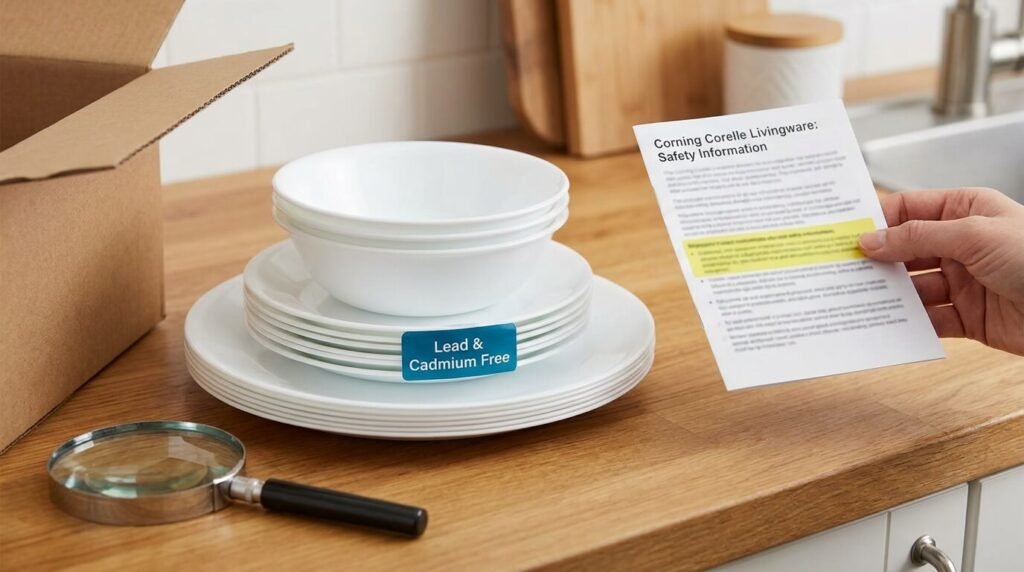
Lead in Corelle Livingware comes from decorative glazes, ceramic decals, and painted patterns, not from the glass. This single distinction resolves most of the confusion around Corelle safety claims.
Why manufacturers used lead in decorative glazes historically
Lead served two functions: it lowered the melting temperature of pigment glazes (flux), and hardened the finished surface.
Both made lead-containing glazes the global industry standard through the 1980s. A Corelle representative confirmed: “Before the 1990s, virtually all glass and ceramic ware made anywhere in the world contained lead.” Regulatory pressure ended the practice, not voluntary action.
Cadmium — the co-toxicant found alongside lead in patterned Livingware
Many pre-2005 patterned Livingware pieces that contain lead also contain cadmium — a Group 1 human carcinogen that bioaccumulates in the kidneys with a biological half-life measured in decades. Chronic low-level exposure from daily dishware use is the primary risk pathway.
- The FDA leachable-cadmium limit for dinnerware is 0.5 mg/cm²; the threshold considered unsafe in children’s items is 75 ppm total content.
- XRF testing documented cadmium alongside lead in these patterns: Spice and Leaf — 557 ppm (+ 42,900 ppm lead); Vintage Cream — 150 ppm (+ 28,500 ppm lead); Blue Snowflake — 69 ppm (+ 7,823 ppm lead); Old Town Blue — cadmium present (+ 18,200 ppm lead).
- Spice and Leaf’s cadmium level exceeds the 75 ppm children ‘s-item threshold more than seven times.
- Cadmium, sharing the same exposure pathway as lead, reinforces the case for retiring all pre-2005 patterned pieces from food use.
Pre-2005 vs Post-2005 Corelle Livingware — The Lead Safety Dividing Line
Complete vintage Corelle safety guide by pattern and era covers the full pattern database, but 2005 is the critical dividing line.
Post-2005 Livingware uses confirmed lead-free enamels. Pre-2005 patterned Livingware carries a meaningful risk that varies by pattern and glaze condition.
What changed in 2005 — regulatory pressure and lead-free enamels
California’s Proposition 65 — requiring warnings before exposing consumers to listed chemicals, including lead and cadmium created substantial commercial pressure on US dinnerware manufacturers in the early 2000s.
The FDA simultaneously tightened leachable-lead guidelines for food-contact surfaces. Corelle (then World Kitchen) completed its transition to lead-free decorative enamels by 2005, a change Instant Brands has confirmed via third-party testing.
Era-by-era safety comparison table for Corelle Livingware
| Era | Decoration | Lead risk | Cadmium risk | Recommendation |
|---|---|---|---|---|
| 1970–1990 patterned | Lead-based glazes | High — 7,000–43,000 ppm XRF | Present in many patterns | Retire; decorative use only |
| 1970–1990 plain white | None | None detected | None detected | Safe; check for chips |
| 1990–2005 patterned | Mixed reformulation | Moderate — varies by pattern | Present in some patterns | Test before continued use; retire if chipped |
| 1990–2005 plain white | None | None detected | None detected | Safe for food use |
| 2005–2018 any pattern | Lead-free enamels | None confirmed | None confirmed | Safe per current standards |
Which Corelle Livingware Patterns Contain Lead — XRF Test Data
Corelle patterns have been independently tested for lead coverage of the full database?
Before reviewing figures, one distinction is essential: XRF measures total lead in the decoration; FDA’s standard measures leachable lead migrating into food. Both numbers matter, and they are not the same measurement.
Patterns with documented high lead levels (with ppm figures)
| Pattern | Era | XRF lead (ppm) | Cadmium (ppm) | Verdict |
|---|---|---|---|---|
| Spice and Leaf | 1972–1979 | 42,900 | 557 | Retire immediately |
| Blue & Yellow Floral w/ Butterflies | 1970s–1980s | 41,500 | Present | Retire immediately |
| Vintage Cream (floral) | 1970s–1980s | 28,500 | 150 | Retire immediately |
| Butterfly Gold | 1970–1988 | 18,700 | Present | Retire immediately |
| Old Town Blue | 1972–1982 | 18,200 | Present | Retire immediately |
| Spring Blossom / Crazy Daisy | 1970–1987 | 15,200 | Present | Retire immediately |
| Blue Snowflake | 1970s–1980s | 7,823 | 69 | Retire immediately |
| Basket with Flowers | 1970s–1980s | 2,406 | Present | Retire immediately |
XRF data from Lead Safe Mama independent testing. All figures are total lead in decorative areas, not leachable lead.
The difference between XRF-detected lead and leachable lead — why both matter
Corelle’s compliance claims and independent XRF results appear contradictory, but they measure fundamentally different things:
XRF total lead: All lead in the decoration, including lead encapsulated beneath intact glaze. A Butterfly Gold plate at 18,700 ppm does not mean 18,700 ppm enters your food.
FDA leachable lead (ASTM C738): Only the lead that migrates into a standardized acidic solution. The FDA limit is ≤3 ppm for flatware. An intact piece may meet this standard despite high XRF figures.
The critical variable is glaze condition and food type. An intact piece with high XRF lead may leach minimally with neutral foods. The same piece with a chip, or used to heat acidic foods in a microwave, leaches significantly more.
Corelle’s compliance claim and Lead Safe Mama’s XRF readings are both accurate: they represent different ends of the exposure range, and real-world risk falls between them.
Corelle’s Official Position vs Independent Testing — What Each Shows
Neither source alone gives the complete picture. Reading both together, with the XRF vs leachable distinction in mind, produces the most accurate risk assessment.
What Corelle (Instant Brands) has publicly stated
- All Corelle testing uses leachable-lead methodology (ASTM C738), not XRF total-content measurement — the two produce incomparable figures.
- Corelle’s 2022 statement was the first public confirmation that lead was used in pre-2000 decoration, described as “a small amount of lead was an ingredient in the decorating process of many household products.”
- Corelle itself recommends pre-2005 dishes as “decorative pieces” — the manufacturer’s own acknowledgment that they are not suitable for everyday food use.
What independent XRF testing actually found — Lead Safe Mama data
- Lead Safe Mama (Tamara Rubin) published specific ppm results by pattern name via professional XRF instruments — a transparency level that Corelle’s statements have not matched.
- A New Hampshire DHHS Facebook post warning consumers about pre-2005 Corelle went viral in 2022 with more than 77,000 shares, citing Lead Safe Mama data and Corelle’s own decorative-use recommendation.
- NH DHHS updated the post to clarify that elevated lead is “most dangerous in young children and pregnant mothers” and that decades of daily use can deteriorate decoration and increase leaching.
- Independent testing consistently finds zero lead in plain white Corelle across all eras, confirming the Vitrelle glass substrate is inert.
How to Assess Whether Your Specific Corelle Livingware Is Lead Free
Whether your specific Livingware is lead-free depends on three variables: decoration, production era, and glaze condition.
Step-by-step decision framework — white or patterned, era, condition
- Is your piece plain white with no patterns, colored bands, or decals? → Lead-free in any era. Continue using it; inspect periodically for chips.
- Does it have any decoration? → Proceed to step 3.
- Was it made after 2005? → Post-2005 Corelle uses confirmed lead-free enamels; safe for food use.
- Was it made before 2005? → Identify the pattern name from the underside stamp and cross-reference against the XRF table above.
- Is the decoration chipped, worn, or visibly deteriorated? → Retire it from food use regardless of pattern. See how to safely dispose of Corelle dishes that contain lead for removal options.
- Still uncertain? → Test with a home lead kit or professional XRF.
Home lead test kits for Corelle — what they measure and their limits
- Swab-based kits ($10–$30 at hardware stores) detect surface lead on the decorated area with a colour-change result in seconds — a useful first-pass screen.
- Chemical reagent kits offer marginally higher sensitivity but still detect only surface-accessible lead, not lead encapsulated beneath intact glaze.
- Professional XRF testing ($25–$75 per item) measures total lead content and is the most useful option if young children or a pregnancy is involved.
- A positive result from any kit type on a pre-2005 patterned piece is a clear signal to retire the dish from food use.
- See how to test your Corelle dishes for lead at home for the full testing process.
What Current Corelle Collections Replaced Livingware — and Are They Lead Free?
The Livingware collection was retired in 2018. All current Corelle dinnerware uses Vitrelle glass with confirmed lead-free and cadmium-free enamels, compliant with Prop 65 and FDA food-contact standards.
For non-Corelle alternatives, see the best lead-free dinnerware alternatives for families.
Current Corelle collections and their lead-free status
| Collection | Material | Lead-free | Cadmium-free | Microwave safe | Dishwasher safe |
|---|---|---|---|---|---|
| Classic | Vitrelle glass | ✅ Yes | ✅ Yes | ✅ Yes | ✅ Yes |
| Signature | Vitrelle glass | ✅ Yes | ✅ Yes | ✅ Yes | ✅ Yes |
| Boutique | Vitrelle glass | ✅ Yes | ✅ Yes | ✅ Yes | ✅ Yes |
| Bistro Studio | Vitrelle glass | ✅ Yes | ✅ Yes | ✅ Yes | ✅ Yes |
How to verify a Corelle product is lead-free before buying
- Check packaging for explicit “lead-free” and “cadmium-free” labelling — all post-2018 Corelle products include this.
- Confirm the collection name is one of the four current lines (Classic, Signature, Boutique, Bistro Studio), not a vintage or discontinued pattern name.
- For secondhand purchases, check the underside for a date code or pattern name and cross-reference with the era table above.
- When the origin is uncertain, a $10–$15 home swab kit provides a rapid screen before first use.
Frequently Asked Questions
Is plain white Corelle Livingware safe to use regardless of age?
Yes. Plain white undecorated Livingware — including 1970s and 1980s production — tests negative for lead because no decorative glazes are present. Retire any piece that chips or cracks, as the fracture creates ingestion risk unrelated to lead.
Which Corelle Livingware patterns have the highest lead levels?
Based on independent XRF testing: Spice and Leaf (42,900 ppm), Blue and Yellow Floral with Butterflies (41,500 ppm), Vintage Cream floral (28,500 ppm), Butterfly Gold (18,700 ppm), Old Town Blue (18,200 ppm), and Spring Blossom / Crazy Daisy (15,200 ppm).
All figures are total lead in decorative areas, not leachable lead.
Is it safe to buy vintage Corelle Livingware from thrift stores
Only if you can confirm the piece is plain white or post-2005. Vintage patterned Livingware of unknown era carries unquantified lead and cadmium risk. If you cannot verify the origin, run a home swab test on the decoration before first food use.
When did Corelle (Corning) stop putting lead in its Livingware dishes?
Full transition to lead-free enamels was complete by 2005, driven by Prop 65 and tightening FDA guidelines. The 2005 date marks the reformulation’s completion, not its start; Corelle’s 2022 statement confirmed lead was standard practice in pre-2000 decoration.
Does chipping or cracking Corelle Livingware increase lead exposure?
Yes, significantly. Intact glaze encapsulates lead beneath the surface, limiting migration into food. A chip or worn area removes that barrier, directly exposing lead-containing material to food and liquids.
Any pre-2005 patterned piece with visible glaze damage should be removed from food use immediately.
Is microwave use more likely to leach lead from patterned Corelle Livingware?
Yes, when the dish contains acidic food and has any decoration on the food-contact surface. Heat accelerates lead migration from glaze into food, and acidic foods (tomato sauce, citrus, vinegar) further increase leaching rates.
Using pre-2005 patterned Livingware to microwave acidic foods is the highest-risk scenario, as it combines heat, acid, and extended contact time simultaneously.
About the Author & Reviewer
Sarah Emirone, Author
Sarah researches and writes SafeKitchn’s dinnerware and kitchenware guides, with a focus on material safety, lead content, and manufacturer specifications. She cross-references product data sheets, safety certifications, and regulatory filings (including FDA and Prop 65 records) before publishing, and updates articles when new information becomes available.
James Daniels, Reviewer
James reviews SafeKitchn’s material safety content for scientific accuracy. He holds a B.Sc in inorganic chemistry and works as a materials researcher, with particular focus on the composition and safety behavior of glass, ceramic, and metal used in kitchenware.