

If you’ve recently discovered your vintage dinnerware may be contaminated, you need clear steps on how to dispose Corelle dishes that contain lead, not more anxiety about whether they’re dangerous.
The short answer: federal law permits regular household trash disposal, and that is the most practical route for most people. You do not need to treat them as industrial hazardous waste.
This guide covers every disposal method available for trash, household hazardous waste programs, and responsible repurposing, plus how to handle the dishes safely and clean your kitchen afterward.
Written by Sarah Emirone | Reviewed by James Daniels, B.Sc, Inorganic Chemist & Materials Researcher | Updated September 2026 | See How We Test | Filed under: Material Safety & Lead Testing
First, Confirm Your Dishes Actually Contain Lead
Before deciding how to dispose of your Corelle, confirm whether lead is actually present.
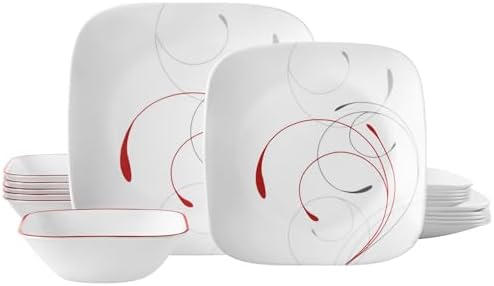
Which vintage Corelle patterns tested positive for lead is well-documented: pre-2005 pieces with brightly colored decorative patterns — Butterfly Gold, Spring Blossom (Crazy Daisy), Old Town Blue — are the primary concern.
Undamaged white or undecorated Corelle carries far lower risk. Corelle’s own 2022 statement recommended that pre-2005 patterned dishes be used as decorative pieces only.
Home lead test kits — what they can and cannot tell you
- Swab-based test kits ($10–$30 at hardware stores) detect surface lead on decorated dish areas and return a color-change result within seconds — a practical first filter.
- Home chemical test kits offer slightly more sensitivity than swabs, but still measure only what is accessible at the surface layer.
- Neither type detects lead fully encapsulated beneath intact glaze — a negative result confirms no current surface leaching, not zero lead content.
- A positive result from either kit is a clear signal to remove and dispose of the dish immediately.
When to use professional XRF or lab testing
Professional XRF testing — the method used by the Consumer Product Safety Commission, measures total lead content in parts per million across the entire dish.

This level of testing is warranted if you have children under six, are pregnant, or have used heavily worn, patterned vintage Corelle daily for years.
Independent XRF testing has recorded lead levels in some 1970s–1980s Corelle patterns exceeding 15,000 ppm in the decorative areas, well above the 90 ppm limit now applied to children’s products.
How to test your Corelle dishes for lead at home covers the full process in detail.
Is It Legal to Throw Corelle Dishes with Lead in the Trash?
Yes — under federal law, disposing of lead-containing household items in regular municipal trash is fully legal. This is the most commonly misunderstood aspect of this topic, and the anxiety it produces is unnecessary.
The federal household waste exemption
40 CFR 261.4(b)(1) — Summary
The Resource Conservation and Recovery Act (RCRA) classifies waste from residences as household solid waste, explicitly excluded from regulated hazardous waste status — regardless of what the waste contains. The EPA’s own FAQ on lead-contaminated consumer items confirms: “consumers that qualify as a household may dispose of their lead-contaminated [items] in the same manner that they discard ordinary household trash.”
Corelle dishes with lead, generated in a private home, are household waste. They require no hazardous waste manifests, licensed haulers, or special permits under federal law.
State and local regulations that may differ
- California and several other states operate under stricter environmental regulations than federal minimums — check your county waste authority before trash disposal.
- Some municipalities encourage (but do not mandate) HHW disposal for known lead-containing items, even where trash disposal is technically legal.
- To verify your local rules: search “[your county] household hazardous waste guidelines” or call your local solid waste authority directly.
How to Dispose Corelle Dishes that Contain Lead in Regular Trash (Step-by-Step)
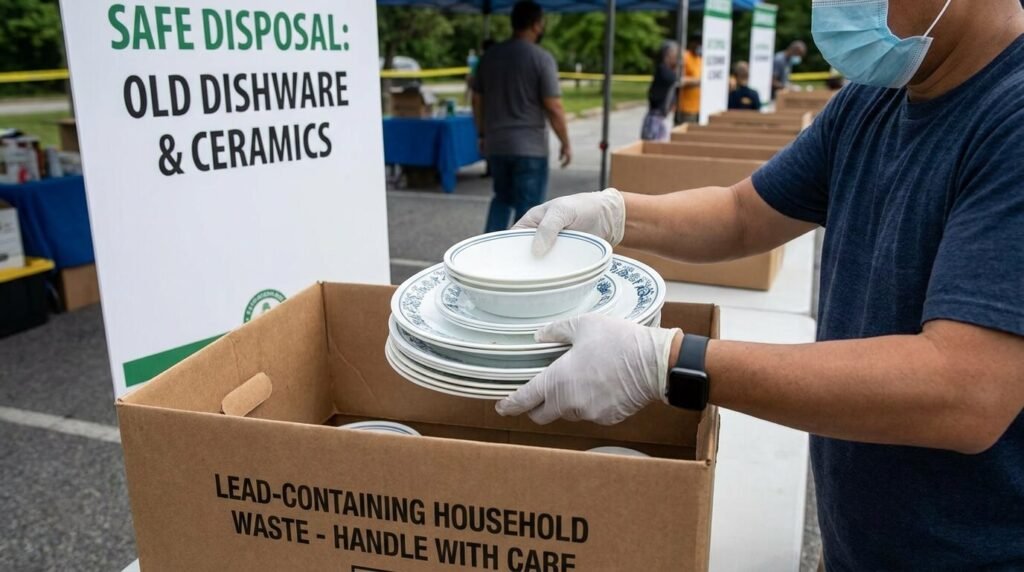
For most households, regular trash is the correct and federally legal route. Follow these steps to protect yourself and sanitation workers.
- Put on nitrile or latex gloves before handling dishes intended for disposal.
- Do not stack dishes loosely in a trash bag — intact Corelle is a cutting hazard if the bag splits.
- Score and snap rather than crush dishes that need to be broken down — see the safe handling section below for why this matters.
- Wrap shards in newspaper or place them in a puncture-resistant inner bag before the main trash bag.
- Double-bag and tie securely; label the outer bag “Glass — handle with care.”
- Place in your municipal bin for regular collection — no special lead labeling is required under federal household waste rules.
Safe handling — avoiding lead dust and glass shards
Breaking Corelle the wrong way is the primary safety risk during disposal. Several published guides recommend “breaking or crushing” dishes without addressing what this releases.
Violently shattering lead-decorated dishes can briefly suspend fine particulate, including lead-containing pigment from the decorative glaze, in the air. The correct protocol:
- Score, don’t smash. Use a glass cutter or controlled edge pressure to break the dish into pieces rather than shattering it with force.
- Work on a damp surface or lay the dish on damp newspaper — this suppresses fine particulate at the point of fracture.
- Do not dry-sweep the break area. Wipe immediately with a damp cloth or damp paper towel.
- Bag the damp wipe material immediately in a sealed plastic bag before disposing.
- Wash your hands thoroughly with soap and water after the entire process.
How to wrap and bag leaded Corelle for sanitation workers
- Place broken pieces into a doubled layer of newspaper, folding all edges closed so no glass is exposed.
- Transfer the wrapped bundle into a tied or sealed plastic bag.
- Place this inner bag inside your main trash bag — never lose broken glass directly into a bin liner.
Household Hazardous Waste (HHW) Programs — A Safer Alternative
If you prefer not to use regular trash, or your local authority recommends HHW disposal for lead-containing items, household hazardous waste programs are a free and legitimate alternative.
Most counties operate permanent drop-off facilities or periodic collection events for items including lead-containing dishware, batteries, and paint.
How to find your local HHW drop-off or collection event
Household hazardous waste programs by state vary by location. To find yours:
- Visit earth911.com and search “household hazardous waste” with your zip code.
- Search your county government website for “hazardous waste disposal” or “HHW drop-off.”
- Call your local solid waste authority directly to confirm leaded dishware is accepted and whether any prep is required.
- Check for quarterly one-day collection events, which typically accept a broader range of materials than permanent facilities.
What to expect at the HHW facility — accepted items and prep
- Call ahead to confirm glass dishware with lead decoration is on the accepted items list — some facilities focus on liquids and electronics only.
- Pack dishes in sealed plastic bags labeled “Possible lead-containing dishware” before transporting.
- Most residential HHW drop-offs are free; some charge a small fee for larger quantities.
- No paperwork or proof of lead testing is required — staff handles sorting and disposal after drop-off.
Can You Recycle Corelle Dishes with Lead?
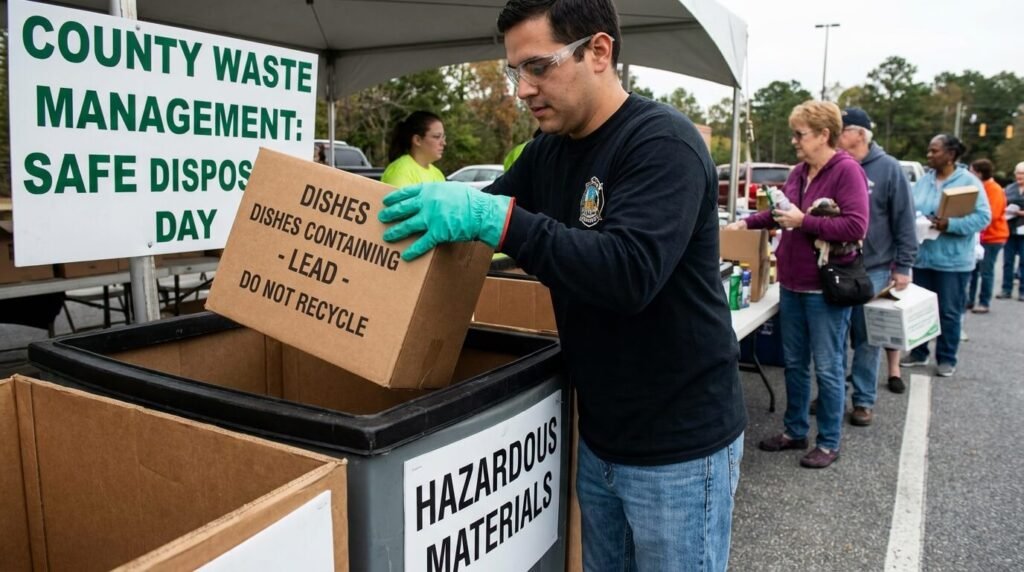
In most locations, Corelle cannot be recycled through standard curbside glass programs, and attempting to do so can contaminate an entire recycling batch. This is primarily a materials issue, not just a lead issue.
Why most glass recyclers won’t accept Corelle
- Corelle is made from Vitrelle — a tempered, triple-layer laminated glass with a higher melting point than standard container glass (bottles and jars).
- When Vitrelle enters a standard glass batch, it does not melt at the same temperature, creating weak points in the recycled output.
- Most municipal programs explicitly exclude all tempered and ceramic glass, including Pyrex and Corelle, for this reason.
When glass recycling IS accepted — and how to check locally
- Check your municipal recycling program’s accepted materials list online.
- Call your local recycling coordinator and specifically ask: “Do you accept tempered or vitrified glass dinnerware?”
- If your metro area has a specialty glass recycler, contact them directly — some accept non-container glass for aggregate applications where lead content is less of a concern.
Should You Donate or Sell Corelle Dishes That Contain Lead?
No. Donating or selling Corelle dishes you know or suspect contain lead transfers the health hazard to someone with no knowledge of the risk.
Thrift stores and online marketplaces regularly move vintage Corelle to buyers who will use it for food. Complete guide to lead safety in vintage Corelle documents the specific patterns and lead levels that make this a genuine concern.
Why donation and resale transfer the hazard — and your liability
A buyer at a thrift store has no way to know the dishes contain lead unless you disclose it.
Beyond the ethical issue, knowingly selling items with undisclosed safety hazards can create civil liability in some jurisdictions. Leaving dishes at the curb with a “free” sign carries the same problem.
The one exception — museum donation or lead-safety advocacy collections
Lead safety advocate Tamara Rubin (Lead Safe Mama) has documented accepting vintage lead-containing dishware for research and museum purposes.
If you have a well-documented high-lead pattern and are in contact with a verified advocacy organization that has explicitly requested donations, that narrow context is the one case where passing the dishes on serves a public benefit rather than creating a new hazard.
Repurposing Leaded Corelle — What Is and Isn’t Safe
| Repurposing Use | Safe? | Notes |
|---|---|---|
| Decorative wall display | ✅ Yes | No food contact; lead stays in glaze |
| Dry trinket or key dish | ✅ Yes | No wet or acidic items in contact |
| Plant pot (non-edible plants) | ⚠️ Caution | Lead can leach into the soil with watering |
| Mosaic craft material | ⚠️ Caution | Wear gloves when cutting; seal the finished piece |
| Bird feeder or bird bath | ❌ No | Wildlife lead exposure risk |
| Pet food or water bowl | ❌ No | Direct food contact; same risk as human use |
| Children’s play dishes | ❌ No | Young children mouth objects; high exposure risk |
Safe non-food uses — decorative display, planters, crafts
- Mount dishes in a wall display or glass cabinet where food contact is impossible, and handling is occasional.
- Use as a dry decorative bowl for keys or candles — no acidic or liquid contents that could increase surface leaching.
- Incorporate into sealed mosaic projects wearing nitrile gloves; use sealed grout to encapsulate any exposed edges.
Uses to avoid — pet bowls, outdoor food prep, children’s play
- Pet bowls: Acidic pet food and repeated washing degrade the glaze over time, increasing lead leaching — the exposure risk applies equally to pets.
- Edible garden planters: Do not grow herbs or vegetables in leaded Corelle; lead can accumulate in edible soil.
- Children’s play kitchen items: Children under six are most vulnerable to lead, and they regularly mouth objects during play.
Clean Up After Removing Leaded Corelle From Your Kitchen
Removing the dishes is not the final step. Decades of stacking lead-decorated dishes can leave trace deposits on the shelf surfaces where they were stored particularly if any dishes were chipped or had worn glaze.
How to clean shelves and cupboards that held lead dishware
- Put on nitrile gloves before touching the shelf surfaces.
- Dampen a disposable cloth with an all-purpose household cleaner — do not dry-dust, which can suspend particles.
- Wipe all shelf surfaces where dishes rested, working from back to front; use a fresh, damp cloth for each shelf.
- If you have a HEPA vacuum, run the attachment lightly over the shelf after wiping.
- Seal used wipes, gloves, and any shelf paper in a plastic bag, tie it, and dispose of it in regular household trash.
- Wash your hands thoroughly with soap and water.
When professional lead remediation is worth considering
For most households, the wipe-down above is sufficient.
Consider a professional lead assessment if you have children under six with known elevated blood lead levels, XRF testing showed patterns above 10,000 ppm that were used heavily for years, or your local health department offers a free home assessment.
Most health departments provide free home lead assessments for households with young children call your county directly.
What to Replace Your Corelle Dishes With
Once your leaded dishes are gone, a certified lead-free replacement removes the ongoing risk entirely.
Lead-free materials at a glance — borosilicate glass, stainless, bamboo
| Material | Lead-free | Microwave safe | Dishwasher safe | Approx. cost per place setting |
|---|---|---|---|---|
| Borosilicate glass | ✅ Yes | ✅ Yes | ✅ Yes | $20–$50 |
| Tempered soda-lime glass | ✅ Yes | ✅ Yes | ✅ Yes | $10–$30 |
| Stainless steel | ✅ Yes | ❌ No | ✅ Yes | $15–$40 |
| Bamboo composite | ✅ Yes | ❌ No | ⚠️ Hand wash | $10–$25 |
| Modern Corelle (post-2005) | ✅ Yes | ✅ Yes | ✅ Yes | $15–$35 |
Best lead-free dinnerware alternatives for families covers the full comparison. Borosilicate glass is the closest match to Corelle in weight and durability; stainless steel is the most durable for households with young children.
Does Corelle offer a replacement program for leaded dishes?
Instant Brands conducted additional safety testing on pre-2000 vintage patterns beginning in 2022, and a replacement program was reported for some patterns.
Program availability has changed over time — check corelle frequently asked questions directly or call Instant Brands consumer support to confirm current eligibility and terms.
Ready to act? Find your local HHW drop-off at earth911.com or the EPA waste locator at epa.gov. Once your dishes are gone, explore our best non-toxic dinnerware alternatives for families (link above) for a safe replacement.
Frequently Asked Questions
Do I need to declare lead dishes as hazardous waste
No, for residential households. Federal EPA regulations explicitly exclude all household waste from RCRA hazardous waste regulation, regardless of lead content.
Businesses disposing of large commercial quantities may face different rules — check with your state environmental agency.
Can breaking Corelle release lead dust?
Yes, if broken carelessly. Violently shattering lead-decorated dishes can briefly generate airborne fine particulate containing lead pigment.
Score and snap rather than smash, work on a damp surface, and wipe the break area with a damp cloth immediately, rather than sweeping.
My child ate from leaded Corelle — what should I do?
Contact your child’s pediatrician immediately and request a blood lead level test — this is the only way to measure actual exposure. Signs of lead exposure in children and what to do next outlines what elevated results mean and what follow-up care looks like.
Can I use leaded Corelle as a plant pot?
For non-edible plants, it is generally acceptable as a display planter, though lead can leach into the soil with repeated watering. Do not grow herbs, vegetables, or any edible plants in leaded Corelle, and avoid use as a bird feeder or bird bath.
How long does lead remain dangerous on dish surfaces?
Indefinitely. Lead in glaze does not break down or become inert over time. Chips, cracks, and glaze wear increase the rate of leaching — age and use make the hazard worse, not better.
About the Author & Reviewer
Sarah Emirone, Author
Sarah researches and writes SafeKitchn’s dinnerware and kitchenware guides, with a focus on material safety, lead content, and manufacturer specifications. She cross-references product data sheets, safety certifications, and regulatory filings (including FDA and Prop 65 records) before publishing, and updates articles when new information becomes available.
James Daniels, Reviewer
James reviews SafeKitchn’s material safety content for scientific accuracy. He holds a B.Sc in inorganic chemistry and works as a materials researcher, with particular focus on the composition and safety behavior of glass, ceramic, and metal used in kitchenware.