

Vitrified porcelain dinnerware is porcelain that has been fired at temperatures between 1,200°C and 1,400°C (2,200°F–2,550°F) until its clay particles fuse into a dense, glass-like, non-porous structure.
The result is a material that does not absorb water, resists staining and bacterial growth, and handles the repeated stress of daily dishwasher cycles without degrading.
It is the dominant material in professional restaurant and hotel dining worldwide, and it has become an increasingly common choice for households that want dinnerware that performs like a workhorse while looking refined enough for guests.
If you have seen the term “vitrified” on dinnerware packaging and were not sure what it meant or why it mattered, this guide explains the process, clarifies how vitrified porcelain compares to every other ceramic dinnerware material, addresses the safety questions most buyers encounter, and tells you what to look for when buying.
Written by Sarah Emirone | Reviewed by James Daniels, B.Sc, Inorganic Chemist & Materials Researcher | Updated September 2026 | See How We Test | Filed under: Buying, Care & Product Guides
What Vitrification Actually Means — and Why It Changes Everything
Vitrification is not a coating or glaze applied to the surface of the dinnerware after firing. It is a physical transformation that happens inside the clay body itself during the firing process.
Understanding this distinction is what separates an informed dinnerware purchase from a confused one.
The Firing Process That Creates Vitrified Porcelain Dinnerware
Standard ceramic clay is composed of particles that, when fired at low to moderate temperatures (below approximately 1,150°C), remain distinct and retain spaces between them.
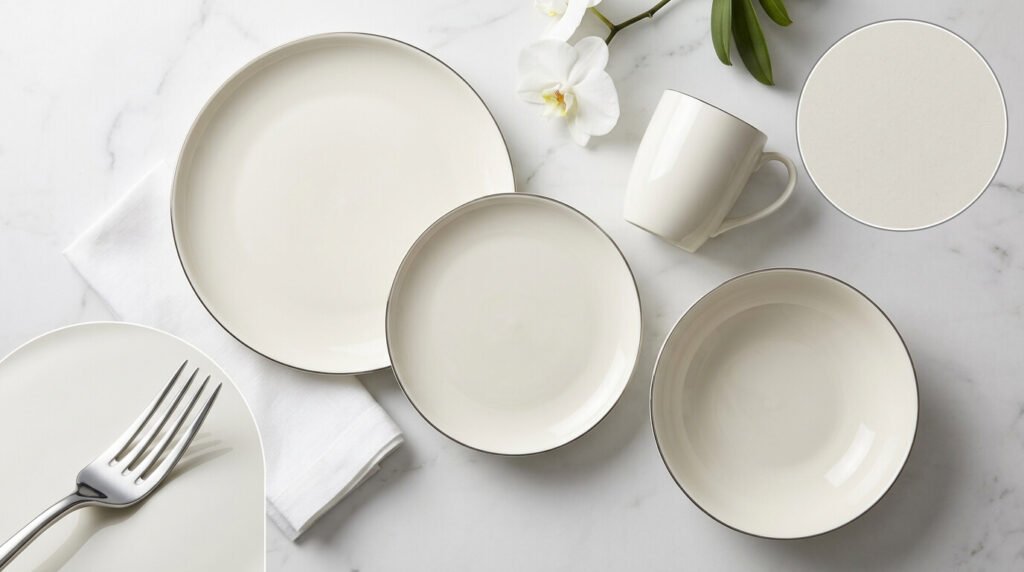
This porosity is what makes earthenware absorbent — cut earthenware in cross-section, and you can see the tiny voids that allow water and food particles to penetrate the material. Glazing earthenware creates a sealed surface layer, but the body beneath remains porous.
When porcelain clay — a refined mixture of kaolin (white primary clay), feldspar (a mineral flux), and silica (quartz) — is fired above 1,200°C, the feldspar melts and flows into the spaces between the clay and silica particles.
At full vitrification temperature (typically 1,280°C to 1,400°C for hard-paste porcelain), these molten minerals fuse the entire clay body into a single dense, interlocked structure with essentially no remaining pore space.
The result is not glazed ceramic — it is a material that has become, at the molecular level, glass-like throughout its entire thickness. Water absorption in fully vitrified porcelain is typically below 0.5%, compared to 5–15% for earthenware.
This is why vitrified porcelain behaves so differently from other ceramics in daily use. There are no pores to harbor bacteria or absorb food odors.
There is no underlying absorbent layer that can expand and contract with moisture and cause the glaze to crack over time. The material is the same throughout, from surface to base.
Why “Vitrified” Is Not the Same as “Glazed”
A common misunderstanding in dinnerware marketing is treating “glazed” and “vitrified” as equivalent terms. They are not. Glazing is the application of a glass-like coating to the surface of a fired ceramic piece.
It can be applied to earthenware, stoneware, or porcelain, and it creates a sealed surface regardless of the porosity of the body beneath. Vitrification refers to the clay body itself becoming non-porous through high-temperature firing — the glaze, if applied at all, is a decorative or protective finish on top of an already non-porous structure.
This matters practically because a glazed earthenware plate with a chip in the glaze surface now exposes the absorbent clay body beneath to food contact.
A vitrified porcelain plate with a chipped glaze exposes the non-porous vitrified body, a surface that is still hygienic and non-absorbent. The consequence of a chip is categorically different depending on what is underneath the glaze.
The Four Types of Ceramic Dinnerware — Where Vitrified Porcelain Fits
Most dinnerware marketing uses the terms porcelain, china, stoneware, and earthenware loosely or interchangeably. They are distinct materials with different clay compositions, firing temperatures, and resulting properties.
Ceramic Dinnerware Materials Compared
| Material | Firing Temperature | Vitrification Level | Water Absorption | Weight | Typical Use |
|---|---|---|---|---|---|
| Earthenware | 900°C–1,150°C | None (requires glaze to seal) | 5–15% | Heavy | Casual /decorative |
| Stoneware | 1,200°C–1,300°C | Semi- to fully vitrified | 0.5–3% | Heavy-medium | Everyday casual |
| Porcelain (hard-paste) | 1,280°C–1,400°C | Fully vitrified | Below 0.5% | Light-medium | Everyday to formal |
| Bone China | 1,200°C–1,300°C | Fully vitrified | Below 0.5% | Lightest | Formal /fine dining |
Earthenware
Earthenware is the least dense and most porous ceramic.
It must be glazed to be functional as dinnerware. It is the most affordable ceramic to manufacture, but also the least durable, as chips expose a porous clay body, and the material is brittle under thermal stress.


Traditional terracotta falls in this category.
The FDA and county health guidelines identify traditional glazed terracotta as one of the higher-risk ceramic categories for lead leaching, particularly from Latin American and Southwestern U.S. production, where lead-based glazes have historically been common.
Stoneware
Stoneware uses a denser clay body than earthenware and is fired at higher temperatures, producing a material that ranges from semi-vitrified to fully vitrified depending on the clay composition and firing protocol.
Fully vitrified stoneware performs close to porcelain in terms of hygiene and durability. Semi-vitrified stoneware still requires a glaze for full water resistance.
Stoneware has thicker walls than porcelain at equivalent strength, which gives it better heat retention at the table, useful for serving hot food that needs to stay warm, but also makes it heavier.
A 16-piece stoneware set typically runs $40–$120 at U.S. retail; individual dinner plates are commonly $6–$15.
Hard-Paste Porcelain (Vitrified Porcelain)
Hard-paste porcelain, fired at 1,280°C–1,400°C, is fully vitrified throughout the clay body.
Its kaolin clay base produces a characteristically white, slightly translucent material hold a thin porcelain plate up to light, and you can see a faint shadow of your hand through it, a property you will not see in stoneware.
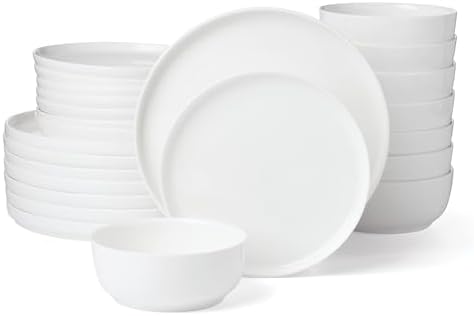

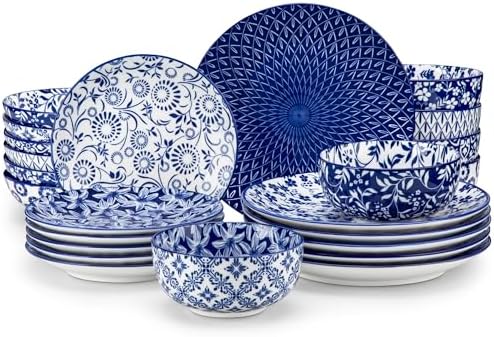
It is lighter than stoneware at an equivalent size, chip-resistant, fully non-porous, and the material of choice for restaurant and hotel dinnerware worldwide.
Every day porcelain sets at U.S. retail run $60–$200; fine or decorated porcelain can reach $150–$350 and above.
Bone China
Bone china is a specific type of porcelain in which at least 25% of the clay body is replaced with bone ash, calcined animal bone that has been ground to a fine powder.
The bone ash contributes to a distinctive bright white color, exceptional translucency, and surprising strength in thin-walled forms. It is the lightest and most delicate-looking of all ceramic dinnerware materials, while being structurally strong when handled carefully.
It is also the most expensive. Most bone china is fully vitrified and is dishwasher and microwave-safe, though its thin profiles make it more susceptible to chipping at the rim than thicker porcelain. Bone china sets commonly start at about $90(or less, depending on the brand and retailer) and can exceed $500.
Why Vitrified Porcelain Dinnerware Dominates Restaurant and Hotel Dining
The commercial food service industry does not use vitrified porcelain out of aesthetic preference alone. It uses it because of how the material performs under the specific stresses of commercial operation, stresses that are far more demanding than typical household use.
Commercial Performance Standards
Commercial dinnerware in a busy restaurant or hotel faces conditions that household dinnerware rarely encounters: hundreds of dishwasher cycles per year at high temperatures with heavy detergents, constant stacking and unstacking by kitchen staff under time pressure, temperature swings from cold storage to hot food service, and the probability of drops on hard kitchen floors.
Vitrified porcelain meets all of these conditions more reliably than any alternative ceramic material.
Reputable commercial porcelain manufacturers test their products to standardized benchmarks before certification for food service:
- Thermal shock resistance: Plates are cycled between 180°C and 20°C to verify that the material does not crack under rapid temperature change.
- Dishwasher endurance: Sets are run through 500 or more commercial dishwasher cycles and inspected for glaze crazing, chipping, and pattern fading.
- Edge chip resistance: The rim — the most vulnerable point on any plate — is tested against impact to confirm it maintains integrity under repeated handling.
These are not household tests. They represent conditions that home dinnerware is never expected to meet.
When you purchase vitrified porcelain sold for home use from a manufacturer that also supplies commercial accounts, you are typically getting a product that has cleared these standards.
Chip Resistance vs. Break Resistance — an Important Distinction
Vitrified porcelain is chip-resistant, not shatterproof. This distinction matters when comparing it to other durable dinnerware options.
When vitrified porcelain is dropped on a hard floor, it typically chips at the rim, a clean, contained failure that produces a small fragment at the impact point.
It does not shatter into fine, scattered shards the way tempered glass (such as Corelle’s Vitrelle) can when it fails. The chip is visible, localized, and the rest of the plate remains structurally sound.
This failure mode is predictable and easy to manage: a chipped plate is inspected and replaced; there is no glass-fragment cleanup concern.
For buyers who want a material that survives drops entirely without any failure, melamine, wheat straw fiber, or stainless steel are the correct choices.
For buyers who want the combination of elegant appearance, commercial-grade durability, and non-porous hygiene, vitrified porcelain is the correct choice, accepting that chips are the expected failure mode rather than shattering.
For a full comparison of unbreakable and break-resistant dinnerware materials, see our guide on unbreakable dishes like Corelle.
Safety and Lead: What Vitrification Does — and Does Not — Guarantee
This is the section that most buying guides for vitrified porcelain skip, and it is the one that matters most for buyers who care about chemical safety in food contact materials.
The Role of the Glaze, Not Just the Clay Body
High-fired, fully vitrified porcelain clay is chemically inert. The concern with lead and cadmium in ceramic dinnerware does not come from the clay body itself; it comes from the glaze and decorative pigments applied to the surface.
Lead oxide was historically used in ceramic glazes because it lowered the melting temperature of the glaze, producing a smoother, glossier finish and expanding the usable firing temperature range.
Cadmium-containing pigments were used to achieve intense reds, oranges, and yellows in decoration.
When a glaze is fired at inadequate or poorly controlled temperatures, lead and cadmium are not fully incorporated into the glaze structure; they remain in a form that can leach into acidic foods (vinegar, tomato sauce, citrus juice) over time and with repeated dishwasher cycling.
When porcelain is fired above 1,280°C in a controlled commercial process, the glaze bonds completely to the vitrified ceramic matrix, and properly formulated lead-free glazes fully fuse with the body.
A poorly controlled firing at any temperature, or the use of lead-containing glazes regardless of firing temperature, creates a different outcome.
The firing temperature guarantee of vitrification applies to the clay body’s porosity — it does not automatically certify that the glaze is lead-free.
The FDA regulates leachable lead and cadmium from ceramic dinnerware under Compliance Policy Guides CPG Sec. 545.450 (lead) and CPG Sec. 545.400 (cadmium). Note: it is not illegal for dinnerware to contain traces of lead or cadmium as long as leach levels test below the FDA’s established thresholds.
The meaningful assurance is not a “lead-free” label alone; it is documented low-leach test results under recognized standards.
What to Look for When Buying
- Seek explicit lead-free and cadmium-free certification, ideally with reference to FDA, EU, or German LFGB standards — the strictest commonly applied to ceramic dinnerware.
- Prefer plain white or lightly decorated pieces over brightly painted or hand-decorated designs. Bright reds, oranges, and yellows historically required cadmium-containing pigments; plain white avoids this risk entirely.
- Avoid over-glaze decoration — decoration applied on top of the glaze layer after the main firing, rather than under or within it, is fired at lower temperatures and may not fully bond into the surface.
- Be cautious with metallic trims. Gold and platinum rim accents are decorative and safe for food contact, but must not be microwaved — metal in the microwave causes arcing regardless of the porcelain body’s safety.
- For vintage or imported pieces without certification, treat them as display-only for hot or acidic foods. See our non-toxic dinnerware guide for a full material safety ranking and certified brand recommendations.
Vitrified Porcelain in Home Use: What Buyers Need to Know
Most buyers encountering vitrified porcelain are choosing between it and stoneware for everyday household use. The decision is not purely about durability; it involves weight, aesthetics, care requirements, and how the dishes will be used daily.
Vitrified Porcelain vs. Stoneware for Home Use
| Factor | Vitrified Porcelain | Stoneware |
|---|---|---|
| Weight per plate | Lighter | Heavier |
| Appearance | Bright white, glossy, refined | Matte/satin glazes, earthy tones, casual |
| Heat retention | Moderate | Better (thicker walls) |
| Chip resistance | High (chip, not shatter) | Moderate (thicker walls buffer impact) |
| Scratch visibility | Low (smooth surface) | Higher (rougher texture shows knife marks) |
| Microwave safe | Yes (avoid metallic trims) | Yes (most) |
| Dishwasher safe | Yes | Yes |
| Oven safe | Yes (most; check manufacturer) | Yes (most) |
| Price range (16-piece set) | $60–$200+ | $40–$120 |
| Best aesthetic match | Formal, minimalist, modern tables | Casual, rustic, farmhouse settings |
Care and Maintenance
Vitrified porcelain is lower-maintenance than its elegant appearance might suggest. Its fully non-porous surface means food residue does not penetrate the material and wipes away easily. A few care points are worth noting:
- Dishwasher use is safe, but avoid loading plates so close together that they contact during the wash cycle — edge-to-edge contact in the dishwasher is the most common cause of rim chips in daily household use.
- Use soft pads between stacked plates when storing large sets, particularly if the plates are stored for extended periods. The glazed surface can be scratched by the unglazed foot ring of the plate stacked on top.
- Avoid abrasive cleaning tools — steel wool and harsh scrubbing pads can scratch the glaze surface. A soft sponge and standard dishwashing detergent are sufficient for daily cleaning.
- Do not microwave pieces with metallic decoration. Plain white or underglaze-decorated porcelain is fully microwave-safe; gold or platinum rim accents are not.
- Thermal shock is a real risk, though less common in home use than in commercial settings. Moving a cold plate directly into a hot oven, or placing a hot plate on a cold, wet surface, can cause cracking. Allow plates to come to room temperature before placing them in a preheated oven.
Who Should Choose Vitrified Porcelain
Vitrified porcelain is the correct choice for buyers who:
- Want one set that handles casual daily meals and occasional formal dinners without looking out of place in either setting.
- Prioritize a non-porous, hygienic surface that does not absorb food odors over the years of use.
- Want lighter plates than stoneware with equivalent durability.
- Are equipping a home kitchen to a near-commercial standard — for frequent hosting, cooking school use, or intensive daily family use.
- Want dinnerware that coordinates with a range of table settings without imposing a specific aesthetic.
Vitrified porcelain is a less suitable choice for buyers who:
- Need fully shatterproof and fragment-free dishes (families with toddlers, elderly adults with frequent drops)
- Prefer the heavy, warm aesthetic of thick-walled stoneware for a casual or rustic table setting.
- Have a strict budget below $60 for a full set — quality vitrified porcelain begins at this threshold; cheaper options at lower prices may not be fully vitrified.
How to Identify Genuine Vitrified Porcelain When Buying
The term “vitrified” is sometimes used loosely in product listings. Here is how to confirm the claim before purchasing.
Verification Checklist
- Check the listed firing temperature. Genuine hard-paste vitrified porcelain is fired above 1,280°C. If the product listing specifies a firing temperature below this, the body may be semi-vitrified stoneware or earthenware, not hard-paste porcelain.
- Look for water absorption data. Fully vitrified porcelain has water absorption below 0.5%. Some manufacturers publish this figure. If the listing states 0% or “non-porous” without a specified firing temperature, request or search for the specification sheet.
- Test translucency if possible. Hold a plate up to a light source. Hard-paste vitrified porcelain will show a faint shadow of your fingers through the plate wall. Stoneware and earthenware will be opaque. Bone china will be more translucent than standard porcelain.
- Read the backstamp. Porcelain made for food service by established manufacturers typically carries the brand name, country of manufacture, and a food-safe or lead-free certification statement on the base.
- Ask for certification references. Reputable manufacturers selling for food service — commercial or domestic — should be able to reference FDA compliance, EU food contact material regulation compliance, or LFGB (German food safety standard) certification. These are the three most commonly cited standards for ceramics sold in Western markets.
For independently tested and certified recommendations, see our guide on testing dishes for lead and our best dinnerware sets for everyday use.
Vitrified porcelain is not a marketing term — it describes a specific physical state that the clay body achieves through high-temperature firing. That state is what determines the material’s hygiene, durability, and long-term food safety. Buying it correctly means verifying the firing temperature, checking for lead-free glaze certification, and understanding that the chip-at-the-rim failure mode is normal and manageable rather than a defect.
Frequently Asked Questions
Q: Is vitrified porcelain the same as bone china?
Both are fully vitrified, but they use different clay bodies. Vitrified hard-paste porcelain uses kaolin clay, feldspar, and silica.
Bone china replaces a portion of the clay (at least 25%) with calcined bone ash, which produces a brighter white color, greater translucency, and a lighter weight in thin-walled pieces. Bone china is typically more expensive and is used for formal or fine dining applications.
Q: Is vitrified porcelain microwave safe?
Yes, provided it has no metallic decoration. Plain white vitrified porcelain and pieces with underglaze decoration are fully microwave safe. Pieces with gold or platinum rim accents must not be microwaved the metal trim causes arcing, regardless of the safety of the porcelain body itself.
Q: Is vitrified porcelain dishwasher safe?
Yes. Vitrified porcelain is designed for commercial dishwasher use in restaurant settings, which are significantly more demanding than household machines.
In home dishwashers, the main precaution is preventing plates from contacting each other during the wash cycle, as edge-to-edge contact under dishwasher pressure is a common cause of rim chips.
Q: Can vitrified porcelain contain lead?
The fully vitrified clay body itself does not leach lead. The risk lies in the glaze and decorative pigments, not the clay. High-quality vitrified porcelain from reputable manufacturers uses lead-free, cadmium-free glazes certified to FDA, EU, or LFGB standards.
Always verify lead-free certification — particularly for brightly colored or heavily decorated pieces, and for any vintage or imported dinnerware without a documented certification.
Q: How does vitrified porcelain compare to stoneware for everyday use?
Porcelain is lighter, has a brighter and more refined appearance, and is fully non-porous in the clay body. Stoneware is heavier, retains heat better at the table, and has a more casual, earthy aesthetic. Both are dishwasher and microwave-safe and chip-resistant.
Porcelain is the better choice for buyers who want a formal or versatile aesthetic and lighter plates; stoneware suits buyers who prefer a rustic look and appreciate the heavier, more substantial feel.
Q: Why is vitrified porcelain used in restaurants instead of stoneware or melamine?
Restaurants choose vitrified porcelain for its combination of food safety, durability under commercial dishwasher cycles, non-porous hygiene, and the professional presentation it provides.
Stoneware is an acceptable alternative at casual dining establishments, but its greater weight and texture make it harder to maintain in high-volume service. Melamine is prohibited for hot food service by most health codes because of its chemical leaching risk above 160°F.
Q: What is the difference between fully vitrified and semi-vitrified dinnerware?
Fully vitrified dinnerware has water absorption below 0.5% — the clay body is essentially non-porous throughout.
Semi-vitrified dinnerware (common in some stoneware) has water absorption between 0.5% and 3%, meaning the body retains some porosity.
Semi-vitrified pieces require a complete glaze to be food-safe; a chip in the glaze of a semi-vitrified piece exposes a slightly absorbent body. Fully vitrified pieces maintain hygiene even at a chipped rim because the body itself is non-absorbent.
About the Author & Reviewer
Sarah Emirone, Author
Sarah researches and writes SafeKitchn’s dinnerware and kitchenware guides, with a focus on material safety, lead content, and manufacturer specifications. She cross-references product data sheets, safety certifications, and regulatory filings (including FDA and Prop 65 records) before publishing, and updates articles when new information becomes available.
James Daniels, Reviewer
James reviews SafeKitchn’s material safety content for scientific accuracy. He holds a B.Sc in inorganic chemistry and works as a materials researcher, with particular focus on the composition and safety behavior of glass, ceramic, and metal used in kitchenware.