

Few kitchen brands carry the kind of quiet familiarity that Corelle does. The history of Corelle dishes stretches back to 1970, but the real story begins decades earlier in a Corning Glass Works laboratory, with a material that was never intended for dinner tables at all.
Vitrelle glass, the triple-layer laminate at the heart of every Corelle plate, was originally developed for television screens in the 1940s.
What followed was a deliberate act of reinvention: a technology engineered for living rooms repurposed for kitchens, producing one of the most durable, lightweight, and enduring dinnerware brands in American history.
More than 2,000 patterns later, Corelle is still in production and still made in the United States.
Written by Sarah Emirone | Reviewed by James Daniels, B.Sc, Inorganic Chemist & Materials Researcher | Updated September 2026 | See How We Test | Filed under: Origin & Manufacturing
History of Corelle Dishes at a Glance — Key Milestones at a Glance
| Year | Milestone | Significance |
|---|---|---|
| 1851 | Corning Glass Works was founded by Amory Houghton | The parent company that would birth Pyrex, CorningWare, and Corelle |
| 1915 | Pyrex launched | First major consumer glassware brand from Corning |
| 1940s | Vitrelle glass was developed for television screens | The material that would later become Corelle |
| 1952 | S. Donald Stookey accidentally discovers glass-ceramic | Becomes CorningWare — the second major kitchen brand in the Corning family |
| 1958 | CorningWare launched | Preceded Corelle; established Corning’s kitchen presence |
| 1965 | Corning scientist perfects laminating technique for thin, strong glass | The technical breakthrough that made Corelle possible |
| 1970 | Corelle Livingware launched with four inaugural patterns | Changed American dinnerware culture permanently |
| 1998 | Corning sells consumer division to Borden/World Kitchen | First ownership change: Corelle leaves Corning |
| Early 2000s | FDA finds lead in certain decorative glazes | Most pre-2005 decorated patterns retired; composition revised |
| 2019–2020 | World Kitchen renamed; acquired by Instant Brands Inc. | Current ownership structure established |
Before Corelle — the Glass Material That Started as a TV Screen
In the 1940s, Corning Glass Works was experimenting with new glass formulations for an entirely different industry.
Television was entering American living rooms for the first time, and Corning was among the manufacturers developing the glass needed for cathode-ray tube screens, glass that had to be thin yet structurally strong, capable of holding its form under the mechanical and thermal stress of early television production.
The material they developed, which would later be branded Vitrelle, used a lamination process that bonded multiple glass layers together, creating a composite that was stronger than its constituent layers individually.


Corning’s scientists recognized that the same properties that made this glass useful for screens — strength-to-weight ratio, resistance to impact, thinness without fragility — could be redirected into a completely different application.
A 1965 breakthrough by a Corning researcher refined the laminating technique, achieving a three-layer glass bond thin enough for tableware but robust enough to survive the daily impacts of a family kitchen.
Five years of development followed before Corelle Livingware reached the market in 1970.
For a deeper look at what Vitrelle glass is and how it works, see our guide to what Vitrelle glass actually is.
The Corning innovation ecosystem — Pyrex, CorningWare, and Corelle as a family
Corelle did not arrive in isolation. By 1970, Corning had already built two landmark kitchen brands from unconventional origins.
Pyrex launched in 1915, born from a glass formulation developed for railroad lantern glass that could resist thermal shock — a material repurposed for bakeware after Bessie Littleton used a sawed-off battery jar to bake a sponge cake.
CorningWare arrived in 1958 after an entirely different kind of accident: in 1952, Corning scientist S. Donald Stookey accidentally overheated a sample of photosensitive glass in a furnace, found that instead of melting, it had crystallized into something new, and dropped it.
It did not break. That accidental crystalline material became the glass-ceramic behind CorningWare. Three kitchen icons from one company, each one born from serendipity or repurposing rather than deliberate product planning.
The early Corelle patterns were designed to coordinate visually with Pyrex and CorningWare, recognizing that many households would own all three. See our glass dinnerware materials explained guide for the full material science behind Vitrelle.
1970 — the Launch That Changed American Dinnerware
In 1970, American dinnerware meant ceramic or earthenware — sets that were heavy, expensive, required careful handling, and often ran to dozens of pieces across multiple plate sizes, bowl types, and accessory formats.
A quality dinner set was a significant investment and a fragile one. Breakage was accepted as inevitable. Replacement pieces were a routine purchase.
Corelle’s arrival was a genuine disruption. A single Corelle dinner plate weighed roughly half what a ceramic equivalent did. The three-layer Vitrelle glass resisted chips and everyday drops in ways that ceramic simply could not.
And Corning brought the set concept down to its functional essentials: dinner plates, smaller plates, and bowls at a price that put quality dinnerware within reach of households that had previously settled for cheap replaceable ceramics.
The four inaugural patterns of 1970
The first Corelle sets launched with four patterns, each chosen to appeal to the dominant interior design sensibilities of the early 1970s:
- Spring Blossom Green (Crazy Daisy) — Stylized white daisies with bright green leaves on white; the most iconic early Corelle pattern and a design that has remained recognizable fifty years later
- Butterfly Gold — Warm golden-yellow butterfly motif with earthy tones; quintessentially 1970s in palette and spirit
- Old Towne Blue — A blue-on-white pattern with a folk art quality; the most traditional of the four inaugural designs
- Snowflake Blue — Clean geometric snowflake motif in blue and white; the most restrained and modern of the launch patterns
Why Corelle was a radical departure from what came before
The simplification Corelle offered was not merely practical; it was cultural.
Before Corelle, a complete formal dinner set commonly included separate luncheon plates, multiple bowl sizes, serving platters, and accessory pieces that collectively demanded significant storage space and careful handling.
Corelle’s launch philosophy reduced this to a coherent core: dinner plate, side plate, bowl. The dishes were stacked flat because of the rimless profiles of the early patterns.
Six place settings took up the cabinet space that two or three ceramic settings had occupied. For the households of the early 1970s, many of them newly suburban, living in modest kitchens with limited storage, this was not a minor convenience.
It was a rethinking of what dinnerware could be.
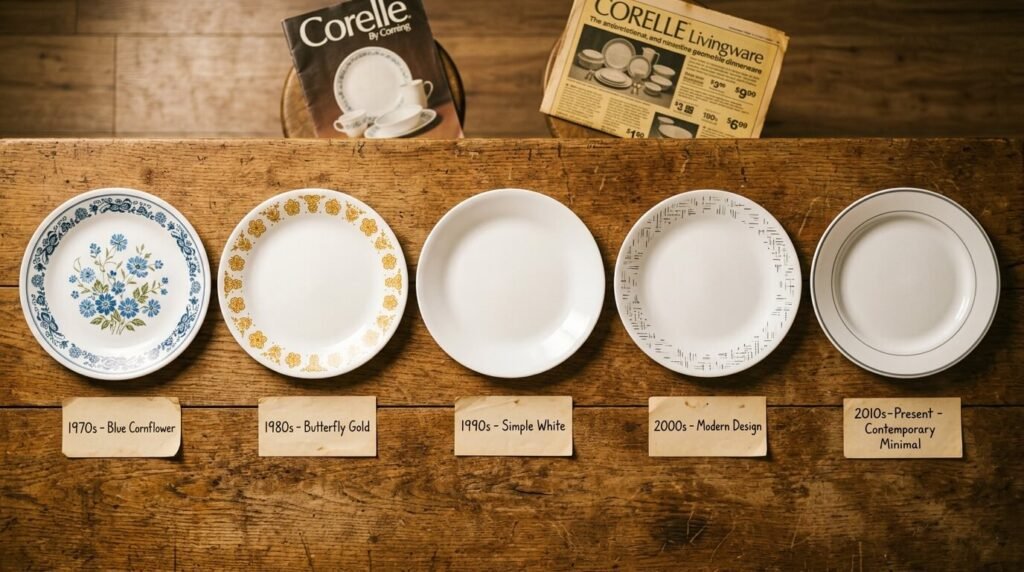
Decade by Decade — How Corelle’s Designs Evolved
| Era | Design direction | Iconic patterns | What drove the aesthetic |
|---|---|---|---|
| 1970s | Folk art, earth tones, botanical motifs | Spring Blossom Green, Butterfly Gold, Old Towne Blue | Post-1960s optimism; coordinated with Pyrex and CorningWare |
| 1980s | Country kitchen, florals, blue and white | Country Blue, Blue Hearts, Blue Iris | Peak suburban kitchen culture; Corelle at its widest adoption |
| 1990s | Multicoloured, more complex patterns | Shadow Iris, Callaway, Coordinates | Shift toward busier decorative styles; international expansion |
| 2000s | Pattern revision and retirement | Most pre-2005 decorated patterns retired | FDA lead findings: safety-driven redesign of decoration system |
| 2010s–present | Contemporary minimalist, solid colours, modern prints | Livingware+ ranges, solid whites, geometric prints | Health-conscious buyers, return to simplicity |
1970s — the folk art era: florals, earth tones, and optimism
The 1970s were Corelle’s formative decade, and the aesthetic of those years is still what most people picture when the brand comes to mind.
Spring Blossom Green became one of the best-selling dinnerware patterns in American history — a design that coordinated deliberately with the Pyrex Spring Blossom pattern (an inverted colour palette with larger motifs).
The Butterfly Gold and Old Towne Blue patterns found their place in millions of kitchens alongside matching CorningWare casserole dishes.
Corning’s strategy of building a visually coordinated ecosystem across Pyrex, CorningWare, and Corelle was a deliberate design decision, and it worked.
A 1970s kitchen table set with all three in matching patterns represented the complete Corning vision.
1980s — country kitchen patterns and the peak of cultural dominance
By the 1980s, Corelle had established itself as America’s most widely adopted dinnerware brand. The design aesthetic of the decade shifted toward country kitchen patterns, blue cornflower motifs, delicate floral clusters, and geometric border designs.
Country Blue, Blue Hearts, and Blue Iris became the defining Corelle patterns of the era, appearing in homes across the country with the reliability of a utility product rather than a considered purchase.
The 1980s were the decade in which Corelle stopped being a new product and became a household item that many families simply had, without remembering when or why they bought it.
1990s to 2000s — multicolour, then crisis
The 1990s brought more decorative complexity patterns with multiple colour elements, stylized botanical prints, and a wider palette that moved away from the blue-and-white dominance of the 1980s.
International expansion also accelerated, with Corelle entering markets in Australia, Asia, and the Middle East. Then the early 2000s brought the FDA-led finding that would reshape the brand’s entire pattern portfolio.
The 2000s FDA Lead Crisis — the Most Important Regulatory Event in Corelle’s History
In the early 2000s, FDA testing identified lead content in certain Corelle decorative glazes and pigments — specifically in the coloured and detailed decorative elements applied to pre-existing patterns.
The Vitrelle glass itself was not the source; the issue was in the ink and glaze system used to print decorative designs onto the glass surface.
This was not a unique failure of Corelle — lead had been used widely in ceramic and glass decoration chemistry for decades — but the FDA findings required a response.
Corelle’s response was comprehensive: the brand retired the majority of its pre-2005 decorated patterns, revised its decoration and glaze chemistry to eliminate lead-containing compounds, and introduced new standards for decorative pigments that remain in place today.
The 2000s pattern retirement programme was the single largest design discontinuity in the brand’s history, and it is the primary reason that pre-2005 Corelle patterns are now treated as vintage collectibles rather than current products.
What the FDA’s lead finding means for people who own vintage Corelle today
If you own Corelle dishes made before approximately 2005, the safety guidance depends entirely on whether the piece is plain white or decorated:
- Plain white Corelle (Winter Frost White and similar undecorated patterns) — These contain no decorative glaze and present no lead risk. Pre-2005 plain white Corelle is safe for everyday food use, including hot and acidic food
- Decorated pre-2005 Corelle — Patterns with coloured borders, floral prints, or any form of decorative glaze should not be used for hot food or acidic food without testing; the decorative layer may contain lead compounds
- Display use of decorated vintage pieces — Entirely safe; the risk is in the migration of lead into food, not from physical handling
- Testing option — An at-home lead swab ($5–$15) can indicate surface lead; for certainty, an accredited laboratory leach test is the definitive method
- The 2005 cutoff — Post-2005 Corelle was produced under the revised decoration standards and is safe for all food use
See our non-toxic dinnerware guide for full guidance on testing vintage dishes and understanding lead safety thresholds. For a broader kitchen safety context, see our safe kitchen guide.
Ownership History — Who Has Made Corelle Through Each Era
| Owner | Years | Why the change happened | Key events |
|---|---|---|---|
| Corning Glass Works | 1970–1998 | Original inventor and manufacturer | Launched Corelle; built iconic 1970s–1980s pattern library; established US manufacturing |
| Borden Inc. / World Kitchen LLC | 1998–2019 | Corning refocused on core glass technology; sold consumer division | Continued global expansion; managed 2000s FDA crisis; introduced new patterns; retained US manufacturing |
| Corelle Brands Holdings / Instant Brands Inc. | 2019–present | World Kitchen restructured and rebranded | Operates the current Corelle, Pyrex, CorningWare, and Visions portfolio; ongoing manufacturing in the US |
Is Corelle still made in the United States?
Yes. Despite three ownership changes over fifty-five years, Corelle’s Vitrelle glass manufacturing has remained in the United States throughout.
The manufacturing process for Vitrelle, the thermal compression lamination of three glass layers, has been maintained at US facilities since the 1970 launch.
This is a meaningful continuity for a brand that has changed ownership twice and operated under very different corporate strategies across its history.
The consistency of US manufacturing is one of the reasons the fundamental quality and properties of Corelle have remained stable even as designs, marketing, and ownership have changed substantially.
How to Identify and Date Your Corelle Dishes by Backstamp
The mark on the bottom of a Corelle dish is the most reliable way to date the piece and understand its era.
| Backstamp | Era | Owner | Notes |
|---|---|---|---|
| “CORELLE LIVINGWARE by CORNING” with Corning logo | 1970–1998 | Corning Glass Works | Original backstamp; confirms pre-1998 manufacture |
| “CORELLE” with “Made in USA” — no Corning reference | 1998–2019 | World Kitchen LLC | Transition era; Corning branding removed after the 1998 sale |
| “CORELLE” or “CORELLE BRANDS” with current logo | 2019–present | Instant Brands / Corelle Brands LLC | Current production mark |
| “CORELLE by CORNING” (no “Livingware”) | Some 1990s pieces | Corning / early World Kitchen | Transitional mark during the late Corning era |
The presence of the Corning name or logo on the backstamp confirms the piece is a pre-1998 part of the original Corning era and almost certainly features one of the classic 1970s or 1980s patterns.
Vintage Corelle as a Collectible — What Patterns Are Worth and Why
Vintage Corelle has experienced a genuine collector resurgence in recent years, driven by nostalgia for mid-century kitchen aesthetics and the renewed appreciation for the durability and design quality of the original patterns.
Most vintage Corelle on the secondary market — eBay, antique fairs, estate sales — falls in the $25 to $100 range per lot. Individual pieces typically fetch $8 to $10.
Complete sets in excellent condition average around $60, with rarer patterns and larger sets reaching $120 to $1,000 depending on condition and pattern desirability.
The condition premium is significant: chips, crazing, or fading of decorative patterns reduces value substantially, while mint-condition pieces with the original Corning backstamp command the highest prices.
Most sought-after vintage Corelle patterns and approximate values
| Pattern | Era | Rarity | Individual piece value | Full set value |
|---|---|---|---|---|
| Spring Blossom Green (Crazy Daisy) | 1970s | Moderate | $8–$15 | $40–$150 |
| Butterfly Gold | 1970s | Moderate | $8–$12 | $35–$120 |
| Blue Snowflake (Snowflake Blue) | 1970s | High | $10–$20 | $60–$200 |
| Country Blue | 1980s | Low–moderate | $5–$10 | $25–$80 |
| Wildflower | 1977–1984 | High | $15–$30 | $80–$300 |
Still Going After 55 Years
Corelle in 2025 is a different product from Corelle in 1970 in almost every surface dimension, the patterns, the ownership, the marketing language, the safety standards, but the same in one dimension that matters most: the Vitrelle glass.
The three-layer laminate invented for television screens, repurposed for dinner tables, and refined through fifty-five years of continuous manufacture, is still the material in the plate you set on the table tonight.
See our best Corelle alternatives if you are considering other glass or lightweight dinnerware options.
Frequently Asked Questions About the History of Corelle Dishes
u003cstrongu003eWhen was Corelle invented, and who made it?u003c/strongu003e
Corelle was invented by Corning Glass Works and launched in 1970. The material behind it — Vitrelle glass — was developed through a laminating technique perfected by Corning scientists in 1965, building on glass work that had begun in the 1940s. u003cbru003eu003cbru003eCorning Glass Works, founded in 1851, was the original inventor and manufacturer of Corelle until it sold the consumer products division in 1998.
u003cstrongu003eWhat was the very first Corelle pattern?u003c/strongu003e
Corelle launched simultaneously with four inaugural patterns in 1970: Spring Blossom Green (also known as Crazy Daisy), Butterfly Gold, Old Towne Blue, and Snowflake Blue. u003cbru003eu003cbru003eSpring Blossom Green is typically cited as the most iconic of the four and became one of the best-selling dinnerware patterns in American history. It was designed to coordinate with the existing Pyrex Spring Blossom Green pattern.
u003cstrongu003eWhen did Corning sell Corelle and why?u003c/strongu003e
Corning sold its consumer products division — which included Corelle, Pyrex, and CorningWare — to Borden Inc. in 1998. u003cbru003eu003cbru003eThe decision was part of Corning’s strategic refocus on its core glass technology and industrial businesses, particularly optical fibre, which had become the company’s primary growth area by the late 1990s. u003cbru003eu003cbru003eThe consumer brands were profitable but peripheral to Corning’s new direction.
u003cstrongu003eAre vintage Corelle dishes safe to eat from?u003c/strongu003e
It depends on the piece. Plain white vintage Corelle — pieces with no coloured decoration — contains no decorative glaze and is safe for everyday food use regardless of age. u003cbru003eu003cbru003eDecorated pre-2005 Corelle carries a risk of lead in the decorative glaze layer and should not be used for hot or acidic food without testing. u003cbru003eu003cbru003ePost-2005 Corelle was produced under revised decoration standards and is safe for all food use.
u003cstrongu003eWhy did Corelle discontinue so many of its original patterns?u003c/strongu003e
The majority of pre-2005 decorated Corelle patterns were retired following FDA testing in the early 2000s that identified lead content in certain decorative glazes and pigments. u003cbru003eu003cbru003eCorelle revised its entire decoration chemistry system, which meant retiring patterns whose existing glaze formulations contained lead compounds. u003cbru003eu003cbru003eThis was the largest single pattern-retirement event in the brand’s history, and is why pre-2005 decorated patterns are now treated as vintage collectibles.
u003cstrongu003eHow many patterns has Corelle made since 1970?u003c/strongu003e
Corelle has produced more than 2,000 patterns since its 1970 launch — an average of roughly forty new designs per year across its fifty-five-year history. u003cbru003eu003cbru003eMany of these patterns had short production runs and are now difficult to find; others, like Winter Frost White, have been in continuous production since the early 1970s. u003cbru003eu003cbru003eThe pre-2005 FDA-driven retirement programme removed the majority of the original decorated pattern library from active production.
u003cstrongu003eWhat is vintage Corelle worth?u003c/strongu003e
Most vintage Corelle on the secondary market sells for $25 to $100 per lot, with individual pieces typically ranging from $8 to $10 and complete sets averaging around $60. u003cbru003eu003cbru003eRarer patterns in excellent condition, particularly early 1970s designs like Spring Blossom Green, Snowflake Blue, or Wildflower in complete sets, can reach $200 to $300 or more. u003cbru003eu003cbru003eCondition is the primary value driver: mint-condition pieces with the original Corning backstamp command significantly higher prices than worn or chipped equivalents.
About the Author & Reviewer
Sarah Emirone, Author
Sarah researches and writes SafeKitchn’s dinnerware and kitchenware guides, with a focus on material safety, lead content, and manufacturer specifications. She cross-references product data sheets, safety certifications, and regulatory filings (including FDA and Prop 65 records) before publishing, and updates articles when new information becomes available.
James Daniels, Reviewer
James reviews SafeKitchn’s material safety content for scientific accuracy. He holds a B.Sc in inorganic chemistry and works as a materials researcher, with particular focus on the composition and safety behavior of glass, ceramic, and metal used in kitchenware.