

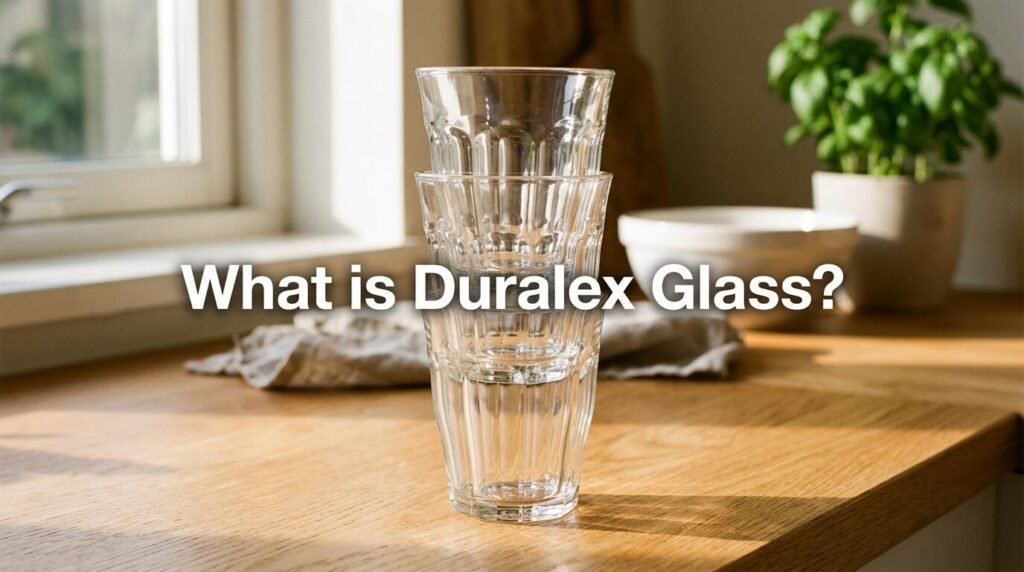
Duralex glass is tempered soda-lime glass, manufactured at a single factory in Orléans, France, since 1945.
If you’ve been searching “what is Duralex glass” because someone described it as a safer alternative to plastic or because you’re trying to figure out if it’s the same thing as Pyrex, the short answer is: it’s neither borosilicate nor the same as European Pyrex.
It’s a distinct glass type with its own composition, strength profile, and use limits. This guide covers all of it: what the glass is made of, what it’s safe for, where it sits against Pyrex and borosilicate, and what happened to the company in 2024.
Written by Sarah Emirone | Reviewed by James Daniels, B.Sc, Inorganic Chemist & Materials Researcher | Updated September 2026 | See How We Test | Filed under: Buying, Care & Product Guides
What is Duralex Glass Made Of?
Duralex starts as soda-lime glass, the most common glass type in the world, and becomes something meaningfully different through a thermal tempering process the company developed in the 1940s.
Understanding both parts matters because one explains what it’s made of, and the other explains why it performs the way it does.
Soda-Lime Glass — The Base Material
Soda-lime glass is made from three raw materials: silica sand, soda ash (sodium carbonate), and limestone (calcium carbonate). Mixed and melted at around 1700°C, these form a clear, hard, chemically stable material.
It’s the base for most drinking glasses, window glass, and glass bottles in the world.



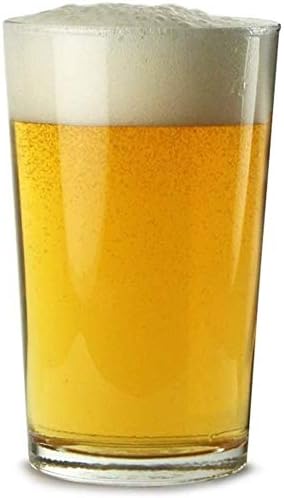

In its untreated state, soda-lime glass has one real weakness: impact. Drop an untreated soda-lime glass from table height onto a hard floor, and it shatters.
It also has a relatively high thermal expansion coefficient — around 9 × 10⁻⁶ per °C — which means it expands and contracts more than borosilicate glass under temperature changes.
That’s why untreated soda-lime glass can crack when you pour boiling water directly into a cold glass. Duralex addresses the impact problem through tempering.
It doesn’t fully resolve the thermal expansion characteristic, which is why the oven question (covered below) has a non-obvious answer.
The Tempering Process — How Duralex Gets Its Strength
The tempering process is the entire reason Duralex exists as a distinct product. Glass is heated to approximately 700°C — just below the point where it would deform then blasted with jets of cold air on all surfaces simultaneously.
The outer layers of the glass cool and harden almost instantly. The interior, still hot, tries to contract as it cools but is constrained by the already-hardened outer layers. This creates a state of permanent compressive stress on the surface and tensile stress in the core.
The result: Duralex glass has 2.5 times the impact resistance of untreated soda-lime glass of the same thickness, according to Duralex’s own published specifications.
Drop a Picardie tumbler on tile, and it will often survive. When it does eventually break from a hard enough impact or severe thermal shock, the compressive stress releases all at once, causing the glass to shatter into small, roughly granular pieces rather than long jagged shards. That’s by design, not coincidence.
Is Duralex Glass Safe?
Yes. Duralex glass contains no lead, no cadmium, and no synthetic chemical additives of any kind; it’s inorganic silicate glass all the way through. For buyers coming from plastic drinkware or worrying about ceramic glazes, the material safety profile is clean.
What Duralex Does Not Contain
For non-toxic drinking glass options compared, Duralex checks every box on the standard non-toxic checklist:
- No lead — soda-lime glass formulations do not use lead oxide; Duralex has confirmed this in its published safety documentation.
- No cadmium — clear Duralex glass has no colorants of any kind; colored Duralex ranges use minerals fused into the glass during production, not sprayed-on coatings that can chip or leach.
- No arsenic — historically used as a refining agent in glass production; Duralex does not use it.
- No BPA or BPS — these are plasticizers with no role in glass manufacturing; the question comes up because people switching from plastic to glass want explicit confirmation.
- No phthalates — same situation as BPA; not applicable to glass, but worth stating clearly for buyers doing a full material audit.
- Nonporous surface — unlike some ceramics and plastics, glass does not absorb liquids, flavors, or odors over time, so it won’t carry yesterday’s coffee into tomorrow’s water.
The colored ranges Duralex produces amber, green, and smoked glass options, which use mineral oxides fused directly into the melt, not surface coatings. The color is in the glass itself.
How Duralex Glass Behaves When It Breaks
Tempered glass breaks differently from untreated glass, and the difference matters if you have children at home or if you use glass in a kitchen where breakage is a real possibility.
When untreated soda-lime glass breaks, it fractures along stress lines into large pieces with sharp, irregular edges. The shards can be large and blade-like.
Duralex, being tempered, stores energy in its compressive surface layer. When that layer is finally breached — by a hard enough impact or a sharp thermal shock — the stored energy releases across the entire piece simultaneously.
The glass doesn’t crack from the impact point outward; it essentially disintegrates into small, roughly cube-shaped granules.
These are still sharp and should be cleaned up carefully, but they’re far less likely to cause a serious laceration than a large glass shard.
This is the same principle used in car side windows, which are tempered for the same reason.
Duralex Glass in the Dishwasher, Microwave, Freezer, and Oven
Duralex is compatible with most kitchen appliances, but not all, and the one exception (the oven) is specific enough to cause real problems if you get it wrong.
What Duralex Is Cleared For — and the Temperature Range
| Appliance | Safe? | Notes |
|---|---|---|
| Dishwasher | ✅ Yes | All Duralex products are dishwasher safe; top rack preferred for longevity but not required |
| Microwave | ✅ Yes | Safe for standard microwave use; avoid microwaving empty (as with any glass) |
| Freezer | ✅ Yes | Rated to -20°C (-4°F); leave space for liquid expansion if freezing full containers |
| Oven | ⚠️ Depends on product line | Standard products (Picardie, Gigogne) are NOT oven safe; OVENCHEF line only |
| Direct flame / stovetop | ❌ No | No Duralex product is rated for direct flame or electric coil contact |
| Broiler | ❌ No | Intense radiant heat from above falls outside the thermal ratings for all product lines |
Standard Duralex products are rated for a temperature range of -20°C to 130°C (-4°F to 266°F). For the full breakdown of what each product line can handle, see the Duralex care guide for dishwasher, microwave, and freezer use.
The Oven Question — Why Most Duralex Is Not Oven Safe
Standard Duralex tumblers and bowls — including the Picardie and Gigogne — are not oven safe. This catches people off guard because the glass feels so solid and heat-tolerant in everyday use.
The issue isn’t the glass’s strength; it’s thermal shock. For which Duralex products are oven safe and which are not, the line is very clear: only the OVENCHEF reinforced collection is rated for oven use.
The OVENCHEF line is manufactured with a higher thermal shock tolerance — rated for a differential of 200°C (392°F), meaning you can move it from a room-temperature environment into an oven preheated to 200°C above that without the glass failing.
Standard Duralex products, by contrast, should not be exposed to temperature differentials exceeding 130°C. Going from a cold fridge directly into a hot oven would easily exceed that.
The glass won’t show stress lines before it fails — it will shatter without warning, which is exactly why the product line distinction matters. If the base of your piece does not say OVENCHEF, keep it out of the oven.
Duralex vs. Pyrex vs. Borosilicate Glass — What’s Actually Different
For the full comparison of tempered soda-lime glass and borosilicate glass, the chemistry is what separates them. Duralex is tempered soda-lime. European Pyrex is borosilicate.
US Pyrex — and this is the part most buyers don’t know — switched from borosilicate to tempered soda-lime in the 1980s, making it compositionally closer to Duralex than to the European product sold under the same name. They are three different things, not two.
How the Three Glass Types Compare on the Dimensions That Matter
The thermal expansion coefficients tell you most of what you need to know. Borosilicate glass has a coefficient of approximately 3.3 × 10⁻⁶ per °C. Soda-lime glass sits around 9 × 10⁻⁶ per °C — nearly three times higher.
That gap is why borosilicate handles oven temperatures more forgivingly, and why tempered soda-lime (Duralex, US Pyrex) handles drops better — the tempering process compensates for the brittleness but doesn’t change the expansion rate.
| Glass Type | Composition | Thermal Shock Resistance | Impact Resistance | Oven Safe? | Recyclable? | Best For |
|---|---|---|---|---|---|---|
| Duralex | Tempered soda-lime | Moderate (130°C differential, standard) | High (2.5× untreated) | OVENCHEF line only | ✅ Yes | Everyday drinkware, stackable bowls, food storage |
| European Pyrex | Borosilicate | High (~300°C+ differential) | Moderate (untreated) | ✅ Yes | ❌ No (contaminates glass recycling stream) | Bakeware, lab glass, high-heat cookware |
| US Pyrex | Tempered soda-lime | Moderate | High | Limited | ✅ Yes | Bakeware, measuring cups, food storage |
| Generic Borosilicate | Borosilicate | High | Moderate | ✅ Yes | ❌ No | Bakeware, tea/coffee carafes, laboratory use |
One clarification on recyclability: soda-lime glass (Duralex, US Pyrex) is recyclable through standard glass recycling streams.
Borosilicate glass has a different melting point and contaminates soda-lime recycling batches — most municipal recycling programs do not accept it. This is a practical difference for buyers who care about end-of-life disposal.
Which One to Choose — and Why the Answer Depends on Use Case
For everyday drinkware — water glasses, juice glasses, tumblers for children — Duralex wins. Its impact resistance is the single most relevant property for a glass that gets used daily, washed repeatedly, and occasionally dropped.
Borosilicate’s advantage (oven tolerance) is irrelevant for a drinking glass. European Pyrex’s advantage is similarly wasted on a tumbler.
For bakeware and cookware that goes from stovetop to oven, borosilicate or European Pyrex is the right choice.
The thermal shock tolerance is genuinely higher, and oven use is specifically where that matters. For how Duralex and Pyrex differ for bakeware and cookware, the use case drives the answer every time.
US Pyrex sits in an awkward middle position — it’s tempered soda-lime like Duralex but sold in bakeware form, which is the one category where its composition is the weaker fit. It works, but it’s not the best tool for that job.
The Duralex Product Range — What They Actually Make
Duralex is primarily a drinkware company. That’s where the brand made its name and where the majority of its product range sits — but it’s not all they make.
The Picardie and Gigogne — Two Products in Museum Collections
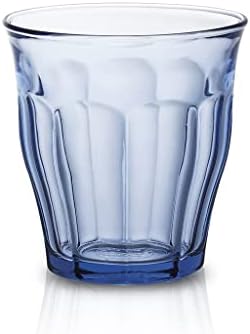
The Picardie tumbler, introduced in 1954, is the product most people picture when they hear Duralex. It has nine flat-panel facets that wrap around the glass and comes in seven sizes from 5cl to 50cl.
It’s been in continuous production at the same factory for over 70 years. The Museum of Modern Art (MoMA) in New York has it in its permanent design collection. Not as a historical artifact, but as a current product, still in production, still unchanged.
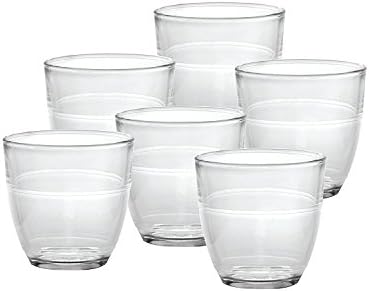
The Gigogne predates it. Designed in 1946 by a team led by Émile Sautier, it’s a stackable tumbler — tapered so that 40 glasses can nest into a 30cm column.
The Musée des Arts Décoratifs in Paris holds it in its permanent collection. Both are still made in La Chapelle-Saint-Mesmin, in the same factory, on the same site.
For more on sizing, stacking configurations, and how the Picardie fits into a modern kitchen, see the complete guide to the Duralex Picardie tumbler sizes and uses.
Beyond Tumblers — The Full Duralex Product Line
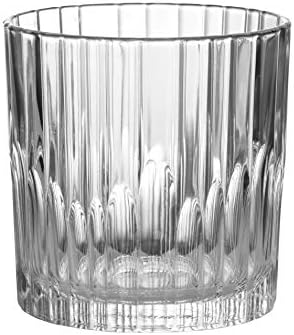
- Drinking glasses — the Picardie, Gigogne, Provence (curved), and Stacking series cover most everyday use cases from espresso to large water glasses; all tempered soda-lime, all dishwasher safe.
- Bowls — the Lys bowl series and Gigogne bowl range use the same tempered glass and the same stacking principle as the tumbler line; common in French school cafeterias.
- Food storage containers — lidded glass containers with BPA-free plastic lids; the glass bodies are Duralex tempered glass, the lids are polypropylene.
- OVENCHEF bakeware — the only Duralex line rated for oven use; includes baking dishes, gratin dishes, and roasting pans; rated for 200°C thermal shock differential.
- Colored glass ranges — amber, smoked, and green versions of the standard tumbler lines; color comes from mineral oxides (iron, manganese, chromium) added to the melt, not applied as a surface coating.
Where Duralex Glass Is Made and Who Owns It Now
Every piece of Duralex glass has been made at one factory in La Chapelle-Saint-Mesmin, a commune just west of Orléans in the Loire Valley, since 1945. All of it.
No overseas production, no licensing arrangements — one factory, one address. As of 2024, the people running that factory are the people who work there.
The La Chapelle-Saint-Mesmin Factory — Still the Only Production Site
The site’s glassmaking history predates the Duralex brand by several decades. Saint-Gobain, the French industrial conglomerate, operated a glass factory at La Chapelle-Saint-Mesmin from the 1930s.
When that operation was separated and rebranded as Duralex in 1945, it inherited the site, the furnaces, and most of the workforce.
The company has operated continuously at that location through more than 75 years of ownership changes, recessions, and two world events that disrupted production.
The glass that ships today from the same postcode as the glass that shipped in 1954 when the Picardie was introduced. No other glass manufacturer in France makes 100% of its products domestically at this scale.
From Receivership to Workers’ Cooperative — What Happened in 2024
The corporate history of Duralex since 1996 is, per Monocle’s October 2025 reporting, a record of six insolvencies. The most recent incident nearly ended the company entirely.
COVID-19 hit Duralex hard. The combination of restaurant closures, supply chain disruption, and reduced demand pushed the company into approximately €32 million of debt.
In January 2021, International Cookware the holding company that also owns the Pyrex brand, acquired Duralex for €3.5 million, rebranding the parent entity as La Maison Française du Verre in 2022. It looked like a rescue.
Then energy prices spiked. In late 2022, Duralex was forced to shut down its furnaces for five months, an extraordinary step for a glassmaker, since restarting a furnace after a cold shutdown takes weeks and costs significantly.
The energy crisis exposed how thin the financial cushion actually was.
In April 2024, La Maison Française du Verre placed Duralex into judicial administration — the French equivalent of entering bankruptcy protection. The likely outcome, at that point, was liquidation.
What happened instead: the employees organized. With support from the local Orléans government and backing from the regional authority, Duralex workers formed a SCOP — a Société Coopérative et Participative, a workers’ cooperative — and submitted a takeover bid.
It was accepted. By June 2024, Duralex was operating as a worker-owned cooperative, documented by WorldCrunch (May 2025) and confirmed by Monocle’s on-the-ground reporting in October 2025.
The product quality is unaffected. The glass coming out of La Chapelle-Saint-Mesmin today is the same formula, the same tempering process, the same factory.
But the ownership structure is different from any other major glassware brand in the market — and for buyers who specifically care about worker ownership and French manufacturing provenance, that’s now part of the product story.
Before you buy: If you’re deciding between Duralex and another glass type for a specific use, the comparison table above covers the key dimensions. For oven use, check the base of your specific piece — OVENCHEF is stamped clearly.
For everyday drinking glasses, Duralex is the most impact-resistant option in its price range, and the workers’ cooperative ownership means your purchase goes directly to the people manufacturing the product.
Frequently Asked Questions About Duralex Glass
Is Duralex the same as Pyrex?
No. Duralex is tempered soda-lime glass. European Pyrex is borosilicate glass, a different composition with a different thermal expansion rate and different use cases.
US Pyrex is also tempered soda-lime, but it’s a different product made by a different company. The two brands share a parent company (International Cookware acquired both), but are not the same material or the same product.
Why does Duralex glass have a number on the bottom?
The number is a mould identifier, not a date code or a size indicator. Each glass is formed in one of many moulds in the factory, and the number tells quality control teams which mould produced that piece.
In French café culture, the number became a way for friends to gamble on whose glass held the highest number — whoever lost paid for the round. The tradition is well documented and still practiced.
Is Duralex glass safe for hot drinks?
Yes, within limits. Standard Duralex is rated for temperatures up to 130°C (266°F), and hot beverages, such as coffee, tea, and hot chocolate, sit well below that.
The caution is sudden thermal shock: don’t pour boiling water into a glass that’s been sitting in a cold environment, and don’t put a hot glass directly onto a cold surface. Let the glass reach room temperature first.
Can Duralex glass go from freezer to microwave?
Yes, with one practical step in between. Duralex is rated for -20°C in the freezer and is microwave safe. But moving it directly from freezer to microwave creates a rapid temperature differential, the outside warms faster than the interior of frozen contents.
Let it sit at room temperature for five minutes first. The glass can handle the range; it’s the speed of the transition that creates risk.
Is Duralex glass fully recyclable?
Yes. Soda-lime glass, including all Duralex products, is recyclable through standard glass recycling streams.
This is a meaningful difference from borosilicate glass (European Pyrex, generic borosilicate), which has a different melting point and contaminates soda-lime recycling batches. Most municipal programs accept soda-lime glass but not borosilicate.
What does “2.5 times stronger” mean for Duralex glass?
It means 2.5 times the impact resistance of untreated soda-lime glass of equivalent thickness, based on Duralex’s published specifications. It does not mean indestructible — drop it hard enough onto a stone floor from a height, and it will shatter.
But it survives the ordinary drops and knocks of daily kitchen use far better than standard glass, which is why it’s been the standard choice for French school cafeterias for decades.
Is Duralex glass good for children?
It’s one of the better glass options for children, specifically because of how it breaks into small granular pieces rather than large, sharp shards and because of its impact resistance.
The Gigogne 16cl and Picardie 16cl sizes are standard in French schools and have been for generations. Glass does break, and tempered glass is not shatterproof, but the risk profile is lower than that of untreated glass for the same use.
Does Duralex colored glass fade in the dishwasher?
No. The color in Duralex glass is not a surface coating; it’s mineral oxides fused into the glass melt during production. Iron oxide produces amber, manganese and chromium produce greens and smoky tones.
Because the color is inside the glass rather than on it, dishwasher detergent cannot strip or fade it. This is different from colored glass products that use surface enamels or sprayed-on finishes, which can fade.
What is Duralex OVENCHEF, and how is it different?
OVENCHEF is Duralex’s oven-rated bakeware line, the only Duralex product range cleared for oven use.
It’s manufactured with a higher thermal shock tolerance than standard Duralex: rated for a 200°C (392°F) differential, versus the 130°C limit for standard products.
It includes baking dishes, gratin dishes, and roasting forms. Standard Duralex tumblers and bowls — Picardie, Gigogne, Lys — are not OVENCHEF and should not go in the oven.
About the Author & Reviewer
Sarah Emirone, Author
Sarah researches and writes SafeKitchn’s dinnerware and kitchenware guides, with a focus on material safety, lead content, and manufacturer specifications. She cross-references product data sheets, safety certifications, and regulatory filings (including FDA and Prop 65 records) before publishing, and updates articles when new information becomes available.
James Daniels, Reviewer
James reviews SafeKitchn’s material safety content for scientific accuracy. He holds a B.Sc in inorganic chemistry and works as a materials researcher, with particular focus on the composition and safety behavior of glass, ceramic, and metal used in kitchenware.