

Simax is always borosilicate glass. The Pyrex you can actually buy in a US store today is soda-lime, a different material with a much narrower thermal shock tolerance.
That single distinction is the entire Simax vs Pyrex comparison, and most articles never state it this directly. Worse, “Pyrex” itself isn’t one product.
There’s US Pyrex (soda-lime, made by Anchor Hocking), European PYREX (still borosilicate, made in France), and vintage US Pyrex (a mix, depending on the decade).
If you’re comparing Simax against Pyrex, you need to know which Pyrex you mean. This guide covers the material science, the real Pyrex formulation history, the actual thermal shock numbers, and which one to buy based on how you cook.
Written by Sarah Emirone | Reviewed by James Daniels, B.Sc, Inorganic Chemist & Materials Researcher | Updated September 2026 | See How We Test | Filed under: Brand & Product Comparisons
The Pyrex Problem: Which Pyrex Are You Actually Comparing Against?
“Pyrex” in 2025 means at least three different products depending on where and when it was made, and that ambiguity is why most Simax vs Pyrex comparisons are incomplete before they even start.
US Pyrex, European PYREX, and Vintage Pyrex: The Three Versions Explained
| Version | Glass Type | Manufacturer | Where Sold | Logo | Current Status |
|---|---|---|---|---|---|
| US Pyrex (today) | Soda-lime, tempered | Anchor Hocking, Lancaster, Ohio | United States, Canada | Lowercase “pyrex” | Production shifted here after Charleroi, PA plant closed April 2025 |
| European PYREX (today) | Borosilicate | International Cookware / Arc International, France | Europe, UK, international | Uppercase “PYREX” | Still in production, carries EU knife-and-fork food contact symbol |
| Vintage US Pyrex (pre-1980s) | Mostly soda-lime from the late 1940s onward; some borosilicate | Corning Glass Works | US (collector/secondhand market) | Mixed — both cases used historically | No longer in production |
The Real Pyrex Formulation History: The Switch Started in the 1940s, Not 1998
The 1998 World Kitchen sale did not trigger the switch to soda-lime glass. That’s the version everyone repeats, and it’s wrong.
Corning began switching clear Pyrex ovenware from borosilicate to soda-lime in the late 1940s, around the same time it launched opal glass decorated pieces, which were soda-lime from the start.


Herb Dann, a Corning designer from 1961 through the 1990s, confirmed in a 2014 interview that by the time Corning sold its consumer products division to World Kitchen in 1998, the company had already switched to soda-lime for “almost all” of its tableware.
The exception was the 13″×9″×2″ pan, which was never made with soda-lime. So buying “pre-1998 Pyrex” doesn’t guarantee borosilicate. It’s a coin flip, at best.
There’s a more recent development nobody’s covering. The Charleroi, Pennsylvania, plant, the last US Pyrex manufacturing facility, operating for 132 years, closed in April 2025. Production moved to Lancaster, Ohio, under the new owner, Anchor Hocking.
The glass formula didn’t change. The supply chain did. Meanwhile, European PYREX has continued using borosilicate the entire time, under a separate license held by International Cookware (Arc International) since the 1970s.
What Is Simax Glass? The Material, the Manufacturer, and the Standards
Simax is borosilicate Type 3.3 glass, manufactured by Kavalierglass a.s. in the Czech Republic, a company with over 185 years of borosilicate manufacturing experience. Unlike Pyrex, Simax has never switched formulas.


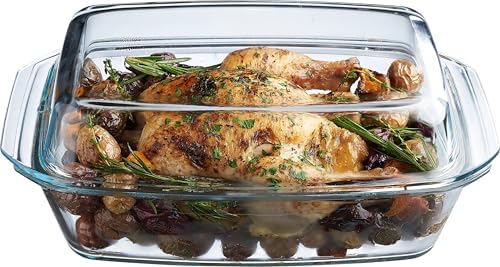
It’s the same glass specification used in laboratory beakers and pharmaceutical vials, just shaped into casserole dishes and saucepans.
Simax Glass Physical Specifications: What ISO 3585 Type 3.3 Actually Means
| Specification | Value | What It Means in Practice |
|---|---|---|
| Glass type | Borosilicate 3.3 | Same classification as scientific glassware |
| Coefficient of thermal expansion (CTE) | 3.3 × 10⁻⁶ K⁻¹ | Low expansion under heat — the core reason it resists cracking |
| Transformation temperature | 525°C | Upper limit before the glass structure changes |
| Max continuous use temperature | 300°C | Safe for sustained oven use well above typical baking temps |
| Temperature range for kitchenware | -40°F to 572°F (-40°C to 300°C) | Covers freezer through high-heat roasting in one material |
| Density | 2.23 g/cm³ | Lighter than soda-lime glass of equivalent thickness |
| Standard compliance | ISO 3585, ASTM E438 Type I Class A, ČSN ISO 3585 | International and US-recognized technical standards |
| Certification | TÜV CERT, EN ISO 9001:2000 | Third-party quality verification |
| Chemical resistance | Inert to water, acids, and salts | Attacked only by hydrogen fluoride and concentrated hot phosphoric acid — neither shows up in a kitchen |
Thermal Shock Resistance: The Specific Numbers Most Comparisons Leave Out
Here’s the number that actually answers “why did my Pyrex dish explode”: borosilicate glass tolerates roughly 166°C (300°F) of sudden temperature change before fracture risk becomes significant.
Soda-lime tempered glass — which is what US Pyrex is — tolerates roughly 55–60°C (99–108°F). That’s close to a 3:1 difference, and it’s the entire reason a glass dish pulled straight from the freezer into a hot oven behaves differently depending on which brand it is.
| Glass Type | CTE | Max Thermal Shock Differential | Fracture Risk | Source |
|---|---|---|---|---|
| Simax borosilicate 3.3 | 3.3 × 10⁻⁶ K⁻¹ | ~166°C (300°F) | Low | Kavalierglass technical documentation |
| European borosilicate PYREX | Similar CTE | Similar differential | Low | International Cookware specs |
| US soda-lime Pyrex | ~9 × 10⁻⁶ K⁻¹ | ~55–60°C (99–108°F) | Higher | Documented thermal expansion analysis |
Kavalierglass’s own technical data breaks the number down by wall thickness. Thinner walls equalize temperature faster, and thicker walls hold more internal stress. At 1mm, Simax tolerates a 303°C differential.
At 3mm, closer to an actual casserole dish wall, it drops to 175°C. At 6mm, it’s 124°C. Even at the thickest end, it still beats soda-lime by a wide margin.
Simax vs Pyrex: Side-by-Side Performance and Compatibility
This comparison is Simax against US Pyrex (soda-lime) unless noted otherwise — European PYREX is called out separately where it diverges.
Full Appliance and Use Compatibility: Simax vs US Pyrex vs European PYREX
| Use | Simax | US Pyrex (soda-lime) | European PYREX (borosilicate) |
|---|---|---|---|
| Oven | Yes | Yes | Yes |
| Max oven temp | 572°F | 425°F per manufacturer instructions | Comparable to Simax |
| Freezer to oven | Yes, no rest period needed | Caution advised — restricted by manufacturer | Yes |
| Stovetop / direct flame | Yes, on Simax’s dedicated cookware range | No | Limited, product-dependent |
| Microwave | Yes | Yes | Yes |
| Dishwasher | Yes | Yes | Yes |
| Freezer safe | Down to -40°F | Yes, but avoid sudden temperature shifts | Yes |
| Broiler | Check specific product | Not recommended | Check the specific product |
Stovetop and Direct Flame: Where Simax Has a Genuine Advantage
Simax makes a dedicated cookware range — saucepans and pots — rated for electric and gas stovetops, with handles that stay cool while the pot is on heat. US Pyrex bakeware was never designed for stovetop use.
European PYREX has some stovetop-rated products, but it’s far from the whole line. If stovetop-to-oven flexibility matters, Simax is the only one of the three built for it.
How to Tell Which Pyrex You Own or Are Buying
Because Pyrex spans multiple eras and two manufacturing regions, knowing which version sits in your cabinet changes both how you should use it and whether it’s worth replacing.
Pyrex Identification Guide: Logo, Origin, and Era
| Signal | What It Tells You | Reliable? |
|---|---|---|
| Uppercase “PYREX” logo | Often suggests European or vintage origin | Partially — not conclusive |
| Lowercase “pyrex” logo | Corning began using this as early as 1994, years before the World Kitchen sale | Partially — doesn’t reliably indicate glass type |
| “Made in France” or “Made in Europe” marking | Almost certainly borosilicate | Yes, reliable |
| “Made in USA” or no origin marking | Soda-lime, especially anything from the 1980s onward | Reliable |
| Slight blue tint on the edge | Borosilicate tends toward a faint blue; soda-lime trends greenish | Partially reliable |
| Weight | Soda-lime is heavier per unit of glass; borosilicate is lighter | Only partially useful on its own |
The Corning Museum of Glass addresses the most commonly repeated identification myth directly: “The short answer is that the change from upper to lower case signified a rebranding of the trademark Pyrex® in the late 1970s, but is not a conclusive way to determine, historically, what type of glass formulation the product is made from.”
If a blog tells you all-caps means borosilicate, that’s a simplification at best.
What the April 2025 Charleroi Plant Closure Means for US Pyrex Buyers
The Charleroi, Pennsylvania, plant, the last US Pyrex manufacturing facility, running for 132 years, shut down in April 2025. Anchor Hocking, the new owner, moved production to Lancaster, Ohio.
The glass type hasn’t changed; US Pyrex remains soda-lime tempered glass. What’s changed is the manufacturing footprint, and that’s worth knowing if “Made in USA” matters to your buying decision.
If you specifically want guaranteed borosilicate performance, that’s not something US Pyrex has offered in decades. Regardless of where it’s made, Simax (Czech Republic) and European PYREX (France) remain the consistent sources.
For options beyond Simax specifically, see our best borosilicate glass bakeware brands.
Simax vs Pyrex: Price, Availability, and Which to Buy
Before deciding, our safe glass bakeware guide: what to look for before buying covers the specs that actually predict how a dish performs.
Here’s the direct answer for Simax vs Pyrex specifically: if thermal shock resistance and stovetop versatility matter to how you cook, Simax wins. If you bake in a preheated oven and don’t move dishes between extreme temperatures, US Pyrex soda-lime is adequate and considerably cheaper.
European PYREX sits between genuine borosilicate and Simax in terms of wider retail availability than Simax in most regions.
Price and Value Comparison
| Brand | Glass Type | Typical Price (9″×13″ baker equivalent) | Where to Buy | Why the Price Difference |
|---|---|---|---|---|
| Simax | Borosilicate | $25–$45 | Amazon, specialty retailers | Borosilicate is more expensive to manufacture; imported from the Czech Republic |
| US Pyrex | Soda-lime | $10–$20 | Walmart, Target, Amazon | Soda-lime is cheaper to melt and shape — the reason manufacturers switched in the first place |
| European PYREX | Borosilicate | $20–$40 | Amazon, specialty kitchen stores | Borosilicate cost, offset by wider production scale than Simax |
Who Should Buy Simax and Who Can Stick with Pyrex
- Buy Simax if you’ve had a Pyrex dish crack or shatter from a temperature change — that’s the single clearest signal you need borosilicate.
- Buy Simax if you regularly move dishes from the fridge or freezer directly into a hot oven, which is common with assembled casseroles or gratins.
- Buy Simax if you want a glass dish that also works on the stovetop, since it’s the only one of the three with a dedicated range built for that.
- Stick with US Pyrex if you bake in a preheated oven, let dishes cool gradually, and never combine extreme hot and cold — under those conditions, soda-lime performs fine for a fraction of the price.
- Consider European PYREX if you want borosilicate but find Simax harder to source — it’s genuine Type 3.3-equivalent glass with a broader retail footprint in most markets outside Eastern Europe.
Care and Maintenance: How to Use Glass Bakeware Safely Regardless of Brand
- Always preheat the oven before placing any glass dish inside — going from a cold oven into a sudden temperature ramp stresses both glass types.
- Never set a hot dish directly on a cold countertop or wet surface; use a dry towel, trivet, or wooden board.
- Never add cold liquid to a hot glass dish — this is the single most common cause of shattering incidents across both Simax and Pyrex.
- Check for chips or surface cracks before each use. Damaged glass fails at temperature differentials it would otherwise handle fine.
- Both brands are dishwasher safe on normal cycles. Skip abrasive scouring pads — they create micro-scratches that become stress points later.
Simax is the clearer choice if you want verified, documented borosilicate performance without ambiguity about which version you’re getting.
For a broader rundown of options beyond these two brands, see our best borosilicate glass bakeware brands (link above), and for the deeper material science behind why this all matters, see our borosilicate vs soda lime glass: full comparison.
Frequently Asked Questions: Simax vs Pyrex
Is Simax better than Pyrex?
For thermal shock resistance and stovetop use, yes — Simax is borosilicate glass with roughly three times the temperature-change tolerance of US Pyrex’s soda-lime formula.
For basic oven baking with no sudden temperature swings, US Pyrex performs adequately at a much lower price. The better choice depends on how hard you push the glass, not brand loyalty.
Is Pyrex still made of borosilicate glass?
US Pyrex sold today is soda-lime tempered glass, manufactured by Anchor Hocking in Lancaster, Ohio.
European PYREX, made by International Cookware in France, remains genuine borosilicate. If you’re buying in the US, assume soda-lime unless the packaging specifically states otherwise.
What is the difference between Simax and Pyrex?
Simax has only ever been borosilicate Type 3.3 glass, manufactured by Kavalierglass in the Czech Republic since the 1800s.
Pyrex’s material depends entirely on which version you’re buying — US Pyrex is soda-lime, European PYREX is borosilicate, and vintage US Pyrex is a mix depending on the era. The brand name alone doesn’t tell you the glass type; Simax’s name does.
Why did my Pyrex dish shatter or explode?
Soda-lime glass — what current US Pyrex is made from — has a much lower thermal shock tolerance than borosilicate, roughly 55–60°C versus borosilicate’s 166°C.
Sudden temperature changes, like cold liquid hitting a hot dish or a dish moving straight from freezer to hot oven, exceed that threshold and cause a fracture. This is a property of the glass type, not necessarily a defect.
Can Simax glass go directly from the freezer to a hot oven?
Yes, no rest period required. Simax’s borosilicate composition gives it a thermal shock tolerance of around 166°C, comfortably covering the jump from a -40°F freezer to a preheated oven.
This is one of the clearest practical advantages over soda-lime Pyrex, where the manufacturer advises against that kind of abrupt transition.
Is European PYREX the same as US Pyrex?
No. European PYREX (International Cookware/Arc International, France) is genuine borosilicate and carries the EU knife-and-fork symbol. US Pyrex (Anchor Hocking) is soda-lime tempered glass.
They share a brand name through historical licensing, but are materially different products.
Where is Simax glass made?
Simax is manufactured by Kavalierglass a.s. in the Czech Republic, a company with over 185 years of borosilicate glass manufacturing experience. All Simax kitchenware, regardless of where it’s sold, comes from this single source.
How do I know if my Pyrex is borosilicate or soda-lime?
Check the origin marking first — “Made in France” or “Made in Europe” reliably indicates borosilicate, while “Made in USA” indicates soda-lime, particularly after the 1980s.
Logo capitalization is commonly cited as an indicator, but the Corning Museum of Glass states it’s “not a conclusive way to determine” glass formulation. If origin doesn’t settle it, assume soda-lime.
Is Simax glass dishwasher and microwave safe?
Yes to both, across the full Simax range. Borosilicate glass handles dishwasher heat and microwave use without the thermal shock concerns that apply to abrupt oven or stovetop transitions.
Dishwasher and microwave temperature changes are gradual enough that neither glass type is meaningfully at risk.
What happened to Pyrex in 2025?
The Charleroi, Pennsylvania, plant, the last US Pyrex factory, operating for 132 years, closed in April 2025. Anchor Hocking, the brand’s current owner, shifted production to Lancaster, Ohio.
The glass formula didn’t change; US Pyrex remains soda-lime tempered glass made in America, just at a different plant.
About the Author & Reviewer
Sarah Emirone, Author
Sarah researches and writes SafeKitchn’s dinnerware and kitchenware guides, with a focus on material safety, lead content, and manufacturer specifications. She cross-references product data sheets, safety certifications, and regulatory filings (including FDA and Prop 65 records) before publishing, and updates articles when new information becomes available.
James Daniels, Reviewer
James reviews SafeKitchn’s material safety content for scientific accuracy. He holds a B.Sc in inorganic chemistry and works as a materials researcher, with particular focus on the composition and safety behavior of glass, ceramic, and metal used in kitchenware.