

If you have ever watched a meal go from hot to lukewarm to cold before the person eating it has finished half their plate, you already understand the problem.
For most people, a cooling plate is a minor annoyance. For a slow eater, whether that is an elderly parent with Parkinson’s, someone recovering from a stroke, a person with dementia, or a toddler who treats every mealtime like a negotiation, cold food is a daily reality that affects nutrition, comfort, and dignity at the table.
Plate warmers solve this problem simply and reliably. But the category has more variety than most people realise, and the right type depends entirely on who is using it, where, and what level of heat control and safety they need.
This guide covers every type, the best options in each category, and three things no other roundup addresses: how long each type actually stays warm, the burn risk profile for medical users, and which options travel to a care home or hospital room.
Written by Sarah Emirone | Reviewed by James Daniels, B.Sc, Inorganic Chemist & Materials Researcher | Updated September 2026 | See How We Test | Filed under: Buying, Care & Product Guides
Why Food Goes Cold Faster Than Slow Eaters Can Finish It
Food loses heat faster than most people expect. A plate of pasta served at around 160°F (71°C) can drop to below 100°F within ten to fifteen minutes at room temperature, well below the point at which most people find food enjoyable to eat.
The plate material makes it worse: a cold ceramic or porcelain plate draws heat out of food from the moment it is served, accelerating the cool-down before the first bite is even taken.
For someone eating at a normal pace, this is manageable. For someone who genuinely needs more time, whether because of a medical condition, age-related changes in swallowing or coordination, or simply being a young child who cannot be rushed, the food is often cold long before the meal is done.
Who needs a plate warmer the most
- Elderly adults eating alone or with limited mobility, who cannot quickly finish a meal before it cools
- People with Parkinson’s disease, whose tremors and coordination difficulties slow their eating pace significantly
- Dementia patients, for whom meal distraction and slow processing mean food is often untouched for long stretches
- Stroke recovery patients are rebuilding swallowing and motor skills through supervised eating
- Toddlers and young children, particularly picky eaters who graze rather than eat in focused sittings
- Anyone who eats alone slowly and wants to enjoy a meal at their own pace without repeatedly microwaving it
The Four Types of Plate Warmer for Slow Eaters
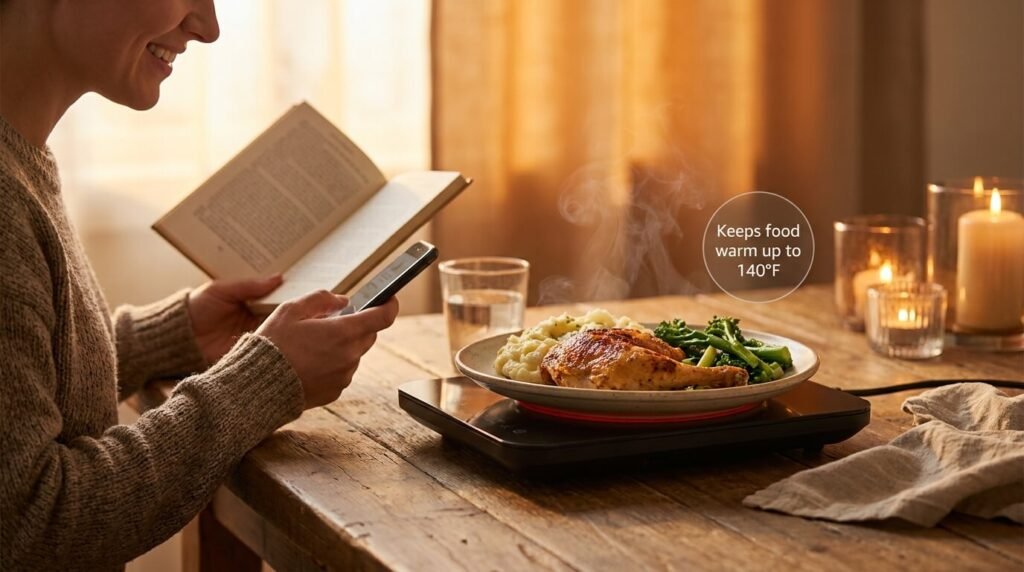
Before looking at specific products, it is worth understanding what is actually available. There are four distinct types, and they work differently, cost differently, and suit different users.
| Type | How it works | Heat duration | Best for | Price range |
|---|---|---|---|---|
| Electric warming pad | Thermostatically controlled heating element warms stacked plates before serving | 45–60 min (active) | Households, pre-warming multiple plates | $30–$120* |
| Hot water reservoir plate | Cavity in the plate base is filled with boiling water before use | 25–35 min | Elderly, toddlers, portability, no electricity needed | $15–$50* |
| Double-walled insulated plate | An air insulation layer between the inner and outer walls slows heat loss passively | 20–30 min | Budget-conscious, travel, lightweight users | $10–$40* |
| Microwavable thermal plate | Gel or stone core is microwaved, then retains and radiates heat during the meal | 15–25 min | Quick solo meals, minimalist households | $20–$60* |
Electric warming pads — most consistent heat control
An electric warming pad pre-heats plates before food is served, typically reaching 160°F (71°C) across the plate surface.
You stack plates on the pad for ten to fifteen minutes before a meal, then serve food onto an already-hot plate, giving the food significantly more time to stay warm at the table.

- 【10s Rapid Full-Surface Heating】Our electric warming mat is equipped with a 500W heating system with advanced directiona…
- 【Premium Silicone Nano-Material】Our food heating pad adopt top-tier flexible silicone nano material,allowing for easy ro…
- 【Adjustable 6-Level Temperature Control】 This silicone electric heating tray providing six temperature levels from 122 ℉…
The Waterbridge model, for example, can warm up to fifteen large plates or six small ones in a single cycle. Electric warming pads are ideal for households where multiple people eat together, where meals are served in courses, or where a caregiver prepares food in advance.
The limitation is that they require a power outlet and are not designed to keep food warm at the table; they warm the plate, not the ongoing meal.
They are not suitable for use at a bedside or in a care home room without reliable access to a socket.
Hot water reservoir plates — no electricity required
These plates have a sealed cavity in the base that is filled with boiling water before the meal begins.
The heat stored in the water conducts gently through the plate surface, keeping food warm from below for twenty-five to thirty-five minutes without any electrical connection.
The Ornamin Keep Warm Plate and the Essential Aids Stay-Warm Feeding Dish are both built on this principle. Hot water reservoir plates are the most versatile type — they work anywhere, require no batteries or cable, and present no electrical burn risk.
They are particularly well-suited for toddlers, elderly adults eating at their own pace, and anyone visiting a care home where power access may be limited.
The main drawback is that they require preparation; you need to fill the reservoir with boiling water a minute or two before serving, which adds a small step to the mealtime routine.
Double-walled insulated plates — passive heat retention
Double-walled plates use an insulating air layer between the inner food surface and the outer shell, slowing the rate at which heat escapes into the surrounding air.
They require no water and no electricity; they simply slow the natural cooling process. This makes them the most low-maintenance option and the easiest to carry to a hospital or care home.

- Generous Capacity and Dimensions: 13 oz capacity with diameter of 12cm/5 inch and height of 6cm/2.2 inch, weight 88 gram…
- Premium Material Construction: made of quality 304-stainless steel with excellent rust resistance, suitable for kitchen …
- Versatile Usage Applications: the double wall bowl can use as rice bowls, soup bowls, ice cream bowls, and snacks bowls …
The con is that they are entirely passive: they do not add heat to the food, they only retain what is already there. A meal served at 160°F will still cool, just more slowly.
For meals served at a high temperature, this buys a useful extra twenty to thirty minutes. For a meal served already slightly lukewarm, the effect is more limited.
Microwavable thermal plates — preheat and go
Microwavable thermal plates contain a gel, stone, or composite core material that absorbs and stores heat when placed in the microwave for one to two minutes.
The core then slowly releases that heat into the food during the meal. HotSmart’s Gourmet Plate is the most recognised product in this category and requires only one minute of preheating to maintain food warmth for over thirty minutes.
These plates suit solo users who want a simple one-step routine: microwave the plate, serve the food, and eat at their own pace.
They are dishwasher-safe in most cases and look like standard dinner plates, which matters for users who value dignity and do not want to draw attention to their eating difficulty.
Related: Dinner Plates that Keep Food Warm
Best Plate Warmers for Elderly Slow Eaters
For elderly adults, the right plate warmer needs to balance heat retention with safety, ease of use, and, critically, the dignity of looking like normal tableware rather than a medical device.
The options below are the most consistently recommended in caregiver communities and occupational therapy circles.
Ornamin Keep Warm Plate — best overall for independent dining
The Ornamin Keep Warm Plate is a double-walled melamine plate with a hot water reservoir base, designed specifically for slow eaters and people with reduced mobility.
It fills via a small stopper on the underside, holds enough boiling water to maintain food warmth for twenty-five to thirty-five minutes, and features a non-slip base that stays steady on the table without needing to be held important for one-handed users or anyone with limited grip.
The design is notably discreet: it looks like a standard plate rather than a disability aid, which is a meaningful consideration for users who want to eat independently without a visible marker of their condition.
BPA-free, dishwasher safe, and available in a neutral white finish. At around £25–£35 ($30–$45), it represents very strong value for a daily-use adaptive dining product. See our full Ornamin Keep Warm Plate review for more details.
Waterbridge Electric Plate Warmer — best for warming multiple plates
The Waterbridge Plate Warmer is a thermostatically controlled electric warming pad made in Canada that heats up to fifteen large plates or six smaller plates to a consistent 160°F (71°C).
It covers 95% of the plate surface area, leaving only the outer rim slightly cooler for safe handling — a thoughtful design detail that prevents the handle-and-drop problem that happens when plates come out of a hot oven.

- KEEPS FOOD HOT, LONGER. A thermostatically controlled electric heating pad safely heats up to 15 plates to a hot and com…
- INSULATED BASE PAD protects all tabletop surfaces. There is no chipping or cracking from heating plates in an oven, micr…
- INNOVATIVE DESIGN FOR PLATES. Covers 95% of plate’s surface area, leaving the outside rim of the plate slightly cooler f…
The removable fabric slipcover protects fine bone china and casual dinnerware alike. Waterbridge is the best choice for caregivers who prepare multiple plates at once or for households where someone needs consistently pre-warmed dinnerware across every meal of the day.
Not portable — requires a power outlet — but for home use, it is the most reliable multi-plate pre-warming solution available.
Navaris Electric Plate Warmer — best mid-range electric option
The Navaris Electric Plate Warmer handles up to ten plates and heats in around ten minutes, making it a more compact and affordable electric alternative to Waterbridge for smaller households.
It is widely available across the UK, US, and Europe, consistently rated well for ease of use, and straightforward to operate — plug in, stack plates, wait.

- 10-PLATE WARMER: The electric plate warmer simultaneously heats 10 dinner plates up to 165 degrees Fahrenheit (74 degree…
- FITS FULL SIZE PLATES: The electric plate blanket features pockets that accommodate 2 ceramic dinner plates each (total …
- CONVENIENT: Using this electric plate warmer only takes 10 minutes to heat, saving time and energy compared to warming p…
The temperature is fixed rather than adjustable, which is a minor limitation for users who want precise control, but for everyday family use, it delivers reliably warm plates at a significantly lower price than premium alternatives.
A good starting point for anyone new to plate warming who wants to test the habit before committing to a higher-end model.
Best Plate Warmers for Parkinson’s and Dementia Patients
Parkinson’s and dementia introduce specific requirements that standard plate warmer reviews rarely address.
Tremors, involuntary movement, and reduced sensation all change the safety calculus around heat. A plate that is perfectly safe for a healthy adult can become a burn risk for someone whose hand shakes unpredictably or whose ability to sense heat is reduced.
At the same time, mealtime independence, the ability to eat without constant supervision, is a genuine quality-of-life priority that the right product can support.
What to look for when buying for a Parkinson’s or dementia patient
- Cool rim design: The outer edge of the plate or the shell of a hot water reservoir should remain cool enough to handle safely, even if the food surface is warm
- Non-slip base: Essential for users with tremors — the plate must not move when pushed against during scooping
- No cord at the table: Electric warming pads with trailing cords are a trip and knock-over risk; hot water reservoir or insulated plates are safer at the table itself
- Easy-fill mechanism: For caregivers filling a hot water reservoir, the stopper must be simple, and the cavity should be clearly marked to avoid overfilling
- Discreet appearance: Patients with dementia can become distressed by unfamiliar-looking objects; plates that look like standard dinnerware cause less confusion
HotSmart Gourmet Plate — best for Parkinson’s and tremor users
The HotSmart Gourmet Plate is a microwavable thermal plate that requires one minute of preheating and then maintains food warmth for over thirty minutes at the table.
Its key advantage for Parkinson’s users is the design of the heat distribution system: the food surface reaches and maintains serving temperature while the rim stays cool enough to handle safely, reducing burn risk during the involuntary contact that tremors can cause.
It looks and functions exactly like a standard dinner plate, which removes the visual unfamiliarity that can confuse dementia patients. One-minute microwave prep is also manageable for caregivers with limited time.
Widely used in Parkinson’s caregiver communities and recommended by occupational therapists as a first-line dining aid for tremor-affected users.
Best Plate Warmers for Toddlers and Picky Eaters
For toddlers, the priorities flip. The concern is less about medical safety and more about the practical reality of a small child who takes forty-five minutes to eat a bowl of pasta, ignores half of it, wanders off, comes back, and then complains it is cold.
Hot water reservoir plates and compact electric warming options both work well in this context, and the best products for kids add useful features like divided compartments and suction bases on top of the heat-retention function.
Stay-Warm Feeding Dish — best hot water plate for toddlers
The Stay-Warm Feeding Dish from Essential Aids is a divided hot water reservoir plate designed specifically for slow eaters, including young children. The base cavity fills with hot water and keeps food warm for twenty-five to thirty-five minutes.
The two divided sections keep food separated important for children who object to different foods touching, and it includes an integrated egg cup.
It is microwave safe for reheating directly on the plate and dishwasher safe for easy cleaning. At around £12–£18, it is one of the most affordable dedicated slow-eater plates available, and its durable plastic construction makes it practical for daily toddler use.
A genuine all-in-one solution for parents who want to stop reheating the same bowl of food three times per meal.
ROPPLIFE Electric Warming Plate — best compact electric option for kids
The ROPPLIFE is a small 8.3-inch electric warming tray with six temperature settings and a memory function that remembers your last setting.
It sits on the table and keeps the plate or bowl warm throughout the meal without pre-warming required; you simply place the plate on it when you serve.

- ✔️【Plate Warmer for Slow Eaters】Helps keep prepared meals warm through the last bite, so slow eaters and seniors can enj…
- ✔️【6 Temperature Settings with Memory】 Choose from 140 to 230°F for different meals; the memory function recalls your pr…
- ✔️【13.8 x 10 Inch Warming Surface】 Sized for everyday dinner plates, bowls or takeout containers; a practical electric w…
At the lowest settings, the surface temperature is gentle enough for everyday family use without presenting a burn risk to curious hands that touch the tray.
It is also compact enough to pack for travel, making it a useful option for family holidays or grandparent visits where mealtime difficulties follow the child.
The ROPPLIFE sits at around $25–$35, making it a cost-effective entry into electric warming for family households.
Are Electric Plate Warmers Safe, and How Much Do They Cost to Run?
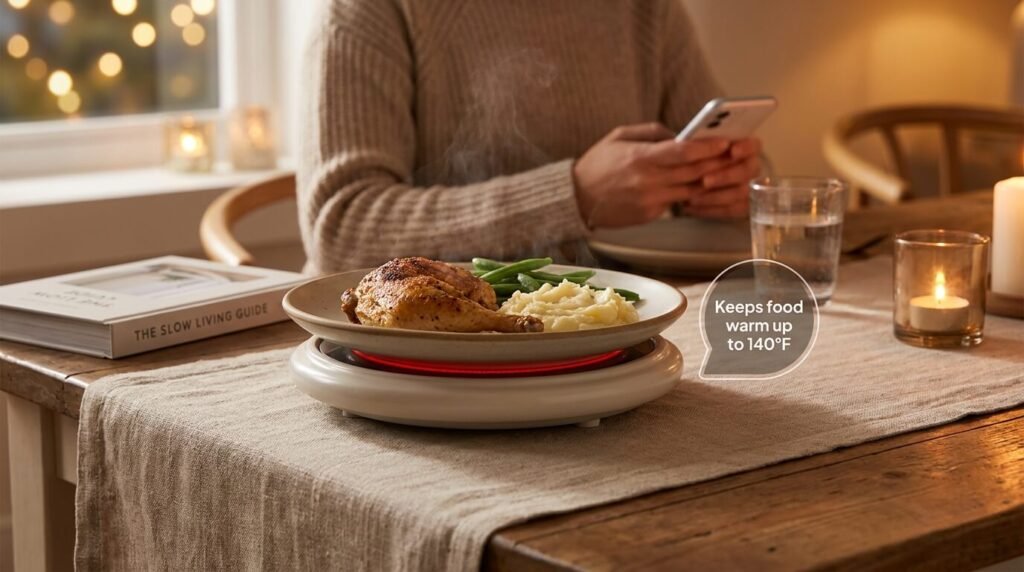
Electric plate warmers consume between 15 and 20 watts during operation — a figure that makes them among the most energy-efficient kitchen appliances in regular use.
At that wattage, running a plate warmer for one hour costs approximately one to two cents, making daily use negligible in terms of electricity cost over a month. For reference, a standard microwave uses around 1,000 watts; an electric plate warmer uses roughly 5% of that.
Safety depends on the type and context. Electric warming pads heat the plate before serving, meaning the heat is in the ceramic or porcelain, not in an exposed electrical element.
The plate surface reaches approximately 71°C (160°F) at the centre, with the rim remaining cooler due to how most pads distribute heat. For healthy adults, this is comfortably safe.
For Parkinson’s patients or dementia users, the key considerations are cord management at the table, trailing cables are a fall and knock-over hazard, and whether the unit has an auto-shutoff feature, which most modern models include as a standard safety measure.
For those users, hot water reservoir plates or insulated plates without any electrical element are the safer at-table option, with electric warming pads used in the kitchen by the caregiver for pre-warming only.
How Long Does Each Type of Plate Warmer Keep Food Hot?
This is the most commonly asked question in this category, and it is one that almost no reviews answer with actual data.
The table below reflects approximate heat retention durations measured at a standard room temperature of 68°F (20°C).
Colder rooms will shorten these times; warmer rooms will extend them marginally.
| Plate warmer type | Approximate heat duration | Notes |
|---|---|---|
| Electric warming pad (pre-warmed plate) | 35–50 min after serving | Depends on plate material; ceramic retains longer than thin porcelain |
| Hot water reservoir plate | 25–35 min | Hot water cools steadily; boiling water at fill extends duration |
| Double-walled insulated plate | 20–30 min | Purely passive — slows cooling but does not add heat |
| Microwavable thermal plate (e.g. HotSmart) | 20–35 min | Core material and preheat time affect output significantly |
| No warmer — standard ceramic plate | 10–15 min | Baseline for comparison |
The practical implication: for someone who takes up to thirty minutes to finish a meal, a hot water reservoir or double-walled plate is sufficient.
For someone who takes forty-five minutes or longer — common with advanced Parkinson’s or dementia — a pre-warmed electric option or a microwavable thermal plate gives the most margin.
No passive solution keeps food genuinely warm for a full hour; for very slow eaters, a combination approach (pre-warmed plate plus an insulated cover) is worth considering.
Burn Risk by Plate Warmer Type — What Caregivers Need to Know
This is the most important consideration for anyone buying for a Parkinson’s patient, a dementia care setting, or a young child. The table below summarises the actual burn risk profile of each type.
| Type | Food surface temp | Outer plate/shell temp | Risk level for tremor users | Risk level for children |
|---|---|---|---|---|
| Electric warming pad (pre-warmed plate) | ~71°C / 160°F | Same as food surface | Moderate — rim cooler on some models | Moderate — depends on plate design |
| Hot water reservoir plate | Food temp only | Outer shell ~40–45°C | Low — water is sealed, shell is warm not hot | Low — outer shell is handleable |
| Double-walled insulated plate | Food temp only | Ambient — not heated | Very low | Very low |
| Microwavable thermal plate (HotSmart style) | ~65–70°C / 150–158°F | Rim is designed cool on most models | Low–moderate — check manufacturer spec | Low–moderate |
| No warmer — oven-heated plate | Up to 100°C+ / 212°F+ | Same as the food surface | High | High |
The key takeaway for caregivers: hot water reservoir plates and double-walled insulated plates carry the lowest burn risk because the outer shell never reaches the temperature of the food surface.
Electric pre-warmed plates carry a moderate risk depending on whether the rim is designed to stay cool.
Oven-heated plates, the traditional alternative, carry the highest risk of all, and should be avoided for anyone with tremors, reduced sensation, or impaired grip.
Plate Warmer Portability — Which Options Work at a Care Home or Hospital
This scenario appears repeatedly in caregiver forums: a family member wants to visit a parent in a care home or hospital and bring a warm home-cooked meal. Which plate warmer type actually works in that context?
Hot water reservoir plates are the most practical option. They require no power outlet, no equipment, and no setup at the destination. You fill the reservoir with boiling water from a flask or the care home kitchen immediately before serving.
The Ornamin Keep Warm Plate and Essential Aids Stay-Warm Feeding Dish both fall into this category and are fully portable.
Double-walled insulated plates are the most portable of all. Self-contained, lightweight, and requiring nothing from the environment, they are ideal for a visit where you cannot predict what facilities are available.
The con is the shorter heat retention window compared to a reservoir plate.
Electric warming pads are portable only in the sense that they can be plugged into any standard socket. In a hospital setting, ward sockets may be limited or restricted.
In a care home, this is usually manageable in a resident’s private room, but cord management in a medical setting requires care. These are better suited to home use or as a fixed kitchen appliance.
Microwavable thermal plates require microwave access at the destination. Many care homes have communal microwaves available, making this a reasonable option, but it requires knowing the facility in advance.
How to Choose the Right Plate Warmer for Your Situation
Work through these five questions before purchasing.
- How long does the person typically take to finish a meal? Under thirty minutes — a hot water reservoir or insulated plate is adequate. Thirty to forty-five minutes — a microwavable thermal plate or pre-warmed electric plate gives more margin. Over forty-five minutes — consider a combination of a pre-warmed plate and an insulated food cover.
- Is electrical safety a concern? For Parkinson’s, dementia, or stroke patients eating unsupervised, choose a non-electric option at the table. Reserve electric warming pads for caregiver use in the kitchen only.
- Does the plate need to travel? If yes, hot water reservoir or double-walled insulated plates are the only practical options. See the portability section above.
- Is this for a toddler? Look for a divided plate design with a suction or non-slip base in addition to heat retention. The Stay-Warm Feeding Dish covers both requirements in a single product.
- Does the appearance matter to the user? For dignity-conscious elderly users or dementia patients who may be confused by unfamiliar objects, choose a plate that looks like standard tableware. The HotSmart Gourmet Plate and Ornamin Keep Warm Plate both pass this test.
Our Top Picks at a Glance
For an elderly parent eating independently at home: Ornamin Keep Warm Plate — no electricity, cool outer shell, non-slip base, discreet design.
For a Parkinson’s or tremor user: HotSmart Gourmet Plate — cool rim, looks like standard dinnerware, one-minute microwave prep.
For pre-warming multiple plates before a family meal: Waterbridge Electric Plate Warmer — most reliable multi-plate capacity, cool-rim design, made in North America.
For a toddler or young child: Stay-Warm Feeding Dish — divided sections, hot water reservoir, affordable, dishwasher safe.
For care home or hospital visits: Ornamin Keep Warm Plate or any double-walled insulated plate — no power needed, fully portable.
Frequently Asked Questions About Plate Warmers for Slow Eaters
u003cstrongu003eWhat is the best plate warmer for an elderly parent who eats very slowly?u003c/strongu003e
The Ornamin Keep Warm Plate is the most consistently recommended option for elderly users. u003cbru003eu003cbru003eIts hot water reservoir base requires no electricity, the outer shell stays cool enough to handle safely, and the non-slip base keeps the plate stable for one-handed users. u003cbru003eu003cbru003eFor families warming multiple plates before serving, the Waterbridge Electric Plate Warmer adds consistent pre-meal plate heating without the burn risk of oven-heated plates.
u003cstrongu003eHow long does a hot water reservoir plate keep food warm?u003c/strongu003e
Approximately twenty-five to thirty-five minutes at a room temperature of 68°F (20°C), depending on how hot the water is at the time of filling. u003cbru003eu003cbru003eUsing freshly boiled water and filling the reservoir to capacity gives the longest retention. u003cbru003eu003cbru003eColder rooms will shorten this window; a warmer room or insulating food cover will extend it. u003cbru003eu003cbru003eFor meals that routinely take longer than thirty-five minutes, a microwavable thermal plate or pre-warmed ceramic combination will serve the user better.
u003cstrongu003eIs it safe to use an electric plate warmer around someone with Parkinson’s?u003c/strongu003e
Electric warming pads are safe for use by caregivers in the kitchen for pre-warming plates, but should not be placed on the dining table for unsupervised use by a Parkinson’s patient. u003cbru003eu003cbru003eTrailing cords are a significant hazard for anyone with involuntary movement, and the plate surface temperature at 160°F is a burn risk for someone with reduced sensation or unpredictable hand movement. u003cbru003eu003cbru003eAt the table, hot water reservoir plates and double-walled insulated plates are the safer choices for this group.
u003cstrongu003eWhat temperature does a plate warmer heat to — is it enough?u003c/strongu003e
Most electric plate warmers heat to approximately 160°F (71°C) — the standard restaurant threshold for serving food on a warm plate. u003cbru003eu003cbru003eHot water reservoir plates warm the plate surface to approximately 50–60°C (122–140°F), depending on water temperature at fill. u003cbru003eu003cbru003eBoth temperatures are sufficient to meaningfully extend the warmth of food during a meal. u003cbru003eu003cbru003eFor context, food is generally considered enjoyable to eat above about 130°F (54°C); below that, it begins to feel noticeably lukewarm.
u003cstrongu003eCan I use a plate warmer for a toddler’s meals?u003c/strongu003e
Yes, and it is one of the most practical applications. u003cbru003eu003cbru003eHot water reservoir plates like the Stay-Warm Feeding Dish are specifically designed with young children in mind — divided compartments, durable plastic construction, and a cool outer shell that will not burn small hands. u003cbru003eu003cbru003eAvoid placing any electric warming pad within reach of a child. For toddlers, the compact ROPPLIFE electric warming tray at low settings is also a workable table option, provided it is positioned out of direct reach.
u003cstrongu003eDo I need a plate warmer or just a heat-retaining plate — what is the difference?u003c/strongu003e
A plate warmer actively adds or retains heat — it does something to keep food warm. u003cbru003eu003cbru003eA heat-retaining plate (double-walled insulated) passively slows the rate of heat loss without adding any external energy. u003cbru003eu003cbru003eA plate warmer will keep food warm longer; a heat-retaining plate is simpler, cheaper, and requires no preparation. For a slow eater who takes up to twenty-five minutes, an insulated plate is often sufficient. u003cbru003eu003cbru003eFor someone who regularly takes thirty-five to forty-five minutes or more, an active warming solution, a hot water reservoir, or an electric is worth the added preparation step.
u003cstrongu003eHow much electricity does a plate warmer use per day?u003c/strongu003e
Very little. Most electric plate warmers draw 15–20 watts, which means running one for one hour costs approximately one to two cents at average US electricity rates. u003cbru003eu003cbru003eUsing it for thirty minutes before every meal — twice a day — adds under $2 per year to your electricity bill. Energy use is not a meaningful reason to avoid an electric plate warmer.
u003cstrongu003eCan a plate warmer be used in a care home or hospital room?u003c/strongu003e
Yes, with the right type. u003cbru003eu003cbru003eHot water reservoir plates are fully portable and require no power outlet — fill the reservoir with boiling water immediately before visiting, and the plate will stay warm for twenty-five to thirty-five minutes without any electrical connection. u003cbru003eu003cbru003eDouble-walled insulated plates are equally portable. Electric warming pads can work in care home rooms that have standard sockets, but cord management in a care setting requires attention. u003cbru003eu003cbru003eMicrowavable thermal plates work if communal microwave access is available. When in doubt, the hot water reservoir plate is the most reliably portable option for care settings.
For more information on understanding dinnerware for the elderly, read our guide on Adaptive dining.
About the Author & Reviewer
Sarah Emirone, Author
Sarah researches and writes SafeKitchn’s dinnerware and kitchenware guides, with a focus on material safety, lead content, and manufacturer specifications. She cross-references product data sheets, safety certifications, and regulatory filings (including FDA and Prop 65 records) before publishing, and updates articles when new information becomes available.
James Daniels, Reviewer
James reviews SafeKitchn’s material safety content for scientific accuracy. He holds a B.Sc in inorganic chemistry and works as a materials researcher, with particular focus on the composition and safety behavior of glass, ceramic, and metal used in kitchenware.