

Is porcelain stronger than glass? The honest answer is that it depends on which kind of “strong” you mean, and almost nobody asking this question gets told that.
Standard glass has a higher compressive strength than most porcelain, around 1,000 megapascals, versus figures that rarely get published at all for porcelain.
But porcelain usually wins on toughness, which is why a dropped plate chips instead of exploding into a hundred pieces.
Those are two different properties, and mixing them up is exactly why search results on this topic contradict each other.
This article breaks the question into the three properties that actually matter, with real numbers attached to each one.
Written by Sarah Emirone | Reviewed by James Daniels, B.Sc, Inorganic Chemist & Materials Researcher | Updated September 2026 | See How We Test | Filed under: Buying, Care & Product Guides
Hardness vs. Strength vs. Toughness — Why “Stronger” Means Three Different Things
“Stronger” gets used to mean three separate things, and the answer to “Is porcelain stronger than glass?” changes depending on which one you’re asking about.
Glass often beats porcelain on raw strength. Porcelain almost always beats glass in toughness. Hardness is close to a tie, with the specific numbers depending on the glass type and the porcelain glaze.
None of the popular comparison articles separates these, which is why one site tells you porcelain is stronger, and another cites glass’s higher strength rating; they’re both right, about different things.
The Three Properties Defined
Hardness measures a material’s resistance to scratching and surface indentation. It’s tested by seeing what can scratch what, using the Mohs scale, and it tells you nothing about whether the material will survive a fall.
Strength measures how much force a material can withstand before it fractures, usually reported as compressive strength (crushing force) or tensile strength (pulling/stretching force) in megapascals.
Toughness measures how much energy a material can absorb before it breaks — its ability to bend, flex, or deform slightly instead of snapping. This is the property that decides whether a dropped item survives.
Which Property Actually Predicts a Broken Plate
Toughness is the property to watch if you care about whether your dinnerware survives being dropped, and this is where porcelain has the real advantage.
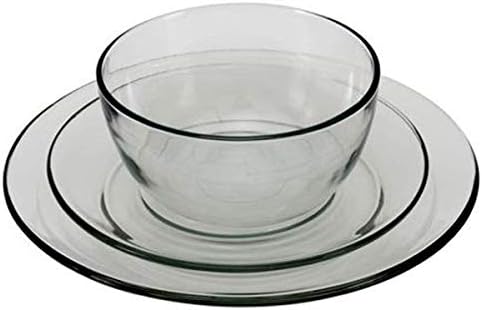
Glass can have excellent hardness and even strong compressive numbers, but it’s brittle — it stores stress right up until it fails, then releases all of it at once in a shatter pattern.
Porcelain, fired into a denser, more vitrified structure, tends to absorb more of that energy before failing, so it’s more likely to chip a corner than come apart entirely.
That’s the real reason porcelain “feels” sturdier at the dinner table, even in cases where a lab test would show glass out-scoring it on pure strength.
Porcelain vs. Glass Hardness on the Mohs Scale
Porcelain and glass land in almost the same range on the Mohs hardness scale, and the winner depends entirely on which type of each material you’re comparing.
This is one of the areas where competitor comparisons wave their hands, because the honest answer isn’t a clean win for either side.
Mohs Hardness Comparison Table
| Material | Mohs Hardness | Notes |
|---|---|---|
| Soda-lime glass (standard) | ~5.5 | Most common glass type — windows, drinking glasses, basic dinnerware |
| Borosilicate glass | ~6 | Higher heat resistance, common in bakeware and lab glass |
| Porcelain (glaze-dependent) | 6–8 | Range depends on firing temperature and glaze composition |
| Quartz (reference point) | 7 | Included for scale — scratches soda-lime and borosilicate glass |
| Steel knife blade (reference point) | ~5.5 | Roughly equal to soda-lime glass, which is why glass scratches easily with metal |
Porcelain’s range overlaps with glass at the low end and pulls ahead at the high end, but the spread exists because hardness in porcelain is mostly a property of the glaze, not the clay body underneath.
Two porcelain plates from different manufacturers can land three points apart on this scale depending on how hot the glaze firing ran.
Is Porcelain Scratch-Resistant?
Yes, porcelain resists scratching well in daily use, largely because most kitchen utensils — steel, wood, plastic — sit well below its hardness range.
A steel knife rates around 5.5 on the Mohs scale, and porcelain glazes typically start above that, which is why porcelain plates rarely show cutlery marks the way soft ceramic or melamine does.
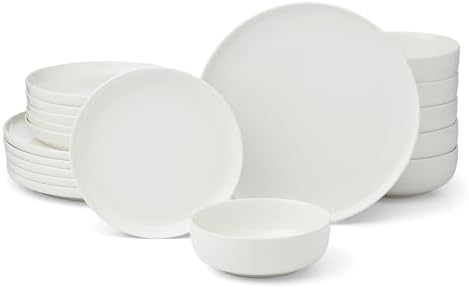
- WHY IT’S SPECIAL: 24 Seven dinnerware does it all from sunup to sundown. This simple, sensible design dresses up and dow…
- WHO IT’S PERFECT FOR: Anyone who wants dishes that look elegant, feel effortless, and work for everything from weeknight…
- WHAT’S IN THE BOX: This 18-piece dinnerware includes service for 6 with 6 dinner plates, 6 accent plates, and 6 all-purp…
Glass resists scratching from soft materials, too, but soda-lime glass, sitting at roughly the same hardness as a steel blade, means it’s more vulnerable to fine scratching from metal utensils over the years of use.
That faint cloudiness you see in old drinking glasses is scratch damage, not residue.
Porcelain vs. Glass: Compressive and Tensile Strength
Glass has a notably higher compressive strength than most porcelain, which surprises people who assume “more fragile-looking” means “structurally weaker.”
Compressive strength measures how much crushing force a material can take before it fails, and glass performs well here, it’s the impact and bending scenarios where it falls apart, literally.
Strength Comparison by the Numbers
| Property | Standard Glass | Porcelain |
|---|---|---|
| Compressive strength | ~1,000 MPa | Generally lower, though rarely standardized or published by manufacturers |
| Tensile strength (practical) | ~7 MPa | Comparable order of magnitude, varies by body composition and glaze |
| Tensile strength (theoretical ceiling) | Up to ~17 GPa, due to strong Si–O bonds | Not applicable in the same way — porcelain’s failure mode differs structurally |
| Practical takeaway | High resistance to crushing; low resistance to sudden impact or flexing | Lower peak strength numbers, but fails more gradually |
Glass’s theoretical tensile strength ceiling — around 17 gigapascals — comes from the strength of its silicon-oxygen bonds, but that number is rarely reached in real-world glass because microscopic surface flaws concentrate stress and cause failure long before the material’s true potential is tested.
Porcelain doesn’t have a comparable theoretical ceiling published anywhere, because its failure behavior depends more on the clay-glaze interface than on a single bond structure.
Why High Compressive Strength Doesn’t Prevent Shattering
A material can have excellent compressive strength and still shatter easily, because compressive strength and impact resistance test completely different kinds of stress.
Glass resists being crushed under a slow, evenly distributed load extremely well — that 1,000 MPa figure is real.
But drop a glass plate on a tile floor and the failure mode isn’t compression, it’s a sudden, localized impact that creates a crack and propagates it through the material almost instantly, because glass has very little give.
Porcelain, with lower compressive numbers but higher toughness, tends to absorb more of that impact energy through microscopic deformation in the glaze and body before a crack forms.
This is the gap that makes “porcelain is stronger” technically wrong and practically right at the same time — wrong for compressive strength, right for the specific stress of being dropped.
Is Tempered Glass Stronger Than Porcelain?
Tempered glass can be stronger than porcelain in practical impact scenarios, and this is the comparison almost every competing article skips entirely.
Standard, untempered glass loses to porcelain in toughness. Tempered glass changes the equation because the tempering process doesn’t change hardness; it changes how stress is distributed across the surface.
Annealed vs. Tempered vs. Borosilicate Glass
| Glass Type | Mohs Hardness | Relative Strength vs. Annealed | Notes |
|---|---|---|---|
| Annealed (standard) glass | ~5.5 | 1x (baseline) | Cools slowly, no internal stress engineering, breaks into sharp shards |
| Tempered glass | ~5.5 (unchanged) | 4–5x stronger | Rapid cooling creates compressive surface stress that resists crack initiation |
| Borosilicate glass | ~6 | Higher thermal shock resistance, moderate strength gain | Better for heat cycling, not primarily an impact-strength upgrade |
The hardness number staying flat at 5.5 for both annealed and tempered glass is the detail that trips people up.
Tempering doesn’t make the surface harder to scratch; it makes the surface resistant to the crack initiation that leads to shattering, which is a toughness and strength improvement, not a hardness one.
Tempered Glass vs. Porcelain — Which Wins on Impact
| Scenario | Tempered Glass | Porcelain |
|---|---|---|
| Dropped on a tile floor from counter height | Often survives due to compressive surface stress | Often chips or cracks at point of impact |
| Sustained daily scratching (utensils, stacking) | Resists well, similar to the hardness of porcelain glaze | Resists well, similar range |
| Thermal shock (hot food, then cold rinse) | Handles moderate shifts; borosilicate variants handle more | Handles well due to vitrified structure |
| Overall winner for drop resistance | Tempered glass, by a real margin | Loses this specific comparison |
This is the one scenario where glass outright wins, and it’s the comparison most buying guides never run because they treat “glass” as a single material instead of naming the type.
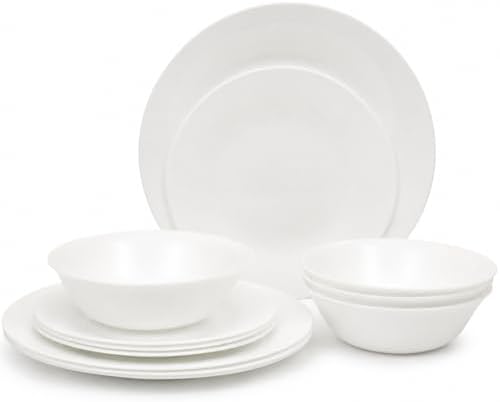
- WHAT’S IN THE BOX: Four 10.5-inch dinner plates, Four 8-inch dessert plates, and Four 6-inch cereal bowls
- PORCELAIN DINNERWARE: Crafted from porcelain, this dinnerware collection resists chipping and breakage to offer durabili…
- STACKABLE DESIGN: Modern shapes with tall edges and flat interior allow each piece to fit and stack to save space in any…
If your priority is a set that survives being dropped by a toddler, the best tempered glass dinnerware sets are a more useful search than “porcelain vs glass” in general.
Porcelain vs. Glass for Everyday Dinnerware
For most households, porcelain and standard (non-tempered) glass fail differently, rather than one being universally better, and which one matters more depends on what kind of breakage worries you most.
For a related comparison in the same material family, see porcelain vs bone china strength.
Chipping vs. Shattering — How Each Material Actually Fails
- Porcelain typically fails at a single point of contact, leaving a chip or crack while the rest of the piece stays intact and usable.
- Glass typically fails across the entire piece at once, because a crack that starts anywhere propagates through the whole structure almost instantly.
- Chipped porcelain can often stay in rotation for casual use, while shattered glass is a total loss and a safety hazard from the fragments.
- Glass shards from a shattered plate spread further and stay sharper than a porcelain chip, which matters directly in households with kids or pets on the floor nearby.
- Porcelain’s failure is more predictable because it usually starts at the rim or a stress point from prior use, while glass failure location depends more on where the impact lands.
Best Choice by Household Type
| Household Type | Better Fit | Why |
|---|---|---|
| Families with young kids | Tempered glass or porcelain (not standard glass) | Standard glass shatter risk is a real safety concern on kitchen floors |
| Formal dining/adults only | Porcelain | Chips gracefully, holds up to decades of careful daily use |
| Small households, careful handling | Standard glass | Lower cost, fine if drop risk is genuinely low |
| Rental or high-turnover settings | Tempered glass | Best impact resistance per dollar |
If your main concern is choosing dinnerware that survives a household with kids, choosing dinnerware for kids covers the safety angle in more depth than a general strength comparison can.
Want the numbers next to actual product picks? See our full comparison of tempered-glass and porcelain dinnerware sets, sorted by household type and drop-test performance, so you can match the material to how your kitchen actually gets used.
Frequently Asked Questions
Does porcelain break more easily than glass?
No, standard porcelain generally resists impact breakage better than standard (untempered) glass, because it absorbs more energy before failing instead of cracking instantly.
Tempered glass reverses this and can outperform porcelain on drop resistance.
Is tempered glass stronger than porcelain?
Yes, in impact scenarios, tempering makes glass 4 to 5 times stronger than annealed glass at the same hardness, often giving it an edge over porcelain for drop resistance. This only applies to tempered glass specifically, not glass in general.
Why does porcelain chip while glass shatters?
Porcelain’s denser, more vitrified structure absorbs impact energy locally, so a fall typically damages just one point of contact. Glass has very little give, so a crack that starts anywhere propagates through the entire piece almost instantly.
Is porcelain scratch-resistant?
Yes, most porcelain glazes rate 6 to 8 on the Mohs hardness scale, well above steel utensils at roughly 5.5. This is why porcelain plates rarely show cutlery marks the way softer materials do.
Is porcelain the same as ceramic?
No, porcelain is a specific type of ceramic fired at higher temperatures (up to about 2,600°F) using refined kaolin clay, which makes it denser and less porous than standard ceramic. All porcelain is ceramic, but not all ceramics are porcelain.
Which is more durable for everyday dishes, porcelain or glass?
Porcelain is more durable than standard glass; tempered glass is more durable than porcelain. The material name matters more than the general “glass vs. porcelain” framing suggests.
What is the Mohs hardness of porcelain versus glass?
Porcelain ranges from 6 to 8, depending on glaze and firing temperature, while soda-lime glass sits around 5.5, and borosilicate glass around 6. The ranges overlap, so hardness alone doesn’t settle the strength question.
Is porcelain or glass better for countertops?
Porcelain generally wins for countertops because it resists scratching, heat, and impact better across daily kitchen use, while glass countertops require more careful handling to avoid chips and cracks at the edges.
Tempered glass narrows this gap but is still less common in countertop applications than porcelain slabs.
About the Author & Reviewer
Sarah Emirone, Author
Sarah researches and writes SafeKitchn’s dinnerware and kitchenware guides, with a focus on material safety, lead content, and manufacturer specifications. She cross-references product data sheets, safety certifications, and regulatory filings (including FDA and Prop 65 records) before publishing, and updates articles when new information becomes available.
James Daniels, Reviewer
James reviews SafeKitchn’s material safety content for scientific accuracy. He holds a B.Sc in inorganic chemistry and works as a materials researcher, with particular focus on the composition and safety behavior of glass, ceramic, and metal used in kitchenware.