

Most people shopping for budget-friendly glass dishes frame the question as a durability race: which one breaks less?
But when comparing IKEA Oftast vs Corelle, the more useful question is which one costs less per year of actual use, and that answer is not what the sticker prices suggest.
Both are lightweight, microwave-safe, lead-free (in their modern plain white versions), and widely available.
The differences are real, but they matter more for some households than others. This guide breaks down the material science, real-world drop test data, XRF safety results, and a cost-of-ownership model that no other comparison has built out.
Written by Sarah Emirone | Reviewed by James Daniels, B.Sc, Inorganic Chemist & Materials Researcher | Updated September 2026 | See How We Test | Filed under: Brand & Product Comparisons
What Are IKEA Oftast and Corelle Actually Made Of?
For anyone choosing between glass dinnerware options, the best glass dinnerware sets for everyday use all come down to one question: what is the material, and how does it behave under stress?
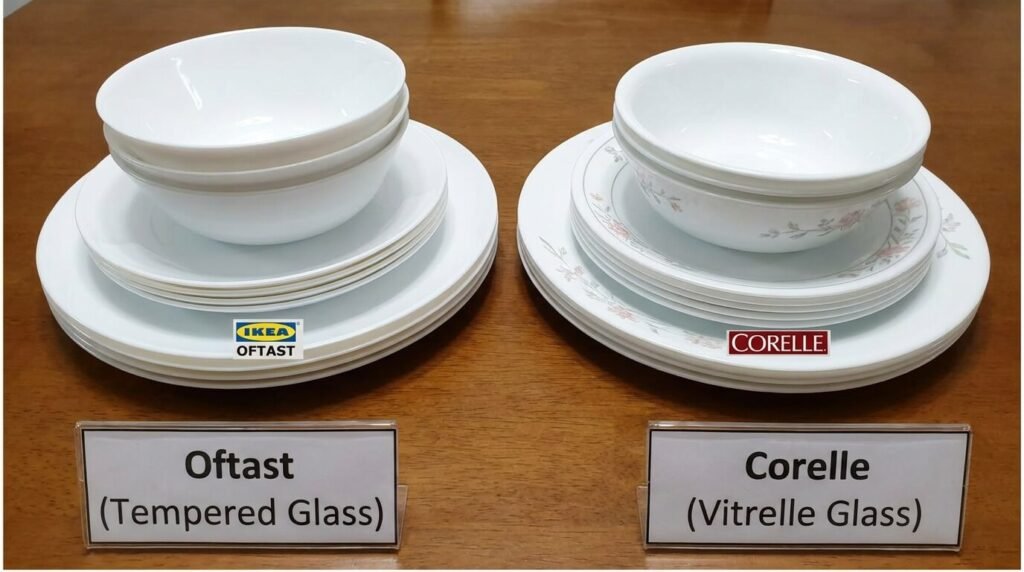
IKEA Oftast and Corelle are both glass, but they are not the same type of glass, and that difference drives every performance gap between them.
IKEA Oftast: Tempered Soda-Lime Glass, Single Layer
Oftast is made from tempered soda-lime glass — a single layer of standard glass that has been heat-treated to increase its strength.

- Material Type: Stoneware
- Item Shape: Round
The tempering process compresses the outer surfaces while the interior remains in tension, which makes the plate roughly 4–5× stronger than untreated glass.
IKEA launched the Oftast collection in 2010 as an affordable, functional alternative to ceramic plates, and the soda-lime construction keeps production costs low.

- This tableware has the same look and feel as bone porcelain, but is made of tempered glass. This means that we can push …
The result is a dish that handles everyday use competently but is ultimately a single-layer product with no structural redundancy.
Corelle Vitrelle: Three-Layer Thermally Bonded Glass
Corelle is made from Vitrelle — a proprietary laminate developed by Corning scientists in the 1940s and commercialized in 1970.
Vitrelle bonds three layers of glass together under heat: two outer compression layers sandwich a core layer that provides tensile strength.
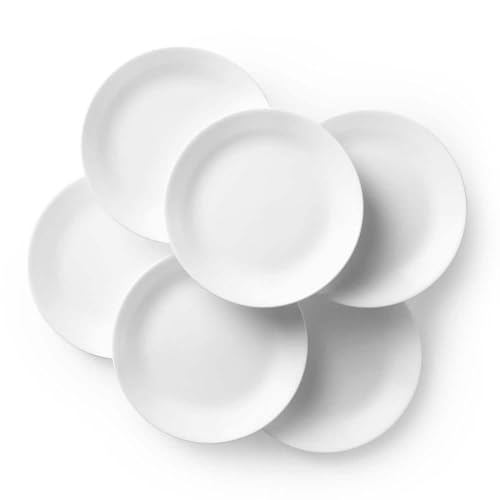
- Pattern: Winter Frost White
- Material: Vitrelle glass
- Color: White
This construction is why Corelle plates are notably thinner and lighter than they look and why they outperform single-layer tempered glass in drop resistance.
Vitrelle is manufactured in Corning, New York, and has remained Corelle’s core technology for over 50 years. For readers interested in how this material classification affects other considerations, see our piece on Corelle’s halachic status as glass.
Side-by-Side Comparison IKEA Oftast vs Corelle: How the Materials Compare Across 8 Dimensions
| Attribute | IKEA Oftast | Corelle (Vitrelle) |
|---|---|---|
| Material type | Single-layer tempered soda-lime glass | Three-layer thermally bonded Vitrelle glass |
| Layer count | 1 | 3 |
| Manufacturing origin | France (historically); now also China | USA (Corning, NY) |
| Chip resistance | Good for everyday use; chips on edges over time | Superior; designed to be chip-resistant |
| Break resistance | Higher than standard glass; lower than Vitrelle | Industry-leading for glass dinnerware |
| Microwave safe | Yes | Yes (up to 350°F in preheated oven) |
| Dishwasher safe | Yes (edge roughing reported with heavy use) | Yes |
| Warranty | None | 3-year manufacturer warranty (chip and break) |
Which Is More Durable: IKEA Oftast or Corelle?
Corelle is more durable than IKEA Oftast. The material construction alone makes this outcome predictable, and controlled testing confirms it.
The meaningful question is not whether Corelle wins, but by how much, and whether the gap matters for your specific household.
Drop Test Results: What Happens at Countertop Height on Three Surfaces
MarketingScoop conducted drop tests from countertop height (36 inches) onto wood, tile, and concrete, pitting Oftast against Corelle’s standard plates. The results across surfaces:
| Surface | IKEA Oftast result | Corelle result |
|---|---|---|
| Wood floor (36″) | Survived most drops; occasional edge chip | Survived nearly all drops; rare breakage |
| Tile floor (36″) | Broke on 40–60% of drops | Survived the majority; cracked on severe impacts |
| Concrete (36″) | Broke consistently | Broke on severe impacts; survived glancing falls |
The gap was most visible on tile and concrete real-world surfaces in most kitchens and utility areas. Corelle outperformed Oftast in every category, though the difference on wood was minor. For most households, the tile test is the relevant benchmark.
Chip Resistance: Where Each Product Fails First
Both products chip before they break, and both chip in the same location: the rim. Tempered glass concentrates stress at edges, which is why Oftast plates typically develop rim chips after repeated contact with other dishes in the dishwasher or sink.
Corelle’s three-layer construction distributes stress more effectively, making its rim chips less frequent and slower to develop.
One pattern noted by Oftast users on multiple forum threads: dishwasher use accelerates rim roughing on Oftast significantly faster than hand washing does. Corelle users report the same phenomenon, but over a longer time horizon.
How Each Product Breaks When It Does Fail
The failure mode of each product is worth understanding before purchase:
- IKEA Oftast breaks into several large, irregular pieces when it fails — similar to a standard tempered glass door or table panel, where the break is abrupt, and the shards are large but relatively manageable.
- Corelle (Vitrelle) is more likely to shatter into many small, sharp pieces under a severe impact — this is a documented behavior and a known complaint from Corelle users, particularly on hard floors from significant height.
- Both products produce sharp fragments — neither should be considered safe to handle bare-handed after breaking.
- Practical implication: Families with young children should factor this shatter behavior into their decision, as Corelle’s small-fragment failure mode requires more thorough cleanup.
Are IKEA Oftast and Corelle Lead-Free and Safe?
Both modern, plain white versions of IKEA Oftast and Corelle are safe for food use, but the full picture requires distinguishing between modern and vintage Corelle, and between IKEA’s different manufacturing batches.
For the complete background on this topic, read our complete guide to lead-free dinnerware safety.
IKEA Oftast XRF Test Results: What Lead Safe Mama Found
Tamara Rubin (Lead Safe Mama), a federal-award-winning consumer goods safety advocate, tested IKEA Oftast plates made in France using XRF instrument technology — the same model used by the US Consumer Product Safety Commission.
Results from the 2022 published test:
| Metal | IKEA Oftast (France-made) | Safety threshold |
|---|---|---|
| Lead (Pb) | Non-detect | 90 ppm (children’s items) |
| Cadmium (Cd) | Non-detect | 75 ppm (Denmark standard) |
| Arsenic (As) | Non-detect | — |
| Mercury (Hg) | Non-detect | — |
| Chromium (Cr) | 1,344 ppm | Not a food-contact concern at this level |
| Barium (Ba) | 6,441 ppm | Naturally occurring in glass materials; not a leaching concern |
| Zirconium (Zr) | 554 ppm | Naturally occurring in glass |
The Chromium and Barium readings are naturally occurring components of glass manufacturing — not food-contact hazards at detected levels. The relevant safety metals (Pb, Cd, As, Hg) all returned non-detect results.
Modern vs. Vintage Corelle: The Lead Safety Divide
Not all Corelle is equally safe — and this is the single most important safety you should know.
Modern plain white Corelle tests negative for Lead and Cadmium when tested with XRF instruments. But pre-2005 Corelle with colored decorative patterns is a documented hazard:
- Vintage Corelle Butterfly Gold pattern: tested at 18,700 ppm Lead in the decorative pattern — far above any safe threshold.
- Other vintage patterned Corelle (pre-2005): consistently positive for Lead and/or Cadmium, Arsenic, and Antimony in painted decorations, according to Lead Safe Mama’s published test database.
- Modern plain white Corelle (post-2005, no decorative pattern): tests negative for Lead and Cadmium in nearly all tested samples.
- Modern patterned Corelle: some patterns have tested for elevated Cadmium — check Lead Safe Mama’s database for specific pattern results before purchasing.
- Practical rule: If you have pre-2005 patterned Corelle in your home, do not use it for food service and do not give it to children.
Country of Manufacture and What It Means for Safety Standards
IKEA Oftast was historically manufactured in France, where the XRF-tested samples originated.
Production has since shifted for some batches to China. IKEA states that all food-contact products meet EU and US regulatory safety standards, regardless of manufacturing location, but the France-made units are the ones with published XRF non-detect results.
If you purchase Oftast and want certainty, check the “made in” marking on the base of the plate. Corelle is manufactured in Corning, New York, and has maintained US production throughout its history, which gives it consistent regulatory oversight under FDA and CPSC standards.
IKEA Oftast vs Corelle: Price, Value, and 5-Year Cost
Corelle costs more per plate upfront. Whether it costs more over time depends on how long each product actually lasts in your household — and the math on that question consistently favors Corelle for anyone planning to keep dishes for more than two to three years.
Price Per Plate: What You Actually Pay at Retail
| Product | Piece type | Approximate retail price |
|---|---|---|
| IKEA Oftast | Dinner plate | $0.79–$1.50 |
| IKEA Oftast | Side/salad plate | $0.79–$1.50 |
| IKEA Oftast | Bowl | $0.79–$1.50 |
| Corelle | Dinner plate (open stock) | $5–$8 |
| Corelle | Salad plate (open stock) | $4–$6 |
| Corelle | Bowl (open stock) | $4–$6 |
| Corelle | 18-piece set | $45–$75 |
| IKEA Oftast | 18-piece equivalent (individual) | $15–$25 |
Total Cost of Ownership: The 5-Year Replacement Math
The price gap narrows considerably — and often reverses — when lifespan is factored in. Corelle users frequently report using the same set for 10–15 years without replacement.
Oftast users in forum discussions report beginning to replace chipped pieces within 2–3 years of regular family use.
| Metric | IKEA Oftast | Corelle |
|---|---|---|
| Upfront cost (12-piece set) | ~$12–$18 | ~$45–$65 |
| Estimated household lifespan | 2–4 years (regular family use) | 10–15+ years |
| Annual cost (12-piece set) | ~$4–$9/year | ~$3–$6/year |
| 5-year total spend (1–2 replacements) | ~$24–$54 | ~$45–$65 (no replacement needed) |
| Cost per plate per year | ~$0.30–$0.75 | ~$0.25–$0.55 |
The 5-year math shows Corelle at comparable or lower annual cost — and potentially lower total spend — despite costing 3–5× more per piece at purchase. For households replacing Oftast sets every 2–3 years, the crossover point arrives quickly.
Microwave, Dishwasher, and Oven: How Each Handles Daily Use
Both Oftast and Corelle are microwave-safe and dishwasher-safe for standard everyday use. The differences emerge at the margins: oven use, temperature limits, and long-term dishwasher effects.
Microwave and Dishwasher Compatibility
| Feature | IKEA Oftast | Corelle |
|---|---|---|
| Microwave safe | Yes | Yes |
| Dishwasher safe | Yes | Yes |
| Oven safe | No — not designed for oven use | Yes, up to 350°F (preheated oven only) |
| Broiler safe | No | No |
| Freezer safe | Yes | Yes |
| Stovetop safe | No | No |
| Recommended detergent | Non-citrus; citric acid etches glass | Non-citrus; same caution applies |
Corelle’s oven safety (up to 350°F in a preheated oven) is a meaningful practical advantage for anyone who reheats plated food or serves directly from oven to table. Oftast is not rated for oven use.
The Dishwasher Edge-Roughing Problem: What Causes It and Who’s Affected
Both Oftast and Corelle develop rough edges along the rim with repeated dishwasher cycles, but Oftast users report it more frequently and earlier.
The cause is a combination of factors: repeated thermal cycling in the dishwasher expands and contracts the glass, creating micro-stress at the rim; citric acid in some detergents chemically etches the glass surface; and plate-to-plate contact in the dishwasher basket creates repeated minor impacts at the rim edge.
Rough edges are more than an aesthetic issue; micro-chipped rim surfaces can trap bacteria and are uncomfortable against lips.
Using non-citrus dishwasher detergent and placing plates with space between them in the rack reduces this problem for both products. If this is a significant concern, hand washing extends rim integrity on both brands considerably.
Design, Weight, and Warranty: The Details That Matter
Weight Comparison: Grams Per Standard Dinner Plate
| Product | Piece | Approximate weight |
|---|---|---|
| IKEA Oftast | 10″ dinner plate | ~390–420 g |
| Corelle | 10.25″ dinner plate | ~280–310 g |
| Standard ceramic | 10″ dinner plate | ~600–800 g |
Corelle is meaningfully lighter than Oftast despite being a larger plate, a direct result of the Vitrelle lamination process producing a thinner overall profile.
For elderly users, children, or RV owners managing vehicle weight limits, this gap is practically significant.
Design Variety: Minimalist White vs. Hundreds of Patterns
IKEA Oftast is available in plain white and only plain white in the core line, with limited seasonal color additions at select stores.
If your kitchen aesthetic is minimalist or Scandinavian, this is a strength; if you want pattern options, it is a hard constraint.
Corelle offers over 2,000 archived patterns and regularly releases seasonal designs spanning florals, geometrics, and contemporary prints. All pieces are sold open stock alongside sets, which means replacing individual items is easy regardless of pattern.
Corelle’s 3-Year Warranty vs. IKEA’s No-Warranty Policy
Corelle offers a 3-year manufacturer’s warranty against chips and breakage, but requires the damaged item to be kept and returned.
IKEA Oftast carries no manufacturer warranty; replacement is simply purchasing new pieces from IKEA at the same low unit cost.
For Corelle, the warranty provides real financial value only if you retain broken pieces and initiate the claim process, which most households do not.
The more practical replacement advantage for Oftast is that individual pieces cost under $2 and are available in-store without any claim process.
Which Should You Buy? A Decision Guide by Household Type
The right answer varies by household, but it is a specific answer for each buyer type, not a general hedge.
Buy IKEA Oftast If: (Budget Buyers, Students, Renters)
- You need a full 12-piece set for under $20 and have no flexibility on that budget.
- You are in a temporary living situation — student housing, short-term rental, shared apartment — and do not expect to keep the same dishes for more than 2–3 years.
- You move frequently and prefer to replace inexpensively rather than protect and transport carefully.
- You need plain white minimalist dishes with no interest in pattern variety.
- You want the ability to replace individual broken pieces for under $2 each without any claim process.
For readers who want to explore other options at this price tier, see our list of other chip-resistant dinnerware alternatives to Corelle.
Buy Corelle If: (Families, Long-Term Homeowners, RV Owners)
- You plan to keep the same set of dishes for 5 years or more — the TCO math makes Corelle comparable or cheaper per year.
- You have young children in the household and need dinnerware that survives regular drops onto hard floors.
- You use an RV, camper, or boat where lightweight dishes reduce the weight load and breakage risk during travel.
- You want oven-to-table capability (up to 350°F) and prefer not to transfer food to a separate serving dish.
- You want pattern variety, or you want open-stock replacement of individual pieces in a matching design.
For dedicated guidance on travel and mobile use, see our guide to the best lightweight dinnerware for RV and travel use.
The Safety-First Buyer: Which to Choose If Lead Concerns Drive Your Decision
If your primary concern is lead and cadmium safety, particularly for households with young children, both modern plain white versions of Oftast and Corelle are safe choices based on available XRF test data.
The distinction to act on is this: avoid any pre-2005 Corelle with colored decorative patterns, regardless of condition, and stick to plain white versions of both brands for maximum documented safety.
If you have vintage patterned Corelle in your home, retire it from food use.
Between the two modern plain white products, Corelle’s superior durability becomes the tiebreaker, as fewer breaks mean fewer cleanup events involving glass fragments, which is a practical safety advantage in households with small children.
Still Not Sure Which to Buy? Three Questions to End the Debate
Answer these in order:
- Do you need a 12-piece set for under $20? If yes → IKEA Oftast. If no, continue.
- Will you keep these dishes for 5+ years? If yes → Corelle. The annual cost math works in Corelle’s favor past the 3-year mark.
- Are lead safety concerns your primary driver? Both modern plain white versions are XRF-confirmed safe. Choose Corelle for its durability advantage in households with young children.
For broader kitchen setup guidance, see our guide to setting up a complete kosher kitchen from scratch.
Frequently Asked Questions: IKEA Oftast vs Corelle
Is IKEA Oftast really a Corelle knockoff?
Functionally, Oftast occupies the same market position as Corelle — lightweight, white, tempered glass plates at a fraction of the price — but the materials are categorically different. Corelle’s Vitrelle is a three-layer proprietary laminate; Oftast is single-layer soda-lime glass. Calling Oftast a knockoff is accurate in commercial terms but misleading about the construction.
Can Oftast and Corelle be used in the oven?
Corelle is oven-safe up to 350°F in a preheated oven only — not under the broiler and not for stovetop use. IKEA Oftast is not rated for oven use and should not be placed in an oven at any temperature. Both are microwave-safe for standard reheating.
Does Corelle shatter into dangerous shards when it breaks?
Yes — Corelle’s Vitrelle construction, when it fails under severe impact, typically produces many small, sharp fragments rather than a few large pieces. This is a known and documented behavior. IKEA Oftast tends to break into fewer, larger pieces. Both require careful cleanup with footwear on; neither is “safe” to handle bare-handed after breaking.
How long does IKEA Oftast typically last?
In regular family use with dishwasher cycles, most Oftast users begin replacing chipped or roughed pieces within 2–3 years. With careful hand washing and gentle handling, individual pieces can last longer — but the low replacement cost makes attrition the norm rather than the exception.
Is vintage Corelle safe to eat off of?
Plain white vintage Corelle with no decorative patterns tests negative for Lead and Cadmium in most XRF testing. However, pre-2005 Corelle with colored decorative patterns — such as Butterfly Gold, which tested at 18,700 ppm Lead — should not be used for food service. If you are uncertain whether your vintage Corelle has a decorative pattern, retire it from food use.
Where is IKEA Oftast currently manufactured?
Historically, Oftast was manufactured in France, and France-made units are the ones with published XRF non-detect results for lead, cadmium, and arsenic. Production has since shifted for some batches to China. Check the base of your plate for the “made in” marking; IKEA states all food-contact products meet EU and US safety standards regardless of origin.
Can I replace individual Oftast pieces without buying a full set?
Yes — IKEA sells Oftast plates, bowls, and side plates individually at the same unit price as set components ($0.79–$1.50 per piece). No warranty claim or registration is required. Corelle also sells open-stock replacements, but at $4–$8 per piece, and you must match the specific pattern you own.
Which is better for RV or travel use?
Corelle is the stronger choice for RV and travel use for two reasons: its Vitrelle construction survives the repeated minor impacts common during vehicle movement, and its lighter weight (roughly 100g lighter per dinner plate than Oftast) reduces payload. Corelle’s ability to withstand drops better than Oftast also matters in a travel context where replacement options may be limited.
About the Author & Reviewer
Sarah Emirone, Author
Sarah researches and writes SafeKitchn’s dinnerware and kitchenware guides, with a focus on material safety, lead content, and manufacturer specifications. She cross-references product data sheets, safety certifications, and regulatory filings (including FDA and Prop 65 records) before publishing, and updates articles when new information becomes available.
James Daniels, Reviewer
James reviews SafeKitchn’s material safety content for scientific accuracy. He holds a B.Sc in inorganic chemistry and works as a materials researcher, with particular focus on the composition and safety behavior of glass, ceramic, and metal used in kitchenware.