

If you’ve opened your cabinet and wondered why your Corelle dishes are turning brown, the frustrating truth is that “brown staining” is not one problem; it’s four distinct problems, each with a different cause and a different fix.
Applying the wrong cleaner to the wrong stain type is why so many people scrub for an hour and see little result.
This article maps every stain type to its root cause and its correct solution, explains the structural reason Corelle edges are disproportionately affected, and answers the question many long-term owners have: why dishes that were fine for 20 years suddenly started staining after 2010.
Written by Sarah Emirone | Reviewed by James Daniels, B.Sc, Inorganic Chemist & Materials Researcher | Updated September 2026 | See How We Test | Filed under: Buying, Care & Product Guides
The Four Types of Brown Staining on Corelle — and Why They Need Different Fixes
Corelle dishes turn brown for four distinct reasons, and the right fix depends entirely on which type you have.
Grouping them and reaching for one all-purpose cleaner is what causes repeated frustration. Each stain has a different chemical origin, appears in a different location, and responds to a different removal method.
How to identify which type of stain you have before reaching for a cleaner
| Stain Appearance | Where It Appears | Root Cause | Best Cleaner | Prevention |
| Reddish-brown spots or a ring on the rim | Edges and rim only | Rust from a damaged dishwasher rack or drying rack | Bar Keepers Friend paste | Repair or replace the dishwasher rack |
| Yellowish-brown film or overall cloudiness | The entire surface, especially the base | Iron/mineral deposits from hard water | Citric acid soak or Lemi-Shine booster | Rinse aid + water softener |
| Brown interior staining, faint and spread | Inside surface, especially after tomato/coffee/tea | Food chromogen pigments are absorbed over time | Baking soda paste or cream of tartar + hydrogen peroxide | Rinse promptly; avoid prolonged soaking in tannin drinks |
| Grey-brown scratch lines across the surface | Flat plate surface, often with parallel lines | Metal abrasion from utensils or metal sinks | Non-abrasive cleaner; Bar Keepers Friend | Avoid metal scrubbers; limit steak knife use |
Are brown stains on Corelle dishes a safety hazard?
Rust-coloured stains from dishwasher rack transfer are iron oxide deposits sitting on the glass surface, not absorbed into it.
Corelle’s Vitrelle glass is non-porous, which means surface rust does not penetrate the material and does not contaminate food unless the dish surface is also cracked or chipped.
Food chromogen staining (from tomato, coffee, or tea) is purely cosmetic. The exception is a cracked or heavily chipped dish; any dish with structural damage should be retired regardless of staining, because fractures create surfaces where bacteria can accumulate.
Why Your Dishwasher Is the Most Likely Cause of Brown Edges on Corelle
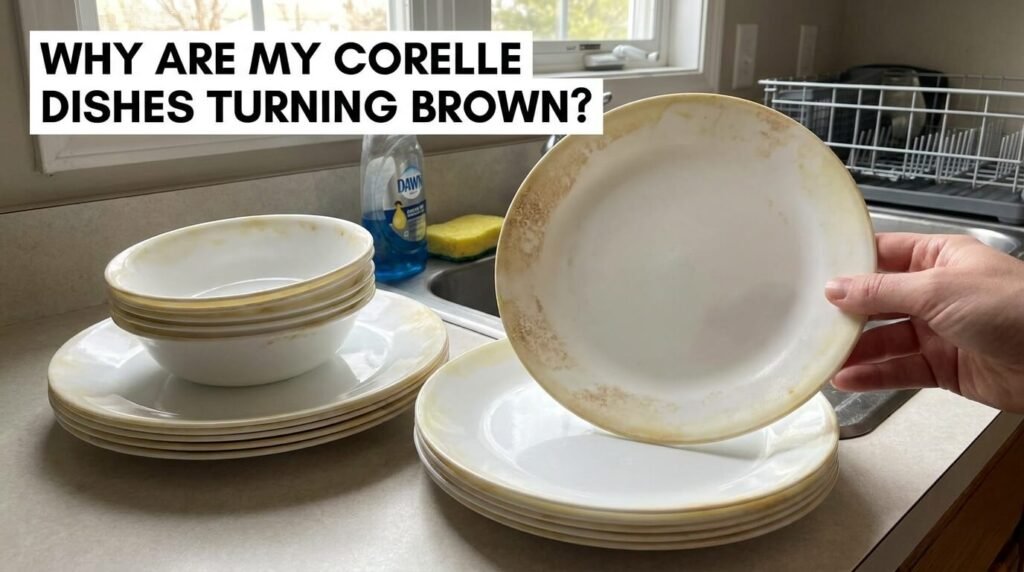
The dishwasher is responsible for the majority of brown edge staining on Corelle, and the cause is almost always a damaged rack, not the dishes themselves.
For the full picture of how Corelle interacts with dishwasher conditions over time, see the complete Corelle dishwasher safety guide.
How Corelle’s sharp edge cuts into the rack vinyl — the feedback loop that causes rust
Unlike traditional ceramic dinnerware, Corelle plates have sharper edges as a result of the Vitrelle glass lamination and cutting process.
That sharpness is part of what makes them elegant, but it also means the plate rim physically abrades the vinyl coating on dishwasher rack tines over time.
Once that coating is breached, a self-reinforcing cycle begins:
- Corelle plate is loaded with its sharp glass rim resting against vinyl-coated metal rack tines.
- Repeated loading and unloading abrade the vinyl at the exact contact point on the tine.
- The bare metal beneath the vinyl is exposed to hot water and steam during every wash cycle.
- The exposed metal rusts; that rust is suspended in the wash water during the cycle.
- Rust-laden water contacts the plate rim — the same location where the rack is touching — and deposits iron oxide on the glass edge.
- The now-stained plate edge has a microscopically rougher surface that collects more residue on subsequent washes.
- The cycle accelerates: each wash deposits more rust, and the rough edge traps it more effectively.
This is why cleaning the dishes without addressing the rack only provides a temporary fix. Within a few wash cycles, the staining returns because the source (the exposed metal on the rack) is still there.
How to inspect your dishwasher rack and decide whether to repair or replace it
- Remove the dishwasher rack fully and set it on a light-coloured surface so rust marks are visible.
- Run your finger along each tine, feeling for rough, gritty, or tacky spots where the vinyl coating has worn or chipped away.
- Look for orange or brown discolouration on the tines — even very small breached areas (a few millimetres) are sufficient to transfer rust to dishes.
- If you find one or two isolated breached spots, purchase a dishwasher rack repair kit (available at most hardware stores) — the vinyl-tip caps or liquid sealant cover exposed metal and stop rust transfer immediately.
- If the coating is deteriorating across multiple tines or sections, replacement racks are available for most dishwasher models from the manufacturer or third-party suppliers — this is cheaper than repeatedly cleaning stained dishes.
- After repairing or replacing the rack, run one empty wash cycle before loading dishes to flush any residual rust from the machine interior.
The phosphate detergent ban and why your dishes may have started staining more after 2010
If your Corelle dishes were fine for 20 or 30 years and then suddenly started developing brown staining, the dishes themselves almost certainly did not change, but your dishwasher detergent did.
In 2010, 17 US states banned phosphates from automatic dishwasher detergents; this was followed by a nationwide reformulation as manufacturers standardized their products.
Phosphates served three critical functions in dishwasher detergent: they acted as chelating agents that bound to mineral ions (iron, calcium, manganese) and kept them suspended in the wash water so they drained away; they softened hard water; and they improved surfactant performance.
Without phosphates, those same mineral ions are no longer held in suspension; they deposit directly onto dish surfaces as the water drains and evaporates.
Community forums are full of long-term Corelle owners reporting that dishes used for 20–30 years “suddenly got brown stains within the last year” — a pattern that tracks directly with the delayed retail rollout of post-ban detergent formulations reaching different US regions in 2010.
The practical fix is to compensate for the lost chelating action: use a citric-acid-based dishwasher booster such as Lemi-Shine alongside your regular detergent, always run a rinse aid, and look for the best phosphate-free detergents for glass dinnerware that include built-in water softening agents.
Hard Water and Iron Deposits: Why Brown Staining Appears on Dishes Without Rust
Hard water staining produces brown or yellowish discolouration that covers the entire surface of the dish — not just the edges — and tends to produce a dull film rather than discrete spots.
It is caused by dissolved iron, manganese, and calcium in the water supply, which precipitate onto the glass surface when the water evaporates during the drying cycle.
Unlike rust from dishwasher racks, this staining has nothing to do with any metal component in the machine itself.
How to test if your water is the cause of brown staining
- Look at where the staining appears: if it covers the entire flat surface of the dish in a thin film or overall cloudiness rather than concentrating on the rim or edges, hard water is the most likely culprit.
- Run a clean white Corelle dish through the dishwasher with no food on it, using only rinse aid and no detergent. If a brown or yellow film appears after the cycle, your water has a high mineral or iron content, and the dishwasher itself is the delivery mechanism.
- For confirmation, purchase a home water test kit that measures iron and water hardness (grains per gallon) — iron content above 0.3 mg/L is sufficient to produce visible staining on glass surfaces over time.
Rinse aids, citric acid, and water softeners: which fix works for which water problem
| Water Issue | Recommended Solution | Effectiveness | Approximate Cost |
| General hard water (calcium, magnesium) | Rinse aid is added to every cycle | High for prevention; none for existing stains | Low — ongoing |
| Moderate iron content (0.3–1.0 mg/L) | Citric acid booster (Lemi-Shine) per wash cycle | High — chelates iron in wash water | Low-moderate |
| High iron content (above 1.0 mg/L) | Whole-house iron removal filter or water softener | Very high — addresses the source | High (one-time) |
| Existing mineral film on dishes | Citric acid soak (1/3 cup crystals in hot water, 30 min) | High for active stain removal | Very low |
| Existing mineral film — dishwasher interior | Empty cycle with citric acid in the detergent compartment | High — cleans machine and dishes simultaneously | Very low |
For longer-term strategies, see how to reduce hard water damage to your dishes long-term.
Food Staining: Tomato, Coffee, and Tea on Corelle Dishes
Food-based brown staining on Corelle appears on interior surfaces and builds up gradually with repeated exposure to certain foods and drinks.
It does not appear on edges, does not look rust-coloured, and does not coincide with dishwasher loading patterns.
It is the easiest type to remove and the most preventable.
Why tomato-based foods and tannin drinks leave brown marks on Vitrelle glass
Tomatoes contain lycopene and other carotenoid pigments that bond readily to glass surfaces, especially under heat (such as microwave reheating directly on the plate).
Coffee and tea contain tannins — polyphenolic compounds that oxidize on contact with air and adhere to glass surfaces, particularly where water minerals have created a slightly rough microscopic surface for them to cling to.


Corelle’s Vitrelle glass is non-porous, which means these pigments sit on the surface rather than soaking in, making them removable, but repeated exposure without prompt rinsing allows successive layers to build up and darken.
Best cleaners for food-based brown staining on Corelle
- Baking soda paste (most stains): Mix baking soda with a small amount of water to form a paste, apply to the stained area, leave for 5 minutes, then scrub gently with a non-abrasive sponge. Rinse thoroughly. This works well for coffee, tea, and light tomato staining.
- Cream of tartar + hydrogen peroxide (stubborn or dark staining): Combine equal parts cream of tartar and 3% hydrogen peroxide to form a paste, apply to stained areas, leave for 10–15 minutes, then scrub with a nylon pad. The mild acid and gentle oxidizing action lift chromogen pigments effectively.
- Lemon juice soak (light overall discolouration): Mix 4 tablespoons of lemon juice in hot water and soak the dish for 20 minutes, then wash normally. The citric acid in lemon juice dissolves light mineral-pigment deposits that amplify food staining.
- Bar Keepers Friend (persistent staining): Apply powder to a wet surface, allow to sit for 1 minute, then scrub lightly with a damp cloth. Rinse well. Effective for both food chromogen and light metal marks.
How to Remove Brown Stains From Corelle Dishes: Cleaners That Work and What to Avoid
Using the diagnostic table above, identify your stain type before starting any removal process.
The methods below address rust and mineral staining, specifically the most common and the most mishandled of the four types. For food staining removal, follow the methods in the previous section.
Step-by-step removal method for rust and mineral stains
Bar Keepers Friend paste method (rust from dishwasher rack):
- Wet the affected area of the dish with cool water.
- Sprinkle Bar Keepers Friend powder directly onto the stained rim or spot — do not mix into a bowl of water, as direct contact is more effective.
- Allow to sit for 60–90 seconds without scrubbing (the oxalic acid in the formula needs contact time to dissolve iron oxide).
- Scrub gently with a damp nylon or plastic pad — never steel wool or abrasive scrubbers.
- Rinse thoroughly and repeat once if any staining remains.
Citric acid soak method (mineral film from hard water):
- Fill a basin or the dishwasher with hot water.
- Add 1/3 cup of citric acid crystals (or run an empty dishwasher cycle with citric acid in the detergent compartment and no other detergent).
- Submerge dishes or run the cycle; allow 30–45 minutes contact time for basin soaking.
- Remove dishes, rinse with clean water, and wash normally with dish soap to remove any citric acid residue.
- Dry immediately with a clean cloth to prevent re-deposition of minerals from tap water.
Cleaners you must never use on Corelle and what happens if you do
Per Corelle’s official use and care instructions, the following will cause permanent damage:
- Steel wool and metal scouring pads physically scratch the Vitrelle glass surface, creating microscopic grooves that trap stain particles more aggressively and make future staining significantly worse.
- Abrasive powdered cleansers (e.g. Ajax, Comet in aggressive formulas) are too harsh for glass surfaces and will etch the finish over time, causing permanent surface dulling that no amount of cleaning will reverse.
- Bleach does not remove rust or mineral staining — iron oxide is not organic, and bleach does not affect it and repeated exposure to bleach can dull the Vitrelle surface and potentially fade decorated patterns.
- Detergents containing lemon scent or added bleach can accelerate surface etching when used in high-temperature dishwasher cycles over many years, particularly on older dishes whose original factory coating has worn.
- Oven cleaner is occasionally suggested in community forums for stubborn stains; while it may work on specific stain types, the highly caustic pH can damage the glass surface and should not be used without testing on an inconspicuous area first.
How to Prevent Corelle Dishes From Turning Brown Again
Prevention requires addressing the source of each stain type, not just cleaning the dishes after staining occurs.
A staining problem that keeps returning within a few weeks of cleaning is almost always a source problem, a rusting rack, uncorrected water quality, or a detergent mismatch, not a cleaning technique problem.
Dishwasher loading and detergent settings that reduce staining risk
- Load Corelle plates so the sharp glass rim contacts the rack’s vinyl-tipped tines at the same point each time — this concentrates abrasion on one spot, so inspect that contact area regularly for early vinyl wear.
- Use a phosphate-free detergent with a built-in water softening agent (check the label), and always add a rinse aid to every cycle without exception.
- Set your water heater to at least 120°F (49°C) — below this temperature, detergent does not fully activate and mineral ions remain in the wash water rather than being flushed during the rinse cycle.
- Run a monthly maintenance cycle through the empty dishwasher using citric acid crystals or a commercial dishwasher cleaner to remove mineral buildup from the machine interior before it transfers to dishes.
- Pre-rinse dishes that have been in contact with tomato sauce, coffee, or tea before loading — dried chromogen pigments bond more aggressively to the glass surface during a hot wash cycle than fresh residue does.
- Do not use metal utensils, steel wool, or abrasive cleaning pads on any Corelle surface, as these create the microscopically rough surface that subsequent staining clings to.
Do older Corelle dishes stain more than new ones, and when to consider replacing a set
Yes, older Corelle dishes do stain more readily than new ones, and this is a real phenomenon rather than an impression.
Corelle Brands Australia’s support documentation confirms that abrasive automatic dishwasher detergents can damage the Vitrelle glass surface over time, causing it to become microscopically rough, particularly along the edges.
That roughness makes the surface more receptive to all four stain types. Use this checklist to decide whether your set is worth continuing to restore or whether replacement is practical:
- Are the edges visibly rough to the touch rather than smooth glass? (Surface etching — staining will worsen and become harder to remove.)
- Are there chips, cracks, or any structural damage? (Safety concern — retire immediately regardless of staining.)
- Does the staining return within 2–3 wash cycles after thorough cleaning? (Likely source problem or irreversibly etched surface.)
- Are the decorated patterns visibly faded or worn? (Surface coating gone — staining will be increasingly permanent.)
- Has the set been in daily dishwasher use for more than 20 years? (Surface wear is cumulative — cleaning returns diminish after this point.)
If three or more of these apply, replacing the set is the more practical choice. For related guidance, see why Corelle dishes chip and crack — and when to stop using them.
Before you go: Found brown staining on your Corelle mugs as well as your plates?
The cause is that different stoneware and porcelain behave differently from Vitrelle glass in both the dishwasher and the microwave. Read why Corelle mugs stain and how to clean them for the full mug-specific guide.
Frequently Asked Questions About Brown Stains on Corelle Dishes
Can I still use Corelle dishes if they have brown stains?
Yes, surface brown staining on intact, unchipped Corelle dishes is cosmetic and not a food safety concern — Vitrelle glass is non-porous and the staining sits on the surface rather than contaminating it.
The exception is any dish with visible chips, cracks, or crazing, which should be retired from use immediately. Staining alone is not grounds for discarding an otherwise structurally sound dish.
Does Bar Keepers Friend remove all types of brown staining from Corelle?
Bar Keepers Friend works well on rust stains (iron oxide from dishwasher rack transfer) and metal abrasion marks because its active ingredient — oxalic acid — dissolves iron compounds.
It is less effective on mineral film from hard water (use citric acid instead) and works only moderately on food chromogen staining from tomato or tannin drinks (baking soda paste or cream of tartar is more targeted for those). Match the cleaner to the stain type for best results.
Will the Corelle warranty cover brown staining?
Corelle’s three-year warranty covers Vitrelle glass dinnerware against breakage, chipping, and staining under normal household use.
If staining occurred during normal use within three years of purchase, contact Corelle Brands customer care with proof of purchase they may replace affected items.
Staining caused by misuse (abrasive cleaners, excessive heat, damaged dishwasher racks) is unlikely to qualify, and the warranty does not apply to stoneware mugs in any case.
Why are only the edges of my Corelle brown, not the centre?
Edge-only brown staining is almost always rust from a damaged dishwasher rack. The edges are the only part of the plate that physically contacts the rack tines — which is where vinyl coating deteriorates and bare metal rusts.
The centre of the plate hangs free inside the rack and has no metal contact, so rust does not deposit there. Inspect your dishwasher rack tines at the contact points for vinyl wear.
My dishes are hand-washed but still turning brown — what’s causing it?
For hand-washed dishes, the most common causes are: a rusting metal drying rack (the same mechanism as a dishwasher rack, just on the counter), high iron content in your tap water depositing during air drying, or food chromogen staining from tomato, coffee, or tea.
Check your drying rack for any rust or exposed metal, dry dishes immediately with a cloth rather than air drying, and test your tap water for iron content if the problem persists.
Can I use bleach to remove brown stains from Corelle?
No — bleach is not effective on rust or mineral staining because iron oxide is an inorganic compound and bleach is an organic oxidiser that targets organic (carbon-based) molecules. Bleach will not dissolve rust.
For organic food staining it has some effect, but regular bleach exposure can dull the Vitrelle surface and fade decorated patterns over time. Use oxalic acid (Bar Keepers Friend) for rust and citric acid for minerals.
How often should I clean my dishwasher to prevent Corelle staining?
Run a maintenance cycle through the empty dishwasher once a month using citric acid crystals or a commercial dishwasher cleaner such as Affresh.
This removes mineral buildup from the spray arms, filter, and interior walls before it accumulates enough to transfer to dishes.
If your water has high iron content, run this cycle every two weeks, and also clean the dishwasher filter.
A clogged filter recirculates mineral-laden water across dishes during the rinse cycle.
About the Author & Reviewer
Sarah Emirone, Author
Sarah researches and writes SafeKitchn’s dinnerware and kitchenware guides, with a focus on material safety, lead content, and manufacturer specifications. She cross-references product data sheets, safety certifications, and regulatory filings (including FDA and Prop 65 records) before publishing, and updates articles when new information becomes available.
James Daniels, Reviewer
James reviews SafeKitchn’s material safety content for scientific accuracy. He holds a B.Sc in inorganic chemistry and works as a materials researcher, with particular focus on the composition and safety behavior of glass, ceramic, and metal used in kitchenware.