

Yes, IKEA Kalas is free from BPA. But the label on the packaging says something slightly different: “No Bisphenol A (BPA) added.”
Not “BPA free.” That wording is deliberate, and for parents asking whether IKEA Kalas is BPA free, the distinction is worth understanding before you put these plates in the microwave every morning.
Kalas is made from polypropylene, a plastic that never uses BPA in its manufacture. So there was nothing to add and nothing to remove. Here’s what that means in practice, and where the actual safety considerations sit.
Written by Sarah Emirone | Reviewed by James Daniels, B.Sc, Inorganic Chemist & Materials Researcher | Updated September 2026 | See How We Test | Filed under: Material Safety & Lead Testing
What Is IKEA Kalas Made Of?
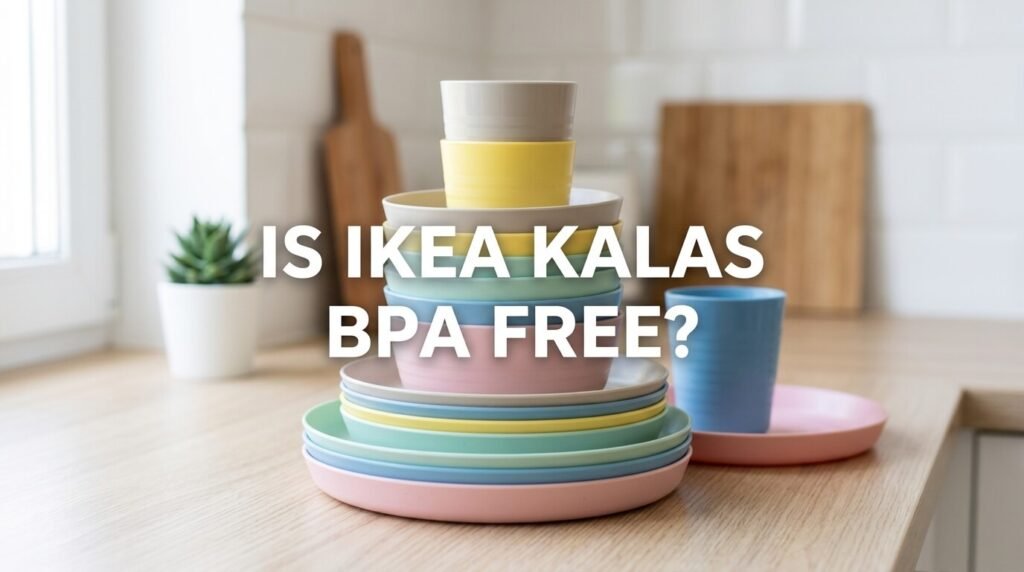
IKEA Kalas: the plates, bowls, cups, and cutlery are made entirely from polypropylene plastic, recycling code #5. That’s all of it. No polycarbonate, no polystyrene, no mixed materials. Just PP.
Polypropylene — What It Is and Why IKEA Uses It
Polypropylene (PP) is one of the most widely produced food-contact plastics in the world. You’ll find it in yogurt containers, reusable lunch boxes, and baby bottles.
It’s chosen for kids’ products because it doesn’t use BPA in its manufacturing chemistry, which is a property of the material, not a decision a brand makes. Polycarbonate plastic uses BPA. Polypropylene doesn’t. They’re different materials with different chemical structures.


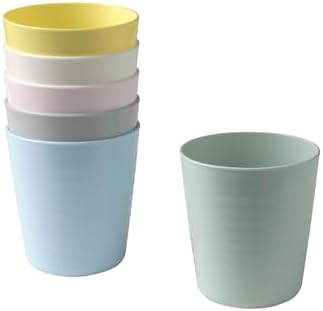
PP is also more heat-stable than most consumer plastics, which is why it carries a microwave-safe rating at all. But “more heat-stable” has limits — which matters for how you actually use these plates day-to-day.
Related: IKEA Outdoor Dinnerware
Related: IKEA Dinera Mug
Related: Is IKEA Dinnerware Lead and Cadmium Free
Full Specifications — Material, Temperature Ratings, Age Recommendation
| Property | Specification | Notes |
|---|---|---|
| Material | Polypropylene (PP) | Recycling code #5 |
| Microwave rating | Safe up to 100°C / 212°F | IKEA advises glass or porcelain for reheating |
| Dishwasher rating | Safe up to 70°C / 158°F | Standard home dishwasher cycles |
| Age recommendation | 3 years and up (plates vary — some pieces from 0+) | Cutlery carries the 3+ warning; check each piece |
| BPA status | No BPA added | Polypropylene does not use BPA in manufacture |
| Phthalate status | Banned in all IKEA children’s and food-contact products | IKEA policy since 2006 |
| BPA phase-out year | 2006 | Full phase-out across children’s and food-contact range |
What Does “No BPA Added” Actually Mean — and Is It the Same as BPA Free?
These two phrases are not the same thing, and the difference tells you something useful about the product.
Why IKEA Says “No BPA Added” Rather Than “BPA Free”
“BPA-free” typically appears on products where BPA could theoretically have been used, and the manufacturer is confirming it wasn’t. Polypropylene doesn’t work that way. BPA is used in polycarbonate manufacturing.
Polypropylene uses a different chemical process entirely, so there’s no BPA to exclude.
When IKEA writes “No Bisphenol A (BPA) added,” they’re being precise.
It’s not a weaker claim; it’s an accurate one. IKEA also went further: they phased out BPA across all food-contact products in 2006, nearly two decades before most manufacturers, and have since banned phthalates in all children’s and food-contact products too.
That’s documented on IKEA’s own product pages across multiple markets.
So the label wording isn’t a red flag. It’s actually the more technically correct version of what “BPA free” is trying to say.
The Concern That “BPA Free” Labels Don’t Answer — BPS, BPF, and Substitutes
This is where parents rightly ask a follow-up: if a brand replaced BPA with something called BPS or BPF to keep a “BPA free” label, does that solve the problem?
The concern is real; some manufacturers did exactly that, and BPS and BPF carry similar endocrine-disrupting properties to BPA according to research from the National Institute of Environmental Health Sciences.
But here’s the key point for Kalas specifically:
- Polypropylene does not use BPA substitutes like BPS or BPF — these are bisphenol compounds used in polycarbonate and epoxy resins, not in PP.
- IKEA has banned phthalates (a different category of plasticiser) in all children’s and food-contact products.
- The “BPA-free but uses BPS” problem applies to products that were previously polycarbonate — it doesn’t apply to polypropylene products like Kalas.
- No bisphenol compound is part of polypropylene’s chemical structure.
For parents worried about the broader category of bisphenol substitutes: Kalas, as a polypropylene product, sidesteps that concern entirely. See the complete guide to BPA-free kids’ plates and what the label means for how this plays out across other materials.
Is It Safe to Microwave Food in IKEA Kalas Plates and Bowls?
Kalas is technically rated for microwave use up to 100°C / 212°F. But IKEA recommends against using it for food reheating — and that recommendation comes from the product page, not from critics.
What IKEA’s Own Product Page Says About Microwaving Kalas
This is the detail that almost nobody writes about, Kalas mentions. On IKEA’s Taiwan product listing for the Kalas plate — which carries the same specs as the international range — the page states:
“If you want to heat food in the microwave, a bowl or plate made of glass or porcelain is preferable since some food can quickly reach temperatures above 100°C.”
A separate section adds: “It’s best to use a bowl or plate made of glass or porcelain. Even though you can heat food in our plastic products, it’s not recommended.”
Both statements are from IKEA’s own listing. The product carries a microwave-safe rating because it doesn’t immediately melt or deform at low temperatures.
But IKEA’s engineers are also telling you that glass or porcelain is the better choice for actually heating food — because certain foods get hotter than the plate’s rated threshold.
In practice, this means:
- Reheating leftovers, soups, or fatty foods directly on a Kalas plate is not what IKEA recommends, even though the plate is technically rated for microwave use.
- Using Kalas for serving food that’s already been heated elsewhere — in a pot, a ceramic bowl, a glass container — is how these plates are designed to be used.
- The microwave-safe symbol tells you the plate won’t shatter or immediately warp at 100°C. It doesn’t mean IKEA thinks it’s the right tool for microwave reheating.
Why Heating Plastic Matters — Chemical Migration and Temperature
The National Institute of Environmental Health Sciences has documented that heat breaks down plastic over time, increasing the rate at which trace chemicals can migrate into food.
This applies to all plastics, polypropylene included, though PP is more stable than most.
The 100°C threshold on Kalas isn’t arbitrary. It’s the point at which the risk of both physical deformation and chemical migration increases.
Foods with high fat or sugar content regularly exceed that temperature in a microwave before the plate does, which is exactly what IKEA’s disclaimer is flagging.
A bowl of pasta reheated for 2 minutes can hit temperatures well above 100°C in spots, even if the plate itself hasn’t reached that point yet.
This isn’t a reason to throw out your Kalas set. It’s a reason to heat food in something else and serve it on Kalas.
For parents who want a clearer picture of which materials actually hold up to microwave use, which kids’ plates are actually safe to microwave, and which covers the options by material.
Is IKEA Kalas Safe for Babies, Toddlers, and Young Children?
For cold and room-temperature food: yes. The plates and bowls are polypropylene, BPA-free, phthalate-free, and designed specifically for young children. The question of microwaving food directly in them is separate from the question of whether they’re safe to eat off.
Age Recommendation and What It Covers
IKEA’s age guidance varies slightly by piece within the Kalas range. The plates — which carry a high edge to help children keep food on the plate — are listed as suitable from 0 years on some IKEA market sites.
The cutlery set (knives, forks, spoons) carries the 3 years and up recommendation, which is a choking hazard and developmental appropriateness designation, not a chemical safety concern.
If you’re using Kalas plates and bowls with a child under 3, the chemical safety profile is the same as for older children. The age warning on the cutlery is about the physical objects — sharp edges and small pieces — not the material.
Practical Rules for Using Kalas Safely With Young Children
- Don’t microwave food directly in Kalas plates or bowls — heat food in glass or ceramic, then transfer to Kalas for serving. This is what IKEA itself recommends.
- Dishwasher use on normal cycles (up to 70°C / 158°F) is fine — standard home dishwasher cycles don’t approach the temperature or pressure thresholds that affect polypropylene.
- Replace pieces that show visible clouding, whitening, or surface cracking — these are signs of surface degradation from repeated heat exposure, and degraded plastic surfaces are more prone to minor chemical migration than intact ones.
- Don’t use visibly scratched or gouged pieces for hot food — scratches don’t cause the plate to become toxic, but they create surface irregularities where residue builds up. Replace scratched pieces if you’re serving hot food on them.
- For food being transferred from hot cookware, let it cool slightly first — a plate at room temperature receiving very hot food from a pan is not the same as microwaving, but it’s worth keeping the principle consistent.
Should You Use IKEA Kalas — or Choose Something Else?
The safest non-toxic dinnerware for young children isn’t a single material; it depends on what you’re actually doing with the plates. Kalas is a reasonable choice for many households. It’s not the right choice for every household.
IKEA Kalas vs Non-Plastic Alternatives — Comparison
| Material | BPA free | Heat safe (microwave) | Drop safe | Dishwasher safe | Best for | Rough cost (set of 6) |
|---|---|---|---|---|---|---|
| IKEA Kalas (polypropylene) | Yes | Rated to 100°C — but IKEA advises against reheating | Excellent | Yes (up to 70°C) | Cold/room-temp serving, parties, travel | £5–£10 |
| Stainless steel | Yes — no plastics | Not microwave safe | Excellent | Yes | Daily use, hot food, toddlers | £20–£50 |
| Tempered glass (Corelle) | Yes | Yes | Good — fails suddenly | Yes | Daily adult-supervised use | £25–£60 |
| Food-grade silicone | Yes | Yes | Excellent | Yes | Babies, self-feeders | £15–£40 |
| Melamine | No BPA, but contains melamine compound | Not microwave safe | Excellent | Yes | Outdoor/camping only | £10–£25 |
Stainless steel wins for parents who want zero plastic at every mealtime. Silicone wins for babies who are still throwing plates. Kalas wins for parents who want an inexpensive, lightweight set they can use for serving cold or room-temperature food — and who heat food separately.
Who Should Keep Using Kalas — and Who Might Want an Alternative
- If you use Kalas for cold or room-temperature food and don’t microwave in them, the safety case is solid. Keep using them.
- If you routinely reheat food directly in Kalas in the microwave, switch to glass or ceramic for the reheating step. A cheap set of Pyrex bowls handles this, and you keep Kalas for serving.
- If your child is under 3 and you’re using the cutlery, check the age label on each piece. Plates and bowls are generally rated from 0 years; knives, forks, and spoons carry the 3+ designation.
- If you want zero plastic at every meal — stainless steel plates (several brands make child-sized versions) or stainless steel kids plates — what to buy and what to avoid is the most practical switch.
FAQ — IKEA Kalas and BPA Safety
Is IKEA Kalas BPA-free?
Yes — Kalas is made from polypropylene, which does not use BPA in its manufacture. IKEA’s own label says “No Bisphenol A (BPA) added,” and IKEA phased out BPA across all food-contact products in 2006.
What is IKEA Kalas made of?
Polypropylene plastic, recycling code #5. All pieces in the Kalas range — plates, bowls, cups, and cutlery — use the same material.
Is it safe to microwave food in IKEA Kalas plates?
Kalas is rated for microwave use up to 100°C, but IKEA’s own product page recommends using glass or porcelain for reheating instead. Some foods exceed 100°C in the microwave before the plate does, which is why IKEA advises against it for food heating.
What does “no BPA added” mean on IKEA Kalas packaging?
It means the product was manufactured without BPA, which is accurate because polypropylene doesn’t use BPA in its chemistry. It’s not a weaker claim than “BPA free”; it’s the more precise version of the same statement.
Is IKEA Kalas safe for babies under 3?
The plates and bowls are listed as suitable for children from 0 years on several IKEA market sites. The 3+ age recommendation applies to the cutlery — knives, forks, and spoons — because of developmental suitability and sharp edges, not because of the material.
Is polypropylene a safe plastic for children’s dinnerware?
Polypropylene is generally considered one of the lower-risk food-contact plastics. It doesn’t use BPA or bisphenol substitutes in manufacture.
Heat increases the rate of chemical migration in any plastic, which is why avoiding microwaving food directly in PP products is the standard precaution.
Does IKEA Kalas contain phthalates or other harmful chemicals?
IKEA has banned phthalates in all children’s and food-contact products. Polypropylene doesn’t use BPA or bisphenol compounds. The material doesn’t contain the chemicals most commonly flagged in children’s plastics safety discussions.
Can IKEA Kalas go in the dishwasher?
Yes — Kalas is dishwasher safe up to 70°C / 158°F, which covers standard home dishwasher cycles. Don’t use high-temperature sanitising cycles that exceed that rating.
When should I replace my IKEA Kalas pieces?
Replace any piece that shows visible clouding, whitening, surface cracking, or deep scratches. These are signs of surface degradation from heat exposure over time. Intact, clear polypropylene that hasn’t been repeatedly microwaved can last several years of normal use.
What are the safest alternatives to IKEA Kalas for young children?
Stainless steel is the most practical plastic-free alternative; it’s indestructible, holds no chemicals, and handles hot food and microwave-adjacent use cases (though not the microwave itself).
Food-grade silicone is the best option for babies and self-feeders. Both cost more upfront than Kalas but last longer.
About the Author & Reviewer
Sarah Emirone, Author
Sarah researches and writes SafeKitchn’s dinnerware and kitchenware guides, with a focus on material safety, lead content, and manufacturer specifications. She cross-references product data sheets, safety certifications, and regulatory filings (including FDA and Prop 65 records) before publishing, and updates articles when new information becomes available.
James Daniels, Reviewer
James reviews SafeKitchn’s material safety content for scientific accuracy. He holds a B.Sc in inorganic chemistry and works as a materials researcher, with particular focus on the composition and safety behavior of glass, ceramic, and metal used in kitchenware.