

For some time now, results have been screwed. You’ll find the answer to this question: “Does Anchor Hocking glass contain lead,” having distinct, a little confusing answers sitting side by side.
Anchor Hocking’s own FAQ states its products are “lead, cadmium, and heavy metal free.”
Independent lab testing on some of the same products has found lead levels as high as 75,300 ppm, over 800 times the federal limit for children’s items.
Both can be true at once, and the reason comes down to one distinction almost no article makes clearly: the clear glass body versus the painted markings on top of it. Here’s how to tell which applies to what’s in your cupboard.
Written by Sarah Emirone | Reviewed by James Daniels, B.Sc, Inorganic Chemist & Materials Researcher | Updated September 2026 | See How We Test | Filed under: Material Safety & Lead Testing
Is Anchor Hocking glassware safe to use for food and drinks?
For plain, clear glass with no exterior decoration, yes. For anything with painted markings, decals, or colored patterns, the answer depends on what’s actually in that paint, and that’s where the company’s blanket statement and the independent test data start to diverge.
Anchor Hocking’s official position: “lead, cadmium, and heavy metal free”
Anchor Hocking’s consumer FAQ is unambiguous. In response to the question “Are Anchor Hocking products lead, cadmium, and heavy metal free?” the company’s stated answer is yes, full stop.
Its representatives have repeated this in writing to individual customers, too. Other online retailers’ responses from the company read: “Anchor Hocking products are lead, cadmium, and heavy metal free.” No qualifiers, no exceptions carved out for painted or decorated pieces.
That claim holds up for the clear glass itself. It does not hold up, according to independent testing, for everything the company sells.
What independent XRF testing actually found on painted and decorated pieces
Tamara Rubin, an independent consumer-safety researcher who runs Lead Safe Mama, has tested Anchor Hocking products using an XRF instrument, the same type used by the U.S. Consumer Product Safety Commission for consumer goods testing.
Her results tell a different story from the company’s FAQ.
One Anchor Hocking “Oven Originals” measuring cup, made in the USA, tested at 36,300 ppm lead and 580 ppm cadmium in its blue-painted markings.
A different Anchor Hocking piece tested even higher: 75,300 ppm lead, roughly 7 times the CPSC’s 90 ppm limit — but not 7 times, more like 837 times, since 90 ppm is the ceiling for items intended for children.
Both findings sit on painted or decorated surfaces, not the clear glass underneath. Rubin has documented this pattern across dozens of Anchor Hocking pieces, including items made within the last 20 years, not just decades-old vintage stock.
The distinction almost nobody explains: clear glass body vs painted markings
This is the piece of information missing, and it resolves the apparent contradiction above.
Why soda-lime glass doesn’t contain lead by chemistry, not by marketing claim
Soda-lime glass — the material Anchor Hocking uses for its standard clear glassware is made from silica sand, soda ash, and limestone, melted together at 1500–1600°C. Lead oxide plays no role in that formulation. It never has.

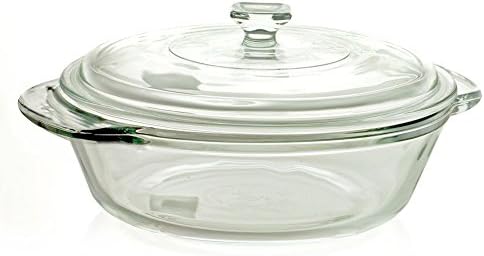

Lead only enters glassmaking when it’s deliberately added to produce lead crystal, a different material entirely, typically containing 10 to 40 percent lead oxide by weight, used for decorative stemware and cut-glass pieces prized for their weight and ring when tapped.
Anchor Hocking doesn’t manufacture lead crystal for its everyday product lines. So when the company says its clear glass is lead-free, that’s not really a claim to take on faith; it follows from what the material is.
Soda-lime glass and lead crystal are chemically distinct categories, and Anchor Hocking’s dinnerware, bakeware, and drinking glasses fall in the former.
Why lead-painted exterior markings are still a real exposure risk even though the glass itself is clean
The glass body being clean doesn’t make the whole product clean, and this is where the risk actually lives.
Painted measurement markings, decorative decals, and colored exterior patterns are a separate manufacturing step, applied on top of finished clear glass, and historically, some of those paints contained lead and cadmium as pigments and stabilizers.
The risk isn’t that lead leaches out of the glass into your coffee. It’s that painted surfaces wear with normal handling, washing, and use, shedding microscopic particles onto hands, lips, and kitchen surfaces over time.
That’s a slow, cumulative exposure pathway, not a single dramatic event, which is exactly why it goes unnoticed for years. A measuring cup with worn blue numbers looks harmless. The wear itself is the mechanism.
What counts as a safe lead level, and why the Prop 65 warning still appears
There’s a specific number that defines “safe” under U.S. law, and it explains a detail that confuses a lot of buyers.
CPSIA, Prop 65, and the actual ppm thresholds that define “safe”
| Standard | Threshold | What it covers |
|---|---|---|
| CPSIA (federal) | 90 ppm lead in paint, glaze, or coating | Items intended for use by children under 12 |
| California Prop 65 | No universal numeric limit; requires a warning if exposure exceeds safe harbor levels | Any product sold in California with potential lead exposure |
| No federal standard | — | Total lead content in glassware intended for adult use (only leachable/surface exposure is regulated) |
There’s no blanket federal cap on lead in adult glassware generally; the 90 ppm figure applies specifically to items intended for children.
That gap matters because it means a coffee mug or measuring cup marketed to adults isn’t legally required to meet the same bar as a kid’s cup, even if both end up in the same kitchen drawer.
Why does Anchor Hocking have a Prop 65 warning if it claims to be lead-free?
A Prop 65 warning doesn’t contradict a “lead-free” claim; it’s triggered by California’s own disclosure rules, which require a warning label if a product could expose users to any detectable amount of a listed chemical above the state’s safe-harbor threshold, regardless of how low that amount is.
Some Anchor Hocking products carry this warning specifically because of painted components, not the clear glass body.
One customer noted exactly this pattern in a review, pointing out that a piece without the warning was reassuring precisely because California’s disclosure threshold is strict enough to catch trace amounts other jurisdictions wouldn’t flag at all.
Vintage Anchor Hocking glass: a different risk profile than modern pieces
Vintage and antique Anchor Hocking pieces carry meaningfully higher risk than current production, meaningfully, and the test data backs that up directly.
Actual XRF test results on specific vintage and modern Anchor Hocking pieces
| Piece | Era | Test result | Verdict |
|---|---|---|---|
| Anchor Hocking Wexford goblet | 1967–1998 | Non-detect lead | Safe by all standards |
| Anchor Hocking royal ruby red pressed tea cup | Vintage | Lead-free, 24 ppm cadmium | Safe by all standards |
| Anchor Hocking “Oven Originals” measuring cup (blue markings) | Modern, under 20 years | 36,300 ppm lead, 580 ppm cadmium | Unsafe — painted markings only |
| Anchor Hocking painted piece (unspecified pattern) | Vintage | 75,300 ppm lead, 580 ppm cadmium | Extreme — do not use for food |
| Related brand: vintage Arcoroc clear plate | Vintage | 256 ppm lead | Above the 90 ppm children’s limit |
The pattern that emerges: plain, unpainted pieces test clean across every era Rubin has examined, including goblets from the 1960s.
Painted pieces test dangerously high, and that’s true regardless of whether the item is genuinely antique or made within the last two decades.
How to tell if a specific piece is higher risk before you test it
- Plain, clear glass with no exterior markings carries the lowest risk, since the testing consistently shows clean results across decades of production when there’s no paint involved.
- Modern pieces purchased new in the last few years carry somewhat lower risk than true vintage stock, though painted markings on recent items have still tested positive, so recency alone isn’t a guarantee.
- Any item with painted measurement lines, decals, or colored exterior patterns should be treated as higher risk and tested before regular food or drink use, especially if it’s used daily.
- Worn or chipping paint on any decorated piece is the highest-risk category, since degraded paint sheds particles more readily than intact paint.
- Anything marketed or intended for children, regardless of age or condition, deserves priority testing given the specific 90 ppm legal threshold that applies to that category.
How to check your own glassware for lead
Testing is affordable and accessible, and the method you choose depends on how precise you need the answer to be.
Home lead test swabs vs professional XRF testing: accuracy and cost compared
| Method | Cost | Accuracy | What it tells you |
|---|---|---|---|
| Home swab test kit | $10–20 for multiple tests | Positive/negative only, no concentration | Whether lead is present above a rough detection threshold |
| Professional XRF testing | $50–150+ per session, or send-in services | Precise ppm concentration | Exact lead, cadmium, and other heavy metal levels |
A swab test tells you yes or no. An XRF reading tells you the actual number, and given that the difference between 24 ppm cadmium (safe) and 75,300 ppm lead (extreme) is the entire point, a swab is a reasonable first pass, but XRF is what gives you a real answer if the swab comes back positive.
Steps to take if your Anchor Hocking piece tests positive for lead
- Stop using the piece for food or drink contact immediately, even if the reading seems moderate rather than extreme.
- Remove it from active kitchen rotation and store it somewhere children and pets can’t reach, since surface particles are the exposure pathway, not just direct ingestion.
- Confirm the result with a second test if the first was a swab, ideally an XRF reading, before deciding what to do with the piece long-term.
- Check whether the piece is a decorative or collectible item you’d rather keep for display than discard — repurposing rather than disposing is a reasonable option for painted vintage pieces with sentimental or collectible value.
- Replace it with an unpainted, clear glass equivalent for daily use, since the testing consistently shows plain glass from the same brands testing clean.
How Anchor Hocking compares to other glassware brands on lead safety
Anchor Hocking isn’t unusual here; the same clear-glass-versus-painted-decoration pattern shows up across most major glassware brands.
Anchor Hocking, Pyrex, Libbey, and Arcoroc: lead status of clear glass vs painted pieces
| Brand | Clear glass body | Painted/decorated pieces |
|---|---|---|
| Anchor Hocking | Lead-free (soda-lime glass) | Some test positive, including measuring cup markings |
| Pyrex (vintage) | Lead-free | Widely documented lead-positive paint, including at levels over 40,000 ppm |
| Libbey | Lead-free | Generally, tests are clean in Rubin’s published results, though not exhaustively tested |
| Arcoroc | Lead-free (Kwarx/tempered glass) | Vintage pieces have tested at 256 ppm lead |
For a full look at how Arcoroc vs Luminarc glassware comparison plays out beyond just lead content, that guide covers the commercial and consumer product lines side by side.
What to look for when buying any glassware brand, not just Anchor Hocking
- Choose plain, unpainted glass whenever possible — every brand’s clean results in independent testing come from undecorated pieces, without exception.
- Treat painted measurement markings on any measuring cup with caution, regardless of brand, since this specific feature has repeatedly tested positive across multiple manufacturers.
- Buy new rather than vintage if lead exposure is a top concern, since older painted pieces have a longer documented history of positive test results than most current production.
- Ask the retailer or manufacturer for third-party test documentation rather than relying solely on a company’s self-reported safety claim, since the Anchor Hocking case shows those claims don’t always hold for every product in a line.
For readers weighing alternatives entirely outside glass, stainless steel dinnerware made in the USA sidesteps the lead-in-paint question altogether.
Want lead-free glassware you don’t have to second-guess? Shop verified lead-free clear glassware → — or see the full guide to lead-free dinnerware brands for plates, bowls, and mugs tested clean across the board.
Frequently asked questions: Does Anchor Hocking glass contain lead
Does Anchor Hocking glass contain lead?
The clear glass body doesn’t use soda-lime glass, which is lead-free by formulation.
Some painted markings and decorated exteriors have tested positive for lead at extreme levels, including one measuring cup at 36,300 ppm and another piece at 75,300 ppm, so the answer depends on whether the specific item has any painted decoration.
Is vintage or antique Anchor Hocking glass safe to use?
Plain, clear vintage pieces, like Wexford goblets from 1967–1998, have tested clean and are safe by all standards.
Painted or decorated vintage pieces are at a higher risk, with some testing as high as 75,300 ppm lead, so the safety of any specific vintage item depends entirely on whether it has exterior decoration.
Is Fire King glassware the same as Anchor Hocking, and is it lead-free?
Fire King is owned by Anchor Hocking, so the same clear-glass-versus-painted-decoration pattern applies.
A vintage Fire King mug’s clear glass body would be expected to test lead-free, but any painted colors or markings on it should be treated with the same caution as painted Anchor Hocking pieces.
How can I test my own Anchor Hocking glassware for lead?
A home swab test kit costs $10–20 and gives a positive or negative result, which works as a first check.
For an exact concentration in parts per million, professional XRF testing runs $50–150 or more and is the method independent researchers like Lead Safe Mama use.
Why does Anchor Hocking glassware sometimes carry a California Prop 65 warning?
Prop 65 requires a warning if a product could expose users to any detectable amount of a listed chemical above California’s strict safe-harbor threshold, which is separate from a general “lead-free” claim.
Products with painted components are more likely to trigger this warning than plain, clear glass, since the paint is where testing has found lead.
Is it safe to microwave or wash painted Anchor Hocking measuring cups?
Regular washing and microwave use both accelerate wear on painted surfaces, which is the exact mechanism that releases lead particles over time.
If a measuring cup has painted markings, the safer approach is switching to an unpainted version for regular use rather than continuing to wash and heat the painted one.
How does Anchor Hocking compare to Pyrex and Libbey on lead safety?
All three brands show the same pattern: clear, unpainted glass tests lead-free, while painted or decorated pieces are where positive results show up.
Vintage Pyrex has an especially well-documented history of lead-positive paint, in some cases exceeding 40,000 ppm, making it comparable in risk profile to the higher-end Anchor Hocking test results.
About the Author & Reviewer
Sarah Emirone, Author
Sarah researches and writes SafeKitchn’s dinnerware and kitchenware guides, with a focus on material safety, lead content, and manufacturer specifications. She cross-references product data sheets, safety certifications, and regulatory filings (including FDA and Prop 65 records) before publishing, and updates articles when new information becomes available.
James Daniels, Reviewer
James reviews SafeKitchn’s material safety content for scientific accuracy. He holds a B.Sc in inorganic chemistry and works as a materials researcher, with particular focus on the composition and safety behavior of glass, ceramic, and metal used in kitchenware.