

Choosing dinnerware is more consequential than it looks.
The material determines how long your set lasts, how much of the dishwasher it can withstand, how well it keeps food warm, how heavy it feels when you carry six plates from the kitchen to the table, and whether it makes sense for everyday family meals or only for occasions.
Most buyers choose based on how a set looks on a shelf or in a photograph.
A better approach is to understand what each material actually does, then choose the one whose strengths match how you actually use your kitchen.
This guide covers all seven major types of dinnerware materials and their benefits: porcelain, bone china, stoneware, earthenware, glass, melamine, and ironstone, with a full compatibility reference table, a lifestyle decision guide, and a direct answer to the most persistent misconception in the category: bone china is not fragile.
It is, in fact, the most chip-resistant ceramic dinnerware material you can buy.
Written by Sarah Emirone | Reviewed by James Daniels, B.Sc, Inorganic Chemist & Materials Researcher | Updated September 2026 | See How We Test | Filed under: Buying, Care & Product Guides
All Dinnerware Materials at a Glance
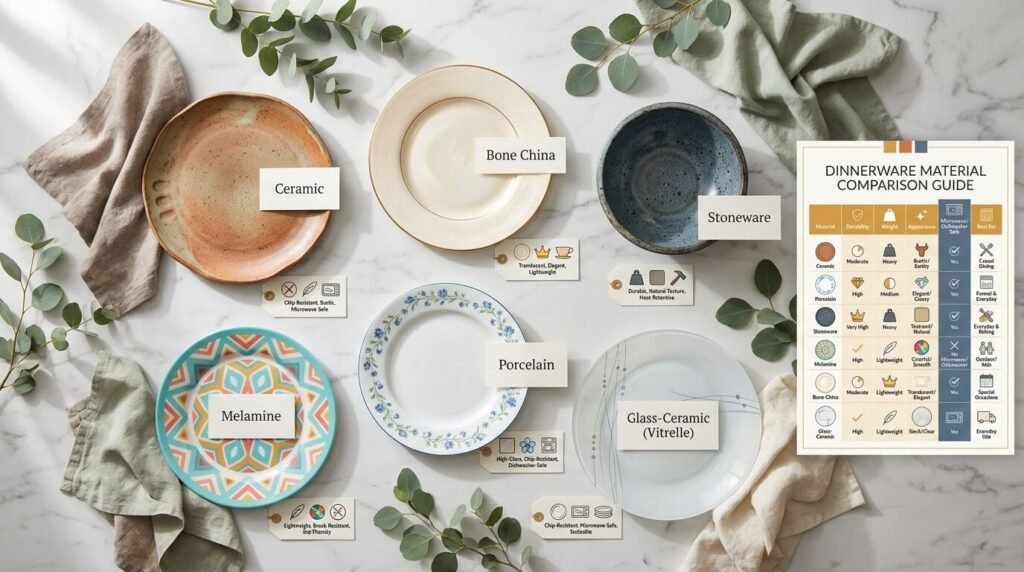
Before the details, here is a cross-material comparison on the six dimensions that matter most to everyday buyers. All ratings assume quality manufacturing from a reputable brand.
| Material | Weight | Durability | Heat retention | Chip resistance | Best use | Price tier |
|---|---|---|---|---|---|---|
| Porcelain | Light–medium | High | Moderate | Moderate | Every day + formal dual-use | Mid–premium |
| Bone china | Very light | Very high | Moderate | Highest among ceramics | Everyday + formal; one-set households | Premium |
| Stoneware | Heavy | Very high | Highest | High | Every day, family use casual dining | Mid |
| Earthenware | Medium | Low | Low–moderate | Low | Decorative, low-heat casual use | Budget–mid |
| Glass (tempered/Vitrelle) | Very light | High | Low–moderate | High (shatter-resistant) | Every day, health-conscious households | Budget–mid |
| Melamine | Lightest | Highest (break-proof) | Low | Highest (unbreakable) | Outdoor, children’s cold meals only | Budget |
| Ironstone | Very heavy | High | High | Moderate | Farmhouse, rustic, casual dining | Budget–mid |
Porcelain — the Most Popular Dinnerware Material and Why
Porcelain accounted for approximately 44% of the global porcelain tableware market in 2024, maintaining its leading position in the tableware category for much of the modern market era.
That dominance is not accidental. Of all the dinnerware materials available, porcelain comes closest to balancing every competing demand simultaneously: it is elegant enough for formal occasions, durable enough for daily dishwasher use, light enough to handle comfortably, and available at a wide enough price range to suit most households.

- 【Dishes set for 6】This 18-pieces porcelain plates set, designed to accommodate dining for 6 people, includes 4 pieces ea…
- 【Unique Floral Patterns】 Each bowl and plate features its own distinct floral design.
- 【Elegant Blue and White Glaze】The classic blue and white color scheme provides a timeless and sophisticated look, perfec…
It is the safe choice in the best sense of the word, not because it is risk-free, but because it rarely disappoints, regardless of how it is used.
How porcelain is made and what that means for performance
Porcelain is produced by firing a mixture of kaolin clay, feldspar, and silica at temperatures between 1,200°C and 1,400°C — high enough to vitrify the clay body, fusing its particles into a dense, non-porous structure with properties comparable to glass.
This vitrification is what gives porcelain its characteristic translucency, its smooth white surface, and its resistance to staining and moisture absorption.

- ELEGANT AND SOPHISTICATED: Crisp white Parchment dinnerware elevates your table with a graceful silvery scroll design bo…
- COMPLETE 40-PIECE SET FOR 8: Includes 8 each of a 10-3/4 inch dinner plate, 8-1/4 inch salad plate, 8-1/2 inch rim soup …
- COMPLETE 40-PIECE SET FOR 8: Includes 8 each of a 10-3/4 inch dinner plate, 8-1/4 inch salad plate, 8-1/2 inch rim soup …
The high firing temperature also makes porcelain non-porous without requiring a glaze for sealing, which is why plain white porcelain from reputable manufacturers consistently passes lead and cadmium safety testing.
There is no soft, low-fired glaze layer in which heavy metals can pool. The thin walls that distinguish fine porcelain are a product of this dense structure: the material is strong enough per unit thickness that it does not need to be thick to be durable.
Porcelain benefits, limitations, and who it suits
Benefits:
- Non-porous and resistant to staining, odour absorption, and bacterial growth
- Elegant appearance that reads appropriately for both casual and formal settings
- Microwave, dishwasher, and oven safe in most unfired decorations; always check metallic trim
- Wide range of designs, shapes, and price points from budget to luxury
- Lighter than stoneware — easier to handle for children, elderly users, and large service sets
Limitations:
- Thinner walls than stoneware mean less heat retention — food cools faster on a porcelain plate
- Can chip at the rim if knocked hard; once the rim chips, the break can propagate
- Decorated porcelain with overglaze embellishments requires hand washing and may have glaze safety concerns
Who it suits: Porcelain is the right choice for households that want one set that works every day and looks appropriate when guests arrive.
It is particularly well-suited to households where the aesthetic of the table matters, but a separate formal set feels excessive.
See our full porcelain vs stoneware comparison for a side-by-side breakdown of these two most popular materials.
Bone China — the Strongest Ceramic, Not the Most Fragile
The most persistent misconception in the dinnerware category is that bone china is fragile. It is not.
Bone china is technically the most chip-resistant ceramic dinnerware material available, stronger than porcelain, stronger than stoneware on a per-gram basis, and capable of daily use for decades when treated with basic care.

- Bring sophistication to your Table using minimalist style, Clean lines, and smooth, pure White surfaces.
- 16Piece dinnerware set includes 4 each of: 11-inch dinner plate, 9-inch Salad plate, 5-3/4 inch cereal bowl and 13-ounce…
- Crisp White bone china
The perception of fragility comes from three sources: its delicate visual appearance, its premium price point (which implies preciousness), and the fact that it is frequently stored in display cabinets rather than used at the table.
None of those things reflects its actual material properties.
What bone ash does to the ceramic structure — why it is stronger than standard porcelain
Bone china is distinguished from standard porcelain by the addition of bone ash — typically calcined cattle bone — at a minimum proportion of 25% of the total clay body, though quality manufacturers often use 35% to 45%.
The bone ash introduces tricalcium phosphate into the ceramic matrix. When the piece is fired, this compound creates a different crystalline structure from the one produced by kaolin and feldspar alone: a more uniformly distributed, finer-grained matrix that is both more flexible under impact stress and more resistant to crack propagation.
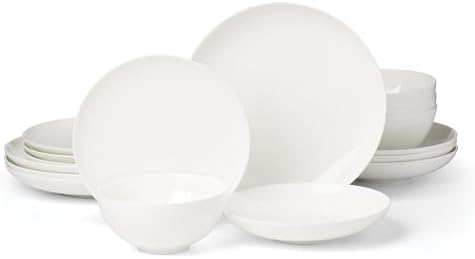
- WHY IT’S SPECIAL: Studio 1414 is expertly designed and passionately perfected to be your for-anything, for-forever dinne…
- WHO IT’S PERFECT FOR: Anyone who wants dishes that look elegant, feel effortless, and work for everything from weeknight…
- WHAT’S IN THE BOX: This 16-piece dinnerware set includes service for 4 with 4 dinner plates (10.98″Diameter), 4 accent p…
In practical terms, this means bone china plates absorb impact energy differently from standard ceramic; they flex slightly rather than fracturing immediately, which is why they chip less readily than their weight suggests they should.
The characteristic translucency of bone china, visible when a plate is held up to the light, is a direct expression of this fine-grained structure and a reliable quality indicator: the more translucent the piece, the more completely and evenly the bone ash has been incorporated into the clay body.
Bone china benefits, limitations, and who it suits
Benefits:
- Highest chip resistance of any ceramic dinnerware material — stronger per gram than porcelain or stoneware
- Exceptionally lightweight — the lightest ceramic option by a meaningful margin
- Versatile enough for daily use and formal occasions, the original one-set solution
- Grows in value and character over time; well-maintained sets from respected manufacturers last generations
- Dishwasher safe on a gentle cycle for plain pieces; microwave safe unless the piece has metallic banding
Limitations:
- Higher price point than porcelain and significantly higher than stoneware
- Plain and lightly decorated pieces are suitable for daily dishwasher use; heavily decorated or gilded pieces require hand washing
- Less heat retention than stoneware due to thinner walls and lower thermal mass
- The perception of fragility is not a material reality but can be a social one — some households treat it preciously when they need not
Who it suits: Bone china is the ideal choice for households that want a single set that performs at the dinner table on a Tuesday night and at a dinner party on a Saturday.
It is also the right material for households where someone has limited hand strength, elderly users, people with joint conditions, because its extreme lightness makes it significantly easier to handle than stoneware or ironstone.
See our bone china vs porcelain guide for a detailed comparison of these two premium ceramic options.
Stoneware — the Best All-Round Choice for Everyday Family Use
Stoneware is the workhorse of the dinnerware category. It is not the most refined material, it is not the lightest, and it is not the cheapest, but it is the most durable for daily household use, the best at keeping food warm, and the most forgiving of the rough treatment that characterises a busy family kitchen.

- 【WHAT’S INCLUDED】: This 12 piece plate set features 4 x 10.25″ dinner plates, 4 x 8.25″ salad plates, and 4 x 26 oz cere…
- 【SAFE & DURABLE】: Fired at 2552°F using GLIDECOAT glaze technology with multi-layer crystallized glaze, MALACASA dinnerw…
- 【UNIQUE AESTHETIC DESIGN】: The sesame speckle decoration adds a modern touch, while the clay-colored block design preser…
It is also, among the ceramic options, the one that has most successfully followed contemporary design trends: modern stoneware comes in matte finishes, reactive glazes, speckled surfaces, and earthy neutral tones that suit the aesthetic direction most kitchens have moved in since the mid-2010s.
Why stoneware retains heat better than any other dinnerware material
Stoneware is fired at temperatures between 1,200°C and 1,400°C — comparable to porcelain — but is made from a denser clay body that produces a thicker, heavier finished piece.
That extra mass is directly responsible for its heat retention advantage. The thermal mass of a stoneware plate absorbs more heat from the food placed on it and releases that heat more slowly back into the food and surrounding air.

- WHAT’S IN THE BOX: Service for 4 that includes 4 of each of the following: 11” Dinner Plates, 8.25” Dessert Plates, 6” (…
- CARE INSTRUCTIONS: beautiful grey and black dishes that are also dishwasher and microwave safe
- STONEWARE/DOUBLE REACTIVE GLAZE: reactive refers to a technique how multiple colors within the glaze react together to c…
The practical result is that food served on stoneware stays warm approximately 30 to 40% longer than the same food served on a thin porcelain plate of equal size.
For families where meals are served buffet-style, for slow eaters, for households where the table is some distance from the kitchen, and for anyone who regularly serves food that is optimal when hot soups, curries, or pasta, heat retention advantage is a meaningful daily benefit rather than a marginal one.
Stoneware benefits, limitations, and who it suits
Benefits or Advantages of Stoneware Dinnerware:
- Best heat retention of any consumer dinnerware material — food stays warm 30–40% longer than on thin porcelain
- Highly chip and scratch resistant — the dense fired body is forgiving of the impacts and abrasions of daily use
- Microwave, oven, and dishwasher safe in most quality brands — the most versatile kitchen compatibility of any ceramic
- Wide range of contemporary designs — currently the most design-forward material in the mid-price category
- Mid-range price point — genuinely good stoneware is available without a premium budget
Limitations of Disadvantages of Stoneware Dinnerware:
- Significantly heavier than porcelain or bone china — carrying a full set of stoneware dinner plates requires more effort, which matters for elderly users, people with limited grip, and anyone with a long carry from the kitchen to the table
- Larger storage footprint — thicker walls mean a stacked set of stoneware takes up more cabinet space than an equivalent porcelain or bone china set
- Not all stoneware is dishwasher or oven-safe — always verify with the specific manufacturer; budget stoneware from unverified sources may not meet these specifications
- Susceptible to thermal shock — moving a stoneware dish directly from a freezer to a hot oven can cause cracking; allow it to come to room temperature first
Who it suits: Stoneware is the correct choice for active family households where the dinnerware is used three times a day, run through the dishwasher regularly, and needs to survive the inevitable daily knocks of a kitchen with children in it.
It is also the right choice for anyone who prioritises heat retention, slow eaters, households where serving and eating are separated by time or distance.
Earthenware — the Oldest Ceramic, Best for Display and Low-Heat Casual Use
Earthenware is the original ceramic material — fired at low temperatures between 900°C and 1,150°C from unrefined clay bodies, and produced in recognisable form since the Neolithic period.
It is the least technically demanding of the ceramic materials to produce, which is part of why it remains the most common material in artisan, handmade, and ethnically specific ceramics worldwide.

- EACH DISHES IS UNIQUE: These dishware sets are fired with two different reactive glazes, so the surface develops a beaut…
- SAFE AND DURABLE STONEWARE DINNER SET: Durability meets safety in this thoughtfully designed collection. Our plates set …
- STACKABLE & SAVE SPACE: Designed to stack neatly and securely to maximize your cupboard space. Beyond their durability, …
It is also the weakest and most porous of the ceramic materials, which is why its applications in modern household dinnerware are narrower than the other options.
The porosity of earthenware is the central characteristic that determines its appropriate uses. Because it is fired at lower temperatures, the clay particles do not fully vitrify — they remain partially open, which means unglazed earthenware absorbs moisture, odours, and, over time, bacteria.
Glazed earthenware resolves the moisture issue, but the fired body beneath the glaze remains weaker and more susceptible to thermal stress than stoneware or porcelain.

- Classic, everyday design: Its classic, smooth, and sturdy design is complemented by a strong glossy finish that’s ringed…
- Durable earthenware: Fired at lower temperatures than stoneware or porcelain, our earthenware is meticulously crafted fr…
- Service for 4: With 4 large 10.5” dinner plates, 4 5.5” cereal bowls, and 4 8″ pasta bowls, this 12-piece set will accom…
Chips and cracks are more common with earthenware than with any other ceramic, and a crack in an earthenware piece renders it unsuitable for food use because the porous body beneath the glaze becomes inaccessible to cleaning.
Earthenware benefits, limitations, and who it suits
Benefits:
- Distinctive rustic, artisan aesthetic that suits informal dining settings, ethnic cuisine presentation, and handmade table design
- Wide colour variety — the porous body absorbs glaze colours and decorative finishes with a depth that higher-fired ceramics cannot always replicate
- The most affordable ceramic material — handmade artisan earthenware can be expensive, but mass-produced earthenware is consistently budget-priced
- Can be used in the microwave and oven when properly glazed — always check the specific piece
Limitations:
- Most breakable ceramic material — chips and cracks under impacts that stoneware or bone china would survive intact
- If cracked, it must be retired from food use immediately — the porous body harbours bacteria that cannot be removed by washing
- Less suitable for formal or everyday regular use, where long-term durability is needed
- Unglazed earthenware is not dishwasher safe and absorbs food residue and flavours over time
Who it suits: Earthenware is appropriate for decorative use, occasional casual dining at room temperature, and specific culinary contexts where the aesthetic is part of the experience — a Mexican-inspired table setting, a handmade pottery collection, a rustic farmhouse breakfast.
For everyday repeated use, earthenware is the weakest performing option of the seven materials and should be chosen for its aesthetic rather than its function.
Glass Dinnerware — the Underrated Everyday Option
Glass dinnerware is consistently underrepresented in buying guides despite offering a combination of properties that makes it among the strongest practical choices for everyday household use.
Tempered glass, borosilicate glass, and Corelle’s Vitrelle triple-layer glass are all non-porous; they have no glaze layer, which means no risk of lead or cadmium leaching from a glaze surface, no odour absorption, and a cleaning simplicity that genuinely porous materials cannot match.
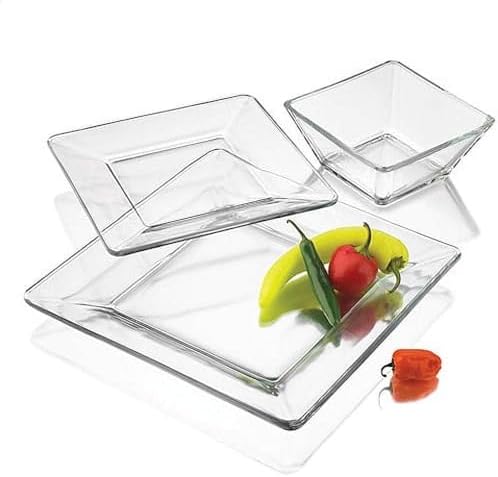
- – 12-Piece Complete Dinnerware Set: Includes 4 x 10.25″ glass dinner plates, 4 x 8″ glass salad plates, and 4 x 5.5″ gla…
- – Dishwasher Safe for Easy Cleaning: This glass dinnerware set is fully dishwasher safe, eliminating the hassle of hand …
- – Important Temperature Note: Not suitable for microwave or oven use. To avoid cracking or damage, please avoid extreme …
For health-conscious households, the absence of a glaze is the most significant material safety advantage in the entire dinnerware category. See our non-toxic dinnerware guide for a full material-by-material safety breakdown.
Glass dinnerware is also significantly lighter than most ceramic alternatives. A Corelle Vitrelle dinner plate weighs approximately 180 grams, comparable to melamine and dramatically lighter than stoneware.
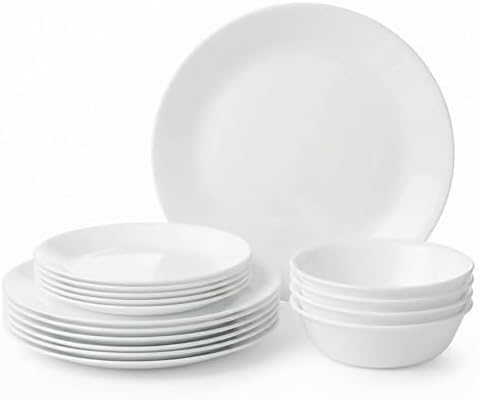
- Service for 6 includes: 6 each 10-1/4″ Dinner Plates, 6-3/4″ Bread and Butter Plates, 18-Ounce Soup/Cereal Bowls
- Made with break and scratch resistant patented Vitrelle glass technology
- Space saving design: lightweight and thin, yet extremely durable
This makes glass dinnerware particularly practical for households where dishes are carried frequently, for users with limited hand strength, and for situations where a large set needs to be transported.
Glass benefits, limitations, and who it suits
Benefits:
- Non-porous with no glaze — no lead, cadmium, or heavy metal risk; the safest dinnerware material for food contact
- Very lightweight — comparable to melamine, significantly lighter than porcelain or stoneware
- Non-porous surface resists staining, odour absorption, and bacterial growth
- Dishwasher, microwave, and oven safe in most formulations; Vitrelle glass oven safe to 350°F
- Modern minimalist aesthetic that suits contemporary kitchen design; available in clear and plain white
Limitations:
- When glass does break, it can shatter into many fragments rather than producing a clean break — a consideration for households with young children and bare feet
- Lower heat retention than stoneware or earthenware due to thin walls and low thermal mass
- More limited design range than ceramic — predominantly clear or white; coloured or patterned glass may use pigment coatings that carry their own material considerations
- Less visually substantial than ceramic on a formally set table
Who it suits: Glass dinnerware is an excellent choice for health-conscious households that prioritise material safety, for users who want the lightest possible dinnerware (elderly users, households with limited grip), and for anyone who values hygienic simplicity over aesthetic versatility.
See our best Corelle alternatives guide for the leading glass and lightweight ceramic options available.
Melamine — the Most Break-Resistant Material and Its Hard Limits
Melamine is in a different category from the ceramic and glass options — it is a synthetic resin material moulded into plate and bowl shapes, not a fired clay or glass product.
That distinction is responsible for both its primary advantage and its most important limitation. Melamine’s break resistance score in standardised testing rates at approximately 8.5 out of 10 — it can be dropped on concrete and bounce back without cracking.

- Add a splash of Mediterranean charm to your table with this 12-piece Talavera melamine dinnerware set, featuring classic…
- Crafted from premium melamine, this set mimics the elegance of hand-painted ceramic while offering durability you can tr…
- The 11″ dinner plates, 9″ salad plates, and 7.5″ bowls (22 oz) are perfectly sized for every course, from hearty mains t…
For contexts where breakage is a genuine operational concern, outdoor dining, poolside meals, children’s tables, camping, and RV living, near-indestructibility is a genuinely useful property that no ceramic can match.
The hard limit is equally clear and non-negotiable: melamine is not safe for use with hot food or in the microwave.
When melamine resin is exposed to hot food, acidic food, or microwave energy, it releases melamine and formaldehyde into whatever it contacts.
This is not a brand quality issue; it is a fundamental property of the material. No melamine product, regardless of how it is marketed or how reputable its manufacturer, is appropriate for heated food. Cold food service only.
Melamine benefits, limitations, and who it suits
Benefits:
- Virtually unbreakable under normal household conditions — the only dinnerware material that is genuinely drop-proof
- Lightest material of all — lighter even than glass or bone china
- Dishwasher safe on the top rack; easy to maintain
- Wide range of designs, including convincing ceramic mimics — visually indistinguishable from stoneware in many patterns
- Most affordable dinnerware material at comparable piece count
Limitations:
- Not microwave safe — ever, regardless of labelling
- Not safe for hot food — formaldehyde and melamine release under heat
- Not safe for acidic food at elevated temperatures
- Scratches over time, particularly in the dishwasher or with metal utensils; scratched melamine presents a higher chemical exposure risk
- Not appropriate for formal dining or settings where material quality is part of the table aesthetic
Who it suits: Melamine is the correct choice for outdoor dining and entertaining, children’s cold meals at any age, camping and RV kitchens, poolside service, and any setting where breakage is a genuine concern and heated food will not be served on the plates.
For any context involving hot food, replace melamine with stoneware, glass, or porcelain. See our safe kitchen guide for more on material safety limits in kitchen contexts.
Ironstone — the Heavy-Duty Farmhouse Ceramic Worth Knowing About
Ironstone is a dense, vitrified ceramic that occupies a position between earthenware and stoneware in the ceramic firing spectrum.
It was widely manufactured in nineteenth-century England and was the dominant household dinnerware material before porcelain became affordable, partly because of its durability and partly because of its visual weight and solidity, which read as quality in an era when thin ceramics were expensive and breakable.
Modern ironstone is primarily associated with farmhouse and rustic table aesthetics, and it is most commonly encountered as vintage or reproduction pieces rather than in contemporary dinnerware sets.

- BRING BOLD COLOR TO YOUR TABLE: Sonoma dinnerware is a stylish way to bring bold color to your table. Choose your favori…
- GLAZED IRONSTONE WITH HAND-PAINTED ACCENTS: Each piece of the Sonoma Dinner Set is made of glazed ironstone, evoking the…
- HIGH QUALITY, STYLISH AND AFFORDABLE: Whether you are looking for rustic charm, classic elegance, whimsical fun or to ad…
The defining characteristic of ironstone is density. An ironstone dinner plate is among the heaviest pieces of dinnerware in regular household use — typically 600 to 800 grams, compared to 450 to 600 for stoneware and 350 to 450 for porcelain.
That weight contributes to heat retention comparable to stoneware and a sense of substance at the table that lighter materials cannot replicate.
The aesthetic is distinctly casual and cottage-influenced, plain white or minimally decorated ironstone suits farmhouse kitchens, vintage table settings, and rustic entertaining. It is not appropriate for formal dining.
Ironstone is oven, microwave, and dishwasher safe in most pieces, though the thermal shock caveat that applies to stoneware applies equally here.
Avoid moving ironstone directly from the freezer to the hot oven. For buyers drawn to the farmhouse or vintage aesthetic who want genuine durability and heat retention alongside it, ironstone is a practical and affordable option that most modern dinnerware guides overlook.
Full Compatibility Reference — Microwave, Oven, Dishwasher, Freezer, and Stovetop Safety by Material
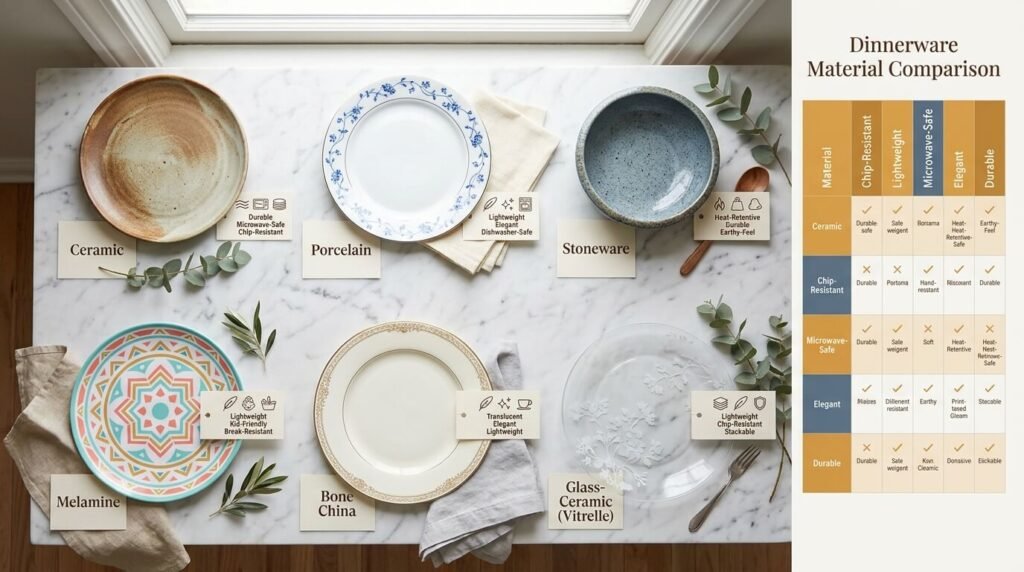
This is the table that should be on every dinnerware buying guide page and is rarely built completely.
For every material across all five key compatibility dimensions, here is what the research and manufacturer specifications confirm.
Where the answer is conditional, the condition is noted.
| Material | Microwave safe | Oven safe | Dishwasher safe | Freezer safe | Stovetop safe |
|---|---|---|---|---|---|
| Porcelain | ✓ (no metallic trim) | ✓ up to 450°F / 232°C (check label) | ✓ (most; hand-wash decorated) | ✓ (avoid thermal shock) | ✗ (no direct heat) |
| Bone china | ✓ (no metallic banding) | ✓ up to 350°F / 177°C (check label) | ✓ gentle cycle (plain); hand wash decorated | ✓ | ✗ |
| Stoneware | ✓ | ✓ up to 450–500°F / 232–260°C (most brands) | ✓ (most quality brands; verify) | ✓ (avoid sudden temperature change) | ✗ |
| Earthenware | ✓ (glazed only) | ✓ with caution (glazed; check label) | ✓ (glazed only) | ✗ (not recommended) | ✗ |
| Glass (tempered / Vitrelle) | ✓ | ✓ up to 350°F / 177°C (Vitrelle); higher for borosilicate | ✓ | ✓ | ✗ |
| Melamine | ✗ — never | ✗ — never | ✓ top rack only | ✗ | ✗ |
| Ironstone | ✓ | ✓ up to 450°F / 232°C | ✓ | ✓ (avoid sudden temperature change) | ✗ |
Why only 1 in 5 plates is truly oven safe — what the conditions mean in practice
The headline figure that 1 in 5 plates is truly oven safe is a reflection of how many oven-safe claims on dinnerware packaging come with conditions that buyers do not read or that the marketing obscures.
The practical conditions to understand are these: almost all ceramic dinnerware that is labelled oven safe refers to a preheated oven, not to sudden transitions from cold to hot.
A stoneware casserole dish that goes from a cold fridge directly into a 450°F oven is at serious risk of thermal shock cracking; the same dish that comes to room temperature first is entirely safe.
Metallic trim — the gold or platinum banding on bone china and porcelain — makes those pieces unsafe for microwave use because metal in a microwave creates arcing; the same piece without metallic trim is microwave safe.
Temperature ceilings matter: bone china is typically rated to 350°F, while quality stoneware handles 500°F. A piece labelled “oven safe” at 350°F is not appropriate for a 450°F roasting use.
Always read the specific temperature ceiling, not just the “oven safe” designation, before using any dinnerware in the oven.
Which Dinnerware Material Suits Your Household — a Decision Guide by Lifestyle
The right material depends not on which one is objectively best but on which one’s strengths match how your household actually uses dinnerware. The table below maps six household profiles to the most appropriate material choice.
| Household profile | Recommended material | Why | Avoid |
|---|---|---|---|
| Active family with young children | Stoneware | Chip resistance + heat retention + dishwasher daily | Earthenware (chips too easily); melamine for any hot food |
| Single person or couple; everyday + occasional entertaining | Porcelain | Dual-use versatility; elegant enough for guests; lighter than stoneware | Earthenware for daily use |
| One-set household wanting everyday AND formal | Bone china | Strongest ceramic + lightest + appropriate for both settings | Stoneware if aesthetic refinement matters for formal use |
| Elderly users or limited hand strength | Bone china or glass | Both are significantly lighter than stoneware; bone china most chip-resistant | Stoneware and ironstone (too heavy); earthenware (too fragile) |
| Outdoor dining, camping, and children’s cold meals | Melamine | Virtually unbreakable; lightest; affordable | All ceramics and glass for outdoor use where breakage is likely |
| Health-conscious household prioritising non-toxic | Glass (Vitrelle/tempered) | No glaze = no lead/cadmium risk; non-porous; easiest to clean | Any unverified glazed ceramic, melamine for hot food |
Frequently Asked Questions About Dinnerware Materials
What is the most durable dinnerware material overall?
It depends on how you define durability. For break resistance — the ability to survive being dropped — melamine is the most durable: it is virtually unbreakable under normal conditions.
For the best combination of chip resistance and daily functional durability in a ceramic that can also go in the oven and microwave, bone china leads the ceramic category, followed by stoneware.
For a household where the priority is a ceramic that handles daily use, dishwashers, and oven temperatures, stoneware offers the best practical durability for most buyers.
Is bone china safe for everyday use?
Yes, completely. The idea that bone china is too fragile for everyday use is one of the most persistent and incorrect beliefs in the dinnerware category.
Bone china is the most chip-resistant ceramic material available — stronger per gram than porcelain or stoneware, thanks to the tricalcium phosphate structure created by bone ash during firing.
Plain and lightly decorated bone china is dishwasher safe on a gentle cycle. The only practical care consideration is avoiding heavily decorated or gilded pieces in the dishwasher, and keeping metallic-banded pieces out of the microwave.
What is the difference between porcelain and bone china?
Both are high-fired white ceramics, but bone china incorporates a minimum of 25% bone ash (calcined cattle bone) into the clay body, which creates a different crystalline structure during firing.
The result is a material that is lighter, more translucent, and more chip-resistant than standard porcelain. Porcelain has a slightly denser, less translucent appearance and is typically less expensive.
In practical terms, both are appropriate for everyday and formal use — bone china is the better performer on weight and chip resistance; porcelain offers better value at the mid-range and a wider variety of designs.
Which dinnerware material keeps food warm the longest?
Stoneware retains heat best among the major dinnerware materials, followed by ironstone. Both owe their heat retention to thermal mass; their dense, heavy construction absorbs heat from hot food and releases it back slowly rather than allowing it to dissipate into the surrounding air.
Stoneware keeps food warm approximately 30 to 40% longer than thin porcelain under comparable conditions.
For households where hot food staying hot is a priority — soup service, slow eaters, long gaps between serving and eating, stoneware is the clear functional choice on this dimension.
What is the lightest dinnerware material?
Melamine is technically the lightest dinnerware material, but since it cannot be used with hot food, it is not a practical choice for all households.
Among materials suitable for heated food service, Corelle Vitrelle glass (approximately 180 grams per dinner plate) and bone china (approximately 200 to 250 grams) are the lightest options.
Both are significantly lighter than porcelain (approximately 350 to 450 grams) and dramatically lighter than stoneware (450 to 650 grams).
For households buying dinnerware for elderly users or anyone with reduced hand strength, glass or bone china provides the most practical weight advantage.
Can melamine go in the microwave?
No — never, regardless of labelling. When melamine resin is exposed to microwave energy, it releases melamine and formaldehyde into food.
This is a fundamental material property, not a quality issue — no melamine product from any manufacturer is safe for microwave use. If a piece of melamine packaging claims microwave safety, that claim is inconsistent with established food safety science.
Melamine is appropriate for cold food service at room temperature; for any heated food, use glass, ceramic, or stoneware.
What is the difference between stoneware and earthenware?
Both are ceramic materials made from clay, but they are fired at very different temperatures and produce materials with very different properties.
Stoneware is fired at 1,200°C to 1,400°C, which vitrifies the clay body into a dense, non-porous, highly durable material.
Earthenware is fired at 900°C to 1,150°C, which leaves the clay body partially porous, weaker, and more susceptible to chips, cracks, and moisture absorption.
In practical terms, stoneware is appropriate for daily use and can handle microwave, oven, and dishwasher cycles.
Earthenware is better suited for decorative use or occasional cold service, the right aesthetic choice, but not the right functional choice for a primary dinnerware set.
Is it worth spending more on bone china or porcelain over stoneware?
It depends on your household’s priorities. Stoneware offers better heat retention, comparable chip resistance at a lower price, and a more casual aesthetic that suits contemporary kitchen design.
Porcelain offers a more refined appearance with dual-use versatility for formal occasions. Bone china offers the best combination of lightness and chip resistance in a ceramic that is equally appropriate for everyday and formal use.
If budget is the primary constraint, stoneware gives the best functional value. If you want one set that performs well at every table occasion and will last for decades, the premium for bone china or quality porcelain is justified.
About the Author & Reviewer
Sarah Emirone, Author
Sarah researches and writes SafeKitchn’s dinnerware and kitchenware guides, with a focus on material safety, lead content, and manufacturer specifications. She cross-references product data sheets, safety certifications, and regulatory filings (including FDA and Prop 65 records) before publishing, and updates articles when new information becomes available.
James Daniels, Reviewer
James reviews SafeKitchn’s material safety content for scientific accuracy. He holds a B.Sc in inorganic chemistry and works as a materials researcher, with particular focus on the composition and safety behavior of glass, ceramic, and metal used in kitchenware.