

Best microwave safe RV camping dishes get recommended online mostly by material, wheat straw, melamine, and glass, with little attention to whether that material actually holds up under an RV microwave.
That gap matters more than most buying guides admit. A plate can be “microwave safe” on the label and still shed trace chemicals under heat, and an RV microwave doesn’t behave like the one in your kitchen at home.
This guide covers what actually determines safety, which materials pass and which don’t, and why your RV’s own microwave changes the answer.
Written by Sarah Emirone | Reviewed by James Daniels, B.Sc, Inorganic Chemist & Materials Researcher | Updated September 2026 | See How We Test | Filed under: Buying, Care & Product Guides
How to Tell If RV Dishes Are Actually Microwave Safe
The label “microwave safe” isn’t tested or certified uniformly; it’s a claim the manufacturer chooses to make, and it doesn’t always hold up.
Before buying, check the material against the BPA-free plastic safety explained question directly, because BPA-free and microwave-safe are two different claims that get bundled together in marketing copy.
What “Microwave Safe” Actually Means on a Label
“Microwave safe” is a manufacturer’s claim that a material won’t melt, warp, or release unsafe levels of chemicals when heated under normal use.
In the U.S., the FDA doesn’t require independent lab certification for this label — it’s self-declared by the brand. That’s why two dinnerware sets can both say “microwave safe” and behave completely differently once you actually use them.
The label tells you what the maker is willing to claim, not what a lab has confirmed.
Materials to Avoid in Your RV Microwave
- Uncertified melamine dinnerware — the FDA states plainly that foods and drinks should not be heated on melamine-based tableware in microwave ovens, full stop.
- Wheat straw sets that don’t disclose their binder — many are wheat fiber mixed with melamine-formaldehyde resin, not pure plant material, and the label rarely says so.
- Thin plastic without a microwave-safe symbol — no symbol means no manufacturer claim, which means no accountability if it warps.
- Metal trim or metallic paint on any dish — this applies even to ceramic and glass, and it’s a bigger issue in RV convection-combi units, covered below.
- Cracked or scratched dinnerware of any material — damage creates surface area where chemical migration accelerates, regardless of what the dish is made of.
Best Materials for Microwave-Safe RV Dishes
Glass and silicone are the two materials with the cleanest safety profile for microwave use; wheat straw and melamine both carry conditions worth knowing before you buy.

- Non-Toxic Titanium Surface: Cook safely with CAROTE pots and pans featuring a titanium-reinforced nonstick coating for e…
- Effortless Cleanup with Ultra-Nonstick: Enjoy effortless cleanup with an ultra-smooth, nonstick surface that allows low-…
- Space-Saving Detachable Handle: Features a secure detachable handle for effortless stacking storage. Saves cabinet space…
For a full appliance pairing, see the best RV cookware sets, but the dish material decision below stands on its own.
Wheat Straw vs. Melamine — Which Is Actually Safer
Most wheat straw dinnerware sold for RVs isn’t pure plant fiber. It’s wheat straw combined with melamine-formaldehyde resin as a binder, and the ratio of straw to resin varies by manufacturer with little disclosure.
A 2023 migration study published in the peer-reviewed journal Toxics tested 46 bowls and cups made from melamine, bamboo, and wheat straw composites purchased from retail and online markets in China, using European Union Reference Laboratory test conditions.
It found measurable migration of melamine and its derivatives from these products, confirming that the “eco-friendly” framing on the package doesn’t mean the resin binder disappeared.
| Factor | Wheat Straw (composite) | Melamine (pure resin) |
|---|---|---|
| Typical composition | Plant fiber + melamine-formaldehyde binder | 100% melamine-formaldehyde resin |
| FDA microwave guidance | Not directly addressed; depends on binder ratio | Explicitly advised against for microwave use |
| Chemical migration risk | Present, documented in lab testing of composite products | Present, well-documented, increases sharply above 160°F |
| Best verified option | “Melamine-free” or 100% wheat straw labeled products | Use for serving only, never for heating |
| Winner for microwave use | Neither is fully clear — pure wheat straw (no resin) wins if you can verify it | Loses outright; FDA guidance rules it out for heating |
The honest answer: neither material wins by default. What wins is a wheat straw product that explicitly states “melamine-free” or “100% wheat straw fiber” on the packaging or spec sheet.
If a wheat straw set won’t tell you what the binder is, treat it the way you’d treat unlabeled melamine fine for serving, not for the microwave.
Glass, Silicone, and Enamel Options Compared
| Material | Microwave Safety | Weight | Breakage Risk in RV | Best Use Case |
|---|---|---|---|---|
| Borosilicate glass | Genuinely microwave safe, no chemical migration concern | Heaviest option | High if dropped on a hard RV floor | Daily reheating, stationary use |
| Silicone (collapsible) | Naturally microwave safe, flexible under heat | Lightest option | Very low — flexes instead of cracking | Boondocking, tight storage |
| Enamel-coated steel | Not microwave safe — metal core reflects microwaves | Moderate | Very low, dents rather than breaks | Serving, campfire cooking, not reheating |
| Standard melamine | Not microwave safe per the FDA | Light | Very low | Serving cold or room-temperature food only |
Silicone wins for RVers who reheat food often and want to skip the chemical-migration question entirely. It’s inert, it folds flat, and it doesn’t crack when it hits the floor during a rough stretch of highway.
Glass is the second-best choice if you want rigid dinnerware and don’t mind the extra weight.
Material Safety Scorecard
| Material | Verified Microwave Safe | Regulatory Flag | Migration Risk (heated) |
|---|---|---|---|
| Borosilicate glass | Yes | None | None documented |
| Silicone | Yes | None | None documented |
| 100% wheat straw (melamine-free, verified) | Yes, if verified | None | Low |
| Wheat straw composite (undisclosed binder) | Unverified | EFSA has raised concerns about bamboo/wheat-straw composites using melamine-formaldehyde binders | Documented in lab testing |
| Melamine | No | FDA: Do not microwave | Documented, increases above 160°F |
Why Your RV Microwave Changes the Rules
RV microwaves run at lower wattage than the one in your kitchen, so reheating instructions written for a home appliance won’t give you the results you expect.
This isn’t a small technicality; it changes how long food needs to heat and, indirectly, how long a dish sits under microwave energy. For appliance-side details, see choosing the right RV microwave wattage.
RV Microwave Wattage vs. Home Microwave Wattage
| Appliance Type | Typical Wattage Range | Reheat Time Impact |
|---|---|---|
| Standard home microwave | 800–1,200W | Baseline — most package instructions are calibrated to this range |
| RV microwave (standard) | 600–1,000W | Often 20–40% longer than the package instructions state |
| RV microwave (compact, boondocking-oriented) | 600–700W | Can take close to double the printed reheat time |
If your RV microwave sits at 700W and the frozen dinner box says “microwave 3 minutes on high,” expect closer to 4 to 5 minutes.
That extra time matters for dish safety, too.
A dish rated for short bursts at full home wattage may spend longer under heat in a lower-wattage RV unit to reach the same food temperature, which is one more reason to favor materials with no migration risk in the first place.
Dish Rules for Convection/Combi RV Microwaves
- Check whether your RV has a straight microwave or a convection-combi unit — many newer RVs replace the propane oven entirely with a combi model, and the two appliance types have different dish rules.
- Never use metal bakeware in combi/fast-bake mode — this mode runs the microwave and the heating element together, and metal in a live microwave field can arc.
- Use the elevated rack that came with a combi unit for convection-only baking — placing a dish flat on the turntable blocks airflow and causes uneven cooking.
- Stick to glass or a manufacturer-confirmed microwave-safe dish for the microwave-only setting — the convection element doesn’t change the chemical migration question, only the airflow question.
- Lower the temperature by about 25°F versus a home oven recipe when using convection mode — RV combi units run hotter for a given setting than most people expect on the first bake.
Unbreakable & Space-Saving Design for Life on the Road
Dish weight and stackability matter as much as material safety once you’re actually living out of a 20-foot cabinet. See space-saving RV kitchen storage ideas for the cabinet layout side of this problem.
Stackable and Nesting Set Features to Look For
- Nestable bowls with a consistent taper — mismatched bowl shapes waste vertical cabinet space that RVs don’t have to spare.
- Flat-bottomed, low-sided plates — deep-lipped designs look nice on a table but stack less efficiently and take up more drawer height.
- A dedicated cup or mug that nests inside the largest bowl — this alone can save two to three inches of shelf height per set.
- Silicone sets that fold flat when empty — this is the single biggest storage win available, since a folded silicone bowl takes up a fraction of a rigid one’s footprint.
- A matched service count, not an odd mix of pieces — sets built for four that actually include four of everything, prevents the drawer clutter that comes from replacing lost or broken singles over time.
Weight Limits — Why Dish Weight Matters for RV Payload
Every pound in your RV counts against RV payload and weight limits, and dinnerware is an easy place to shave weight without giving anything up.
A 12-piece borosilicate glass set can weigh close to double a comparable silicone or wheat straw set, not a dealbreaker on its own, but it adds up alongside cookware, tools, and the rest of a stocked galley.
For weekend trips in a large fifth wheel, the difference barely registers. For full-time living in a smaller trailer or van already close to its GVWR, switching from glass to silicone or verified wheat straw can free up several pounds that matter more than they sound like they should.
How to Choose the Right Set for Your Camping Style
The right set size and material depend on how many people you’re feeding and how often you’re near a campground water hookup versus boondocking off-grid, not on which set has the most five-star reviews.
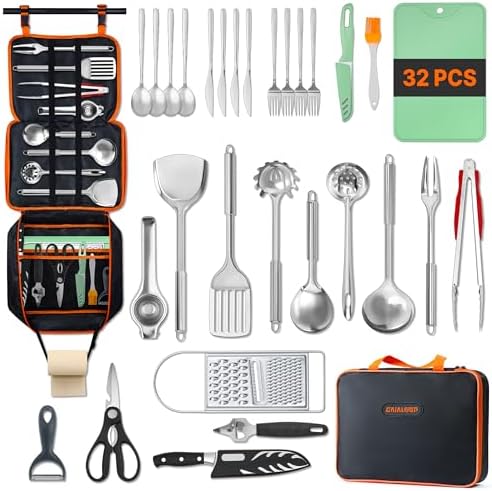
- 【32 PCS Cooking Utensil Set】The 32 PCS include: 1.Can Opener/Bottle Opener; 2.Meat Knife; 3.Vegetable Knife; 4.Cutting B…
- 【Cookout Essential: RV/BBQ/Camping】Gaialoop 32 PCS Cooking Utensil Set covers most of the cooking utensils you will need…
- 【Large Space Organizer Bag】This utensils set comes with a nice large space carrying bag made of Oxford Cloth. It is resi…
For meal planning that pairs with this, see RV camping meal prep essentials.
Set Size by Number of Travelers
| Travelers | Recommended Pieces | Notes |
|---|---|---|
| Solo or couple | 4–8 pieces (2 plates, 2 bowls, 2 cups minimum) | A small set halves the storage footprint versus a service-for-four |
| Family of 4 | 16 pieces (service for 4: plate, bowl, cup, small plate) | Standard configuration most retail sets are built around |
| Group of 5–6 | 20–24 pieces | Look for sets explicitly listed as service for 6 rather than stretching a 4-person set |
Decision Checklist Before You Buy
- Confirm whether your RV microwave is standard or convection-combi, since that determines which materials are off-limits.
- Check the wattage on your RV microwave’s spec plate or manual and mentally add 20–40% to any package reheat time.
- For wheat straw products, look specifically for “melamine-free” or “100% wheat straw” on the label — if it’s absent, assume a resin binder is present.
- Weigh storage space against material weight — silicone wins on both counts, glass wins on rigidity.
- Match the piece count to your actual travel group size rather than buying the biggest set on sale.
- Check for a microwave-safe symbol on the box itself, not just in the product description online.
Ready to shop with this checklist in hand? Compare the specific sets that meet every safety and storage criterion above in our vetted RV dinnerware shortlist filtered by wattage compatibility, verified material, and set size.
Frequently Asked Questions
Are wheat straw plates actually microwave safe?
Only if the manufacturer confirms the product is melamine-free. Most wheat straw dinnerware is a composite bound with melamine-formaldehyde resin, and lab testing has found measurable chemical migration from these composites under heat.
Can I use regular ceramic plates in my RV microwave?
Yes, as long as the ceramic has no metallic glaze, trim, or paint and is labeled microwave safe. Check the underside for a microwave-safe symbol before the first use.
How many dishes do I need for RV camping?
A solo traveler or couple typically needs 4 to 8 pieces, while a family of four does well with a 16-piece set. Buy for your actual group size rather than the largest set on sale.
Are RV dishes dishwasher safe?
Most silicone, glass, and verified wheat straw sets are dishwasher safe on the top rack, but check the manufacturer’s care label first. High-heat dishwasher cycles can accelerate wear on lower-quality composite materials faster than hand washing.
What size dishes fit in a typical RV cabinet?
Most RV cabinets comfortably fit 9- to 10-inch plates and standard cereal-size bowls, though tight galley kitchens may cap plate size closer to 8 inches.
Measure your cabinet depth before ordering, since RV storage varies more than home kitchen storage does.
Can you use paper plates in an RV microwave?
Plain, uncoated paper plates are generally fine for short reheats, but plates with a wax or plastic coating aren’t. Check for a microwave-safe label even on paper goods, since coated versions can warp or leach coating material under heat.
Is wheat straw dinnerware toxic?
Not inherently pure wheat fiber itself isn’t toxic. The concern is the melamine-formaldehyde binder used in most commercial wheat straw products, which can migrate into food under heat exposure according to peer-reviewed migration testing.
Do RV dishes need to be different from regular camping dishes?
Yes, in one specific way: RV dishes need to survive vibration from driving, not just outdoor use. A dish set fine for a stationary tent campsite can rattle, chip, or slide out of an RV cabinet during transit if it isn’t stackable and reasonably lightweight.
About the Author & Reviewer
Sarah Emirone, Author
Sarah researches and writes SafeKitchn’s dinnerware and kitchenware guides, with a focus on material safety, lead content, and manufacturer specifications. She cross-references product data sheets, safety certifications, and regulatory filings (including FDA and Prop 65 records) before publishing, and updates articles when new information becomes available.
James Daniels, Reviewer
James reviews SafeKitchn’s material safety content for scientific accuracy. He holds a B.Sc in inorganic chemistry and works as a materials researcher, with particular focus on the composition and safety behavior of glass, ceramic, and metal used in kitchenware.