

Eating utensils for the disabled aren’t one product category; they’re several, and the right one depends on how much hand and arm function someone actually has, not on their diagnosis.
Two people with completely different conditions can need the same tool. Two people with the same diagnosis at different stages can need completely different tools.
Most guides skip that step and just list ten products in no particular order. This one sorts by function level first, then walks through what works at each stage, including the point where utensils stop being the answer at all.
Written by Sarah Emirone | Reviewed by James Daniels, B.Sc, Inorganic Chemist & Materials Researcher | Updated September 2026 | See How We Test | Filed under: Accessible & Adaptive Dining
Finding the Right Eating Utensil for Your Level of Hand and Arm Function
The right utensil depends on the function level, not the diagnosis. Arthritis, tremor, stroke, cerebral palsy, and spinal cord injury can all land someone at the same starting point, reduced grip strength, and someone at that point needs the same category of tool, regardless of what caused it.
The Four Function Levels This Guide Uses
Full grip with tremor or weakness — the hand can close around a handle, but shaking or reduced strength affects control. This covers many people with Parkinson’s, essential tremor, or early arthritis.
Reduced grip strength — the hand can hold something, but not tightly or for long. Common after stroke, with moderate arthritis, or with progressive muscle weakness.



Minimal hand function — fingers can’t close around a standard handle reliably. Seen in more advanced cerebral palsy, later-stage ALS, or significant nerve damage.
No reliable hand or arm movement — the person cannot bring food to their mouth using any hand-held tool, regardless of how the tool is modified. This is where robotic feeding devices come in, covered later in this guide.
Why Diagnosis Alone Doesn’t Tell You Which Utensil to Buy
A search for “utensils for cerebral palsy” or “utensils for stroke” returns product lists built around the diagnosis rather than the person.
But cerebral palsy ranges from mild spasticity in one hand to no functional arm movement at all. A stroke can leave someone with a slightly weaker grip on one side or with one arm that doesn’t move.
Shopping by diagnosis means wading through products that don’t apply. Shopping by function level — which of the four categories above actually describes today narrows the list fast.
Utensils for Mild to Moderate Grip and Coordination Limitations
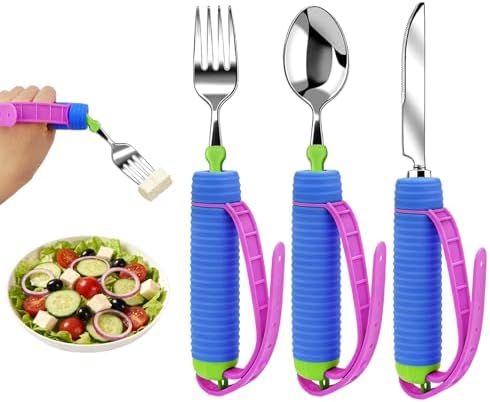
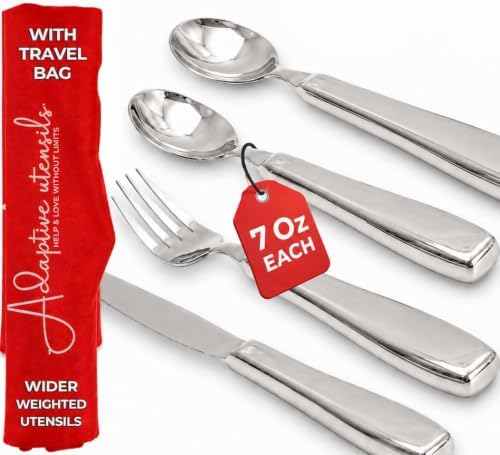
For the “full grip with tremor” and “reduced grip strength” levels, three utensil types cover almost every situation: weighted, built-up handle, and swivel.
Each solves a different problem, and picking the wrong one is the most common reason a $20 utensil ends up unused in a drawer.
Weighted vs. Built-Up Handle vs. Swivel Utensils
| Utensil type | Solves | How | Doesn’t solve |
|---|---|---|---|
| Weighted | Tremor | Added mass (roughly half a pound) dampens involuntary shaking | Weak grip strength can make it feel heavy to hold |
| Built-up handle | Weak grip | Wider handle needs less finger force to hold securely | Tremor doesn’t dampen the shake at all |
| Swivel | Wrist-angle tremor | Head stays level as the wrist moves, cutting spills | Overall weakness — mechanism adds a moving part that can wear out |
Weighted wins for tremor specifically. Built-up handles win for weakness specifically.
Buying weighted utensils for a weak-grip problem, or built-up handles for a tremor problem, is the single most common mismatch, and it’s why so many adaptive utensils get tried once and abandoned.
For the full breakdown by brand, price, and material, see this full comparison of weighted and built-up handle utensils.
Rocker Knives for One-Handed Cutting
A rocker knife has a curved blade that cuts with a single rocking motion instead of the back-and-forth sawing a straight knife needs.
That matters most for anyone eating with one functional hand, since a standard knife-and-fork combination assumes both hands are stabilizing the food. Press down, rock forward, done no second hand required to hold the food still.
For more on eating one-handed generally, this one-handed eating technique covers plate positioning and food prep alongside the knife itself.
Universal Cuffs and Strap-On Devices for Limited Grip Strength
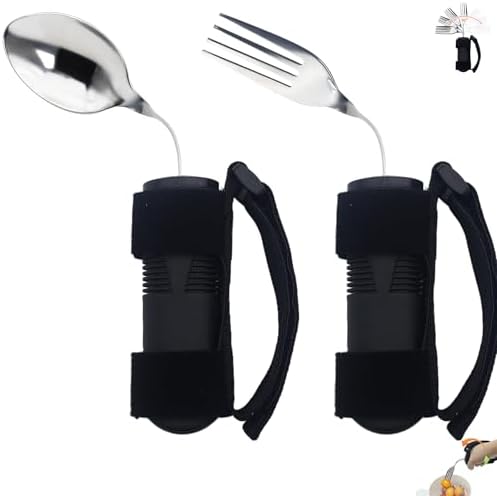
A universal cuff is a strap that wraps across the palm with a small pocket on the underside to hold a utensil handle, so the hand doesn’t have to grip anything at all. It solves a different problem than a built-up handle does.
Built-up handles reduce how much grip force needed, while a cuff removes the grip requirement entirely.
How a Universal Cuff Works
The strap fits across the palm and buckles or velcros closed around the back of the hand.
The utensil slides into the pocket at whatever angle works best for that person’s range of motion, then stays there without the fingers doing anything.
Because the pocket also fits a toothbrush, pen, or hairbrush, one cuff covers more than mealtime, which is part of why it’s a common recommendation from occupational therapists rather than a niche product.
When a Cuff Works Better Than a Handle Modification
- Grip strength has dropped to the point where even a wide, built-up handle can’t be held closed for a full meal.
- Fine motor control is present, but sustained grip fatigue sets in after a few bites with a standard or built-up utensil.
- The person wants to use a regular fork or spoon at a restaurant without carrying adaptive silverware, and the cuff can hold any standard utensil.
- Hand shape or joint damage from arthritis makes closing around any handle painful, regardless of width.
Adaptive Plates, Bowls, and Tableware That Support Any Utensil
The utensil only does half the job; getting food onto it in the first place is the other half, and that’s where plates and bowls matter as much as the fork or spoon.
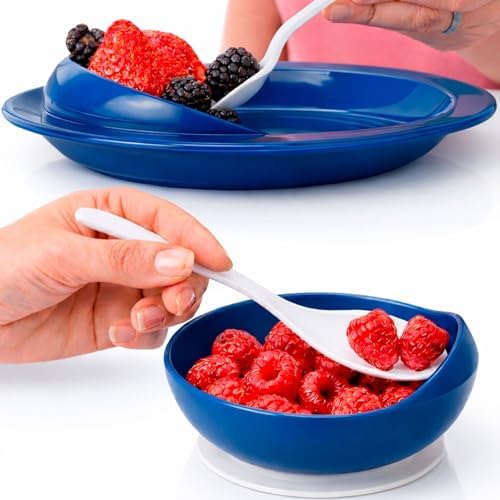
Plate Guards and Scoop Plates
- Plate guards clip onto a regular plate’s rim, creating a wall to push food against instead of chasing it across an open surface.
- Scoop plates and bowls are molded with one high, sloped side built in, doing the same job without a separate clip-on piece.
- Three-compartment plates keep foods from mixing, which matters most for anyone eating slowly enough that a meal sits out for a while.
- Non-slip mats under a plate stop the whole thing from sliding when someone with limited grip has to press down to load a utensil.
Suction-Base and Weighted Bowls
- Suction-base bowls anchor to the table itself, which is a more reliable fix for sliding than a mat alone when tremor or one-handed use is involved.
- Weighted bowls add stability in the same way weighted utensils do, useful specifically when tremor, not slipping, is the cause of spills.
- High-rim bowls let someone scoop against a wall on all sides instead of just one, which helps more with soup or cereal than a single sloped edge does.
When Utensils Aren’t Enough: Robotic Feeding Devices
At the “no reliable hand or arm movement” function level, no amount of weight, handle width, or cuff design solves the problem, because the issue isn’t grip; it’s that no hand-held tool can be operated at all.
This is where robotic feeding devices take over, and it’s the category most utensil guides mention once and move past.
How Robotic Feeders Like Obi Work
Obi uses a six-degree-of-freedom robotic arm that scoops food from one of four bowl compartments and brings it to the user’s mouth. The user doesn’t touch a utensil at all.
Control comes from a switch, button, or sip-and-puff attachment, activated by whatever part of the body can reliably move, whether that’s a chin, a foot, or a slight head turn. It’s classified by the FDA as a Class 1 medical device.
That single design choice separating “control the device” from “hold the utensil” is what makes it work for conditions like quadriplegia, late-stage ALS, or severe cerebral palsy, where standard utensils, cuffs, and handle modifications have already been ruled out.
Cost and Access Options
| Access method | Cost | Best for |
|---|---|---|
| Outright purchase | $5,950 | Long-term use with confirmed benefit from a trial period |
| 18-month lease | $235/month plus $1,750 security deposit | Users who want ownership eventually but need to spread the cost |
| Monthly rental | $300/month plus $1,250 security deposit | Short-term need or an extended trial before committing |
None of these numbers is small, and that’s exactly why the funding question below matters more here than it does for a $20 weighted spoon.
Does Insurance Cover Adaptive Eating Utensils?
Most basic adaptive utensils are not covered by Medicare, and the reason is specific rather than vague.
Medicare’s durable medical equipment rules require an item to meet four conditions at once: it has to be durable, medically necessary, appropriate for home use, and this is the one that is not be generally useful to someone without a disability.
Why Most Basic Utensils Fail Medicare’s DME Test
A weighted spoon or a built-up handle fork fails that fourth test, because a person without a disability could still use one comfortably; it just wouldn’t be necessary.
Medicare and most private insurers classify items like this as self-help or convenience products, not medical equipment, and deny reimbursement on that basis.
A robotic feeding device has a better argument for coverage, since it’s harder to claim a non-disabled person would choose to use one, but approval still typically requires documentation from an occupational therapist showing that lower-cost options were tried first and didn’t work.
Funding Options That Actually Work
- FSA and HSA accounts generally cover adaptive eating utensils as qualified medical expenses, since the IRS threshold for these accounts is lower than Medicare’s DME bar.
- Nonprofit equipment grant programs, run by organizations tied to specific conditions like ALS or cerebral palsy, sometimes fund higher-cost items like robotic feeders when insurance won’t.
- The VA covers adaptive equipment, including robotic feeding devices, for eligible veterans through its prosthetics and assistive technology programs.
- Some state Medicaid programs cover a wider range of adaptive equipment than Medicare does, so it’s worth checking state-specific DME listings rather than assuming Medicare’s rules apply everywhere.
Eating Utensils for Children and Special-Needs Users
Pediatric adaptive utensils solve the same grip and coordination problems as adult versions, but sizing and development stage change what actually works.
What’s Different About Pediatric Adaptive Utensils
- Handles are shorter and lighter than adult weighted versions, since a half-pound utensil built for an adult hand can be too heavy for a young child to lift at all.
- Curved-handle designs matter more for children who are still developing hand-to-mouth coordination, not just those with a diagnosed motor condition.
- Bright colors and familiar shapes increase the odds that a child will actually use an adaptive utensil instead of refusing it, which is a real factor pediatric occupational therapists weigh alongside function.
- Bowls and plates with reinforced suction bases matter more for kids, since young children press down harder and less predictably than adults do while scooping.
Signs a Child Needs an Occupational Therapy Evaluation
- Persistent difficulty bringing food to the mouth well past the age when peers have mastered it.
- Frequent food refusal that seems tied to difficulty managing the utensil rather than the food itself.
- A diagnosed condition — cerebral palsy, a genetic syndrome, or a developmental delay, where feeding is a known area of concern.
- A caregiver spends most of every meal physically assisting rather than letting the child attempt self-feeding.
If you’re not sure which function level fits your situation, or which product actually matches it, an occupational therapist can assess grip strength, range of motion, and coordination in a single visit and recommend specific products rather than a category.
Most plans cover an initial OT evaluation with a physician referral. Ask at your next appointment instead of guessing from a product page.
Frequently Asked Questions
What utensils are best for disabled people?
It depends on the function level, not the diagnosis. Weighted utensils work best for tremor, built-up handles work best for weak grip, and a universal cuff works best when grip strength has dropped too far for either handle modification to hold up through a full meal.
What is the best eating aid for someone with limited hand mobility?
A universal cuff is usually the strongest starting point, since it removes the grip requirement instead of just reducing it.
If mobility is limited enough that even a cuff-held utensil can’t reach the mouth reliably, a robotic feeding device is the next step, not a different utensil.
What is a universal cuff used for?
It’s a palm strap with a pocket that holds a utensil, toothbrush, or pen without requiring the hand to grip anything. It’s most useful when grip strength, not coordination, is the limiting factor.
What eating device works for someone who can’t move their hands at all?
A robotic feeding device like Obi, controlled by a switch, button, or sip-and-puff attachment rather than the hands. No utensil modification solves zero hand or arm movement; the control method has to change entirely.
What are adaptive eating utensils made for arthritis?
Built-up handle utensils are usually the best fit, since arthritis typically reduces grip strength and causes joint pain rather than tremor. A rocker knife also helps for one-handed cutting on days when grip is worse than usual.
Can one-handed people use regular eating utensils?
Yes, for many tasks, but cutting is the exception — a standard knife assumes a second hand is holding the food steady. A rocker knife removes that requirement with a single rocking motion instead of sawing.
About the Author & Reviewer
Sarah Emirone, Author
Sarah researches and writes SafeKitchn’s dinnerware and kitchenware guides, with a focus on material safety, lead content, and manufacturer specifications. She cross-references product data sheets, safety certifications, and regulatory filings (including FDA and Prop 65 records) before publishing, and updates articles when new information becomes available.
James Daniels, Reviewer
James reviews SafeKitchn’s material safety content for scientific accuracy. He holds a B.Sc in inorganic chemistry and works as a materials researcher, with particular focus on the composition and safety behavior of glass, ceramic, and metal used in kitchenware.